
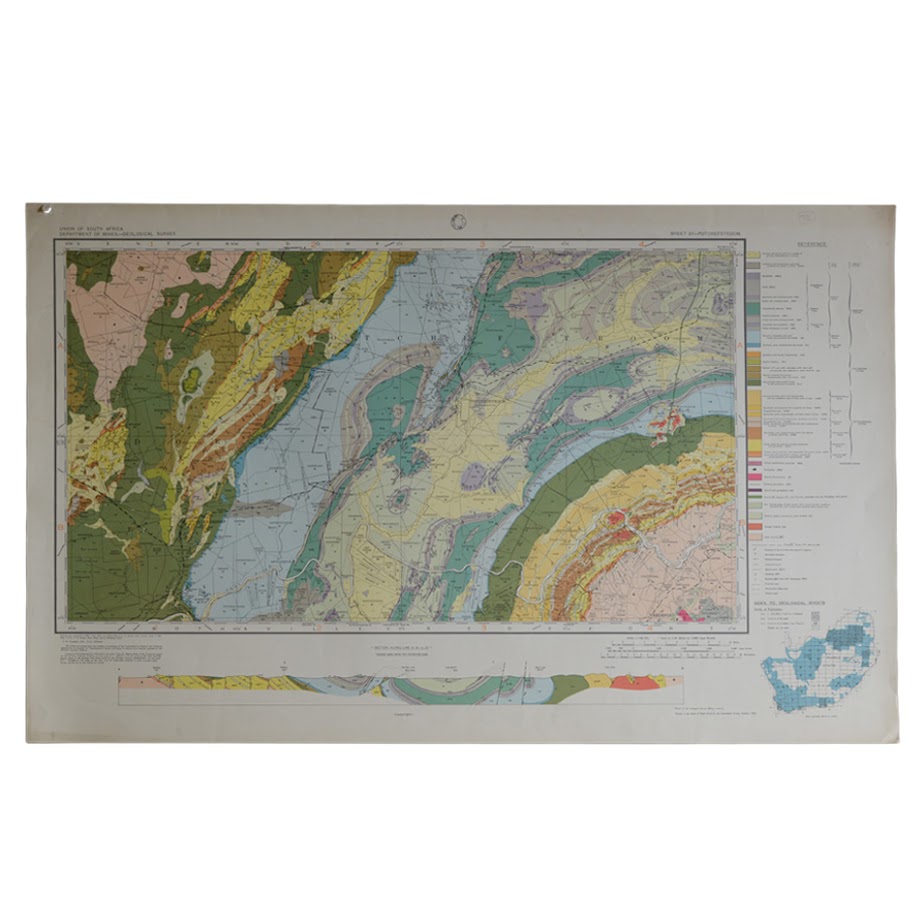
Sheet 61 – Potchefstroom – Union Of South Africa Department Of Mines And Industries – Geological Survey
Mellor, E. T. Nel, Louis T, Truter, F. C & Willemse, J
£125.00
Availability: In stock
Product Description
Sheet 61 – Potchefstroom – Union Of South Africa Department Of Mines And Industries – Geological Survey
Cartographer: E. T. Mellor, Louis T. Nel, F. C. Truter & J. Willemse
Publisher: Union Of South Africa Department Of Mines And Industries – Geological Survey
Price: £125 (post-free in the UK)
Publication Date: 1941
Edition: 1st edition thus
Format: Colour printed
Condition: In very good condition
Sheet Size: 86.2cm x 56cm
Condition:
Sheet Size: 86.2cm x 56cm. Small Institutional stamp to upper margin. Minor pencil marks to margins which could be easily removed. Short closed tear to upper margin. Small amount of loss to top left hand margin corner, not affecting the map or text. A little creased, marked, dusty and rubbed but this is mainly confined to the margins. Colouration very bright and clean. A very good copy. Very scarce.
Location: Pocket RSAGEOL: SR: 002842
Potchefstroom District: An Historical Overview
Geographical Context and Significance
Potchefstroom, often referred to locally as “Potch,” is one of South Africa’s oldest European-established towns and is situated along the banks of the Mooi River in the North West Province. Positioned on the southern edge of the Highveld plateau, it lies approximately 120 kilometres southwest of Johannesburg.
The region surrounding Potchefstroom consists of fertile plains, ideal for agriculture, and has historically been a strategic inland settlement due to its river access, natural resources, and central location between other developing parts of the Transvaal.
Precolonial Era
Prior to the arrival of European settlers, the area that would become Potchefstroom was inhabited by Tswana-speaking communities, particularly of the Barolong and Bahurutshe peoples. These groups engaged in mixed subsistence farming, cattle herding, and regional trade with neighbouring chiefdoms.
Archaeological evidence in the surrounding landscape suggests long-term settlement patterns with the construction of stone wall enclosures, iron-smelting sites, and cultural artefacts that link the region to early Iron Age civilisations.
Founding and Early Boer Settlement (1838–1850s)
Potchefstroom was officially founded in 1838 by Voortrekkers under the leadership of Andries Hendrik Potgieter, following the early phases of the Great Trek. The name is believed to derive from a combination of Potgieter’s name and “chefstroom” (meaning “main stream”), referencing the Mooi River.
This settlement was among the first established by the Voortrekkers in the interior and briefly served as the capital of the Zuid-Afrikaansche Republiek (ZAR), or South African Republic. Potchefstroom soon developed as a centre of administration, religion, and trade for Boer settlers in the Western Transvaal.
Early characteristics of Potchefstroom included:
- A central Dutch Reformed Church, often the spiritual and social heart of the town
- The Volksraad (people’s council), which met there in the 1840s
- A growing agrarian economy, based on livestock, grain, and small-scale trade
Despite its early prominence, Potchefstroom would eventually be replaced by Pretoria as the capital in the 1850s, although it remained an important regional centre.
British Annexation and Conflict (1870s–1902)
The late 19th century was marked by significant political turbulence. In 1877, the British annexed the Transvaal, sparking resentment among Boer settlers. Potchefstroom was a key site during the First Anglo-Boer War (1880–1881), with local Boer commandos laying siege to the British garrison stationed in the town.
During the Second Anglo-Boer War (1899–1902), the region again experienced conflict. Potchefstroom was occupied by British forces early in the war and became a site of:
- Military encampments
- Skirmishes and raids
- A British concentration camp, established for Boer women and children displaced by the scorched earth campaign. Like others, this camp suffered high mortality due to disease and poor conditions.
After the war, Potchefstroom was incorporated into the Transvaal Colony, and by 1910, it became part of the Union of South Africa under British dominion.
20th Century Development: Education and Agriculture
Following the wars, Potchefstroom emerged as a centre of Afrikaner education and identity. One of the most notable developments was the establishment of the Potchefstroom University for Christian Higher Education (PU for CHE) in 1919, which played a major role in promoting Calvinist-Af Afrikaner intellectual life.
In addition, the region experienced steady growth in:
- Commercial agriculture, including maize, sunflower, cattle, and poultry farming
- Education, with the university and teacher training institutions serving the broader region
- Military presence, with the development of training grounds and a military base used throughout the 20th century
Potchefstroom was also home to several research institutions, including the Agricultural Research Council and water testing laboratories, reflecting its enduring role in the rural economy.
Apartheid Period (1948–1994)
Under apartheid, Potchefstroom was shaped by the broader national system of racial segregation. The town itself was largely white and Afrikaner in character, while black South Africans were relocated to townships such as Ikageng, situated on the periphery.
The region became known for:
- Support for Afrikaner nationalism, particularly through its university and conservative politics
- Segregated development, with clear divisions in access to education, healthcare, and housing
- Military training camps, where white South African men served compulsory service
Despite the strict segregation, Potchefstroom was not immune to the growing resistance movements of the 1980s. Student and community protests in Ikageng and surrounding areas reflected broader anti-apartheid sentiments.
Post-Apartheid and Modern Era
After 1994, Potchefstroom was incorporated into the new Tlokwe Local Municipality, later merged into the JB Marks Local Municipality, following national efforts to consolidate local governance structures.
Key developments in the post-apartheid period include:
- Transformation of educational institutions, with Potchefstroom University becoming part of the North-West University (NWU), now one of the country’s largest universities
- Urban integration, with attempts to link historically separated communities
- Continued investment in agriculture, education, and sports training, including the establishment of high-performance centres used by national and international athletes
The city retains its character as a university town, with a growing student population and cultural diversity. It also serves as a regional administrative hub for the surrounding farming communities.
Cultural and Architectural Heritage
Potchefstroom is notable for its historic buildings and cultural institutions, many of which date to the 19th century. These include:
- The Old Gunpowder Magazine, a national monument from the Anglo-Boer era
- The Old Reformed Church building, with its classic gabled architecture
- The President Pretorius Museum, honouring the role of Marthinus Wessel Pretorius, founder of Pretoria and an early resident of Potchefstroom
The town’s heritage reflects both Afrikaner cultural traditions and the complex legacies of colonialism and resistance.
Conclusion
The Potchefstroom region stands as a historically significant area in South Africa’s interior, marked by its early Boer roots, involvement in national conflicts, and ongoing role in education and agriculture. From a Voortrekker settlement to a modern university town, Potchefstroom’s history illustrates the evolution of South African society, with all its tensions, transitions, and resilience.
SHOP WITH CONFIDENCE AT HORNSEYS
At Hornseys, we are dedicated to offering items that uphold the highest standards of quality and authenticity. Our collection of artwork is carefully curated to ensure that each item we offer is authentic, collated, and complete.
Here’s what sets us apart:
- Authenticity and Provenance: Each map is researched and verified for authenticity.
- Expert Curation: We entirely own all our artworks. We trust our taste and have invested heavily in it. We have confidence in all artwork that we offer for sale.
- Customer Satisfaction: We strive to provide an exceptional customer experience, from detailed descriptions and provenance to secure and prompt delivery of your purchase.
- Returns Policy: We offer an unconditional guarantee on every item. If, however, you wish to make a return, artworks may be sent back to us within fourteen days of receipt for whatever reason. We request that we are notified in advance if you wish to do so. They must be returned to us in the same condition as they were sent for a full refund.
OUR COMMITMENT TO QUALITY AND SERVICE
Understanding the value and rarity of these items, we ensure that every aspect of your purchase meets the highest standards of quality and service. This includes:
- Free Expedited, Tracked, and Insured Delivery within the UK: Ensuring that your artwork arrives safely and promptly.
- Fully-Insured Worldwide Delivery: Offering peace of mind for international collectors with reliable and secure shipping options.
EXPLORE OUR COLLECTION
Visit Hornseys today to explore our fine collection of maps and other artworks. Whether you are an avid collector or looking for a special gift, our selection offers something truly unique. Located since 1976 in Ripon in the picturesque Yorkshire Dales, we are recognized as a destination gallery for tastefully curated artwork, rare maps, design, and fine books.
Related products

(The Congo, Angola) Carte Des Royaumes De Congo, Angola Et Benguela Avec Les Pays Voisins Tire de L’Anglois
£65.00Bellin, Jacques Nicolas


You may also like…
Geological Map Of The Country Around Salisbury – Rhodesia – 1958 – First Edition
£245.00R. M. Tyndale-Biscoe
Geologic Map of California Olaf P Jenkins Edition Los Angeles Sheet
£195.00Jennings, Charles W & Strand, Rudolph G
Geological Map Of Israel – Revised Edition – 1976 – Map On Two Sheets
£450.00Picard, L. Y, Golani, U, Bentor, Y. K, Vroman, A & Zak, I
Tectonic Map Of Australia – First Edition – Map On Four Sheets
£650.00Bureau of Mineral Resources, Geology and Geophysics
Geological Map Of The People’s Republic Of China – Presentation Copy From Geologist Shihe Lei
£125.00Published in Beijing


