
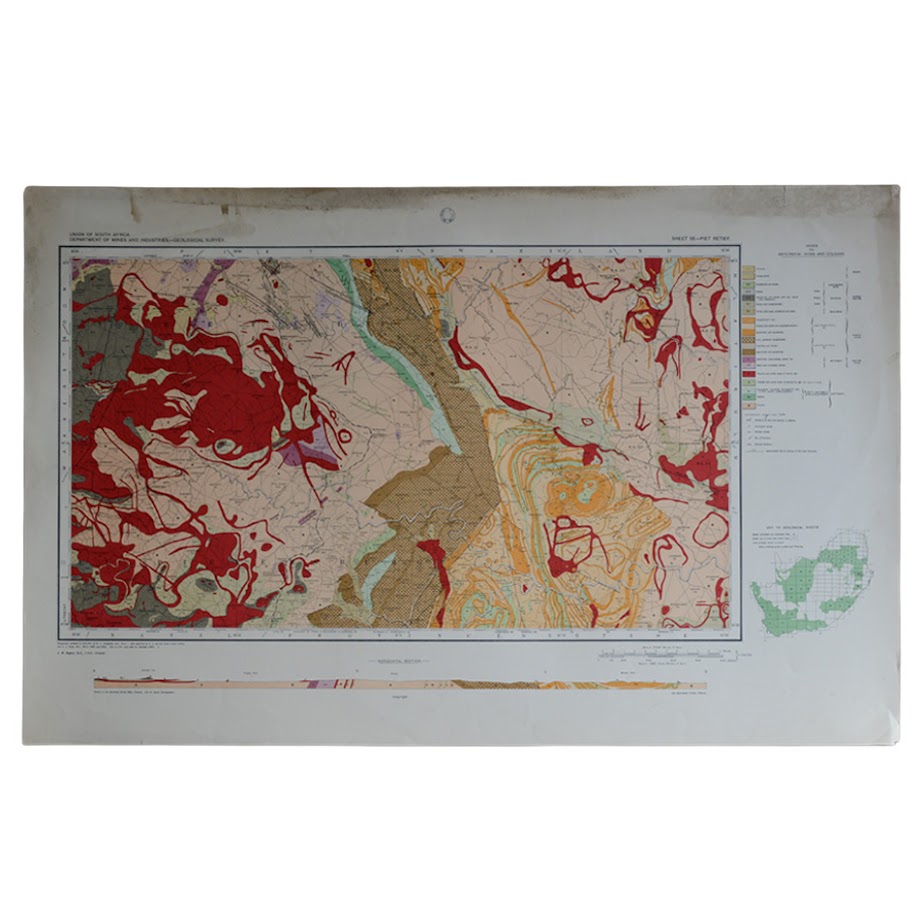
Sheet 68 – Piet Retief – Union Of South Africa Department Of Mines And Industries – Geological Survey
Banks, Eric H.
£95.00
Availability: In stock
Product Description
Sheet 68 – Piet Retief – Union Of South Africa Department Of Mines And Industries – Geological Survey
Cartographer: Eric H. Banks
Publisher: Union Of South Africa Department Of Mines And Industries – Geological Survey
Price: £95 (post-free in the UK)
Publication Date: 1930
Edition: 1st edition thus
Format: Colour printed
Condition: In good condition
Sheet Size: 89.1cm x 57.2cm
Condition:
Sheet Size: 89.1cm x 57.2cm. Small Institutional stamp to upper margin. Minor pencil marks to margins which could be easily removed. Marks to the upper and left hand margins. Minor very short closed tears. A little creased, marked, dusty and rubbed but this is mainly confined to the margins. Colouration very bright and clean. A good copy. Very scarce.
Location: Pocket RSAGEOL: SR: 002844
Piet Retief District: An Historical Overview
Geographical Context
The Piet Retief region, officially renamed eMkhondo, is located in the Mpumalanga Province of South Africa, near the border with Eswatini (formerly Swaziland). Nestled in the upper reaches of the Assegaai River valley, the area is characterised by rolling hills, forest plantations, grasslands, and moderate rainfall, making it an important centre for timber production and agriculture.
Due to its location, the region has historically served as a gateway between the Highveld interior and the coastal lowlands of KwaZulu-Natal and Eswatini, influencing its strategic, cultural, and economic significance.
Indigenous Inhabitants and Early History
Before the arrival of European settlers, the Piet Retief region was inhabited by Nguni-speaking communities, including branches of the Zulu, Swazi, and Ndwandwe peoples. These groups maintained complex chieftaincies, practised cattle herding and crop cultivation, and established interlinking trade routes across the escarpment.
The region’s forests and rivers held spiritual and economic value, with sacred groves, iron-working sites, and seasonal rituals forming part of everyday life. As part of the wider Zulu cultural sphere, the area was drawn into the dynamics of Shaka Zulu’s state formation in the early 19th century, contributing to and affected by the regional upheavals of the mfecane (forced migrations and warfare).
The Voortrekkers and the Death of Piet Retief (1837–1838)
The region takes its name from Piet Retief, a leader of the Voortrekkers—Afrikaner settlers who moved north and east from the Cape Colony during the Great Trek in search of independence from British rule.
In early 1838, Retief led a diplomatic mission to negotiate land from King Dingane, ruler of the Zulu Kingdom. The meeting took place at Mgungundlovu, not far from the modern eMkhondo region. Initially welcomed, Retief and his party were killed by Dingane’s warriors under contentious circumstances, sparking the Zulu–Voortrekker War and becoming a foundational event in Afrikaner historical memory.
Although the massacre did not take place within the present-day town of Piet Retief, the region became symbolically linked to Retief’s legacy and was later named in his honour by settlers.
Settlement and Frontier Society (Mid-19th Century)
The formal establishment of Piet Retief town occurred in the late 1800s, as part of Boer efforts to consolidate farming communities in the eastern Transvaal. Early settlers were primarily Afrikaners, joined later by British traders and missionaries, creating a small but strategic settlement near the Swazi border.
Key developments during this period included:
- Construction of Dutch Reformed churches, schools, and rudimentary administrative buildings
- Establishment of farms and timber plots in the surrounding landscape
- Periodic conflict and negotiation with Swazi and Zulu chiefs, especially concerning land rights and cattle
As with much of the interior, the region’s economy was pastoral, with limited infrastructure and reliance on ox-wagon transport and subsistence farming.
Colonial Expansion and British Rule (Late 19th – Early 20th Century)
With the British victory in the Second Anglo-Boer War (1899–1902), the area was absorbed into the Transvaal Colony and later the Union of South Africa (1910). Piet Retief became a minor administrative centre, connecting outlying districts to Pretoria and Durban.
This period saw:
- Gradual growth of forestry operations, particularly pine and eucalyptus plantations
- Expansion of rail links and better roads to facilitate trade and timber transport
- Introduction of state schools and colonial governance structures
- The imposition of land and labour laws that marginalised African residents
African communities were forcibly removed or confined to “native reserves”, and the region developed along racially segregated lines, with most black inhabitants working as farm labourers or timber workers under restrictive conditions.
Apartheid and Forced Segregation (1948–1994)
Under the apartheid regime, the Piet Retief region experienced the full weight of racial segregation policies. The town itself remained predominantly white and Afrikaner, while black South Africans were moved to townships and homelands, particularly in areas allocated to the KaNgwane homeland, which was intended to serve as a self-governing territory for Swazi-speaking communities.
Key features of this era include:
- Increased development of commercial timber plantations, leading to displacement of rural communities
- Construction of hostels and barracks for African labourers employed in the forestry sector
- Suppression of political dissent, with limited civil rights and police surveillance
- Strong resistance among youth and church-based organisations in the 1980s, inspired by broader anti-apartheid movements
Though marginal in national terms, Piet Retief was not immune to the ideological tensions and human cost of apartheid.
Post-Apartheid Period and Renaming to eMkhondo
With the advent of democracy in 1994, the town was incorporated into the Mpumalanga province, and later, the Mkhondo Local Municipality. As part of a wider effort to reflect local African identities, the town was officially renamed eMkhondo, though the name Piet Retief remains in colloquial use, particularly among older or Afrikaner residents.
Recent developments have focused on:
- Improved municipal services, such as housing, roads, and electrification
- Support for small-scale agriculture and emerging black-owned farms
- Integration of schools and clinics, though disparities remain
- Continuing importance of the forestry sector, including paper and pulp industries
The area still faces economic and developmental challenges, including high unemployment, infrastructure backlogs, and land restitution disputes. However, it is also recognised for its potential in eco-tourism, heritage trails, and agro-forestry ventures.
Cultural and Political Significance
The Piet Retief region holds layered significance:
- For Afrikaner heritage, it remains tied to Voortrekker memory and frontier ideals.
- For Swazi and Zulu communities, it reflects a complex history of land loss, resistance, and cultural endurance.
- For modern South Africa, it represents the challenge of reconciling contested histories and building inclusive regional identity.
Monuments, museums, and community centres are increasingly used to tell multiple stories, recognising both the tragedies and triumphs of its diverse inhabitants.
Conclusion
The Piet Retief (eMkhondo) region stands as a testament to South Africa’s layered history, shaped by precolonial cultures, frontier conflict, colonial rule, and post-apartheid transformation. It is a region where land, language, and legacy remain at the centre of ongoing efforts to foster development, reconciliation, and cultural renewal.
SHOP WITH CONFIDENCE AT HORNSEYS
At Hornseys, we are dedicated to offering items that uphold the highest standards of quality and authenticity. Our collection of artwork is carefully curated to ensure that each item we offer is authentic, collated, and complete.
Here’s what sets us apart:
- Authenticity and Provenance: Each map is researched and verified for authenticity.
- Expert Curation: We entirely own all our artworks. We trust our taste and have invested heavily in it. We have confidence in all artwork that we offer for sale.
- Customer Satisfaction: We strive to provide an exceptional customer experience, from detailed descriptions and provenance to secure and prompt delivery of your purchase.
- Returns Policy: We offer an unconditional guarantee on every item. If, however, you wish to make a return, artworks may be sent back to us within fourteen days of receipt for whatever reason. We request that we are notified in advance if you wish to do so. They must be returned to us in the same condition as they were sent for a full refund.
OUR COMMITMENT TO QUALITY AND SERVICE
Understanding the value and rarity of these items, we ensure that every aspect of your purchase meets the highest standards of quality and service. This includes:
- Free Expedited, Tracked, and Insured Delivery within the UK: Ensuring that your artwork arrives safely and promptly.
- Fully-Insured Worldwide Delivery: Offering peace of mind for international collectors with reliable and secure shipping options.
EXPLORE OUR COLLECTION
Visit Hornseys today to explore our fine collection of maps and other artworks. Whether you are an avid collector or looking for a special gift, our selection offers something truly unique. Located since 1976 in Ripon in the picturesque Yorkshire Dales, we are recognized as a destination gallery for tastefully curated artwork, rare maps, design, and fine books.
Related products

(The Congo, Angola) Carte Des Royaumes De Congo, Angola Et Benguela Avec Les Pays Voisins Tire de L’Anglois
£65.00Bellin, Jacques Nicolas


You may also like…
Geological Map Of The Country Around Salisbury – Rhodesia – 1958 – First Edition
£245.00R. M. Tyndale-Biscoe
Geologic Map of California Olaf P Jenkins Edition Los Angeles Sheet
£195.00Jennings, Charles W & Strand, Rudolph G
Geological Map Of Israel – Revised Edition – 1976 – Map On Two Sheets
£450.00Picard, L. Y, Golani, U, Bentor, Y. K, Vroman, A & Zak, I
Tectonic Map Of Australia – First Edition – Map On Four Sheets
£650.00Bureau of Mineral Resources, Geology and Geophysics
Geological Map Of The People’s Republic Of China – Presentation Copy From Geologist Shihe Lei
£125.00Published in Beijing


