
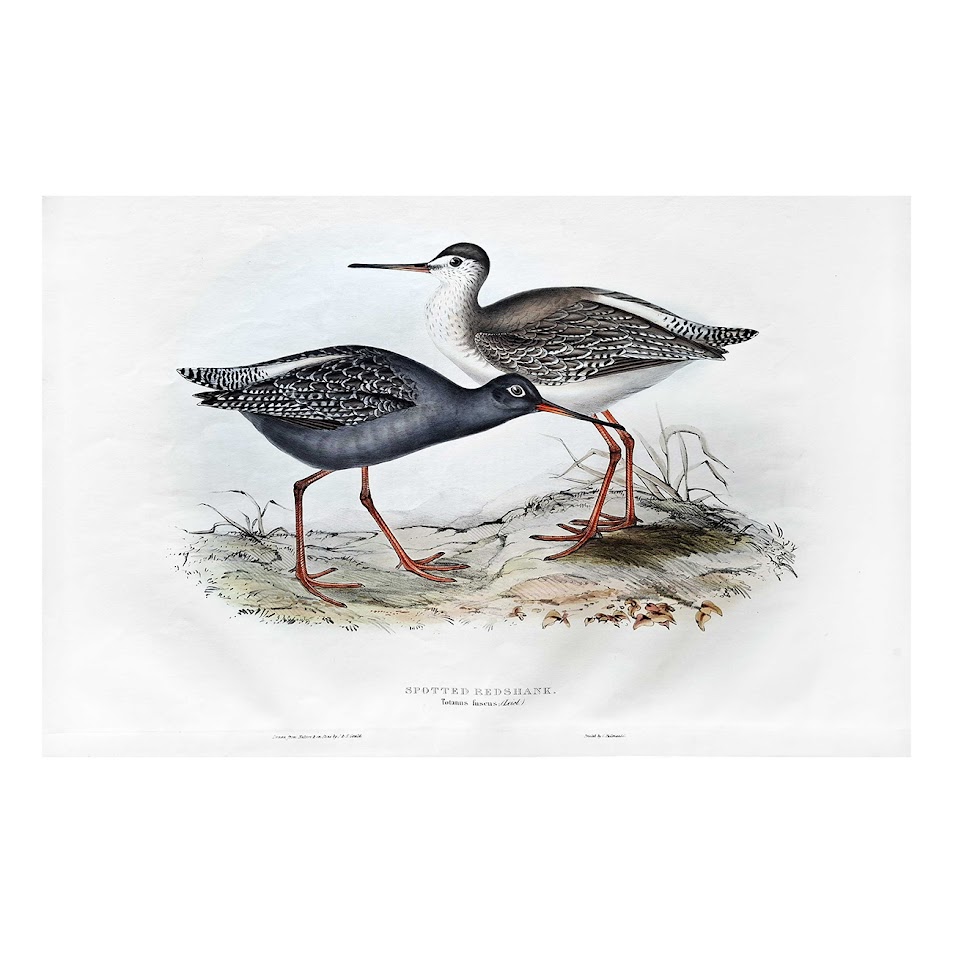
SPOTTED REDSHANK – TOTANUS FUSCUS – ORIGINAL HAND-COLOURED LITHOGRAPH BY JOHN AND ELIZABETH GOULD
GOULD, JOHN & GOULD, ELIZABETH
£245.00
Availability: In stock
Product Description
SPOTTED REDSHANK – TOTANUS FUSCUS – ORIGINAL HAND-COLOURED LITHOGRAPH BY JOHN AND ELIZABETH GOULD
Artists: John and Elizabeth Gould
Price: £245.00
Publisher: Printed by Hullmandel
Publication Date: 1832-1837
Format: Original hand-coloured lithograph heightened with gum arabic
Condition: Very good indeed, bright copy with good margins
Sheet Size: 54cm x 36.4cm
Series: From ‘The Birds of Europe’
This exquisite original hand-coloured lithograph from John and Elizabeth Gould’s magnificent work, ‘The Birds of Europe,’ produced between 1832 and 1837, showcases the Spotted Redshank in stunning detail. The artwork exhibits the meticulous detail and vibrant use of colour that define the Goulds’ lithographs, making it a desirable piece for both art collectors and ornithological enthusiasts. Drawn from life, it reflects the Goulds’ commitment to scientific accuracy combined with artistic elegance. Minor age toning. Very minor textual off-setting as usual. A very good indeed, bright, copy with good margins. Location: Map Drawer B: Folder 1006. 002028
The Story:
John Gould was an English ornithologist and bird artist. He and his wife, Elizabeth Gould, worked closely together to produce some of the most comprehensive and stunning ornithological works of the 19th century. Elizabeth, an accomplished artist, transferred many of John’s sketches into the lithographic prints that were then hand-coloured under her supervision. This piece not only captures the essence of the birds’ characteristics but also stands as a testament to the Goulds’ significant contributions to both art and science.
Condition Details:
- Overall Condition: Shows slight age toning and handling marks.
- Visual Appeal: Bright and vibrant colours, enhanced with gum arabic.
- Margins: Well-preserved with good margins, indicating careful handling over the years.
Key Features:
- Historical Significance: Part of John and Elizabeth Gould’s ‘The Birds of Europe,’ known for its scientific and artistic merit.
- Collector’s Item: Rare especially in such good condition.
- Artistic Detail: Demonstrates high-quality lithographic work and hand-colouring skills synonymous with John and Elizabeth Gould.
The Spotted Redshank: A Brief Description:
The Spotted Redshank (Tringa erythropus), once referred to as Totanus fuscus, is a graceful and slender wading bird from the sandpiper family, Scolopacidae. It is widely distributed across Europe and Asia and is known for its striking seasonal plumage and distinctive calls. The species frequents wetlands, such as marshes, mudflats, and shallow lakes, and is highly migratory, undertaking long journeys between its breeding and wintering grounds.
Physical Description
Size: The Spotted Redshank is a medium to large wader, measuring between 29 and 33 centimetres in length, with a wingspan of 61 to 67 centimetres. It typically weighs around 120 to 250 grams, with males being slightly smaller than females.
Plumage:
- Breeding Plumage: During the breeding season, the Spotted Redshank has a striking black plumage, which covers most of its body, with a slight sheen. The underparts and upperparts are entirely black, and the feathers may have a subtle silvery edging. This dramatic appearance makes it easily distinguishable from other waders.
- Non-breeding Plumage: In the non-breeding season, the plumage transforms into a pale grey on the upperparts and white on the underparts, with a mottled grey appearance on the breast and flanks. The head is also lighter, giving the bird a more subdued look compared to its breeding attire.
Legs and Bill: The legs are long and bright red, providing a striking contrast to the bird’s otherwise dark or pale plumage, depending on the season. The bill is long, slender, and slightly upturned, with a black tip and a reddish base, adapted for probing mud and water in search of food.
Flight: In flight, the Spotted Redshank is easily recognised by its long, narrow wings and a distinctive white rump, which stands out against the darker upperparts. Its flight pattern is strong and direct, with rapid wingbeats, often accompanied by its characteristic call.
Habitat and Distribution
Geographical Range: The Spotted Redshank breeds in the northern regions of Europe and Asia, particularly in the tundra and forested wetlands of Scandinavia and Siberia. During the winter, it migrates to more temperate regions, including the coasts of southern Europe, the Mediterranean, Africa, and southern Asia.
Habitat: During the breeding season, the Spotted Redshank prefers freshwater marshes, peat bogs, and tundra wetlands. In the non-breeding season, it can be found in a variety of wetland habitats, such as coastal mudflats, estuaries, and mangroves, where it feeds and roosts. The bird is highly dependent on shallow water for foraging and often frequents areas with soft mud and plenty of invertebrates.
Behaviour
Diet: The Spotted Redshank is an opportunistic feeder, with a diet that includes insects, worms, small fish, crustaceans, and molluscs. During the breeding season, it primarily feeds on insects and larvae, while in the non-breeding season, it consumes a wider variety of aquatic prey.
Foraging: The bird forages by wading through shallow water, using its long bill to probe the mud or snatch prey from the surface. It often feeds in deeper water compared to other waders and may submerge its head to catch fish or other aquatic creatures. The Spotted Redshank is known for its active and agile feeding style, moving swiftly and gracefully through its habitat.
Vocalisations: The Spotted Redshank is a vocal bird, with a distinctive and clear “tchu-eet” or “tchew” call that is often heard during flight. Its calls are louder and more melodious than those of the Common Redshank, making it an easy bird to identify by sound.
Social Structure
Breeding Behaviour: Spotted Redshanks are generally solitary during the breeding season, establishing territories in suitable wetland habitats. Males perform aerial displays to attract females, including diving flights and vocal calls.
Nesting: The nest is a shallow scrape on the ground, lined with moss or vegetation and usually well hidden among marsh plants. The female typically lays a clutch of 3 to 4 eggs, which are olive or buff-coloured with dark speckles. Both parents may share incubation duties, which last for about 22 to 24 days.
Chick Development: The chicks are precocial and able to leave the nest shortly after hatching. They are well camouflaged and can forage for themselves, though they remain under the watchful eye of their parents until they are capable of sustained flight.
Migration
Resident and Migratory Behaviour: The Spotted Redshank is a long-distance migrant, travelling from its breeding grounds in the northern tundra to wintering sites in southern Europe, Africa, and Asia. Migration typically occurs in flocks, and the birds use a network of stopover sites to rest and feed. During migration, they are often seen in wetlands and coastal areas, where they gather in large numbers.
Conservation Status
The Spotted Redshank is classified as “Least Concern” by the IUCN, but it faces threats from habitat loss and climate change. Wetland drainage, pollution, and human disturbance are significant concerns, especially in its breeding and stopover habitats. Conservation efforts include the protection and restoration of wetlands and the monitoring of key migration sites to ensure the species’ continued survival.
Similar Species
- Common Redshank (Tringa totanus): The Common Redshank is smaller and has brighter red legs, with a more uniform grey-brown plumage in non-breeding season. It lacks the Spotted Redshank’s sleek, slender build and darker breeding plumage.
- Greenshank (Tringa nebularia): The Greenshank is larger, with a pale grey appearance and greenish legs. Its bill is longer and more upturned, and it has a more robust build compared to the Spotted Redshank.
Importance and Ecological Role
The Spotted Redshank plays a vital role in wetland ecosystems, helping to control invertebrate populations and contributing to the biodiversity of its habitats. It serves as an indicator species for wetland health, as it is sensitive to changes in water quality and habitat availability.
Conclusion
The Spotted Redshank (Tringa erythropus) is a striking and adaptable wading bird, admired for its elegant appearance and long migratory journeys. Its reliance on healthy wetlands makes it an important species for conservation efforts, and protecting its habitats is crucial for maintaining the ecological balance in the regions it inhabits. Despite facing challenges, the Spotted Redshank continues to thrive in a variety of wetland environments, captivating birdwatchers and nature enthusiasts with its beauty and grace.
Why Collect This Lithograph?
Owning this lithograph means possessing a piece of ornithological and art history. Its blend of scientific accuracy and aesthetic beauty makes it a worthy addition to any collection of fine art or historical prints.
Why Buy from Us?
At Hornseys, we are committed to offering items that meet the highest standards of quality and authenticity. Our collection of rare lithographs is meticulously curated to ensure that each piece is both a valuable and authentic addition to your collection. Here’s what sets us apart:
- Authenticity and Provenance: Every lithograph is thoroughly researched and verified for authenticity.
- Expert Curation: We select each piece with an eye for historical significance, condition, and visual appeal.
- Customer Satisfaction: We strive to provide an exceptional customer experience, from detailed descriptions to secure and prompt delivery.
- Returns Policy: We offer an unconditional guarantee on every item. If you wish to make a return, any item may be sent back to us within fourteen days of receipt for any reason. We request advance notification of returns, and items must be returned in the same condition as sent for a full refund.
Explore Our Collection:
Visit Hornseys to explore our exceptional collection of original hand-coloured lithographs by John and Elizabeth Gould. Located in the picturesque Yorkshire Dales, our Ripon gallery has been a haven for art lovers and collectors since 1976.
Related products


You may also like…

WHIMBREL – NUMENIUS PHAEOPUS – ORIGINAL HAND-COLOURED LITHOGRAPH BY JOHN AND ELIZABETH GOULD
£245.00GOULD, JOHN & GOULD, ELIZABETH
DOUBTFUL SPARROW – PYRGITA PETRONIA – ROCK SPARROW – ORIGINAL HAND-COLOURED LITHOGRAPH BY JOHN AND ELIZABETH GOULD
£95.00GOULD, JOHN & GOULD, ELIZABETH


