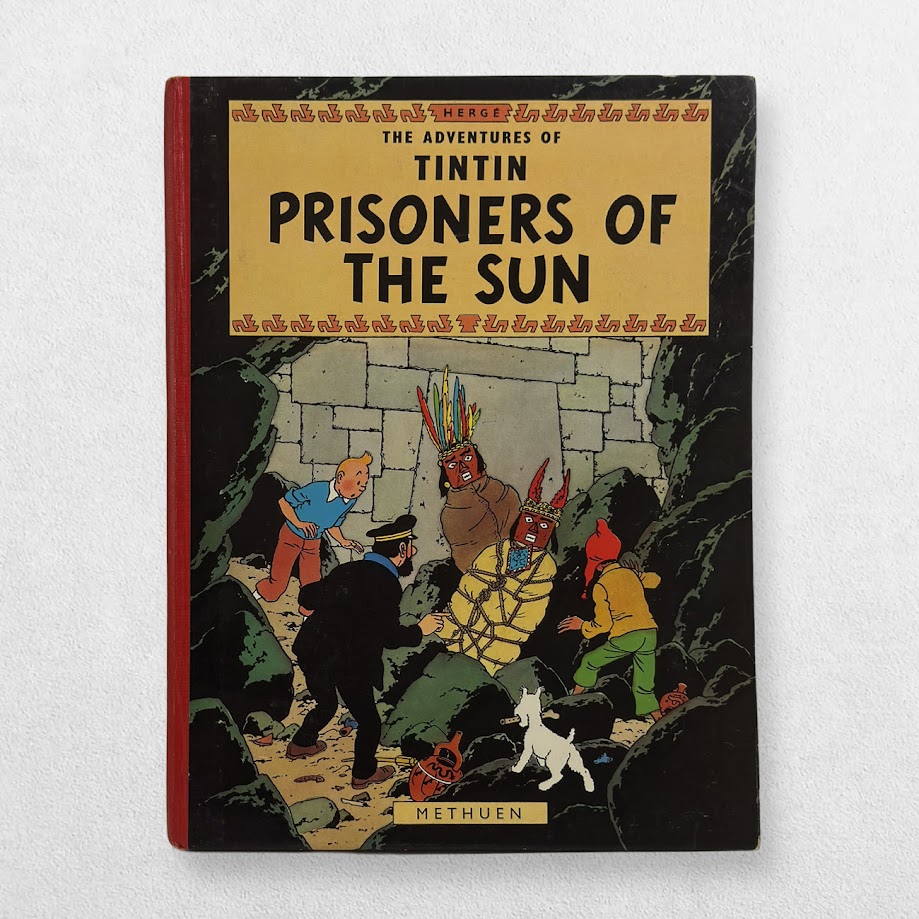
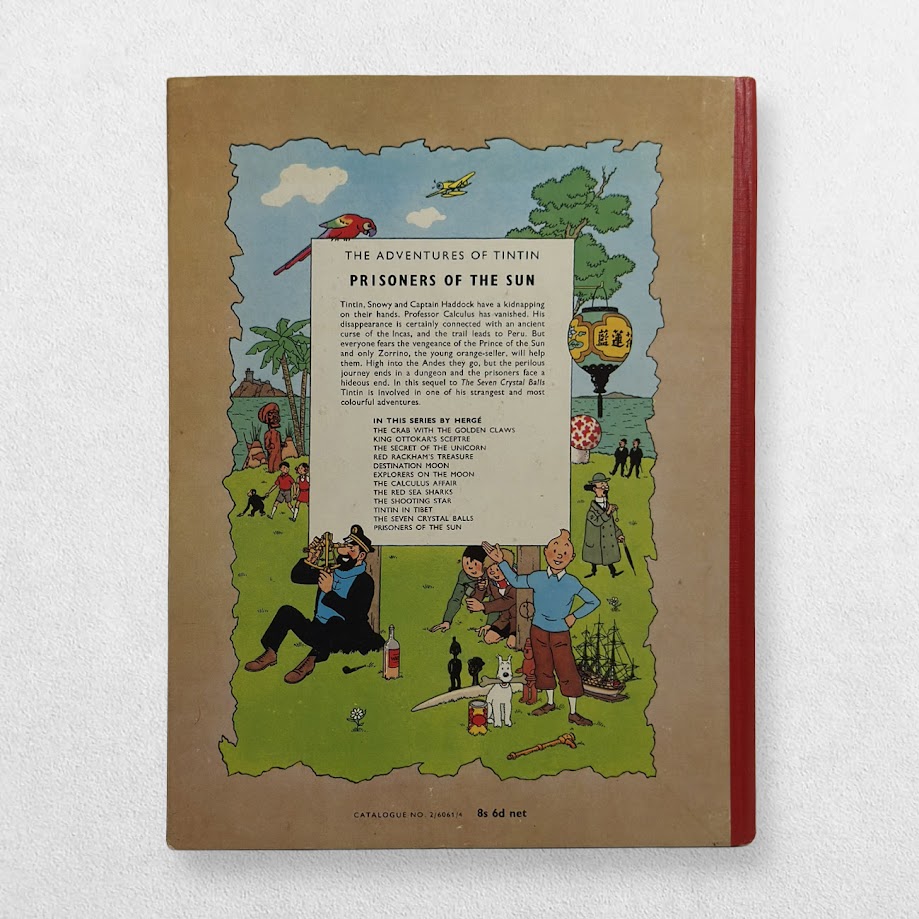
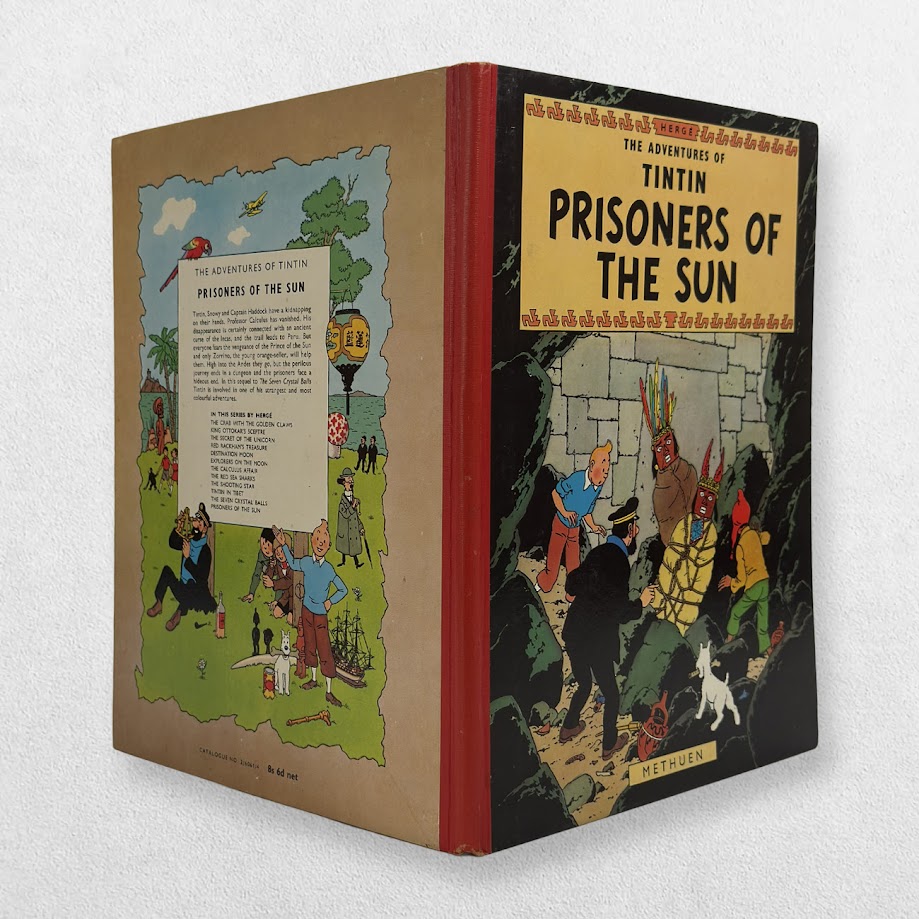
The Adventures Of Tintin – Prisoners Of The Sun – First Edition – 1962
Hergé
£325.00
Availability: In stock
Product Description
The Adventures Of Tintin – Prisoners Of The Sun – First Edition – 1962
Author: Hergé
Price: £325.00
Publisher: Methuen, London, UK
Publication date: 1962
Format: Original cloth-backed boards with pictorial endpapers
Condition: Very Good
Size: 23.2cm x 30.7cm
Pages: 62
Illustrations: Illustrated throughout in colour by the author
Description:
Published by Methuen, London, UK, 1962. 1st edition. Original cloth-backed boards. Pictorial endpapers. Size: 23.2cm x 30.7cm. Pp. 62. Illustrated throughout in colour by the author. Binding nice and tight. Minor rubbing to the spine but with none of the usual fading. Slight age toning to the pages. Minor rubbing to the spine, the boards and the edges of the boards. A very good indeed, tight, clean copy.
‘Prisoners Of The Sun’: A Brief Summary
Prisoners of the Sun, first published in French in 1949, is the fourteenth volume in Hergé’s The Adventures of Tintin. It continues directly from The Seven Crystal Balls, resolving the mystery of the cursed Inca mummy, Rascar Capac, and the abduction of Professor Calculus. Combining exotic travel, suspense, and cultural themes, the story stands as one of the most atmospheric entries in the Tintin canon.
The Search for Professor Calculus
The adventure begins with Tintin, Captain Haddock, and Snowy setting sail for South America, determined to rescue Professor Calculus from his mysterious captors. Their journey takes them to Callao, Peru, where they encounter obstacles almost immediately. The local authorities offer little help, and the trail of the kidnappers seems faint.
Through perseverance and Tintin’s keen observational skills, the group uncovers evidence leading them into the Andean highlands. There they face treacherous terrain, hostile weather, and the threat of betrayal, all while following the faintest of clues.
Encounters in the Andes
Tintin and Haddock’s travels through the Andes are among the most striking sequences in the book. They meet local villagers and gain allies, including the young Quechua boy Zorrino, who proves pivotal in guiding them. Zorrino’s loyalty, bravery, and knowledge of the land provide the adventurers with the means to survive and press on with their mission.
Despite the dangers of the journey, Haddock’s characteristic humour and clumsiness provide comic relief. Snowy, too, plays his part in navigating the hazards of the mountains.
The Hidden Inca Realm
The story reaches its climax when Tintin, Haddock, and Zorrino are captured and brought before the descendants of the Incas, who still maintain a secret civilisation deep within the Andes. Professor Calculus is revealed to be a prisoner of this hidden society, accused of sacrilege for the desecration of Rascar Capac’s tomb during the earlier expedition.
The Inca priests sentence Tintin, Haddock, and Calculus to death, decreeing that they will be burned at the stake. The situation seems hopeless until Tintin, recalling astronomical knowledge, notices that a solar eclipse is imminent. In a dramatic scene, he “commands” the Sun to hide, convincing the Incas that he wields supernatural power.
Resolution
The eclipse terrifies the Inca populace, and Tintin’s ruse succeeds. The priests relent, sparing Tintin, Haddock, and Calculus, though they remain firm in protecting the secrecy of their realm. Zorrino, for his loyalty, is rewarded and offered a place among the Incas.
Tintin and Haddock are allowed to depart with Calculus, though they are forbidden from revealing the existence of the Inca civilisation. The story concludes with the trio’s safe return, their bond of friendship strengthened by the ordeal.
Themes and Significance
Prisoners of the Sun explores themes of cultural respect, superstition, and ingenuity. Tintin’s triumph through knowledge of natural phenomena underscores the importance of science over fear, while the Inca society is portrayed with a blend of reverence and mystique. The narrative also reflects post-war Europe’s fascination with lost civilisations and the legacies of colonial exploration.
As the conclusion to the mystery begun in The Seven Crystal Balls, the volume provides a satisfying resolution, blending suspense with adventure and emphasising loyalty and courage.
Conclusion
Prisoners of the Sun is one of Hergé’s most atmospheric and compelling works, combining adventure with cultural depth. By uniting the suspense of a rescue mission with the grandeur of the Andean setting, it delivers both visual spectacle and narrative satisfaction. The story endures as a high point in the Tintin series, reflecting Hergé’s ability to blend thrilling adventure with human themes of loyalty, bravery, and respect for other cultures.
Why Buy from Us?
At Hornseys, we are committed to offering items that meet the highest standards of quality and authenticity. Our collection of rare books is carefully curated to ensure each edition is a valuable piece of bibliographical history. Here’s what sets us apart:
- Authenticity and Provenance: Each book is meticulously researched and verified for authenticity and collation.
- Expert Curation: Our selection process focuses on significance, condition, and rarity, resulting in a collection that is both diverse and distinguished.
- Customer Satisfaction: We aim to provide an exceptional customer experience, from detailed descriptions to secure and prompt delivery of your purchase.
- Returns Policy: We offer an unconditional guarantee on every item. If you wish to return a book, it may be sent back to us within fourteen days of receipt. Please notify us in advance if you wish to do so. The book must be returned in the same condition as it was sent for a full refund.
Related products

Newt Scamander: Fantastic Beasts And Where To Find Them: Signed By The Illustrator: Includes Promotional Poster
£175.00Rowling, J K & Gill, Olivia Lomenech
The House At Pooh Corner Signed By Christopher Robin Milne.
£695.00Milne, A. A. With Decorations By Shepard, E. H