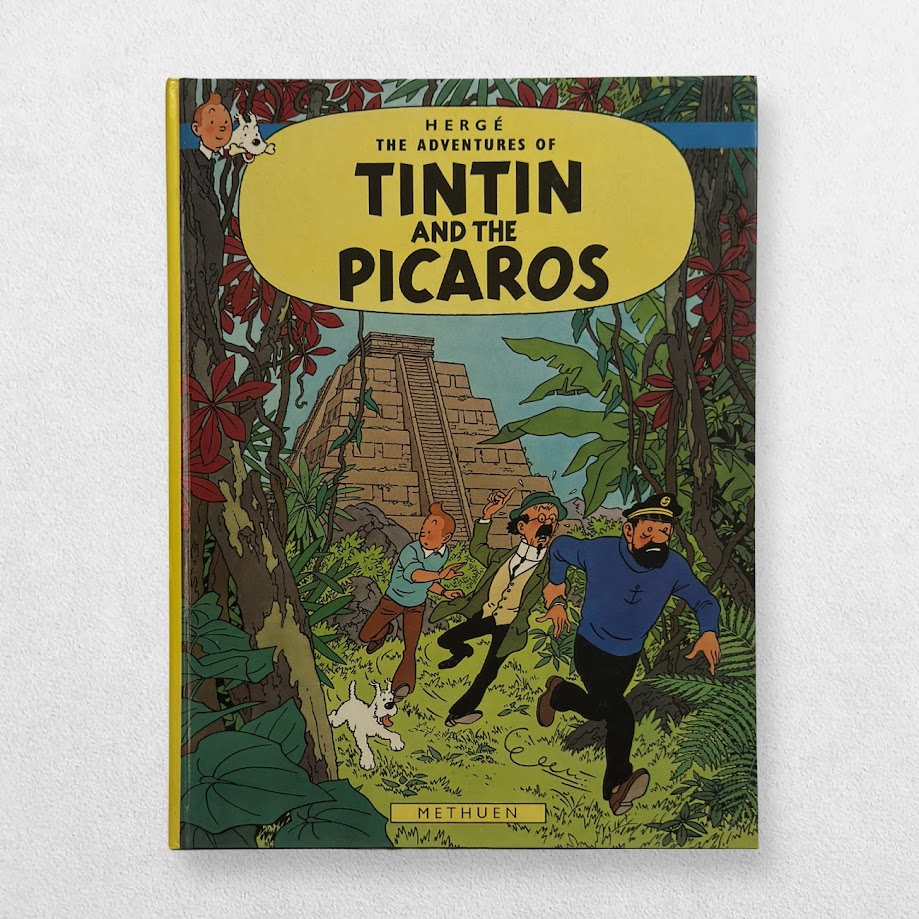
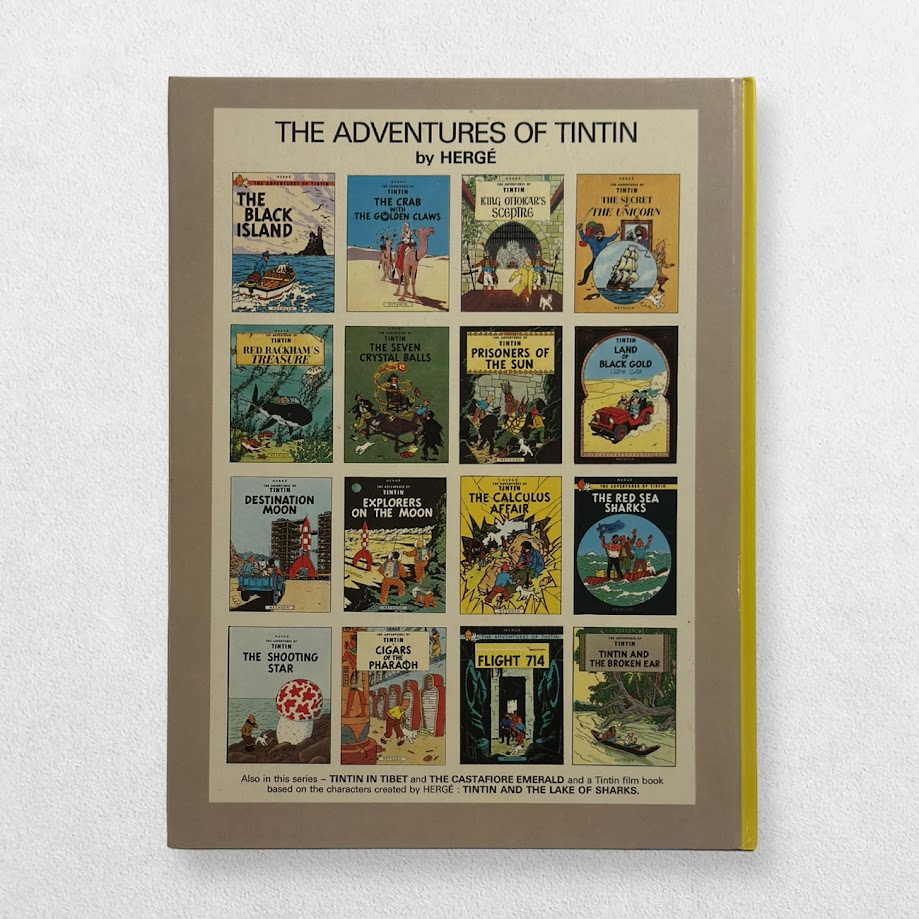
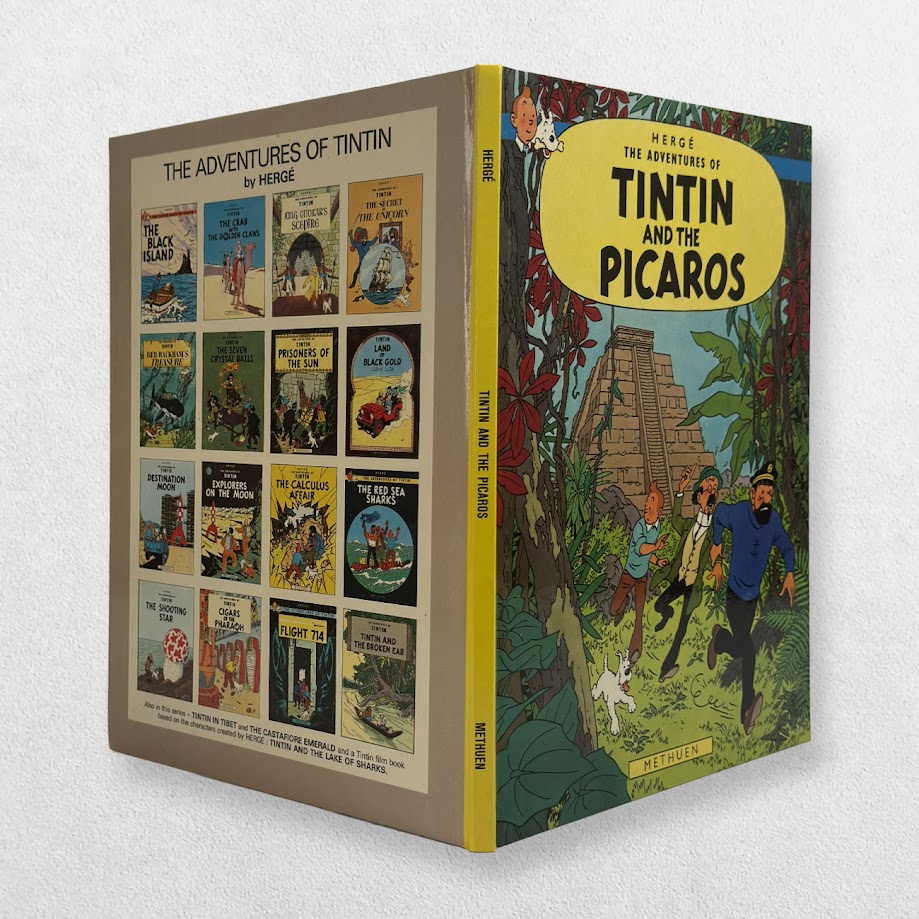
The Adventures Of Tintin – Tintin And The Picaros – First Edition
Hergé
£225.00
Availability: In stock
Product Description
The Adventures Of Tintin – Tintin And The Picaros – First Edition
Author: Hergé
Price: £225
Publisher: Methuen, London, UK
Publication Date: 1976
Format: Original pictorial boards.
Condition: Fine
Edition: First edition
Size: 23.2cm x 30.7cm
Pages: 62
Illustrations: Illustrated throughout by the author
Condition:
Published by Methuen, London, UK, 1976. 1st UK edition. Original pictorial boards. Pictorial endpapers. Size: 23.2cm x 30.7cm. Pp. 62. Illustrated throughout in colour by the author. Spine unfaded and unworn. Has the tiniest amount of creasing to the corners but no visible wear. A fine, tight, clean, copy.
Tintin And The Picaros: A Brief Summary
Tintin and the Picaros (Tintin et les Picaros, 1976) is the twenty-third and last completed volume in The Adventures of Tintin series by Hergé (Georges Remi).
Set in the fictional South American republic of San Theodoros, it revisits familiar characters — including General Alcazar, General Tapioca, Bianca Castafiore, Professor Calculus, and Captain Haddock — in a story that combines political satire, melancholy, and self-awareness.
The album marks a striking departure from Hergé’s earlier adventures: it is less about external heroism and more about disillusionment, irony, and the decline of idealism. Tintin, once the impetuous crusader for justice, now appears introspective, cautious, and morally ambivalent — a reflection of both his creator’s maturity and the turbulent global mood of the 1970s.
Publication Background
Hergé worked on Tintin and the Picaros between 1968 and 1975, during a period of personal introspection and creative fatigue. The late 1960s were marked by political upheaval, Cold War disillusionment, and post-colonial realignments — all of which inform the album’s sceptical tone.
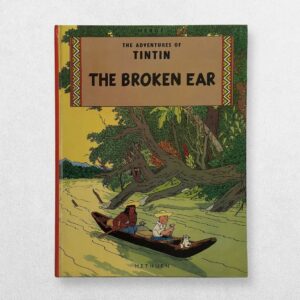
Earlier Tintin adventures, such as The Broken Ear (1937), had also taken place in San Theodoros. By returning to the same setting nearly forty years later, Hergé deliberately mirrored how both his characters and the world around them had changed.
Plot Summary
Prelude: The Framed Castafiore
The story opens with news that Bianca Castafiore, her maid Irma, and pianist Igor Wagner have been arrested in San Theodoros on charges of plotting against the government of General Tapioca. Their supposed conspiracy has been concocted by Tapioca’s propaganda minister, Colonel Sponsz (the same officious villain from The Calculus Affair).
Call to Action
General Alcazar, now leading a band of jungle rebels known as the Picaros, contacts Tintin and Captain Haddock, seeking help to overthrow Tapioca and rescue the imprisoned Europeans. Despite his loyalty to justice, Tintin is reluctant to become involved in another revolution.
Journey to San Theodoros
Accompanied by Professor Calculus, Tintin and Haddock travel to the country under the guise of diplomatic guests. They are met with staged hospitality and constant surveillance, as Tapioca’s regime is riddled with corruption, hypocrisy, and political theatre.
Hergé’s depiction of the capital city — sterile parades, forced cheering crowds, and looming propaganda posters — evokes both Latin American dictatorships and Cold War totalitarianism.
Life with the Picaros
The trio eventually escape to Alcazar’s guerrilla camp deep in the jungle. There they encounter the Picaros — a demoralised, drunken band of soldiers whose revolutionary zeal has evaporated. Alcazar himself, once a fiery idealist, is now harassed by his domineering wife Peggy Alcazar, who nags him incessantly about hygiene, fashion, and status.
Tintin, dismayed by the futility of yet another revolution, reluctantly agrees to help — not for political reasons, but to secure the release of the falsely accused Castafiore and her entourage.
The Carnival Coup
Using Calculus’s invention — a chemical that neutralises alcohol — Tintin sobers the Picaros long enough for them to stage a bloodless coup during San Theodoros’s annual carnival. Disguised as musicians, they infiltrate the capital, oust Tapioca, and install Alcazar as the new leader.
The revolution is peaceful but hollow: the same corrupt system remains, merely under a different name. Tintin, disgusted by the moral emptiness of it all, declines the ceremonial medals offered to him.
The final scene shows the heroes returning home, their victory devoid of triumph — a quiet, ironic ending to a lifetime of adventure.
Major Characters
Tintin
In this final story, Tintin has changed profoundly. He wears casual modern clothes, including a motorcycle jacket and open-necked shirt — a visual symbol of his disengagement from formal heroism.
He is less impulsive, more reflective, and morally uneasy about interfering in other nations’ politics. His refusal to side with any faction reflects a mature, almost pacifist realism.
Captain Haddock
Haddock remains loyal to Tintin but shares his sense of fatigue. His humour and humanity still shine, but the old zest for adventure is gone. He longs for the quiet of Marlinspike Hall rather than the chaos of revolution.
Professor Calculus
Ever the eccentric idealist, Calculus provides the story’s comic science through his alcohol-neutralising potion. His innocence contrasts sharply with the corruption surrounding him.
General Alcazar
Once the fiery revolutionary of The Broken Ear, Alcazar is now a caricature of faded idealism — irritable, henpecked, and weary. His rebellion has degenerated into a pantomime, his “revolution” reduced to drunken inertia.
Peggy Alcazar
Alcazar’s domineering wife adds domestic satire to political farce. Her vanity and nagging expose the smallness of personal ambition amid the rhetoric of revolution.
Bianca Castafiore
As ever, Castafiore provides humour and chaos. Her arrest, supposedly for political conspiracy, is absurdly arbitrary — a critique of regimes that persecute the innocent while flattering the powerful.
Themes and Analysis
- The Death of Idealism
The central theme of Tintin and the Picaros is disillusionment. Hergé dismantles the myth of revolution that once fuelled The Broken Ear. Here, every political actor — Alcazar, Tapioca, Sponsz — is corrupt, self-serving, or deluded.
Tintin’s disinterest in politics underscores Hergé’s message: change without moral renewal is meaningless. When Tintin remarks that “the more things change, the more they stay the same,” he speaks for his creator.
- Cynicism and Maturity
Hergé uses humour to express disillusionment. The revolution’s success, achieved through sobriety rather than ideology, is a parody of historical revolutions that replaced one tyranny with another.
This cynicism, however, is tempered by wisdom. Hergé does not mock the idea of justice — only humanity’s failure to live up to it.
- The Absence of Violence
Remarkably, Tintin and the Picaros features no deaths and almost no physical conflict. Tintin’s insistence on a peaceful resolution — refusing to let anyone be harmed — reflects both Hergé’s pacifism and the 1970s’ disillusionment with violent change.
It is a far cry from the gunfire and danger of earlier adventures, showing Tintin’s moral evolution from action hero to moral philosopher.
- The Power of Theatre
Both generals, Alcazar and Tapioca, are performers rather than leaders. Their regimes depend on spectacle: parades, uniforms, slogans, and carnival. Hergé suggests that modern politics has become a theatre of illusions, where appearances replace convictions.
The carnival setting at the climax symbolises this blending of politics and performance — revolution as masquerade.
Artistic Style
Hergé’s artwork in Tintin and the Picaros retains the clarity and precision of his ligne claire style but with a more subdued palette. Earth tones and muted greens dominate, evoking the dusty fatigue of the tropics rather than the dazzling colour of earlier adventures.
His linework is minimalist, and the pacing more cinematic than ever. Panels often linger on facial expressions and silent pauses, conveying the melancholy of ageing characters and fading ideals.
The jungle scenes are beautifully drawn yet claustrophobic, mirroring the stifling stagnation of San Theodoros.
Moral and Philosophical Dimensions
Tintin’s final outing reflects Hergé’s lifelong moral inquiry: what does integrity mean in a corrupt world?
No longer the naive reformer, Tintin recognises the futility of external change without inner transformation. His insistence on peace, decency, and compassion remains intact, but it is tempered by humility.
The absence of clear villains or heroes signals a new moral complexity — a recognition that good and evil are often intertwined in human affairs.
Psychological Interpretation
Psychologically, Tintin and the Picaros can be read as Hergé’s farewell to his creation. Tintin, weary yet principled, mirrors the artist himself — reflective, sceptical, and ready to let go.
The story’s tone of detachment may also reflect Hergé’s struggle with depression and creative fatigue in his later years. Through Tintin’s quiet withdrawal from adventure, Hergé symbolically retires his alter ego.
Legacy and Reception
Upon its release in 1976, Tintin and the Picaros received mixed reviews. Many readers found its tone subdued and its ending anti-climactic; others praised its intelligence, irony, and moral depth.
Over time, critics have come to view it as a mature, elegiac finale — an honest reflection of the disenchanted post-colonial world and the end of the age of heroes.
Today, it stands as both a conclusion and a commentary — the last word of an artist who understood that heroism, stripped of humility, risks becoming delusion.
Summary
- Title: Tintin and the Picaros (Tintin et les Picaros)
- First Published: 1976
- Main Characters: Tintin, Captain Haddock, Professor Calculus, General Alcazar, Peggy Alcazar, Bianca Castafiore, Colonel Sponsz
- Setting: San Theodoros, a fictional South American republic
- Themes: Disillusionment, political hypocrisy, moral pacifism, decline of idealism
- Tone: Satirical, reflective, bittersweet
- Significance: Hergé’s farewell to Tintin; a philosophical conclusion to the series
Conclusion
Tintin and the Picaros closes the Tintin saga not with triumph, but with wisdom. It acknowledges the limits of idealism while affirming the enduring value of integrity and friendship.
Where once Tintin changed the world, he now understands that change must begin within. The revolutions of the past have become pageants; only decency, compassion, and truth remain uncorrupted.
In its irony, restraint, and quiet melancholy, Tintin and the Picaros stands as Hergé’s most mature and self-aware work — a fitting final chapter for a hero who, having journeyed across the Earth and beyond, finally confronts the most elusive frontier of all: the human heart.
Why buy from us?
At Hornseys, we are dedicated to offering items that uphold the highest standards of quality and authenticity. Our book collection is carefully curated to ensure that each edition is a valuable and authentic piece of bibliographical history. Here’s what sets us apart:
- Authenticity and Provenance: Every book is researched, collated and verified for authenticity.
- Expert Curation: Each book is selected using our keen eye for significance, condition, and rarity, ensuring a collection that is both diverse and distinguished.
- Customer Satisfaction: We strive to provide an exceptional customer experience, from detailed descriptions and provenance to secure and prompt delivery of your purchase.
- Returns Policy: We offer an unconditional guarantee on every item. If, however, you wish to make a return, books may be sent back to us within fourteen days of receipt for whatever reason. We request that we are notified in advance if you wish to do so. They must be returned to us in the same condition as they were sent for a full refund.
Cataloguer: Daniel Hornsey
Daniel Hornsey has specialised in fine and rare books, ephemera, and collectors’ editions for over thirty years. As a long-standing member of the antiquarian book trade, he has advised private collectors, curated catalogues, and sourced works for leading dealers, libraries and institutions across the world.
Hornseys’ exhibit regularly at book and map fairs in London and throughout the UK and are members of the Provincial Booksellers Fairs Association, the PBFA.
His fascination with Hergé’s work — especially ‘The Adventures of Tintin’ — began in childhood. Daniel recalls reading Tintin in original European editions and quickly recognising that these were not merely children’s books, but finely illustrated narratives crafted with artistic depth and wit.
As noted by the Musée Hergé in Louvain-la-Neuve, Hergé’s ‘ligne claire’ style has influenced generations of European comic artists and his original drawings and paintings command very high prices with his painting of ‘The Blue Lotus’ jar fetching £2.8m at auction in 2021.
By presenting these works through Hornseys’, he hopes to contribute to the continued appreciation of one of the 20th century’s most influential illustrators, helping new generations discover the artistry and legacy of Hergé.
Related products

E H Shepard, The Man Who Drew Pooh: The Story Of E H Shepard: Signed By The Author
£35.00Chandler, Arthur R
Newt Scamander: Fantastic Beasts And Where To Find Them: Signed By The Illustrator: Includes Promotional Poster
£175.00Rowling, J K & Gill, Olivia Lomenech


You may also like…
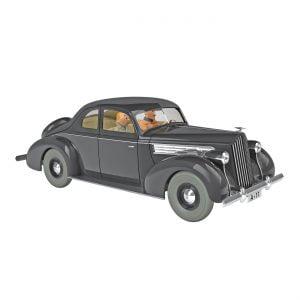
Tintin 1/24 Model Car 29928 – La Packard de Muskar XII – Le Sceptre d’Ottokar
£100.00Tintin New Model Cars 1/24 Scale by Hergé & Editions Moulinsart
The Rally Citroen 2CV – Model Car – 29954 – La 2CV Du Rallye – 1/24 Scale
£200.00Tintin New Model Cars 1/24 Scale by Hergé & Editions Moulinsart
Tintin 1/24 Model Car 29932 – La Voiture de la Castafiore – Le Sceptre d’Ottokar
£100.00Tintin New Model Cars 1/24 Scale
The Blue Jeep – Model Car – 29904 – La Jeep Bleue – 1/24 Scale – First Edition – 2019
£245.00Tintin New Model Cars 1/24 Scale by Hergé & Editions Moulinsart