The Adventures Of Tintin – The Broken Ear – First Edition – 1975
Author: Hergé
Price: £250.00
Publisher: Methuen, London, UK
Publication date: 1975
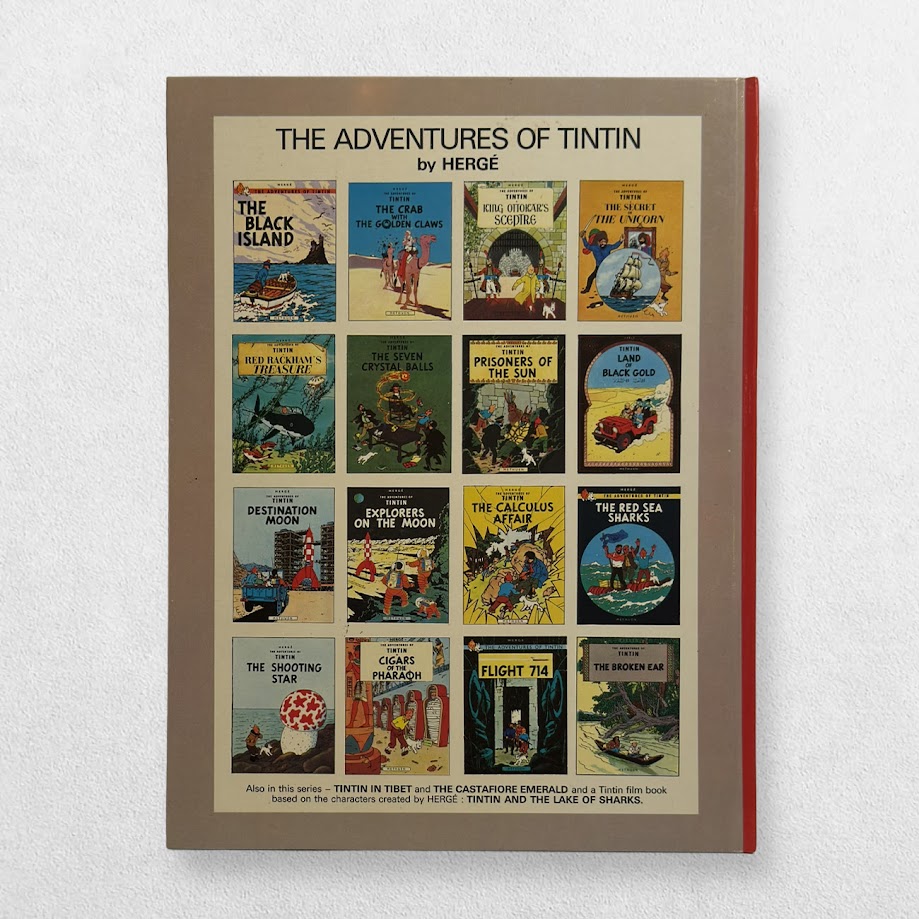
Format: Original pictorial boards with pictorial endpapers
Condition: Fine
Size: 23.2cm x 30.7cm
Pages: 62
Illustrations: Illustrated throughout in colour by the author
Description:
Published by Methuen, London, UK, 1975. 1st UK edition. Original pictorial boards. Pictorial endpapers. Size: 23.2cm x 30.7cm. Pp. 62. Illustrated throughout in colour by the author. Binding nice and tight. Pages very nice and clean. Has the tiniest amount of wear to the spine with none to the edges. Spine unfaded. A fine, tight, clean copy.
‘The Broken Ear’: A Brief Summary
The Broken Ear, first published in 1937 in French, is the sixth volume of The Adventures of Tintin. It is one of the earliest Tintin stories to combine mystery, political intrigue, and satire of South American politics. At its centre is an artefact stolen from a museum—an Arumbaya tribal statue with a broken ear—which draws Tintin into a complex web of theft, murder, and revolution. The story is notable for its darker tone, its satirical edge, and its exploration of greed and corruption.
The Stolen Artefact
The story opens with the theft of a tribal artefact, a small Arumbaya fetish, from the ethnographic museum. Though the statue is later returned, Tintin, ever observant, notices that it is not the same object: the original had a broken ear, while the returned piece is intact. This discrepancy sparks Tintin’s suspicion and sets him on the trail of the mystery.
The artefact is soon linked to a violent chain of events. Murders and betrayals follow as criminals attempt to seize the original fetish, convinced it conceals a hidden secret of immense value.
Tintin’s Investigation
Tintin’s pursuit of the truth leads him from Europe to South America. Along the way, he encounters shady characters, assassins, and rival fortune hunters. Two recurring villains, the ruthless Alonso Pérez and Ramón Bada, emerge as central antagonists. Their determination to obtain the fetish mirrors the greed and treachery that underpin the entire plot.
Snowy, as always, provides both loyalty and comic interludes, though the overall tone of the narrative is more serious and grim than in earlier Tintin adventures.
South American Turmoil
Arriving in the fictional South American republic of San Theodoros, Tintin becomes embroiled in local politics. The country is portrayed as unstable and corrupt, constantly teetering between revolution and dictatorship. Through satire, Hergé parodies the military coups and foreign interference common in Latin America during the early twentieth century.
Tintin is at one point mistaken for a revolutionary and drafted into the army, only to witness first-hand the absurdity and brutality of the regime. These sequences highlight Hergé’s growing interest in embedding social and political commentary within his adventures.
The Secret of the Fetish
The pursuit of the fetish leads Tintin deep into the jungle, where he encounters the Arumbaya people. Though stereotypically depicted in keeping with the attitudes of the 1930s, their presence underscores the colonialist exploitation that runs through the story.
Ultimately, the fetish is revealed to contain a hidden clue connected to a cache of stolen diamonds, explaining the criminals’ relentless pursuit. However, through a mixture of fate and irony, the fetish is lost forever in the river, bringing the cycle of greed and violence to a futile end.
Themes and Significance
The Broken Ear explores themes of greed, corruption, and futility. The artefact, supposedly of cultural and spiritual value, becomes nothing more than a pawn in the schemes of opportunists seeking personal gain. The repeated betrayals and murders demonstrate how avarice consumes all who pursue it.
The story also marks a turning point in Hergé’s work. Its satirical depiction of South American politics, corrupt generals, and futile wars shows his willingness to use Tintin as a vehicle for political commentary. At the same time, the darker tone and moral ambiguity distinguish it from the lighter escapades of earlier volumes.
Conclusion
The Broken Ear is one of the most atmospheric and critical Tintin adventures. With its blend of murder mystery, political satire, and adventure, it highlights both the greed of individuals and the instability of nations. The unresolved fate of the fetish underscores the futility of material obsession, while Tintin’s perseverance and moral clarity provide the only stable anchor in a world of corruption. As such, the book represents an important stage in Hergé’s development as both an artist and a social commentator, ensuring its place as a significant and thought-provoking entry in the Tintin canon.
Why Buy from Us?
At Hornseys, we are committed to offering items that meet the highest standards of quality and authenticity. Our collection of rare books is carefully curated to ensure each edition is a valuable piece of bibliographical history. Here’s what sets us apart:
- Authenticity and Provenance: Each book is meticulously researched and verified for authenticity and collation.
- Expert Curation: Our selection process focuses on significance, condition, and rarity, resulting in a collection that is both diverse and distinguished.
- Customer Satisfaction: We aim to provide an exceptional customer experience, from detailed descriptions to secure and prompt delivery of your purchase.
- Returns Policy: We offer an unconditional guarantee on every item. If you wish to return a book, it may be sent back to us within fourteen days of receipt. Please notify us in advance if you wish to do so. The book must be returned in the same condition as it was sent for a full refund.