

Tintin’s Amilcar – Model Car – 29938 – L’Amilcar de Tintin – 1/24 Scale
Tintin New Model Cars 1/24 Scale
£145.00
Availability: In stock
Product Description
Tintin’s Amilcar – Model Car – 29938 – L’Amilcar de Tintin – 1/24 Scale
Author: Hergé & Editions Moulinsart
Price: £145.00
Manufacturer: Editions Moulinsart
Date: 2022
Format: Model mounted on a presentation plinth beneath a clear Perspex display case, housed in its original illustrated outer box
Condition: New. Model and accompanying booklet remain unopened and in excellent condition.
Description
A finely detailed official 1/24-scale model of Tintin’s brilliant red Amilcar sports car, as depicted in the colourised edition of Tintin in the Land of the Soviets (Tintin au pays des Soviets). The model recreates one of the most visually striking early vehicles in The Adventures of Tintin, with Tintin at the wheel, dressed in his period motoring helmet and goggles, and Snowy leaning animatedly from the passenger compartment.
The car is distinguished by its long red bonnet, exposed wheels, polished radiator surround, twin headlamps, low sporting body and narrow open cockpit. The sculpted figures, steering components, suspension details and contrasting metallic and painted surfaces reflect the high production standards associated with the official Tintin Vehicles collection.
The model is supplied mounted on its original presentation base beneath a protective clear Perspex case. It is accompanied by a richly illustrated 40-page booklet in French and English examining the vehicle, its real-life inspiration, its appearance in Hergé’s story and the development of the model. The complete presentation is housed within its original decorative outer box.
Box dimensions: Approximately 26cm × 12cm × 12cm
Scale: 1/24
Material: Painted metal with resin and plastic components
Colour: Red
Reference: 29938
UPC: 2993800000005
Album: Tintin in the Land of the Soviets
Contents: Model car, display plinth, Perspex case, illustrated bilingual booklet and original outer box
Tintin’s Amilcar: A Brief Account
Tintin’s Amilcar appears in Tintin in the Land of the Soviets, the first published adventure featuring Tintin and Snowy. Tintin is sent by the fictional Belgian newspaper Le Petit Vingtième to investigate conditions within the Soviet Union. The journey develops as a rapid succession of arrests, escapes, disguises, pursuits and mechanical mishaps, establishing the energetic adventure formula that Hergé would refine throughout the following decades.
During the adventure, Tintin acquires an Amilcar sports car for his return journey. It is an unusual episode because Tintin generally borrows, commandeers or accepts lifts in the many vehicles appearing throughout the series; the Amilcar is one of the relatively few cars that he actually purchases. The official Tintin website specifically identifies the vehicle as an Amilcar and illustrates its appearance in the album.
Hergé presents the car as an exceptionally fast and glamorous machine. Its low bonnet, narrow body, separate wings and exposed wheels embody the appearance of the lightweight French sporting cars that became fashionable during the 1920s. In the original black-and-white drawings, the vehicle already possesses a strong visual presence, but the later authorised colourisation transforms it into the vivid red machine reproduced by this model.
The model captures the theatrical quality of the scene particularly well. Tintin sits upright behind the steering wheel wearing a brown leather-style helmet and goggles, while Snowy peers from beside him with an anxious expression. The contrast between Tintin’s composure, Snowy’s apprehension and the exaggeratedly elegant motor car encapsulates the physical comedy of the earliest adventures.
The Amilcar is also important within the visual history of Tintin. Hergé’s fascination with machinery is apparent from the beginning of the series, but his early vehicles are drawn more freely and expressively than the meticulously researched cars, aircraft and ships of the later albums. This model therefore represents not only a memorable fictional vehicle but an artefact associated with the formative period of Hergé’s development.
The Real Amilcar
Amilcar was a French motor manufacturer founded during the early 1920s and became especially renowned for small, lightweight sporting cars. Its automobiles combined compact dimensions with responsive performance and enjoyed considerable success in competition. The marque’s name became closely associated with the fashionable French cyclecar and voiturette movement of the interwar period.
The car depicted by Hergé is generally associated with the sporting Amilcar CGS or CGSS family. The CGSS—its initials denoting Châssis Grand Sport Surbaissé—was introduced during the second half of the 1920s as a lower, more sporting development of the CGS. Its shortened and lowered body, compact radiator and purposeful stance closely resemble the visual character of Tintin’s car. Surviving records indicate that only 984 CGSS examples were built between 1927 and 1929.
Amilcar manufactured many of its own principal mechanical components and developed a substantial reputation in competition. Its sporting cars were technically sophisticated for their class and helped establish a distinctive French interpretation of the affordable performance car.
Hergé’s version should not necessarily be interpreted as a mechanically exact portrait of one particular production variant. As with many vehicles in the earliest Tintin drawings, it combines recognisable real-world characteristics with the artist’s own graphic simplification. Its identity as an Amilcar is nevertheless firmly established within official Tintin material.
Tintin in the Land of the Soviets: A Brief Account
Tintin in the Land of the Soviets was Hergé’s first full-length Tintin adventure. It originally appeared serially in the children’s supplement Le Petit Vingtième from January 1929 and was issued in album form in 1930. Tintin travels from Brussels towards the Soviet Union accompanied by Snowy, intending to report on political and social conditions for his Belgian readers.
The work differs markedly from the carefully structured albums of Hergé’s mature period. Rather than following a tightly constructed central plot, it unfolds episodically, with Tintin moving from one perilous situation to another. He survives bombs, derailments, imprisonment, freezing conditions, staged industrial demonstrations, pursuing agents and numerous vehicle accidents. The relentless pace gives the book an anarchic vitality that remains distinctive within the series.
The album was conceived within the strongly anti-communist editorial environment of Le Vingtième Siècle, the newspaper for which Hergé worked. Its depiction of Soviet society is openly polemical and reflects the political assumptions and source material available to its young author. It is therefore best understood both as the beginning of a major European comic series and as a document of the ideological climate in which it was produced.
Artistically, the book reveals Hergé at an early stage of his career. The figures are energetic, the action is immediately legible and the foundations of the ligne claire method are already apparent, but the drawing is less controlled and naturalistic than in the later albums. Hergé improvised much of the narrative during weekly publication, producing a story driven by movement, danger and visual invention.
Unlike most of the early Tintin adventures, Tintin in the Land of the Soviets was never redrawn and coloured by Hergé during his lifetime. It remained principally known in its original black-and-white form until an authorised colourised edition was published in 2017. The red finish of the present Amilcar model is derived from that modern colour interpretation.
Despite its historical and political complications, the album remains fundamental to an understanding of Tintin. It introduces Tintin and Snowy, establishes the international journey as a narrative framework and reveals Hergé’s early enthusiasm for trains, cars, aircraft and other forms of mechanical transport. The Amilcar is among the most memorable manifestations of that enthusiasm.
The Tintin Vehicles 1/24-Scale Collection
The official Tintin Vehicles collection translates the automobiles and other forms of transport depicted in Hergé’s albums into substantial 1/24-scale display models. The larger format permits greater attention to the sculpting of figures, bodywork, interior fittings and narrative details than is possible in smaller-scale model ranges.
Each vehicle is presented as a complete scene rather than simply as an isolated car. Tintin, Snowy and other characters are positioned according to a particular moment in the relevant album, enabling the models to function as three-dimensional recreations of Hergé’s artwork.
The Amilcar is especially effective in this format. Its long bonnet, narrow sporting body, exposed wheels and prominent lamps create an elegant silhouette, while the inclusion of Tintin and Snowy gives the model immediate narrative character. The bold red finish also distinguishes it strongly when displayed alongside other vehicles in the collection.
Why Buy from Us?
At Hornseys, we are committed to offering collectable objects, rare books and illustrated editions that meet high standards of quality and authenticity.
Authenticity and provenance: Every item is handled, inspected and authenticated in-house at our Ripon gallery. References, edition details and accompanying material are carefully checked before cataloguing.
Specialist Tintin knowledge: Hornseys has assembled one of the most extensive selections of Tintin 1/24-scale vehicles available in the United Kingdom. Each model is individually catalogued with reference to its album, characters and historical context.
Condition: This example is offered in new, unopened condition, complete with its model, display case, bilingual booklet and original illustrated packaging.
Secure delivery: The model will be carefully packed to protect both its outer box and Perspex display case during transit. Delivery within the United Kingdom is included, using a tracked service.
Returns policy: We offer an unconditional guarantee on every item. A purchase may be returned within fourteen days of receipt, provided that Hornseys is notified in advance and the item is returned in the same condition in which it was supplied.
Cataloguer: Daniel Hornsey
Daniel Hornsey has specialised in fine and rare books, ephemera, original artwork and collectors’ editions for over thirty years. He has advised private collectors, prepared specialist catalogues and sourced material for dealers, libraries and institutions throughout the world.
Hornseys exhibits regularly at book and map fairs in London and elsewhere in the United Kingdom and is a member of the Provincial Booksellers Fairs Association.
Daniel’s interest in Hergé and The Adventures of Tintin began in childhood. Through Hornseys, he continues to promote an appreciation of Tintin not simply as a popular comic-book character, but as the centre of one of the most accomplished and influential bodies of European graphic storytelling produced during the twentieth century.
Related products
-

Mr Cutts The Butcher’s Van – Model Car – 29913 – La Camionette Sanzot – 1/24 Scale
£245.00Tintin New Model Cars 1/24 Scale by Hergé & Editions Moulinsart
-

Tintin 1/24 Model Car 29911 – La 2 CV Cassée – Les Bijoux de la Castafiore – First Edition
£145.00Tintin New Model Cars 1/24 Scale
-

The Land Rover Of Trenxcoatl – The Off-Road Vehicle For Trenxcoatl – Model Car – 29957 – Le Tout-Terrain Pour Trenxcoatl – 1/24 Scale – First Edition
£195.00Tintin New Model Cars 1/24 Scale by Hergé & Editions Moulinsart
-

You may also like…
-

The Thompson’s 2CV – Model Car – 29908 – La 2CV Des Dupondt – 1/24 Scale – Second Edition – 2025
£95.00Tintin New Model Cars 1/24 Scale by Hergé & Editions Moulinsart
-
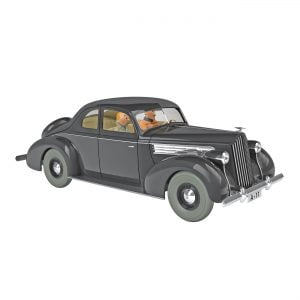
Tintin 1/24 Model Car 29928 – La Packard de Muskar XII – Le Sceptre d’Ottokar
£100.00Tintin New Model Cars 1/24 Scale by Hergé & Editions Moulinsart
-

Tintin 1/24 Model Car 29932 – La Voiture de la Castafiore – Le Sceptre d’Ottokar
£100.00Tintin New Model Cars 1/24 Scale
-
