
Related products

The Handy Series Of Pocket Maps – London And Four And Half Miles Round Charing Cross
£300.00George Philip & Son
Blome, Richard
£125.00
Availability: In stock
Author: Richard Blome
Publisher: Richard Blome
Price: £125 including postage in the UK
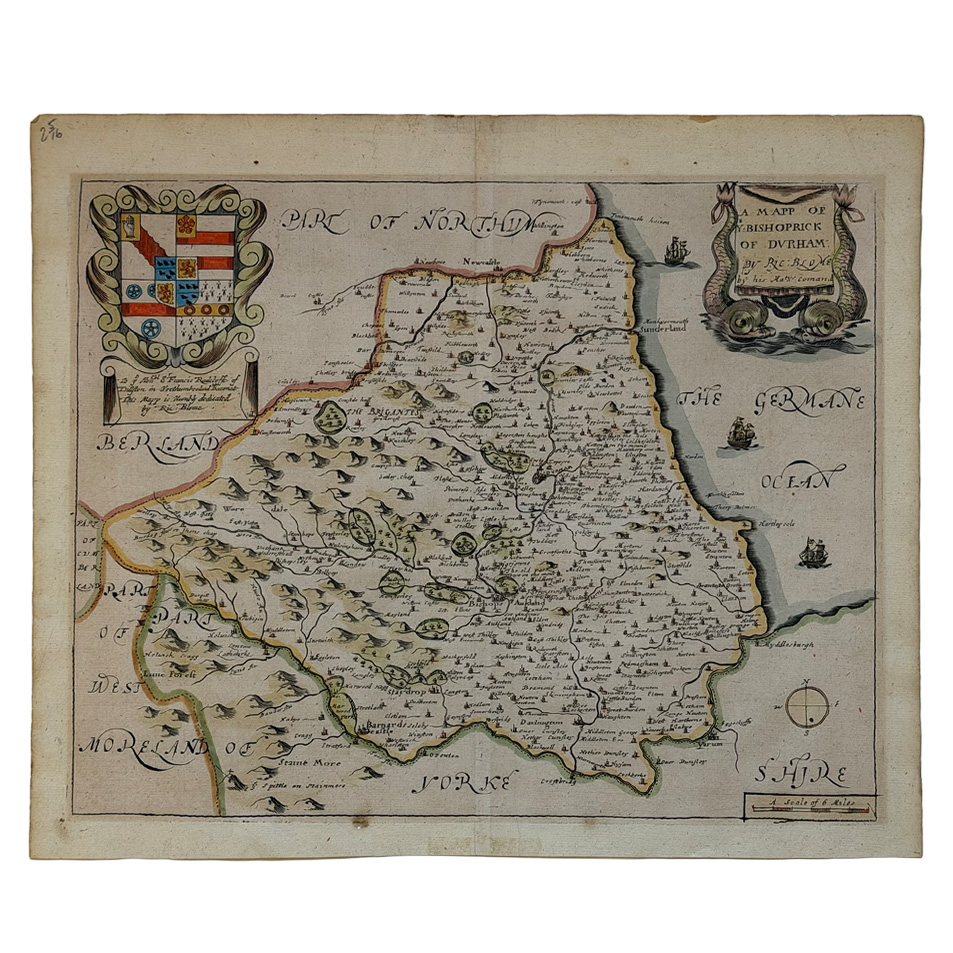
Publication Date: 1673
Edition: First edition
Sheet Size: 35.7cm x 30.4cm
Condition: Very good plus
Original copper-engraved map. Early hand-colouring. Sheet size: 35.7cm x 30.4cm. Blank to the verso. Minor age toning and browning which is mainly confined to the margins. In very good plus, bright, clean condition overall.
In the 17th century, County Durham was not a normal English county. It remained a county palatine, governed by the Bishop of Durham, who exercised quasi-regal powers on behalf of the Crown. These included:
This exceptional autonomy originated in the medieval need to defend the Anglo-Scottish border. By the 1600s, although the border wars had subsided, the palatine system remained intact, making Durham one of the most semi-autonomous regions in England.
Key implications:
County Durham was predominantly rural, with settlement patterns shaped by:
Major settlements:
Villages were typically nucleated, with open-field systems still in use in parts of the county early in the century.
Agriculture
Most people lived from subsistence mixed farming, including:
Enclosure increased slowly during the century, particularly after the Civil War, leading to:
Coal Industry
Coal was the county’s most important economic asset.
This led to:
Durham coal increasingly underpinned England’s urban growth.
Religion was central to life in 17th-century Durham.
Anglican Dominance
The Church of England was institutionally powerful, reinforced by:
Recusancy and Dissent
Despite this, the county had:
During the Civil War and Interregnum:
The Restoration (1660) reinstated episcopal authority, but religious pluralism never entirely disappeared.
County Durham was deeply affected by the national crisis.
Allegiances
Key impacts:
The abolition of palatine powers under the Commonwealth marked a temporary collapse of Durham’s unique constitutional status.
During the Interregnum:
Social Hierarchy
Durham society was stratified:
Social mobility was limited but possible through:
Living Conditions
Poor relief was administered through the parish system, with varying effectiveness.
The bishop’s courts handled:
Customary practices remained strong:
Witchcraft accusations were relatively rare compared to other English regions, though belief in magic and folk remedies was widespread.
By the century’s end:
The Glorious Revolution (1688) had limited immediate impact locally, but it confirmed:
The palatinate survived, but its autonomy was steadily eroding.
In summary, County Durham in the 17th century was:
It combined medieval structures of authority with the early forces of modern capitalism and state centralisation, making it one of the most distinctive counties in early modern England.
At Hornseys, we are committed to offering items that meet the highest standards of quality and authenticity. Our collection is meticulously curated to ensure that each item is a valuable and authentic piece of history. Here’s what sets us apart:
Visit Hornseys to explore our fine collection of rare and signed books, maps, artwork and objects. Whether you are an avid collector or looking for a special gift, our selection offers something truly unique. Located in the picturesque Yorkshire Dales, our Ripon gallery has been a haven for book lovers, art enthusiasts, and collectors since 1976.
Thank you for looking.

George Philip & Son




| Cookie | Duration | Description |
|---|---|---|
| cookielawinfo-checkbox-analytics | 11 months | This cookie is set by GDPR Cookie Consent plugin. The cookie is used to store the user consent for the cookies in the category "Analytics". |
| cookielawinfo-checkbox-functional | 11 months | The cookie is set by GDPR cookie consent to record the user consent for the cookies in the category "Functional". |
| cookielawinfo-checkbox-necessary | 11 months | This cookie is set by GDPR Cookie Consent plugin. The cookies is used to store the user consent for the cookies in the category "Necessary". |
| cookielawinfo-checkbox-others | 11 months | This cookie is set by GDPR Cookie Consent plugin. The cookie is used to store the user consent for the cookies in the category "Other. |
| cookielawinfo-checkbox-performance | 11 months | This cookie is set by GDPR Cookie Consent plugin. The cookie is used to store the user consent for the cookies in the category "Performance". |
| viewed_cookie_policy | 11 months | The cookie is set by the GDPR Cookie Consent plugin and is used to store whether or not user has consented to the use of cookies. It does not store any personal data. |