
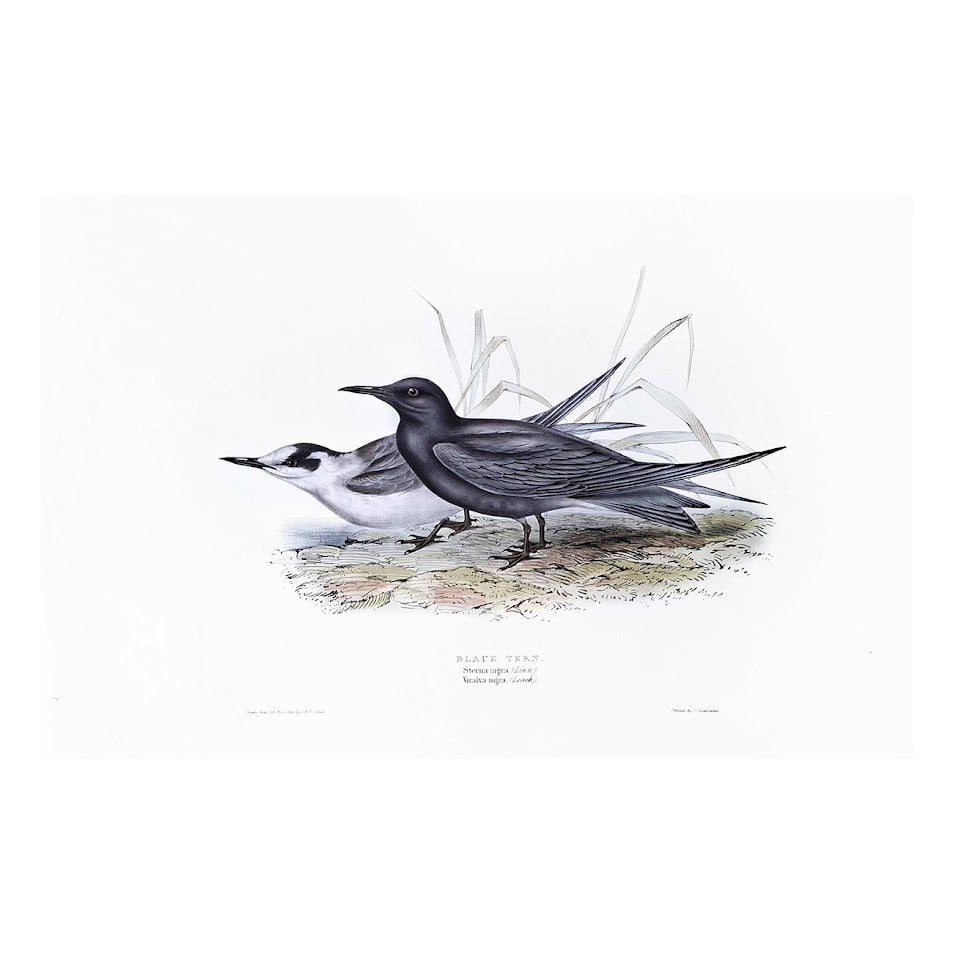
BLACK TERN – STERNA NIGRA – VIRALVA NIGRA
GOULD, JOHN & GOULD, ELIZABETH
£145.00
Availability: In stock
Product Description
BLACK TERN – STERNA NIGRA – VIRALVA NIGRA
Artists: John and Elizabeth Gould
Price: £145.00
Publisher: Printed by Hullmandel
Publication Date: 1832-1837
Format: Original hand-coloured lithograph heightened with gum arabic
Condition: Very good indeed, bright copy with good margins
Sheet Size: 54cm x 34.5cm
Series: From ‘The Birds of Europe’
This exquisite original hand-coloured lithograph from John and Elizabeth Gould’s magnificent work, ‘The Birds of Europe,’ produced between 1832 and 1837, showcases the Black Tern in stunning detail. The artwork exhibits the meticulous detail and vibrant use of colour that define the Goulds’ lithographs, making it a desirable piece for both art collectors and ornithological enthusiasts. Drawn from life, it reflects the Goulds’ commitment to scientific accuracy combined with artistic elegance. Minor age toning. Textual off-setting as usual. A very good indeed, bright, copy with good margins. Location: Map Drawer B: Folder 1006. 002000
The Story:
John Gould was an English ornithologist and bird artist. He and his wife, Elizabeth Gould, worked closely together to produce some of the most comprehensive and stunning ornithological works of the 19th century. Elizabeth, an accomplished artist, transferred many of John’s sketches into the lithographic prints that were then hand-coloured under her supervision. This piece not only captures the essence of the birds’ characteristics but also stands as a testament to the Goulds’ significant contributions to both art and science.
Condition Details:
- Overall Condition: Shows slight age toning and handling marks.
- Visual Appeal: Bright and vibrant colours, enhanced with gum arabic.
- Margins: Well-preserved with good margins, indicating careful handling over the years.
Key Features:
- Historical Significance: Part of John and Elizabeth Gould’s ‘The Birds of Europe,’ known for its scientific and artistic merit.
- Collector’s Item: Rare especially in such good condition.
- Artistic Detail: Demonstrates high-quality lithographic work and hand-colouring skills synonymous with John and Elizabeth Gould.
Black Tern: A Short Description
The Black Tern (Chlidonias niger) is a small, graceful seabird known for its striking breeding plumage and agile flight. This species belongs to the family Laridae and is particularly admired for its seasonal migrations and distinctive appearance. Here’s a detailed description of the species:
Physical Appearance:
- Size: The Black Tern measures approximately 23–28 cm (9–11 inches) in length, with a wingspan of about 57–65 cm (22–26 inches). It typically weighs between 60 to 70 grams (2.1 to 2.5 ounces).
- Plumage:
- Breeding Plumage: During the breeding season, the Black Tern is characterised by its striking black head, neck, and underparts, contrasted by its slate-grey upperparts. This bold colouration makes it easily distinguishable among other tern species.
- Non-Breeding Plumage: Outside of the breeding season, the Black Tern’s plumage changes dramatically. The underparts turn white, and the head and neck become mottled with white and grey, while the back and wings remain grey.
- Bill and Legs: The bill is slender and black, perfect for catching insects in flight, while the legs and feet are also black, contributing to the bird’s elegant appearance.
Habitat:
- Breeding Habitat: The Black Tern breeds in freshwater marshes and wetlands, particularly those with abundant vegetation such as reeds and cattails. It is often found in shallow waters where it can easily forage for food.
- Non-Breeding Habitat: During the non-breeding season, the Black Tern migrates to coastal regions, including estuaries, lagoons, and coastal marshes. It is typically seen in large flocks along coasts, bays, and large inland bodies of water.
Behaviour:
- Feeding:
- The Black Tern primarily feeds on insects, which it catches in flight with remarkable agility. It also feeds on small fish, crustaceans, and other aquatic invertebrates, often foraging close to the water’s surface.
- Its feeding technique involves rapid, acrobatic manoeuvres, making it one of the most skilful fliers among terns.
- Flight:
- The Black Tern is known for its buoyant and erratic flight, often described as fluttery and light. It can be seen gracefully skimming over water surfaces or hovering briefly before diving for prey.
Breeding:
- Nesting: The species nests in colonies, often constructing floating nests made of plant material, which are anchored to vegetation in shallow water. These nests are delicate and can be easily disturbed by water level changes or strong winds.
- Reproduction: The female lays 2 to 4 eggs, which are incubated by both parents for about 21–25 days. The chicks are semi-precocial, meaning they are relatively mature and mobile soon after hatching, but they remain dependent on the parents for feeding and protection.
Conservation Status:
- The Black Tern is currently listed as Least Concern by the IUCN Red List, although its population has declined in some areas due to habitat loss, particularly the draining of wetlands for agriculture. Conservation efforts are focused on preserving and restoring wetland habitats critical to the species’ breeding success.
Distribution:
- Breeding Range: The Black Tern breeds across a wide range in North America, Europe, and parts of Asia, particularly in temperate regions with suitable wetland habitats.
- Non-Breeding Range: During the non-breeding season, the species migrates to tropical and subtropical regions, including the coasts of South America, Africa, and South Asia.
Vocalisation:
- The Black Tern is known for its sharp, staccato calls, often described as “kik-kik-kik,” which are most frequently heard during the breeding season as it defends its territory and communicates with its mate.
The Black Tern is a captivating species, admired for its contrasting seasonal plumage and its impressive aerial agility. Its dependence on wetland habitats underscores the importance of conservation efforts to ensure the continued survival of this dynamic and beautiful bird.
Why Collect This Lithograph?
Owning this lithograph means possessing a piece of ornithological and art history. Its blend of scientific accuracy and aesthetic beauty makes it a worthy addition to any collection of fine art or historical prints.
Why Buy from Us?
At Hornseys, we are committed to offering items that meet the highest standards of quality and authenticity. Our collection of rare lithographs is meticulously curated to ensure that each piece is both a valuable and authentic addition to your collection. Here’s what sets us apart:
- Authenticity and Provenance: Every lithograph is thoroughly researched and verified for authenticity.
- Expert Curation: We select each piece with an eye for historical significance, condition, and visual appeal.
- Customer Satisfaction: We strive to provide an exceptional customer experience, from detailed descriptions to secure and prompt delivery.
- Returns Policy: We offer an unconditional guarantee on every item. If you wish to make a return, any item may be sent back to us within fourteen days of receipt for any reason. We request advance notification of returns, and items must be returned in the same condition as sent for a full refund.
Explore Our Collection:
Visit Hornseys to explore our exceptional collection of original hand-coloured lithographs by John and Elizabeth Gould. Located in the picturesque Yorkshire Dales, our Ripon gallery has been a haven for art lovers and collectors since 1976.


