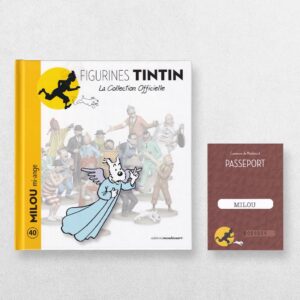
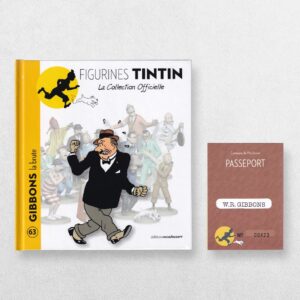
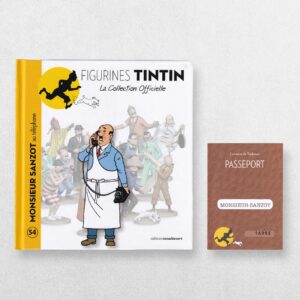
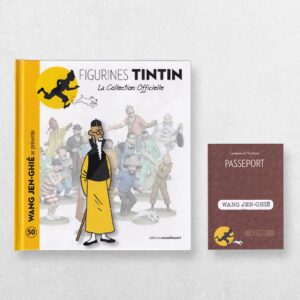
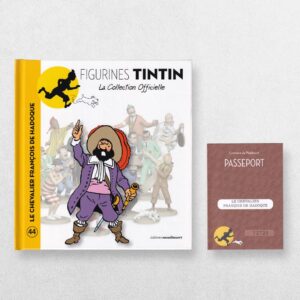
Didi Is Mad – Figurines Tintin La Collection Officielle – 66 – Didi Est Fou
Author: Hergé & Editions Moulinsart
Price: £65.00
Publisher: Editions Moulinsart
Publication date: 2014
Format: Original pictorial boards with passport and figurine
Condition: In very good condition
Illustrations: Illustrated throughout
Description:
Original pictorial boards. Includes passport loosely inserted. Text in French. Includes the accompanying figurine. One from the collection of 111 books and figurines. Very slight wear. Small mark to right arm. In very good, clean condition overall.
Didi: A Brief Account
Didi is a minor yet strikingly memorable character who appears in Cigars of the Pharaoh (Les Cigares du Pharaon, first published 1934–1935)*. Though his role is brief, he encapsulates a key theme in Hergé’s developing narrative style: the intrusion of irrationality and delirium into the ordered world of Tintin.
The recurring phrase “Didi est fou” (“Didi is mad”) defines his identity and functions both as a comic refrain and a metaphor for the disorienting forces Tintin faces in one of the series’ most surreal adventures.
Context in Cigars of the Pharaoh
Cigars of the Pharaoh marks an important turning point in Hergé’s career. It was his first Tintin story to abandon the formula of pure travelogue or propaganda and move towards mystery, psychological intrigue, and visual symbolism.
Set largely in Egypt, Arabia, and India, the story follows Tintin as he uncovers a secret drug-smuggling organisation that hides narcotics inside cigar tubes. Along the way, the narrative dips into hallucination, hypnosis, and delusion — blurring the boundary between reality and madness.
It is within this dreamlike atmosphere that Didi appears: a comic, eccentric figure whose erratic behaviour both amuses and unsettles.
Character Overview
Didi is a local man driven to apparent madness, wandering through the desert landscape and shouting nonsensical phrases. His eyes are wide, his gestures animated, and his words disconnected from context.
When he bursts onto the page, other characters exclaim, “Didi est fou!” — “Didi is mad!” The phrase serves as both diagnosis and refrain, encapsulating the mix of comedy and anxiety that characterises Cigars of the Pharaoh.
Though he appears only briefly, Didi’s presence is deeply atmospheric. He embodies the instability of a world where Tintin’s usual rational control is under threat.
Personality and Traits
- Eccentric and unbalanced: Didi’s speech and behaviour suggest delirium or confusion, though not malice.
- Comic yet pitiable: His exaggerated actions provoke laughter, but his detachment from reason adds a faint note of sadness.
- Expressive and animated: Hergé draws him with large gestures and wild eyes, giving him physical intensity even in still images.
- Harmless: Unlike Tintin’s criminal foes, Didi is benign — a fool rather than a villain.
He belongs to Hergé’s tradition of comic eccentrics — characters such as Professor Calculus and Jolyon Wagg — who disrupt order with absurdity but reveal something deeper about the human condition.
Role in the Narrative
Didi’s function in Cigars of the Pharaoh is both comic and symbolic.
- Comic Relief:
His mad outbursts punctuate the tension of Tintin’s encounters with cults, tombs, and smugglers. Hergé often used such figures to maintain balance in stories where the tone might otherwise become too dark or frightening. - Atmospheric Disruption:
Didi’s madness amplifies the story’s pervasive uncertainty. Cigars of the Pharaoh is a tale of disguises, hallucinations, and shifting identities — Didi’s irrationality fits this theme perfectly. - Mirror to Tintin’s Confusion:
At several points in the story, Tintin himself experiences disorientation — trapped, drugged, or lost in labyrinthine settings. Didi acts as an external echo of this mental chaos, the embodiment of the madness that threatens to consume order. - Social Commentary:
The recurring claim that “Didi is mad” might also be read as a critique of quick judgements — a reminder that misunderstanding and fear often label difference as insanity.
Symbolism
Didi’s brief appearance carries surprising thematic depth:
- Madness as Metaphor:
Madness in Hergé’s work is rarely random; it signals a world where reason falters. Didi represents the limits of logic when confronted by mystery — a human response to confusion and fear. - Comic Humanity:
Despite being called “mad,” Didi remains human, not monstrous. Hergé’s portrayal avoids cruelty; his madness is endearing rather than threatening. This aligns with Hergé’s broader artistic compassion — even his fools are treated with dignity. - The Fragility of Order:
The phrase “Didi est fou” underscores the thin line separating sanity from chaos in Tintin’s world. It is a reminder that adventure and absurdity coexist within the same moral universe.
Artistic Portrayal
Hergé’s visual economy makes Didi instantly recognisable. His animated gestures, expressive eyes, and exaggerated posture convey madness through motion. The clean lines and minimal backgrounds typical of Hergé’s ligne claire style heighten the contrast between Didi’s frenetic energy and Tintin’s calm precision.
The desert and tomb settings surrounding Didi intensify the surreal mood. His figure often seems isolated, surrounded by space — an emblem of mental dislocation within a vast, indifferent landscape.
Even in a few panels, Didi feels alive: a burst of comic chaos interrupting the measured rhythm of Hergé’s narrative composition.
Psychological Dimension
Hergé had a keen psychological instinct. In Cigars of the Pharaoh, madness, hypnosis, and paranoia weave through the plot, suggesting a subconscious fascination with control and surrender.
Didi, in this sense, embodies the fear of losing reason — a theme that recurs in later works such as The Shooting Star and The Calculus Affair. While those stories explore hysteria and obsession on a global or scientific scale, Didi presents madness on a personal, almost innocent level: confusion stripped of menace.
His name, Didi, itself suggests childishness — a simple, repetitive sound that reinforces his role as a kind of naïve holy fool.
Comparison with Other Comic Eccentrics
| Character | Type of Eccentricity | Function | Tone |
| Didi | Madness and confusion | Symbol of irrationality and chaos | Absurd and atmospheric |
| Professor Calculus | Scientific absent-mindedness | Genius and comic foil | Warm and affectionate |
| Jolyon Wagg | Social intrusiveness | Satire of bourgeois manners | Humorous irritation |
Didi is the most surreal of these figures — less developed, but more symbolically potent.
Legacy and Reception
Although Didi appears in only a few panels, he has become a cult favourite among Tintin enthusiasts and collectors. Figurines and illustrations of “Didi est fou” celebrate him as a symbol of Hergé’s humour and visual expressiveness.
Critics have also recognised his importance as an early example of Hergé’s psychological storytelling, marking the artist’s transition from caricature to character.
In academic discussions of Cigars of the Pharaoh, Didi often features as a sign of the story’s hallucinatory atmosphere — part of the visual vocabulary through which Hergé explores perception, reason, and absurdity.
Summary
- Name: Didi
- First appearance: Cigars of the Pharaoh (1934–35)
- Role: Comic eccentric symbolising madness and confusion
- Notable phrase: “Didi est fou” — “Didi is mad.”
- Personality: Energetic, incoherent, harmlessly deranged, expressive
- Symbolism: The fragility of reason; humanity in chaos
- Narrative function: Comic relief, atmospheric disruption, psychological mirror
- Artistic importance: Early example of expressive motion and surreal humour in Hergé’s clear-line style
Conclusion
Didi may occupy only a fleeting space in Cigars of the Pharaoh, but his presence is emblematic of a larger transformation in Hergé’s art. Through Didi’s apparent madness, Hergé explores the boundaries of logic and imagination, fear and laughter.
“Didi est fou” becomes more than a comic remark — it is a refrain that captures the spirit of a story teetering between reason and delirium. Didi reminds us that The Adventures of Tintin are not just about geography and action, but also about the human mind in all its vulnerability and wonder.
In his few brief moments on the page, Didi stands as both clown and mirror — absurd yet revealing, a small figure through whom Hergé lets the world’s madness briefly, brilliantly, speak.
Why Buy from Us?
At Hornseys, we are committed to offering items that meet the highest standards of quality and authenticity. Our collection of objects and rare books are carefully curated to ensure each edition is a valuable piece of bibliographical history. Here’s what sets us apart:
- Authenticity and Provenance: Each item is meticulously researched and verified for authenticity and collation.
- Expert Curation: Our selection process focuses on significance, condition, and rarity, resulting in a collection that is both diverse and distinguished.
- Customer Satisfaction: We aim to provide an exceptional customer experience, from detailed descriptions to secure and prompt delivery of your purchase.
- Returns Policy: We offer an unconditional guarantee on every item. If you wish to return an item, it may be sent back to us within fourteen days of receipt. Please notify us in advance if you wish to do so. The item must be returned in the same condition as it was sent for a full refund.
Cataloguer: Daniel Hornsey
Daniel Hornsey has specialised in fine and rare books, ephemera, and collectors’ editions for over thirty years. As a long-standing member of the antiquarian book trade, he has advised private collectors, curated catalogues, and sourced works for leading dealers, libraries and institutions across the world.
Hornseys’ exhibit regularly at book and map fairs in London and throughout the UK and are members of the Provincial Booksellers Fairs Association, the PBFA.
His fascination with Hergé’s work — especially ‘The Adventures of Tintin’ — began in childhood. Daniel recalls reading Tintin in original European editions and quickly recognising that these were not merely children’s books, but finely illustrated narratives crafted with artistic depth and wit.
As noted by the Musée Hergé in Louvain-la-Neuve, Hergé’s ‘ligne claire’ style has influenced generations of European comic artists and his original drawings and paintings command very high prices with his painting of ‘The Blue Lotus’ jar fetching £2.8m at auction in 2021.
By presenting these works through Hornseys’, he hopes to contribute to the continued appreciation of one of the 20th century’s most influential illustrators, helping new generations discover the artistry and legacy of Hergé.