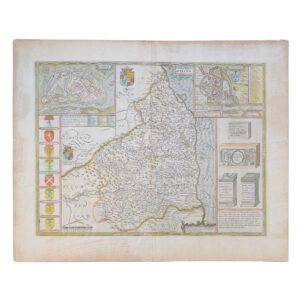
Dunelmensis Episcopatus Qui Comitatus Est Palatinus Olim Pars Brigantum – 1607
Kip, William & Saxton, Christopher
£125.00
Availability: In stock
Product Description
Dunelmensis Episcopatus Qui Comitatus Est Palatinus Olim Pars Brigantum – 1607
Author: Kip, William & Saxton, Christopher
Publisher: George Bishop & John Norton
Price: £125 including postage in the UK
Publication Date: 1607
Edition: Second edition
Sheet Size: 39.7cm x 32.4cm
Condition: Very good plus
Condition:
Original copper-engraved map. Sheet size: 39.7cm x 32.4cm. Blank to the verso. Remnants of old tabs to the good, wide margins. Minor age toning and browning but in very good plus, bright, clean condition overall and a good, strong impression.
The County Palatine Of Durham In The Late 16th Century: A Brief Account
Overview and Historical Position
In the late sixteenth century, County Durham occupied a singular and anomalous position within the English polity. It remained a county palatine, governed by the Bishop of Durham, whose secular authority rivalled that of the Crown itself within the county’s bounds. This constitutional peculiarity, rooted in medieval frontier defence, profoundly shaped Durham’s political culture, religious life, economy, and social structure during the reigns of Elizabeth I and her immediate predecessors.
Durham was simultaneously a border county, a clerical lordship, and an emerging industrial region, poised between feudal survivals and early modern transformation.
- Constitutional Status: The Palatinate in Practice
Episcopal Authority
The Bishop of Durham exercised powers that elsewhere belonged to the monarch:
- Appointment of sheriffs, judges, and justices of the peace
- Control over courts, revenues, and local administration
- Authority to issue writs in his own name
- Command over local military forces
This autonomy made Durham semi-detached from central government, with royal directives often filtered through episcopal priorities.
Relationship with the Crown
Elizabethan governments tolerated Durham’s privileges because:
- The northern border remained strategically sensitive
- The bishopric provided an effective mechanism of control
- Disruption of palatine authority risked local instability
Nevertheless, the Crown increasingly scrutinised Durham, particularly concerning religious conformity and loyalty, given the county’s Catholic sympathies.
- Geography, Settlement, and Landscape
County Durham’s physical character shaped both economy and society:
- Western uplands and moorlands supported pastoral farming
- Central river valleys (Wear, Tees, Derwent) sustained arable agriculture
- Eastern lowlands and coast facilitated coal extraction and trade
Settlements
- Durham City: ecclesiastical capital, dominated by the cathedral and bishop’s administrative apparatus
- Bishop Auckland: principal episcopal residence
- Darlington: modest market town with regional influence
- Stockton-on-Tees: small port beginning to benefit from river trade
- Sunderland: developing coal-export settlement, still secondary to Newcastle
Most of the population lived in villages and hamlets, with nucleated settlement patterns and extensive common land.
- Economy: Agriculture, Coal, and Early Industry
Agriculture
The majority of inhabitants relied on mixed subsistence farming, characterised by:
- Oats, barley, and rye as staple crops
- Cattle and sheep grazing, particularly in upland areas
- Limited wheat cultivation
Open-field systems persisted widely, and enclosure was sporadic and cautious, constrained by custom and communal resistance.
Coal Mining
Coal was already the county’s most distinctive economic asset.
- Shallow pits and bell pits dominated extraction
- Coal was transported by packhorse, cart, and river
- The River Wear was increasingly important for export
Coal from Durham supplied:
- Local domestic consumption
- Regional industry
- Growing demand from London
The late 16th century saw the early formation of coal-owning elites, foreshadowing later industrial dominance.
Other Trades
- Salt production along the coast
- Ironworking in limited inland locations
- Leatherworking, milling, and brewing in market towns
- Religion: Reformation, Resistance, and Conformity
Anglican Settlement
By Elizabeth I’s reign, the Elizabethan Religious Settlement was formally in place, but its enforcement in Durham was uneven.
- The bishopric supported official Anglican doctrine
- Parish churches were gradually re-ordered along Protestant lines
- Clerical standards varied widely
Catholic Recusancy
County Durham was one of England’s strongest centres of Catholic survival:
- Numerous gentry families remained quietly Catholic
- Attendance at Anglican services was often nominal
- Priests operated covertly, supported by kinship networks
This religious conservatism was reinforced by:
- Distance from London
- Border culture and distrust of central authority
- Long-standing loyalty to traditional forms of worship
Surveillance and Enforcement
After the Northern Rising of 1569, the Crown intensified oversight:
- Increased use of ecclesiastical courts
- Fines for recusancy
- Greater scrutiny of gentry households
Despite this, Catholicism persisted as a cultural presence, even where outward conformity prevailed.
- The Border Context and Security
Although large-scale Anglo-Scottish warfare had diminished, the border remained unstable.
Reiving and Disorder
- Cross-border raiding affected western Durham
- Livestock theft and feuding were endemic
- Local justice was often compromised by kinship loyalties
The bishop’s palatine authority was crucial in maintaining order, supplementing royal military resources.
- Social Structure and Hierarchy
Durham society was rigidly hierarchical:
- The Bishop and senior clergy
- Gentry, including coal owners and recusant families
- Yeomen farmers
- Artisans and tradesmen
- Labourers, miners, and servants
Social mobility existed but was limited, most often achieved through:
- Marriage
- Office-holding under the bishop
- Investment in coal or trade
- Law, Custom, and Governance
Courts and Justice
- Palatine courts handled criminal and civil cases
- Manorial courts regulated local custom
- Church courts enforced moral discipline
Durham retained customary law and practices longer than many southern counties, including:
- Rights of common
- Manorial obligations
- Seasonal festivals and rituals
Puritan criticism of such customs existed but had not yet transformed popular culture.
- Living Conditions and Demography
Housing and Diet
- Stone or timber cottages with thatched roofs
- Diet dominated by grain, dairy, and occasional meat
- Vulnerability to harvest failure and price inflation
Population Trends
The late 16th century saw moderate population growth, placing pressure on:
- Land availability
- Employment
- Poor relief mechanisms
Parish-based poor relief was developing but unevenly administered.
- County Durham at the End of the Elizabethan Era
By 1603, County Durham was:
- Constitutionally exceptional
- Religiously conservative but outwardly conformist
- Economically diversified, with coal as a rising force
- Socially traditional, yet under increasing strain
It stood on the threshold of the seventeenth century as a county where medieval structures endured, even as the forces of state centralisation, religious uniformity, and proto-industrial capitalism gathered strength.
Concluding Characterisation
Late sixteenth-century County Durham was neither backward nor fully modern. Its distinctive palatine governance, persistent Catholic culture, and early industrial economy made it one of the most complex and regionally distinctive societies in Elizabethan England.
Why buy from us?
At Hornseys, we are committed to offering items that meet the highest standards of quality and authenticity. Our collection is meticulously curated to ensure that each item is a valuable and authentic piece of history. Here’s what sets us apart:
- Authenticity and Provenance: Every item is researched, collated, and verified for authenticity.
- Expert Curation: Each item is selected with a keen eye for significance, condition, and rarity, ensuring a collection that is both diverse and distinguished.
- Customer Satisfaction: We strive to provide an exceptional customer experience, from detailed descriptions and provenance to secure and prompt delivery of your purchase.
- Returns Policy: We offer an unconditional guarantee on every item. If you wish to make a return, items may be sent back to us within fourteen days of receipt for any reason. We request advance notification of returns, and items must be returned in the same condition as sent for a full refund.
Explore Our Collection:
Visit Hornseys to explore our fine collection of rare and signed books, maps, artwork and objects. Whether you are an avid collector or looking for a special gift, our selection offers something truly unique. Located in the picturesque Yorkshire Dales, our Ripon gallery has been a haven for book lovers, art enthusiasts, and collectors since 1976.
Thank you for looking.