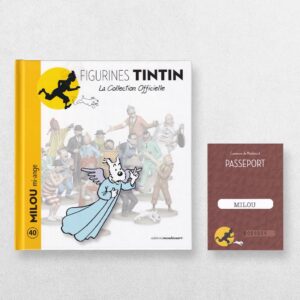
Haddock Covered In Paint – Figurines Tintin La Collection Officielle – 69 – Haddock Couvert De Peinture
Author: Hergé & Editions Moulinsart
Price: £50.00
Publisher: Editions Moulinsart
Publication date: 2014
Format: Original pictorial boards with passport and figurine
Condition: In near fine condition
Illustrations: Illustrated throughout
Description:
Original pictorial boards. Includes passport loosely inserted. Text in French. Includes the accompanying figurine. One from the collection of 111 books and figurines. Very slight wear. In very near fine, clean condition overall.
Captain Haddock: A Brief Account
Captain Archibald Haddock is introduced in The Crab with the Golden Claws (Le Crabe aux pinces d’or, 1941)* and becomes Tintin’s closest companion throughout the remainder of the series. He begins as a down-and-out, alcohol-dependent sea captain and evolves into a complex, passionate, and deeply loyal friend — a figure of both comedy and pathos.
Through Haddock, Hergé brought emotion, imperfection, and moral depth into Tintin’s world. Whereas Tintin is the embodiment of integrity and reason, Haddock represents humanity in all its volatility: courageous yet flawed, tender yet explosive.
Origins and Creation
Hergé conceived Captain Haddock during the Second World War, when he was serialising The Crab with the Golden Claws under the constraints of German occupation. The character appeared at a time when Tintin’s perfection — his calm, almost saintly rationality — risked becoming abstract.
Hergé himself admitted that Haddock entered the series “like a breath of fresh air.” He gave Tintin someone to talk to, argue with, and care for — and gave readers a hero who could lose his temper, get drunk, and make mistakes.
Haddock’s surname derives from the English fish, reflecting Hergé’s love of British names and his fascination with the sea. His expressive face and solid build were inspired by classic caricature types of the bluff sailor and the “good-hearted grumbler.”
Character Overview
Physical Description
Haddock is a stocky man with a thick black beard, heavy eyebrows, and a seafarer’s bearing. His usual attire — blue jumper emblazoned with an anchor, sailor’s cap, and pea coat — instantly conveys his maritime background.
Personality
Haddock is one of the most psychologically nuanced figures in 20th-century comics:
- Passionate: He experiences every emotion intensely — joy, anger, guilt, compassion.
- Courageous but impulsive: He rushes into danger without hesitation, often without a plan.
- Self-deprecating: Beneath his bluster lies insecurity, guilt, and a deep moral conscience.
- Loyal: His devotion to Tintin is absolute, sometimes bordering on paternal.
- Humorous: His explosive temper and inventive insults (“bashi-bazouk!”, “anacoluthon!”, “blistering barnacles!”) are among the series’ comic highlights.
- Tragicomic: His struggles with alcohol and self-doubt give him a rare emotional realism.
Haddock is, in short, the emotional core of the Tintin series — its most fallible and therefore most human character.
First Appearance — The Crab with the Golden Claws
When Tintin first encounters Captain Haddock, he is the drunken, manipulated commander of the freighter Karaboudjan, enslaved by his corrupt first mate, Allan Thompson. Haddock’s alcoholism and despair make him both comic and pitiable — a man whose dignity has been stolen.
Tintin rescues him, setting in motion Haddock’s moral redemption. Their escape through the desert, during which Haddock swings between heroism and delirium, establishes the emotional tension that defines their friendship: Tintin’s rational composure balancing Haddock’s emotional excess.
By the end of the story, Haddock’s courage and decency re-emerge, foreshadowing his transformation from fallen mariner to noble companion.
The Evolution of Captain Haddock
Hergé developed Haddock gradually across later albums, charting an implicit journey of moral recovery and self-discovery.
The Secret of the Unicorn and Red Rackham’s Treasure
Haddock learns that his ancestor, Sir Francis Haddock, was a courageous 17th-century sea captain who defied the pirate Red Rackham. This revelation gives him both pride and purpose. The discovery of Marlinspike Hall at the end of Red Rackham’s Treasure completes his transformation from destitute sailor to gentleman of independent means.
The Shooting Star
Here, Haddock’s brashness and greed briefly reappear, but his loyalty to Tintin remains steadfast. His struggle between vanity and virtue continues — a theme that recurs throughout the series.
The Calculus Affair
Haddock becomes the moral voice of friendship and protectiveness. His anger at Professor Calculus’s abduction reveals genuine emotional depth — rage driven by love rather than pride.
Tintin in Tibet
This is Haddock’s moral apotheosis. His determination to follow Tintin into the Himalayas, despite exhaustion and fear, transforms him into a figure of profound heroism. His loyalty reaches its purest expression when he risks his life in the blizzard, embodying devotion without hope of reward.
By this point, Haddock has evolved from comic drunk to selfless friend — still irascible, still prone to bluster, but ennobled by empathy.
Haddock’s Language
One of Hergé’s greatest achievements is Haddock’s speech. His furious tirades, bursting with invented oaths and obsolete words — troglodytes, ectoplasms, sea gherkins, nincompoops — constitute a comic lexicon all their own.
These outbursts serve multiple functions:
- Characterisation: His vocabulary reflects his education and his love of expressive exaggeration.
- Comic rhythm: His insults punctuate action scenes like percussion, adding energy and sound.
- Moral venting: His anger, though loud, is rarely cruel; it is the frustration of a man who feels too deeply.
Hergé drew inspiration from sailors’ slang, Shakespearean invective, and French theatrical tradition. In English, translator Leslie Lonsdale-Cooper captured the rhythm of Haddock’s speech with creative equivalents such as “billions of bilious blue blistering barnacles!”, preserving his volcanic eloquence.
Psychological Depth
Haddock’s complexity lies in his contradictions. He is brave yet self-doubting, gruff yet tender, worldly yet naive.
His early alcoholism symbolises spiritual defeat — a man numbing himself against guilt and failure. His friendship with Tintin offers redemption through trust, loyalty, and purpose. Hergé presents this transformation with compassion rather than moralising.
Unlike Tintin, who remains almost saintlike, Haddock is recognisably human. He experiences temptation, rage, fear, and shame — and he grows. This human arc gives The Adventures of Tintin emotional credibility beyond the genre of children’s adventure.
Hergé once called Haddock “the human part of Tintin.” Without him, Tintin would risk being an idea; with him, he becomes part of a believable world.
Relationship with Tintin
The friendship between Tintin and Captain Haddock is the moral and emotional centre of the series. It is a relationship of opposites:
- Tintin represents moral clarity, intellect, and restraint.
- Haddock represents emotion, instinct, and imperfection.
Together, they embody balance — mind and heart, youth and experience, composure and passion.
Haddock’s paternal affection for Tintin, often disguised by bluster, gives the series warmth and intimacy. Their companionship is built on mutual trust: Tintin never judges Haddock’s flaws, and Haddock never abandons Tintin’s cause.
Relationship with Professor Calculus
Haddock’s volatile friendship with Professor Calculus (Professeur Tournesol) adds further richness. Calculus’s absent-minded serenity infuriates Haddock, whose temper contrasts sharply with the professor’s calm. Yet beneath the irritation lies real affection — their friendship a comic embodiment of tolerance between opposites.
In The Calculus Affair, Haddock’s protectiveness toward Calculus shows his capacity for deep loyalty and compassion, even toward those who drive him to distraction.
Symbolism and Interpretation
- The Human Everyman
Haddock represents ordinary humanity within Tintin’s near-mythic universe. He fails, apologises, and tries again — proof that imperfection can coexist with heroism.
- Moral Redemption
His journey from alcoholic despair to moral courage mirrors the possibility of self-renewal. Haddock’s evolution is the emotional backbone of Hergé’s later work.
- Emotion versus Reason
Where Tintin symbolises rational virtue, Haddock embodies emotional authenticity. Their partnership unites intellect and feeling, suggesting that moral wholeness requires both.
- The Artist’s Self-Portrait
Many scholars note that Haddock reflects Hergé himself — his self-criticism, mood swings, and inner contradictions. Tintin may be the artist’s ideal, but Haddock is his confession.
Artistic Portrayal
Visually, Hergé designed Haddock with extraordinary expressiveness. His heavy brows, bulbous nose, and mobile mouth allow for an immense range of emotion — from fury to tenderness.
In motion, his gestures are expansive: arms flailing, fists clenching, pipe gesticulating in emphasis. His stance — solid yet restless — embodies moral weight struggling against chaos.
The evolution of Hergé’s drawing style mirrors Haddock’s growth: from broad caricature in The Crab with the Golden Claws to nuanced portraiture in Tintin in Tibet, where fine lines capture fatigue, devotion, and despair with painterly sensitivity.
Cultural and Psychological Significance
Captain Haddock broke new ground in European comics. Before him, comic heroes were static types — brave, clever, and unchanging. Haddock introduced psychological realism: a flawed man capable of moral growth.
His alcoholism, anger, and moments of self-reproach reflect real human struggle. Yet his humour and courage transform those flaws into sources of strength. Hergé’s empathy for him marks a maturity that elevates The Adventures of Tintin from adventure strip to literature.
Legacy
Captain Haddock has become one of the most recognisable figures in world comics — a symbol of loyalty, emotion, and expressive language.
His house, Marlinspike Hall, became the domestic heart of the series. His friendship with Tintin and Calculus defines its human warmth. His volcanic tirades and comic exasperations are quoted worldwide.
More profoundly, Haddock transformed Tintin’s world from pure adventure into moral drama. He gave it soul.
Summary
- Full name: Captain Archibald Haddock
- First appearance: The Crab with the Golden Claws (1941)
- Occupation: Sea captain; later owner of Marlinspike Hall
- Personality: Passionate, loyal, volatile, generous, self-critical
- Symbolism: Human fallibility, moral redemption, the triumph of friendship over despair
- Closest relationships: Tintin, Professor Calculus, Snowy
- Defining traits: Explosive temper, expressive vocabulary, fierce loyalty
- Favourite expressions: “Blistering barnacles!”, “Thundering typhoons!”
Conclusion
Captain Haddock is not only Tintin’s greatest companion but also Hergé’s most profound achievement in character creation. He is the human heartbeat of the series — flawed, emotional, and courageous.
Through him, Hergé transformed The Adventures of Tintin from light adventure into moral comedy and psychological portraiture. Haddock’s anger conceals compassion; his clumsiness hides moral strength. He is both comic foil and tragic hero — a man continually battling his own weaknesses in order to be worthy of his friends.
Above all, Captain Haddock represents the possibility of redemption: proof that courage is not the absence of fault but the perseverance of goodness despite it.
In a universe defined by clarity and idealism, he remains the necessary imperfection — the soul that makes Tintin’s world human.
Why Buy from Us?
At Hornseys, we are committed to offering items that meet the highest standards of quality and authenticity. Our collection of objects and rare books are carefully curated to ensure each edition is a valuable piece of bibliographical history. Here’s what sets us apart:
- Authenticity and Provenance: Each item is meticulously researched and verified for authenticity and collation.
- Expert Curation: Our selection process focuses on significance, condition, and rarity, resulting in a collection that is both diverse and distinguished.
- Customer Satisfaction: We aim to provide an exceptional customer experience, from detailed descriptions to secure and prompt delivery of your purchase.
- Returns Policy: We offer an unconditional guarantee on every item. If you wish to return an item, it may be sent back to us within fourteen days of receipt. Please notify us in advance if you wish to do so. The item must be returned in the same condition as it was sent for a full refund.
Cataloguer: Daniel Hornsey
Daniel Hornsey has specialised in fine and rare books, ephemera, and collectors’ editions for over thirty years. As a long-standing member of the antiquarian book trade, he has advised private collectors, curated catalogues, and sourced works for leading dealers, libraries and institutions across the world.
Hornseys’ exhibit regularly at book and map fairs in London and throughout the UK and are members of the Provincial Booksellers Fairs Association, the PBFA.
His fascination with Hergé’s work — especially ‘The Adventures of Tintin’ — began in childhood. Daniel recalls reading Tintin in original European editions and quickly recognising that these were not merely children’s books, but finely illustrated narratives crafted with artistic depth and wit.
As noted by the Musée Hergé in Louvain-la-Neuve, Hergé’s ‘ligne claire’ style has influenced generations of European comic artists and his original drawings and paintings command very high prices with his painting of ‘The Blue Lotus’ jar fetching £2.8m at auction in 2021.
By presenting these works through Hornseys’, he hopes to contribute to the continued appreciation of one of the 20th century’s most influential illustrators, helping new generations discover the artistry and legacy of Hergé.