Harold Owen – Journey from Obscurity: Wilfred Owen 1893–1918 – Memoirs of the Owen Family – Complete Three-Volume First Edition Set, 1963–1965
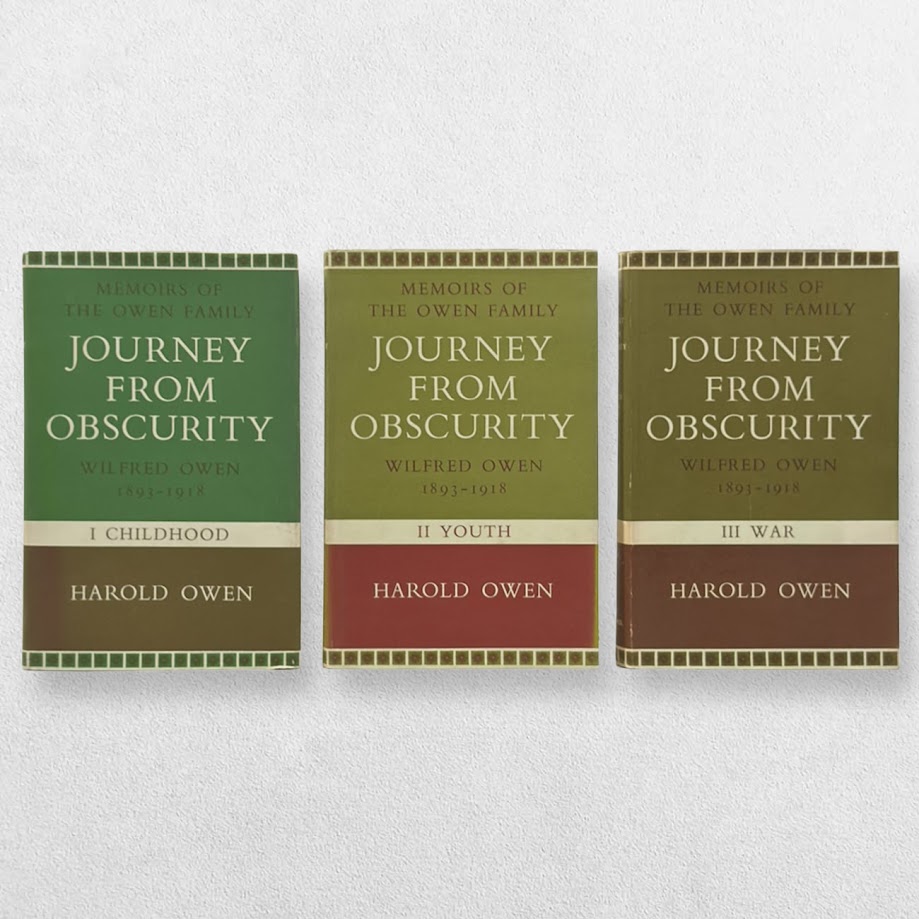
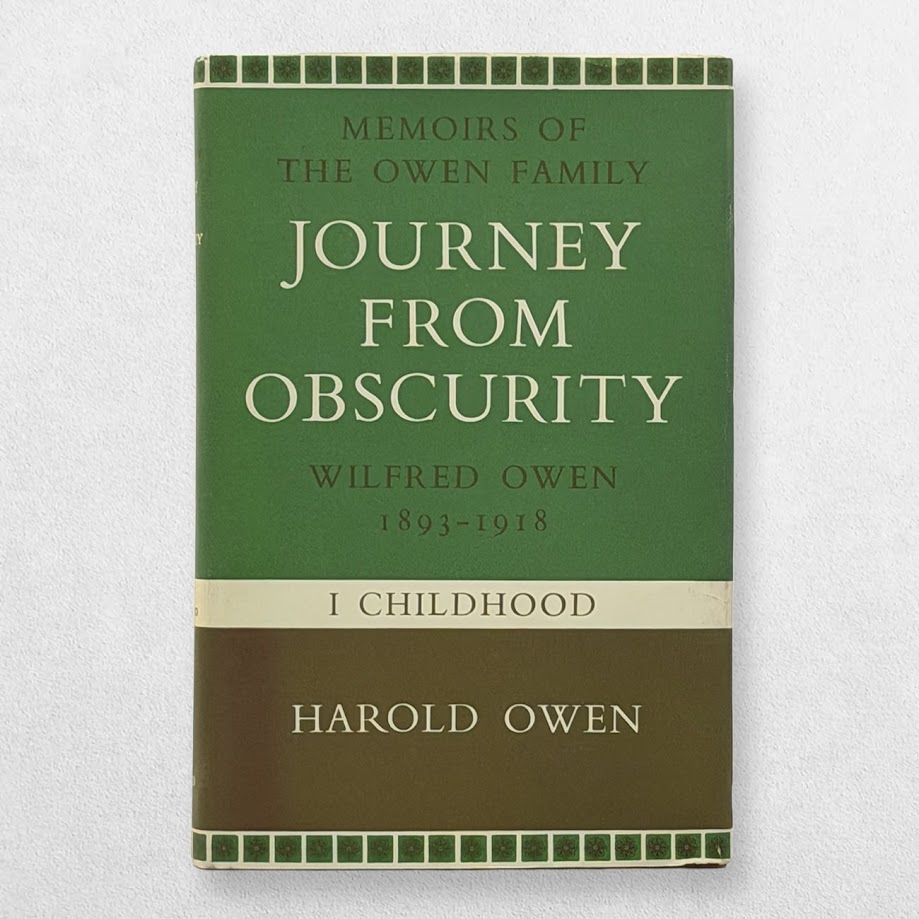
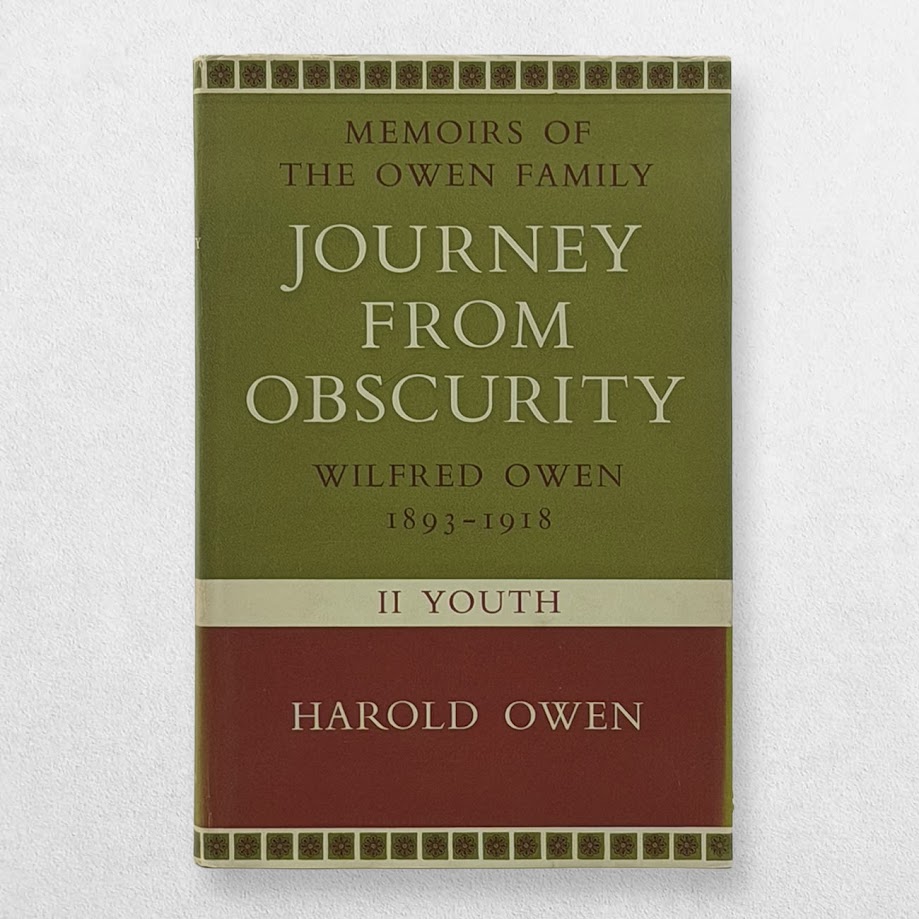
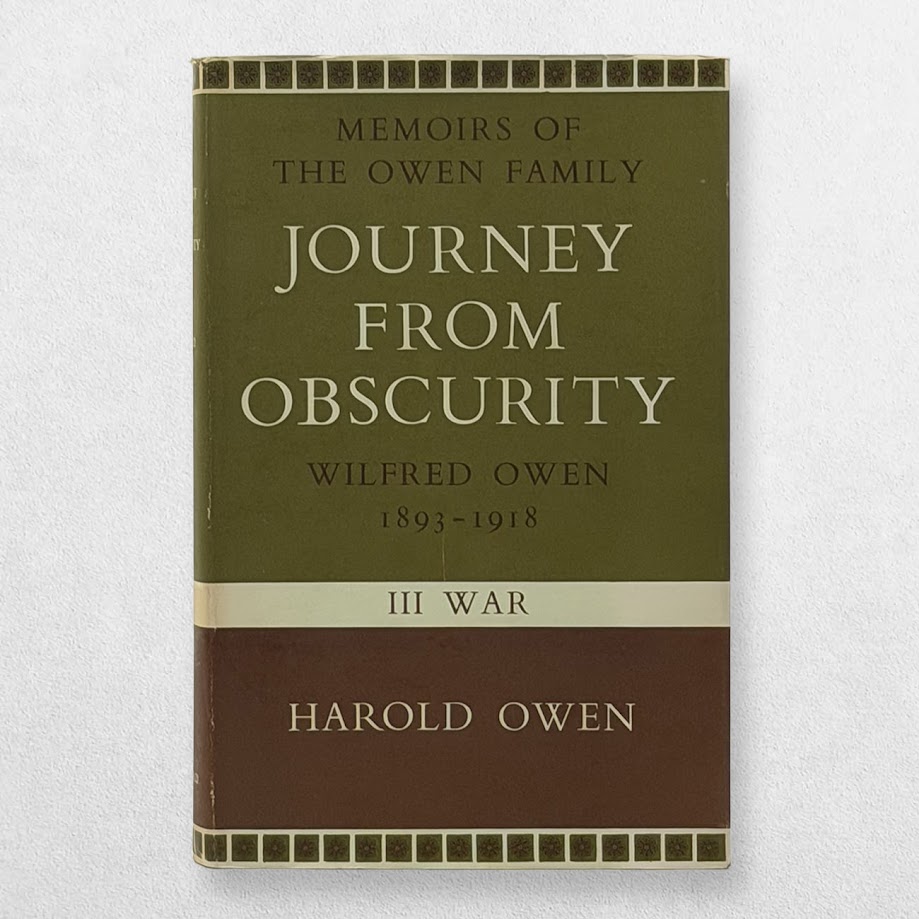
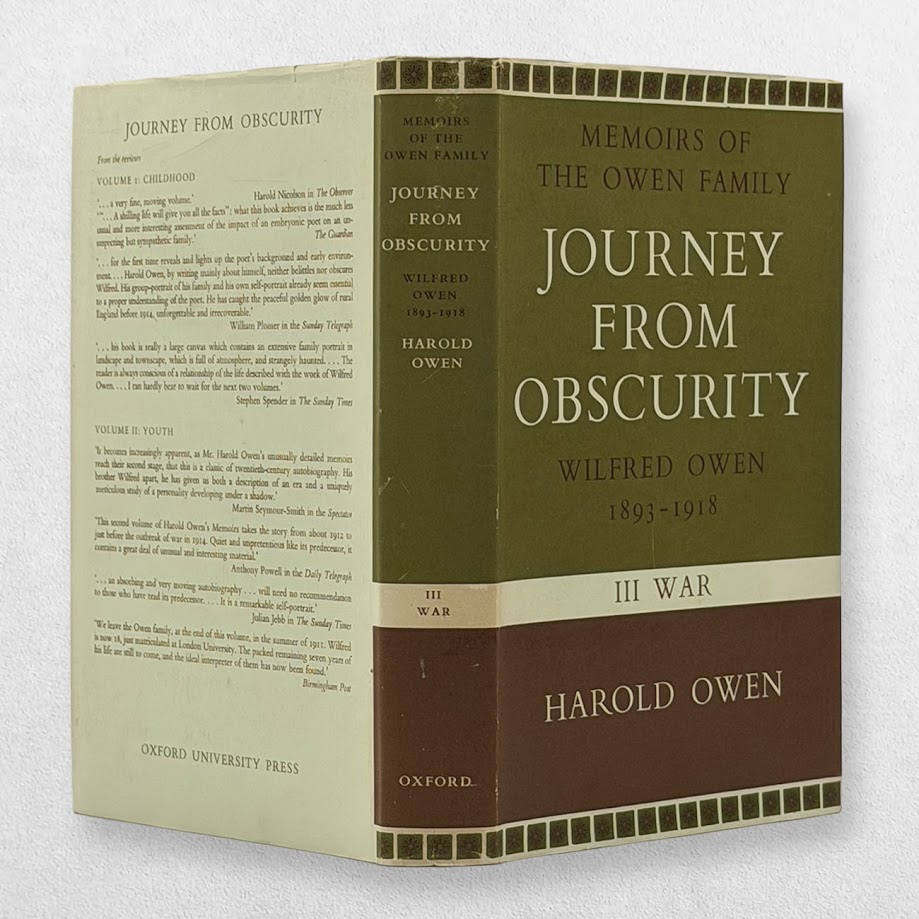
JOURNEY FROM OBSCURITY: WILFRED OWEN 1893–1918. MEMOIRS OF THE OWEN FAMILY. I: CHILDHOOD; II: YOUTH; III: WAR. THE COMPLETE THREE-VOLUME FIRST EDITION SET OF HAROLD OWEN’S IMPORTANT BIOGRAPHICAL MEMOIRS OF HIS ELDER BROTHER, THE FIRST WORLD WAR POET WILFRED OWEN.
Author: Harold Owen (1897–1971).
Publisher: Oxford University Press, London, England.
Publication Dates: 1963, 1964 and 1965.
Edition: First editions of all three volumes.
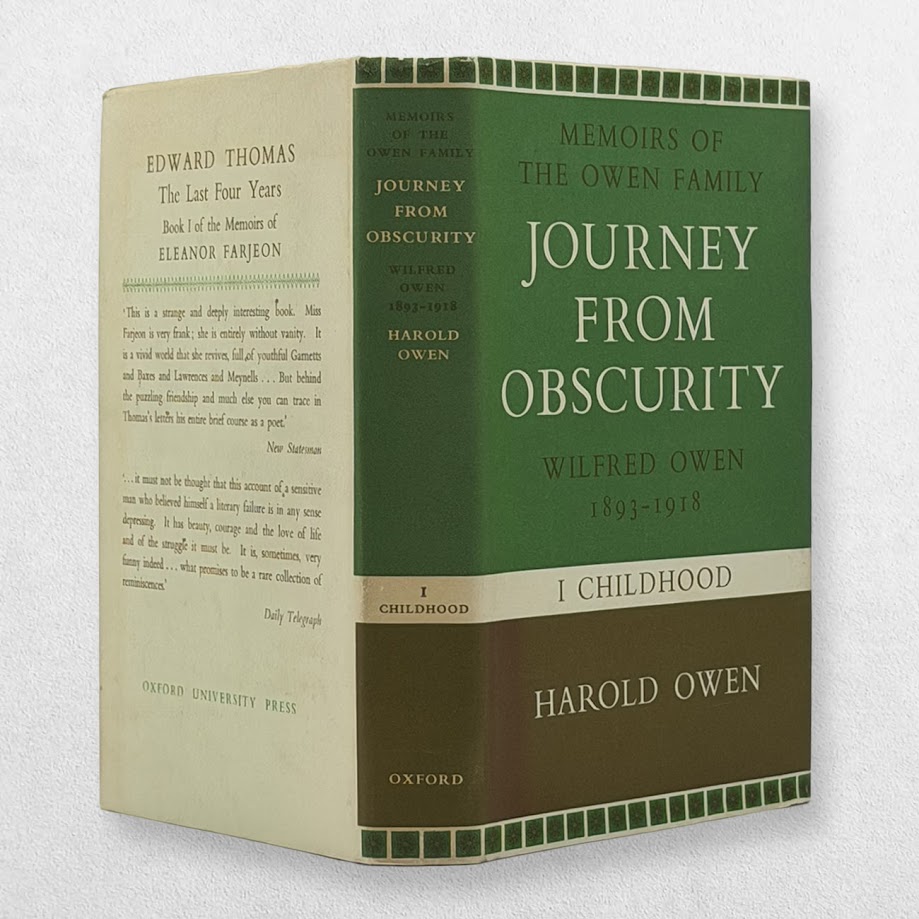
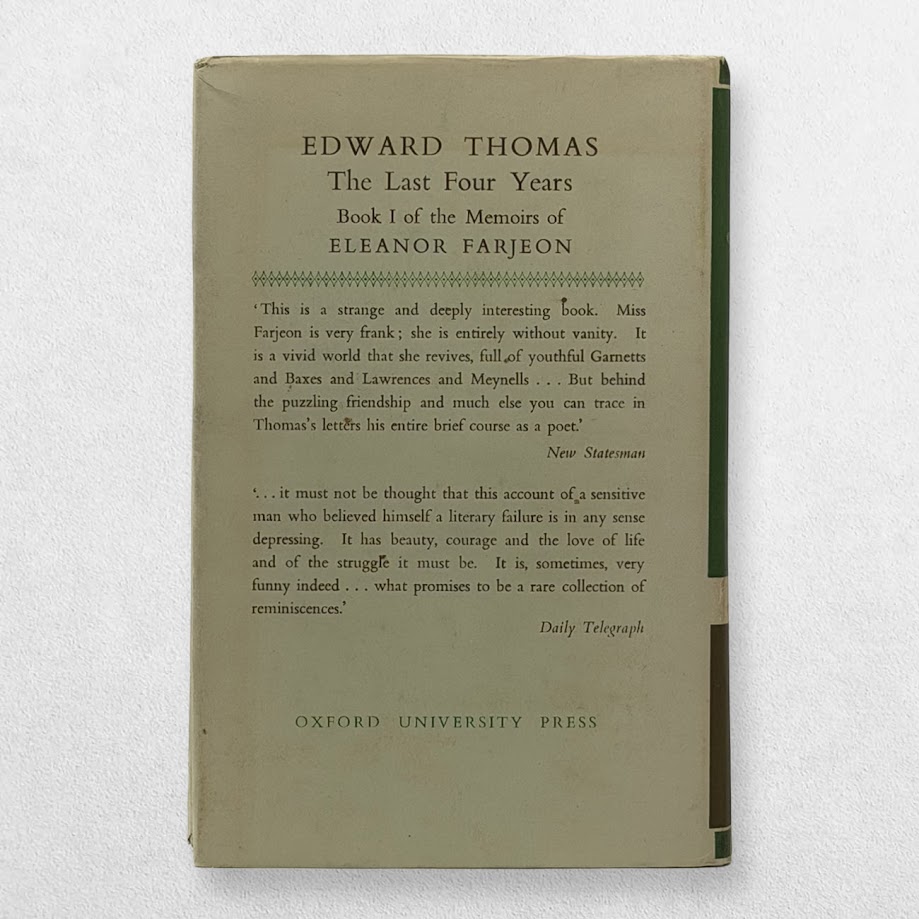
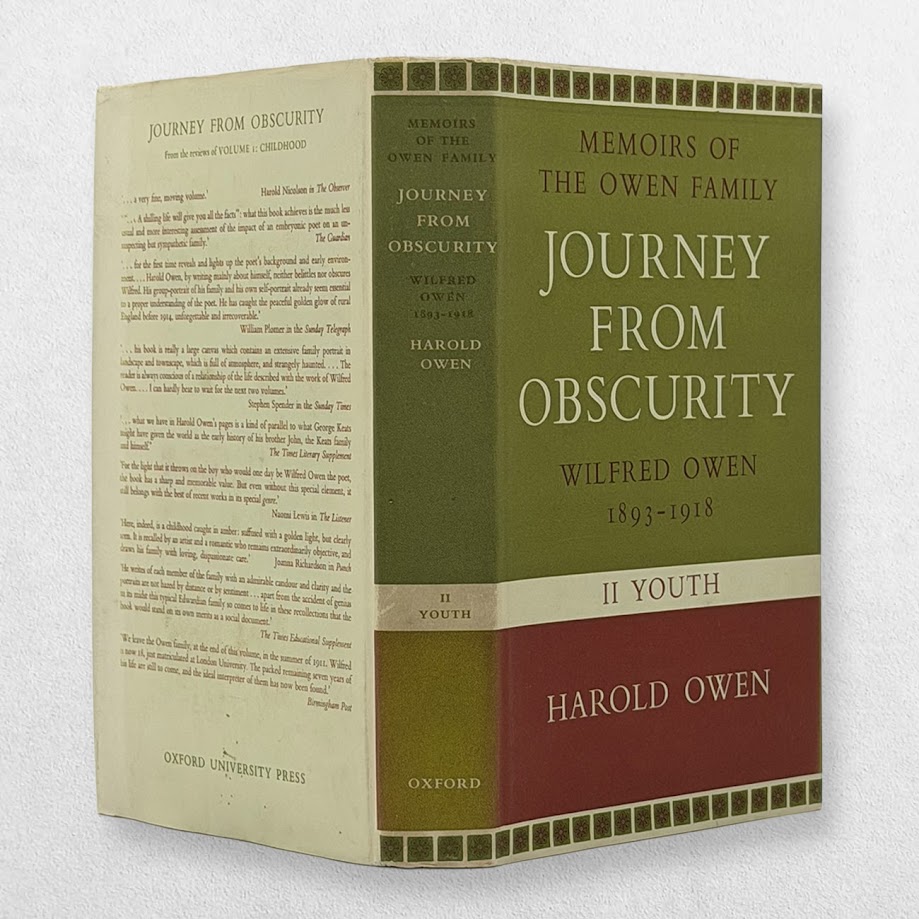
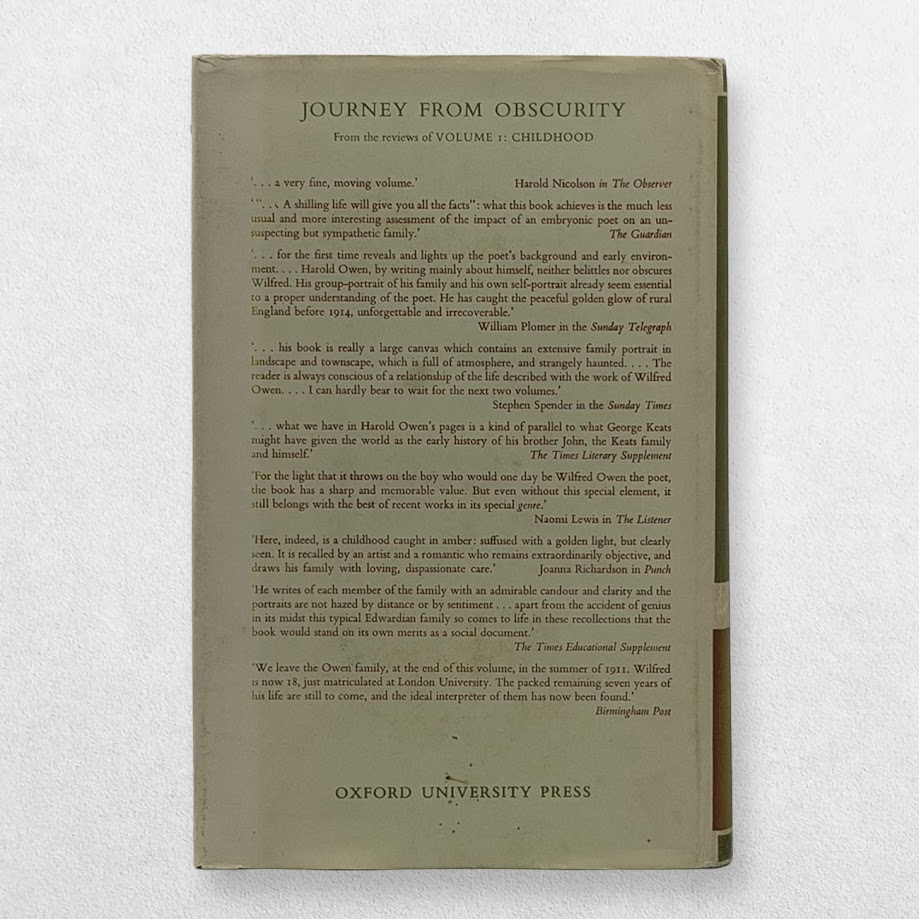
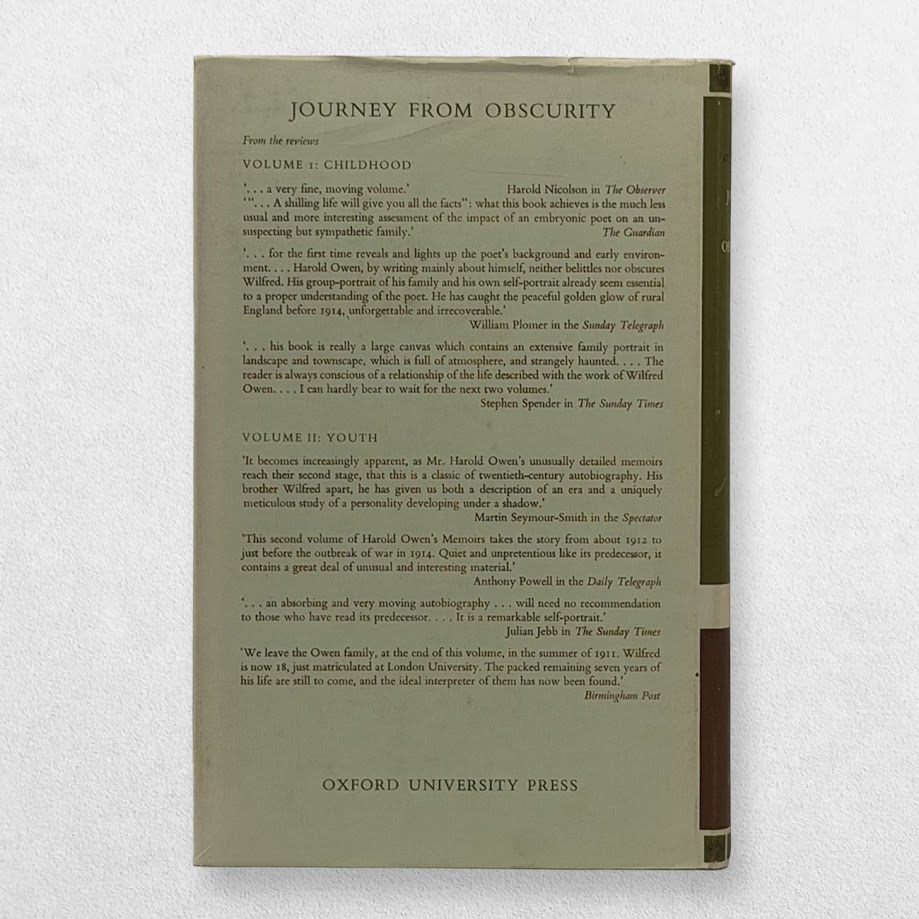
Format: Three volumes, complete. Original publisher’s cloth bindings with the original printed dustwrappers.
Contents: Volume I: Childhood (1963); Volume II: Youth (1964); Volume III: War (1965).
Illustrations: Photographic portraits and plates.
Condition: Near fine throughout in very good plus original dustwrappers. Volume II has a price-clipped dustwrapper.
Location: Bookroom.
Stock Code: 004230.
Description
An exceptionally attractive, complete set of the three first editions of Harold Owen’s Journey from Obscurity: Wilfred Owen 1893–1918. Memoirs of the Owen Family, published by Oxford University Press between 1963 and 1965. Written by Wilfred Owen’s younger brother, William Harold Owen, this substantial three-volume work remains one of the most important personal accounts of the family background, childhood, intellectual development, military service and tragically brief life of one of Britain’s greatest war poets. The three volumes comprise Childhood (1963), Youth (1964) and War (1965), forming a continuous family history that concludes with Wilfred Owen’s death in France on 4 November 1918, just seven days before the Armistice. Although frequently described as a biography of Wilfred Owen, Journey from Obscurity is considerably broader in scope. It is also a remarkable reconstruction of the domestic, social and emotional world of an English family during the late Victorian and Edwardian periods, continuing through the catastrophe of the First World War. Harold Owen’s position as Wilfred’s younger brother gave him an unusually intimate knowledge of the family and access to personal recollections, correspondence and other material unavailable to most biographers. The work combines family memoir, social history, literary biography and personal reflection, providing a substantial account of the circumstances from which Wilfred Owen’s extraordinary poetry emerged.
Volume I: Childhood (1963)
The opening volume examines the origins of the Owen family and the circumstances of Wilfred Owen’s childhood. Born in Oswestry, Shropshire, on 18 March 1893, Wilfred was the eldest of four children born to Thomas and Susan Owen. The family experienced periods of considerable financial uncertainty and changing circumstances, moving between Shropshire and Merseyside as Thomas Owen pursued his career in railway employment. Harold Owen reconstructs this domestic world through detailed recollections of family relationships, homes, education, religious beliefs and everyday life. Particular attention is given to the character and influence of Susan Owen, whose relationship with Wilfred remained profoundly important throughout his life. The volume also explores the circumstances surrounding Wilfred’s developing intellectual interests and the formative influences of childhood. Its significance extends beyond Wilfred Owen himself. Harold’s recollections provide a detailed portrait of family life in provincial England at the turn of the twentieth century, making the book valuable to readers interested in Edwardian social history as well as literary biography. The memoir draws upon Harold’s own experiences as a member of the family, offering the perspective of someone who shared many of the circumstances he describes. Although his interpretation is necessarily personal, the richness of the recollections makes Childhood an important source for understanding the environment in which Wilfred developed.
Volume II: Youth (1964)
The second volume continues the family narrative through the years of Wilfred Owen’s adolescence and early adulthood. It considers his education, literary ambitions, personal relationships and growing determination to establish himself as a poet. Wilfred’s intellectual interests developed against a background of limited financial resources and uncertainty about his future career. He pursued opportunities in education and employment while continuing to write poetry and develop his literary tastes. During these years, he also spent time in France, including a period teaching English at the Berlitz School in Bordeaux. France played an important role in his personal and intellectual development, exposing him to new surroundings and influences before the outbreak of war. Harold Owen’s narrative places these experiences within the wider history of the family, examining the relationships, aspirations and disappointments that shaped Wilfred’s early life. The volume concludes with the period immediately preceding the First World War, when the familiar world of Edwardian Britain was about to undergo profound and irreversible change. For students of Wilfred Owen’s poetry, Youth is particularly valuable because it examines the years before military service, demonstrating that the poet’s artistic development cannot be understood solely through his later wartime experiences. His literary interests, family attachments and moral concerns were already developing long before he entered the Army.
Volume III: War (1965)
The final volume, War, addresses the period for which Wilfred Owen is most celebrated: his service during the First World War and the extraordinary poetic achievement of his final years. Wilfred Owen enlisted in the Artists’ Rifles in October 1915 and subsequently received a commission in the Manchester Regiment. His experiences on the Western Front, particularly during 1917, exposed him directly to the appalling conditions of trench warfare. Following traumatic experiences in France, he was diagnosed with shell shock and sent to Craiglockhart War Hospital, near Edinburgh. It was at Craiglockhart that he met Siegfried Sassoon, already an established poet and an outspoken critic of the conduct of the war. Their friendship became one of the defining relationships of Owen’s literary career. Sassoon encouraged Owen’s development as a poet and helped him refine the techniques through which he expressed the suffering and disillusionment of modern warfare. During this period, Owen produced or developed many of the poems upon which his reputation now rests. His work is distinguished by its technical originality, emotional intensity and uncompromising depiction of the physical and psychological consequences of war. Poems such as Anthem for Doomed Youth, Dulce et Decorum Est, Strange Meeting, Exposure and Futility have become central texts in the study of First World War literature. In 1918, Owen returned to military service in France. He was awarded the Military Cross for his courage during operations near Joncourt in October. On 4 November 1918, while leading his men during an attempt to cross the Sambre–Oise Canal near Ors, Owen was killed in action.
He was twenty-five years old.The news of his death reached his family as church bells were ringing to celebrate the Armistice on 11 November 1918. Harold Owen’s account of these final years combines the history of the poet’s military service with the perspective of a younger brother attempting to understand the experiences and loss of someone to whom he had been deeply attached. The volume provides a particularly important contribution to the personal history of Wilfred Owen and to the wider literature of remembrance associated with the First World War.
Wilfred Owen (1893–1918): One of the Greatest Poets of the First World War
Wilfred Edward Salter Owen occupies a central position in twentieth-century English literature. Although comparatively little of his poetry was published during his lifetime, his posthumous reputation grew rapidly following the publication of the collection Poems in 1920, edited by Siegfried Sassoon. Owen’s achievement represented a significant development in the literary treatment of warfare. Rather than celebrating military glory or patriotic sacrifice in conventional terms, he confronted the physical suffering, emotional trauma and destruction experienced by soldiers during industrialised conflict. His work combined technical sophistication with a powerful sense of compassion. The distinctive use of pararhyme, alliteration, complex rhythms and vivid imagery enabled him to express experiences that resisted traditional poetic conventions. The influence of Owen’s poetry has extended far beyond literary scholarship. His poems are widely studied in schools and universities and continue to inform public understanding of the First World War.
Benjamin Britten incorporated several of Owen’s poems into his War Requiem, first performed in 1962 for the consecration of the new Coventry Cathedral. That composition helped renew public interest in Owen’s writing immediately before the publication of Harold Owen’s memoirs. The appearance of Journey from Obscurity between 1963 and 1965 therefore coincided with a period of considerable reassessment of the First World War and its literary legacy. Owen’s reputation has continued to grow, and he is now recognised as one of the most important English-language poets of the early twentieth century.
Wilfred Owen in Ripon, North Yorkshire, 1918
Ripon occupies an important place in the literary history of Wilfred Owen and the development of some of his finest First World War poetry. On 12 March 1918, following his treatment for shell shock at Craiglockhart War Hospital in Edinburgh and his subsequent posting to Scarborough, Owen arrived at the Northern Command Depot in Ripon, North Yorkshire. Finding the military camp uncongenial, he rented a quiet room in a cottage on Borrage Lane, where he could escape the demands of military life and concentrate upon his writing. During the spring of 1918, Ripon became one of the most productive locations of his brief literary career. Here he composed, drafted or revised several of his most celebrated poems, including The Send-Off, Futility, Mental Cases and possibly Strange Meeting. Drawing upon his experiences of the Western Front and the encouragement of Siegfried Sassoon, Owen developed the extraordinarily powerful poetic voice for which he is remembered today. He also drafted his famous preface to a projected collection of his war poems while in Ripon, articulating his conviction that the true subject of his poetry was the suffering and human cost of war. Owen remained in Ripon until June 1918, when he was passed fit for military service and returned to Scarborough before subsequently rejoining the fighting in France. He was killed on 4 November 1918, just seven days before the Armistice.
Condition
Near fine throughout in very good plus original dustwrappers. All three volumes are exceptionally clean and well preserved. The original cloth bindings are bright and tidy, with little evidence of handling or wear. The pages are very clean. The original dustwrappers remain in very good plus condition, with minor rubbing, light age-related fading and small signs of wear at the extremities. The dustwrapper of Volume II, Youth, is price-clipped. The wrapper designs remain fresh and attractive, retaining their original colour schemes and distinctive Oxford University Press typography. A very clean complete set of the three first editions.
Why Buy From Hornseys?
Established in 1976, Hornseys is an independent, family-run antiquarian bookshop and gallery situated in the historic cathedral city of Ripon, North Yorkshire. Celebrating our fiftieth year in 2026, we specialise in carefully selected first editions, literary biographies, children’s books, illustrated books, historical works, original maps, photographs and ephemera. Our collection reflects a longstanding commitment to bibliographical accuracy, detailed research and the careful selection of books with genuine historical, literary and collecting significance.
Authenticity and Bibliographical Accuracy
Every book offered by Hornseys is individually examined and catalogued. We pay particular attention to edition statements, bindings, dustwrappers, completeness and other bibliographical characteristics. We distinguish original first editions from subsequent editions and reprints, ensuring that collectors receive accurate descriptions of the books offered.
Research and Specialist Knowledge
We endeavour to provide substantial, informative catalogue entries that explain the historical and literary significance of individual works. Our research considers the author, publication history, subject matter and wider collecting context. For important literary works such as Journey from Obscurity, we recognise the distinction between the historical value of a primary source and the conclusions of subsequent scholarship.
Condition Reporting
We examine our stock carefully and aim to provide accurate condition descriptions. Relevant defects, including price-clipped dustwrappers, inscriptions, restoration and other material points, are identified wherever present.
Established Since 1976
Hornseys has served readers and collectors for fifty years, building its reputation upon knowledgeable service, carefully selected stock and accurate cataloguing.
Free UK Tracked Delivery
We offer free tracked delivery within the United Kingdom, with careful packaging appropriate to each book.
Fourteen-Day Unconditional Returns
We offer a fourteen-day unconditional returns policy. Please notify us within fourteen days of receipt if you wish to return an item. Returned books must be in the same condition in which they were supplied.
Visit Hornseys
Our bookshop and gallery is located at 3 Kirkgate, Ripon, North Yorkshire. We welcome enquiries from collectors of modern first editions, First World War literature and literary biography.
Hornseys – Established 1976. Fifty Years of Antiquarian Bookselling and Specialist Literary Collecting.