Nicolaus de Lyra – Postilla super Psalterium – Psalm 94/95 “Venite Exultemus Domino” – Original Incunable Leaf with Hand-Painted Initials – c.1483
Description
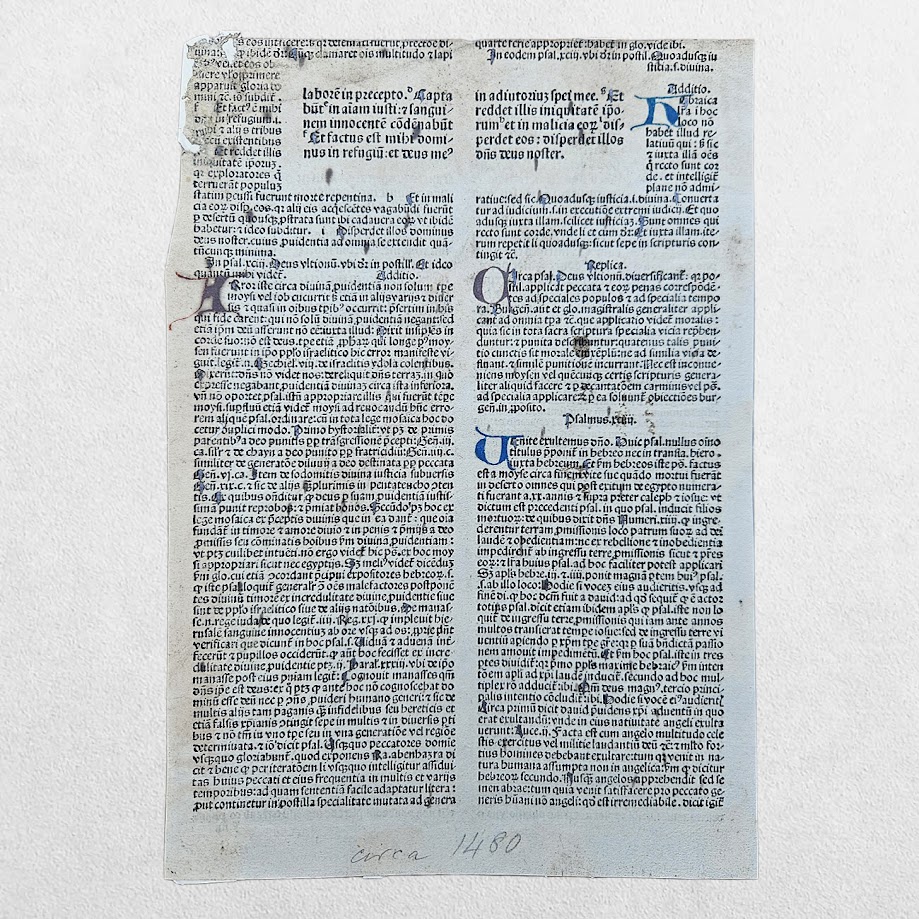
An original fifteenth-century incunable leaf from Nicolaus de Lyra’s celebrated commentary on the Psalms, the Postilla super Psalterium, printed in Latin in two columns of compact Gothic type and embellished with contemporary hand-supplied initials in blue and red. The leaf measures approximately 24.1 x 17 cm.
The most visually and textually significant portion occurs in the right-hand column, where the heading “Psalmus .xciiii.” introduces Psalm 94 according to the Vulgate numbering — Psalm 95 in most modern English Bibles — beginning with the familiar words:
“Venite exultemus domino…”
or, in English, “O come, let us sing unto the Lord.”
The opening is marked by an attractive large hand-painted blue initial V, extending into the upper portion of the text. Smaller blue and red initials elsewhere on the page distinguish individual sections of commentary and associated additions. Such hand finishing is characteristic of the earliest decades of European printing, when printers deliberately left spaces for initials to be supplied by rubricators after the sheets had left the press.
The page contains not only Nicolaus de Lyra’s Postilla but associated scholarly apparatus. The printed headings “Additio” and “Replica” identify the additions traditionally associated with Paul of Burgos and the replies of Matthias Doering, demonstrating the complex exegetical tradition that accumulated around Lyra’s influential biblical commentary.
The textual sequence includes the conclusion of discussion relating to the preceding Psalm before introducing Psalm 94/95, “Venite exultemus Domino”. Lyra’s commentary begins by observing that the Psalm bears no title in the Hebrew text or in Jerome’s translation according to the Hebrew, before proceeding into its interpretation. This is a characteristic example of Lyra’s interest in comparing the Latin biblical tradition with Hebrew textual evidence.
Nicolaus de Lyra and the Postilla
Nicolaus de Lyra, or Nicholas of Lyra (c.1270–1349), was a Franciscan theologian and one of the most influential biblical commentators of the later Middle Ages. His Postilla litteralis emphasised the literal meaning of Scripture and drew unusually extensively upon Hebrew scholarship and Jewish exegetical traditions. It became one of the fundamental biblical reference works of medieval and early Renaissance Europe.
Its importance in the history of printing is equally substantial. Lyra’s biblical commentaries were amongst the earliest substantial theological works to pass from manuscript into movable type and were repeatedly printed during the incunable period. The first printed Postilla was produced at Rome by Sweynheym and Pannartz, with later editions appearing from presses throughout Europe.
Probable Edition
The physical format, Gothic typography, two-column setting, textual arrangement and surviving dimensions are particularly consistent with the quarto Paris edition of Nicolaus de Lyra’s Postilla super Psalterium, printed by Ulrich Gering on 5 November 1483.
That edition is securely recorded bibliographically as:
Nicolaus de Lyra. Postilla super Psalterium. Paris: Ulrich Gering, 5 November 1483. Quarto.
Oxford’s TEXT-inc database records the edition under ISTC in00123000, while the University of Bern records it as GW M26626 / ISTC in00123000, comprising 309 leaves and approximately 22 cm in format. A surviving incomplete copy offered by Heritage was likewise catalogued as Paris, Ulrich Gering, 5 November 1483, quarto.
We have not, however, been able to make a definitive leaf-for-leaf typographical comparison with a complete digitised example of the Gering edition. We therefore catalogue the present leaf conservatively as c.1483, probably Paris: Ulrich Gering, rather than presenting the precise printer attribution as certain.
That distinction is important in responsible incunable cataloguing: typography, lineation and page setting must ultimately corroborate an edition attribution, rather than date or dimensions alone.
Ulrich Gering
If the attribution is confirmed, the printer is of considerable importance. Ulrich Gering (d.1510) belonged to the pioneering generation of Paris printers and produced Nicolaus de Lyra’s Postilla super Psalterium in Paris in 1483; major French bibliographical resources record this edition specifically under his name.
Hand Decoration
Of particular interest are the contemporary hand-supplied initials:
- a large blue initial introducing Psalm 94/95;
- further smaller blue initials;
- at least one red initial and red penwork;
- spaces and paragraph divisions reflecting the interaction between typography and manuscript finishing.
These provide a particularly tangible illustration of the transitional nature of fifteenth-century book production. Although produced with movable type, an incunable such as this was still conceived as an object requiring individual hand finishing after printing.
Condition
The principal side is good and highly presentable for an incunable leaf of this age, retaining clear Gothic letterpress and attractive contemporary colour.
There is general age-toning and surface marking, some spotting and staining, and a degree of marginal wear. There is an irregular loss at the upper left corner affecting a small portion of the printed text, together with minor edge imperfections. An old pencil inscription at the lower margin reads “circa 1480”.
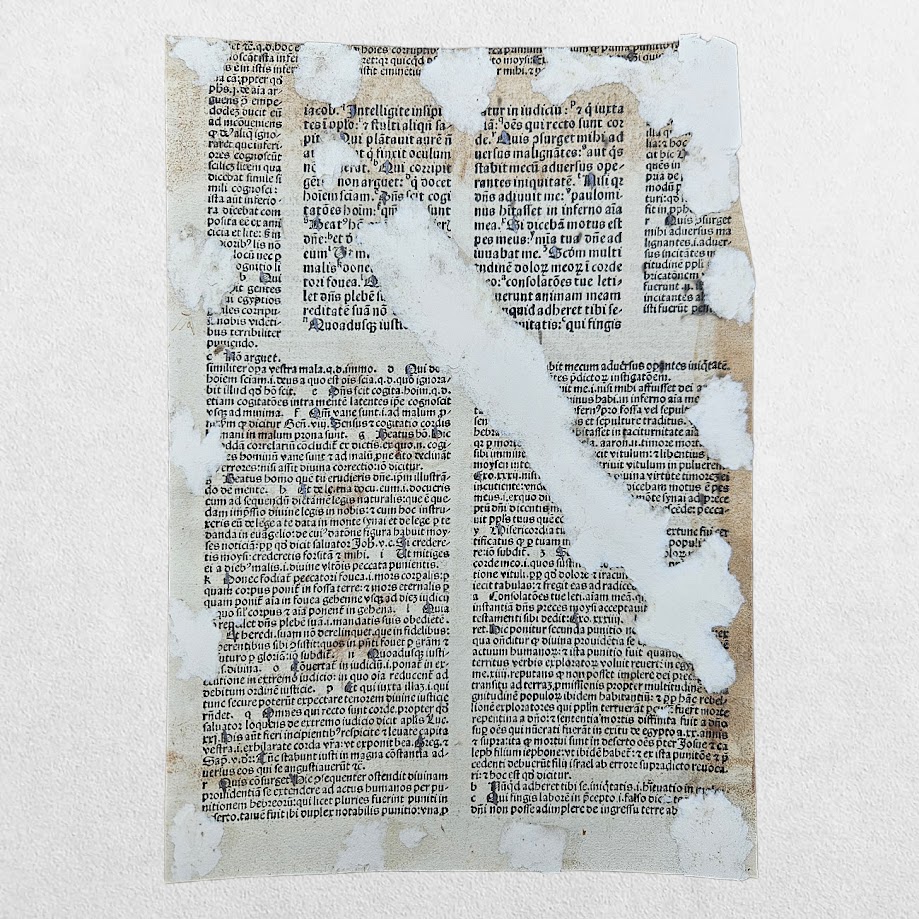
The reverse is considerably compromised by extensive historic paper repair and reinforcement. Numerous areas have been patched or backed, with significant portions of the original printing obscured or lost. There are further edge losses, staining and surface wear.
The leaf should therefore be regarded primarily as a display-side incunable specimen, although enough of the verso survives to demonstrate its original double-sided printed character.
Importantly, the principal recto retains the large blue initial, the Psalmus XCIIII / “Venite exultemus Domino” section and extensive portions of Lyra’s commentary.
Please study the photographs carefully, as they form an integral part of the condition description.
Author
Nicolaus de Lyra (c.1270–1349)
Work
Postilla super Psalterium
Text
Psalm 94 in the Vulgate numbering / Psalm 95 in modern numbering:
“Venite exultemus Domino”
Associated Commentators
Paul of Burgos – Additiones
Matthias Doering – Replicationes
Probable Printer
Ulrich Gering, Paris
Probable Date
1483
Conservatively catalogued as c.1483 pending definitive typographical collation.
Bibliographical Reference for Probable Edition
ISTC in00123000
GW M26626
Size
24.1 x 17 cm
Language
Latin.
Printing
Movable type in Gothic letter, two columns.
Decoration
Contemporary hand-supplied blue and red initials.
Period
Incunable – printed before 1501.
Authentication and Research
This leaf has been handled, inspected and catalogued in-house at our Ripon gallery. The text has been identified from the Psalm heading, biblical incipit and commentary, while the probable 1483 Paris attribution has been compared against modern institutional incunable records including Oxford TEXT-inc, the University of Bern and Biblissima. Those sources independently record Nicolaus de Lyra’s Postilla super Psalterium as printed at Paris by Ulrich Gering on 5 November 1483.
Why buy from us?
At Hornseys, we are committed to offering items that meet the highest standards of quality and authenticity. Our book collection is meticulously curated to ensure that each edition is a valuable and authentic piece of bibliographical history. Here’s what sets us apart:
- Authenticity and Provenance: Every book is researched, collated, and verified for authenticity.
- Expert Curation: Each book is selected with a keen eye for significance, condition, and rarity, ensuring a collection that is both diverse and distinguished.
- Customer Satisfaction: We strive to provide an exceptional customer experience, from detailed descriptions and provenance to secure and prompt delivery of your purchase.
- Returns Policy: We offer an unconditional guarantee on every item. If you wish to make a return, books may be sent back to us within fourteen days of receipt for any reason. We request advance notification of returns, and books must be returned in the same condition as sent for a full refund.
Explore Our Collection:
Visit Hornseys to explore our fine collection of rare and signed books. Whether you are an avid collector or looking for a special gift, our selection offers something truly unique. Located in the picturesque Yorkshire Dales, our Ripon gallery has been a haven for book lovers, art enthusiasts, and collectors since 1976.






![HORTUS SANITATIS [ORTUS SANITATIS] - DE AVIBUS - HARPY, SWALLOW, GYRFALCON AND IBIS - ORIGINAL INCUNABLE WOODCUT LEAF - STRASBOURG, JOHANN PRÜSS - NOT AFTER 21 OCTOBER 1497](https://hornseys.com/wp-content/uploads/2026/08/003988_1-300x300.jpg)


