
NEWHAVEN HARBOUR – NOTICE – By order of the Commissioners, with the Approbation of The Trinity House – 1814
Newhaven Harbour & The Commissioners, Trinity House
£750.00
Availability: In stock
Product Description
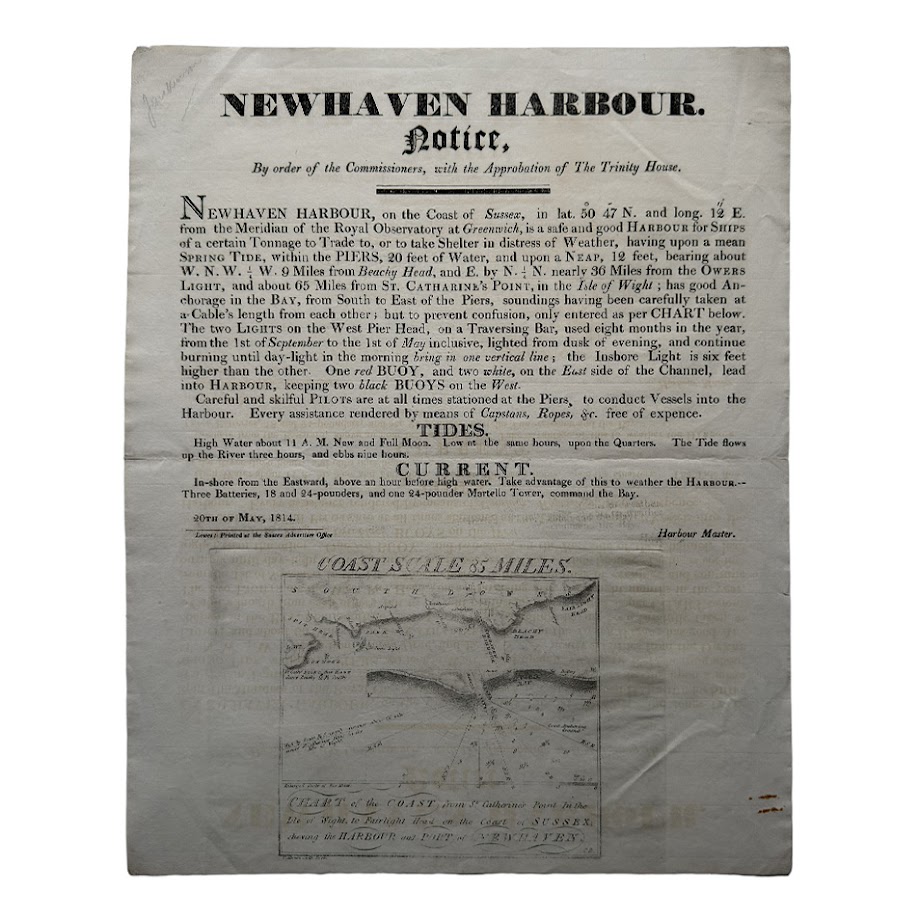
NEWHAVEN HARBOUR – NOTICE – By order of the Commissioners, with the Approbation of The Trinity House – 1814
Lewes: Printed at the Sussex Advertiser Office, 20 May 1814.
Letterpress broadside with engraved coastal chart below.
Engraved chart bearing the imprint of T. Illman, Lewes.
Folio sheet printed on laid paper.
Sheet size: 40.8 cm x 32.9 cm.
Description:
A rare and historically significant early nineteenth-century harbour broadside relating to Newhaven Harbour on the Sussex coast, issued by order of the Harbour Commissioners with the approbation of Trinity House and printed in Lewes at the offices of the Sussex Advertiser on 20 May 1814.
The broadside provides detailed navigational instructions for mariners entering Newhaven Harbour, including bearings, soundings, tidal information, buoyage, pilotage arrangements, harbour lights, anchorage, and warnings concerning the approach from Seaford Bay. The text describes Newhaven as a “safe and good harbour” for vessels engaged in trade or seeking refuge, reflecting the increasing commercial and strategic importance of the harbour during the Regency period.
Occupying the lower section is an engraved coastal chart of the approaches to Newhaven, depicting the coastline around Seaford Bay, the harbour entrance, soundings, navigational references, and coastal profiles intended for practical maritime use. The chart bears the engraved imprint of T. Illman, Lewes, an important detail establishing the broadside firmly within the local Sussex printing and engraving trade of the early nineteenth century. The lower right corner additionally appears to carry the engraved initials “C.R.”, possibly identifying a draughtsman, surveyor, or assistant connected with the preparation of the chart, although no definitive attribution has presently been established.
The broadside was issued during a period when Newhaven occupied an increasingly important position within the network of south coast and Channel navigation. During the late Napoleonic period and its immediate aftermath, safe access to harbours along the Sussex coast was strategically significant for coastal trade, naval movement, communication, and cross-Channel traffic. Newhaven functioned both as a harbour of refuge and as part of the wider maritime infrastructure linking the English south coast with continental routes across the Channel. The detailed navigational instructions contained within the notice reflect the growing importance attached to the safe regulation and improvement of such ports during the early nineteenth century.
The date of publication is especially noteworthy. The broadside was issued only months after the catastrophic fire at the London Custom House on 12 February 1814, an event which destroyed many central maritime registration transcripts and customs records relating to British shipping and trade. Although this document is not itself a registration record, it survives from precisely the same administrative environment of British coastal navigation, harbour regulation, customs oversight, and maritime commerce. Operational harbour documents of this nature consequently acquire added historical importance, preserving practical navigational information from a period for which many earlier centralised maritime records no longer survive.
The reference to Trinity House further underlines the official status of the publication. As the authority responsible for navigational safety, pilotage, buoys, and lighthouses, Trinity House approval indicates that the notice formed part of the regulated infrastructure of British coastal trade during the Napoleonic and immediate post-Napoleonic period.
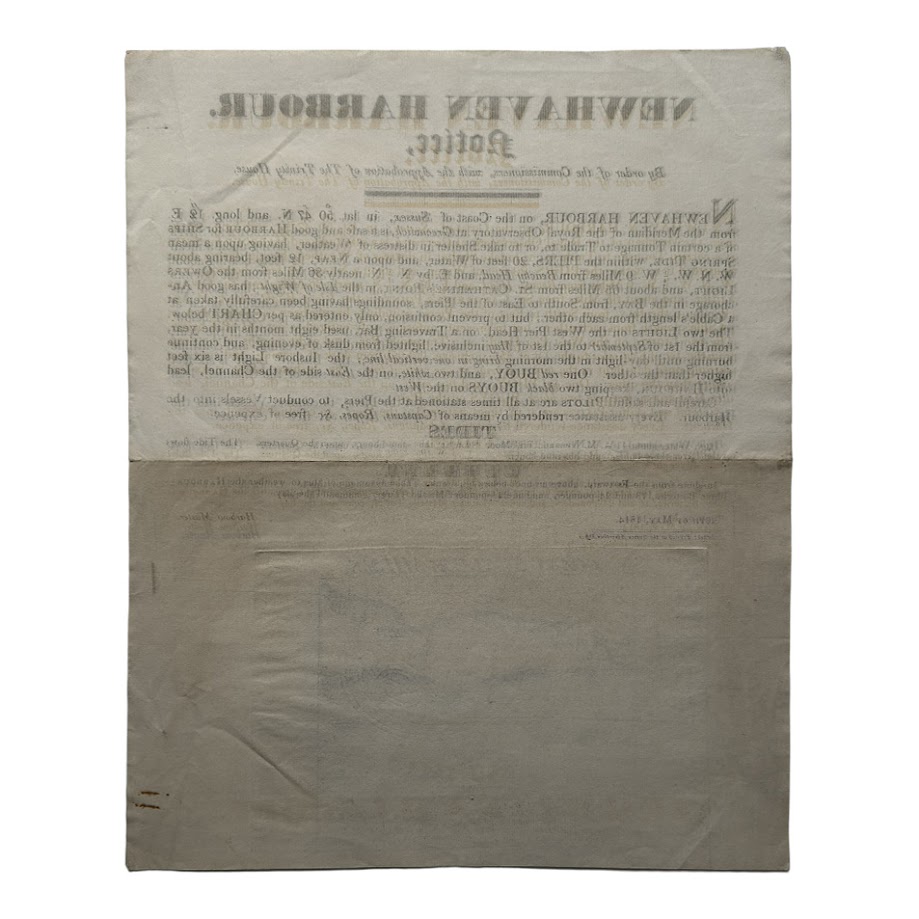
Harbour notices of this kind were fundamentally ephemeral productions. Intended for practical use by mariners, harbour officials, shipowners, and pilots, they were generally discarded after revision or replacement. The survival of this example in complete form, retaining both the printed notice and engraved chart, is therefore distinctly uncommon. The reverse displays pronounced show-through from the original impression together with evidence of historic folding and handling consistent with working maritime use.
No institutional example of this specific 1814 Newhaven Harbour broadside has presently been traced. Surviving operational harbour notices of this nature are notably scarce owing to their utilitarian purpose and historically low survival rate.
An important and evocative Regency maritime survival combining official harbour regulation, local Sussex printing, and engraved coastal cartography. Of considerable interest to collectors of maritime history, Trinity House material, Sussex topography, nautical charts, Channel navigation, and early nineteenth-century British ephemera.
Condition:
The broadside survives in good, unrestored condition for a working piece of early nineteenth-century maritime ephemera. Printed on laid paper with the expected signs of age and historic handling consistent with practical use. The sheet displays original horizontal fold lines, together with associated light creasing and minor handling wear. There is very minor age toning, a rust mark to the margin and light soiling commensurate with age. The engraved lower chart remains strong and well defined, retaining clear impressions throughout. The reverse displays pronounced show-through from the original printing process together with visible platemark evidence from the engraved chart below.
Overall, an attractive and well-preserved example of a scarce Regency maritime broadside, surviving in honest historical condition with strong visual and research appeal in very good plus to near fine condition overall.
Why buy from us?
At Hornseys, we are committed to offering items that meet the highest standards of quality and authenticity. Our collection is meticulously curated to ensure that each item is a valuable and authentic piece of history. Here’s what sets us apart:
- Authenticity and Provenance: Every item is researched, collated, and verified for authenticity.
- Expert Curation: Each item is selected with a keen eye for significance, condition, and rarity, ensuring a collection that is both diverse and distinguished.
- Customer Satisfaction: We strive to provide an exceptional customer experience, from detailed descriptions and provenance to secure and prompt delivery of your purchase.
- Returns Policy: We offer an unconditional guarantee on every item. If you wish to make a return, items may be sent back to us within fourteen days of receipt for any reason. We request advance notification of returns, and items must be returned in the same condition as sent for a full refund.
Explore Our Collection:
Visit Hornseys to explore our fine collection of rare and signed books, maps, artwork and objects. Whether you are an avid collector or looking for a special gift, our selection offers something truly unique. Located in the picturesque Yorkshire Dales, our Ripon gallery has been a haven for book lovers, art enthusiasts, and collectors since 1976.
Thank you for looking.


