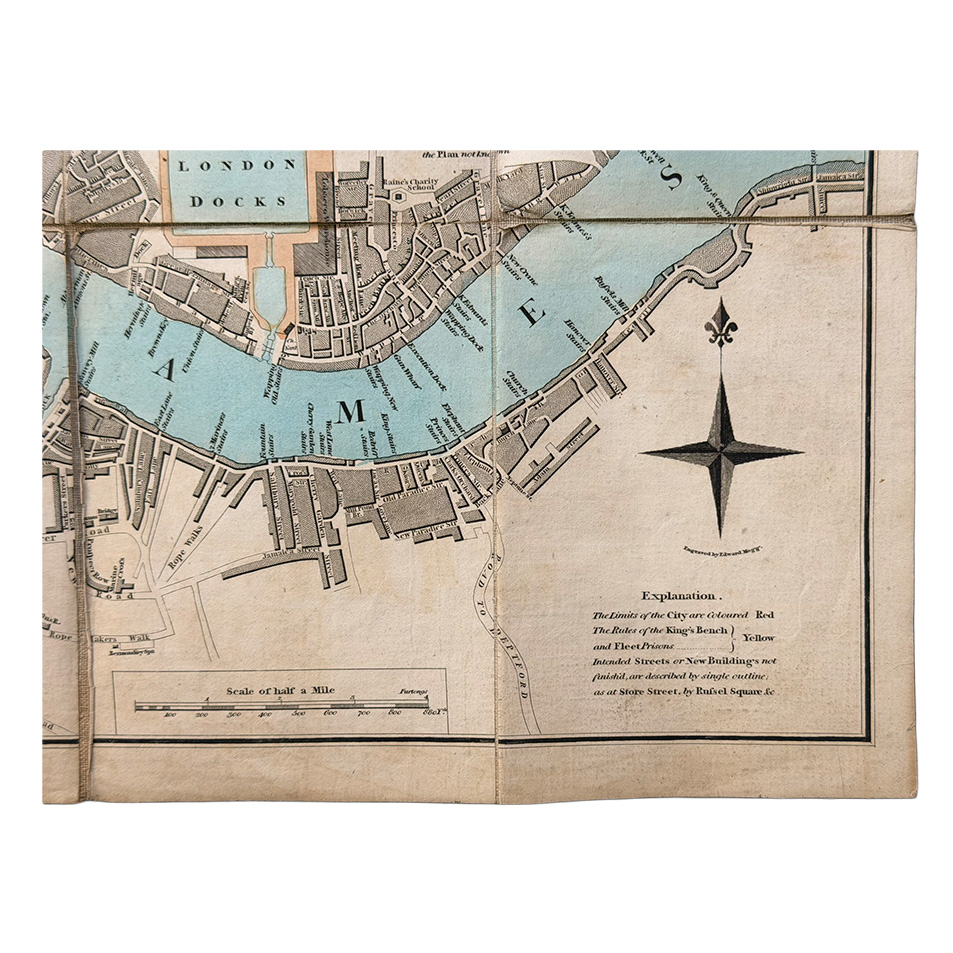
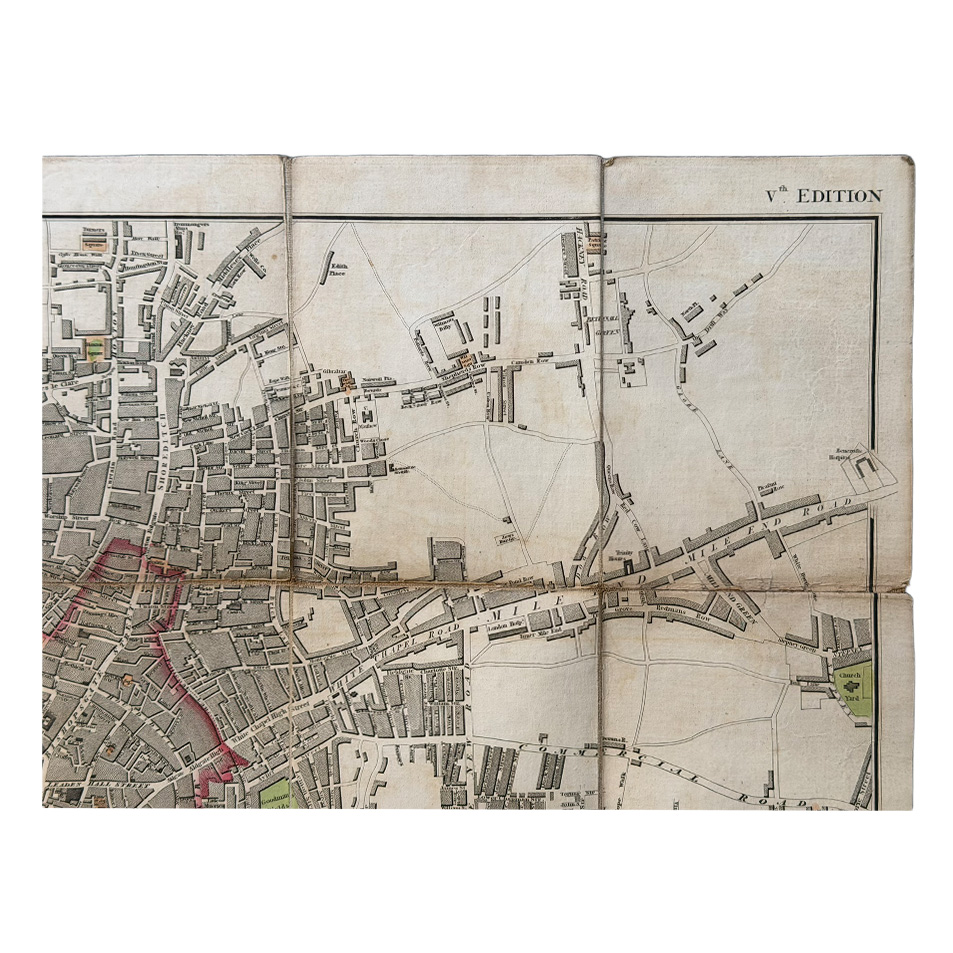
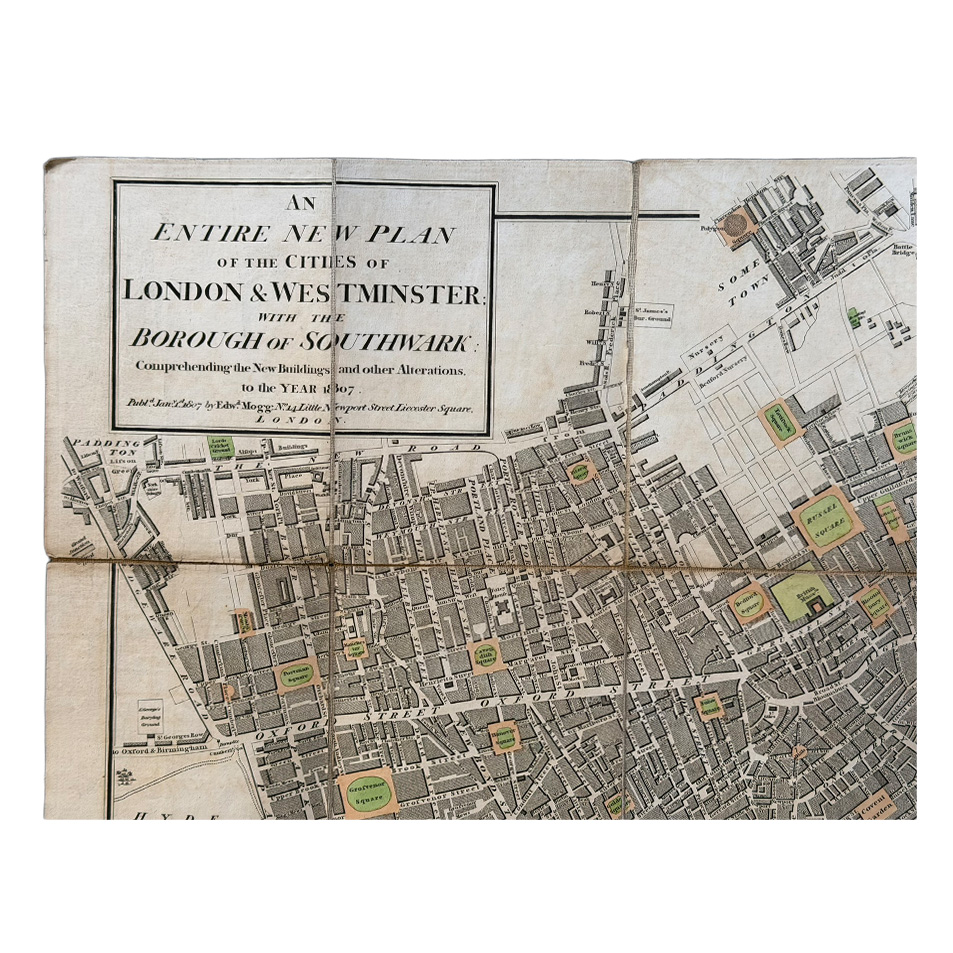
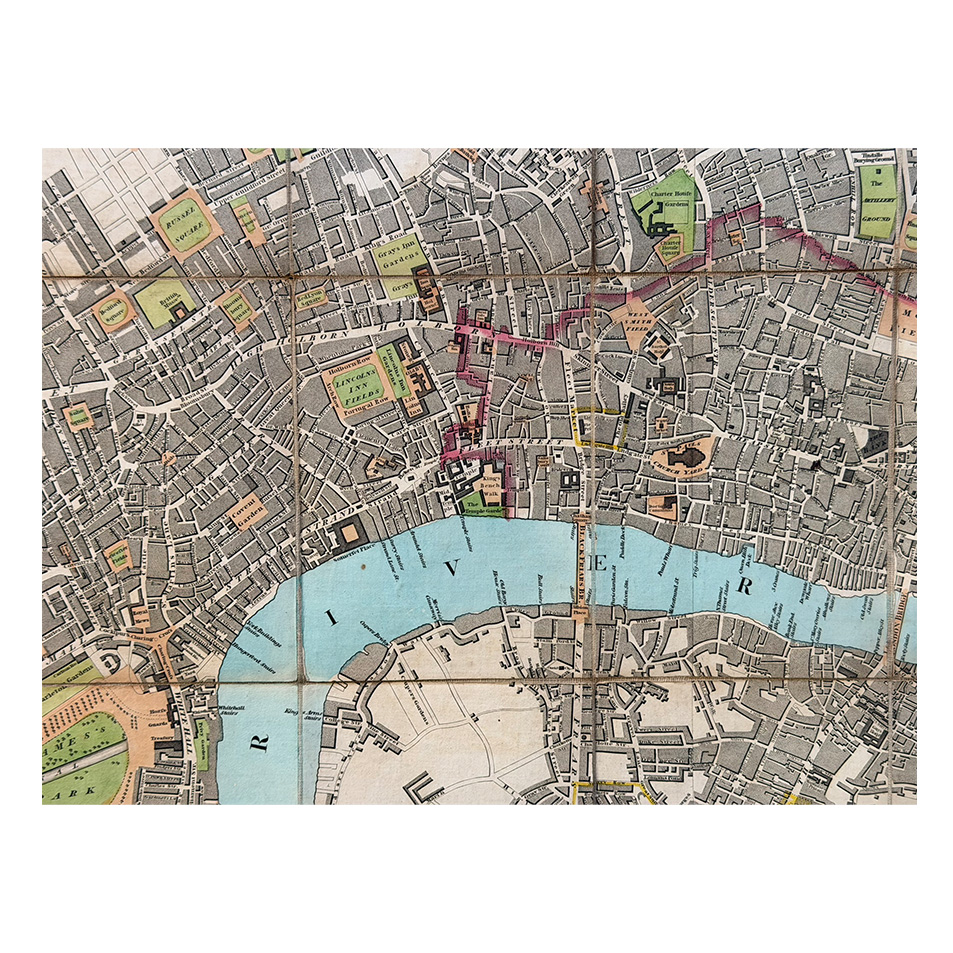
An Entire New Plan Of The Cities Of London And Westminster With The Borough Of Southwark – 1807
Author: Edward Mogg
Publisher: Edward Mogg
Price: £650 including postage in the UK
Publication Date: 1807
Edition: Fifth edition
Sheet Size: 89.4cm x 46.2cm
Condition: Very good plus
Condition:
Date:1807. Original copper-engraved map with original hand-colouring. Sheet size: 89.4cm x 46.2cm. Map slightly age-toned and with very minor wear. In very good plus, bright, condition overall with none of the usual browning or fading to the hand-colouring. Scarce.
Edward Mogg: A Short Biography
Overview
Edward Mogg was a prolific topographer, travel writer, map publisher, and guidebook author whose work helped shape how late Georgian and early Victorian Britain was experienced, navigated, and understood. Operating at the intersection of cartography, commercial publishing, and popular travel literature, Mogg catered to a rapidly expanding readership created by improved roads, coaching networks, and rising middle-class mobility.
Though not a theoretical innovator, Mogg was a highly effective synthesiser and communicator, translating geographical and local knowledge into practical, accessible forms. His publications occupy an important place in the history of British topography, transport culture, and popular geography.
- Early Life and Formation
Origins
Edward Mogg was born in 1774, most likely in or near London, at a time when the capital was emerging as the dominant centre of Britain’s print and publishing industries. Little is known about his family background, but his later career suggests early exposure to:
- Bookselling and print culture
- Practical geography and map use
- The commercial demands of a popular reading public
Unlike elite antiquaries or university-trained geographers, Mogg belonged to a professional publishing milieu, shaped by market demand rather than scholarly institutions.
Entry into Publishing
By the late 1790s, Mogg was active as a publisher and compiler of geographical works. His early success coincided with:
- Expansion of the turnpike road system
- Growth of domestic tourism
- Increasing literacy and leisure travel
These conditions created a strong market for guidebooks, itineraries, and maps designed for practical use rather than learned display.
- The Road Books and Itineraries
Core Achievement: Road Guides
Mogg is best known for his road books, which provided detailed itineraries of Britain’s principal routes. These works typically included:
- Turnpike distances
- Coaching stages
- Market towns and villages
- Notable houses, landscapes, and antiquities
They were aimed at:
- Commercial travellers
- Professionals and tradesmen
- Leisure tourists
- The coaching public
Mogg’s guides helped travellers conceptualise Britain as a connected national space, navigable through standardised routes and distances.
Method and Compilation
Mogg’s work was largely compilatory, drawing on:
- Existing maps and surveys
- Earlier road books
- Local descriptions and correspondence
His skill lay in organisation and presentation. He arranged information systematically, making it usable for travellers in motion—an essential requirement in an age before railway timetables and standardised maps.
- Topographical Writing and Local Description
County and Regional Works
Beyond roads, Mogg produced a wide range of topographical descriptions of counties, towns, and regions. These works blended:
- Geographical overview
- Historical anecdote
- Architectural description
- Observations on scenery and improvement
They were not antiquarian in the strict sense but catered to a readership interested in place, identity, and local distinction.
Tone and Perspective
Mogg’s writing style was:
- Practical rather than literary
- Informative rather than analytical
- Forward-looking, attentive to improvement and infrastructure
He reflected the values of a society increasingly oriented towards mobility, commerce, and rational organisation of space.
- Cartography and Visual Material
Maps and Plans
Mogg published and republished numerous maps, including:
- Road maps
- County outlines
- Urban plans
While he rarely undertook original surveying, his maps were valued for:
- Clarity
- Portability
- Integration with textual guides
They were designed to be used, not merely admired.
Relationship to Earlier Cartographic Traditions
Mogg stood at some distance from the grand cartographic tradition of Saxton or Speed. His work represents a later phase, in which cartography served everyday needs rather than national or symbolic ones. In this sense, Mogg’s maps anticipate the functional ethos later embodied by railway cartography.
- Commercial Strategy and Readership
Publishing Model
Mogg operated as both compiler and entrepreneur. His business model relied on:
- Frequent new editions
- Updating routes and distances
- Repackaging material for different markets
This responsiveness to change was essential in a period when:
- Roads were constantly improved
- Coaching routes shifted
- Urban development altered travel patterns
Audience
His readership was predominantly:
- Middle-class
- Literate but not scholarly
- Engaged in trade, administration, or leisure travel
Mogg’s success demonstrates the emergence of popular geographical knowledge as a commercial genre in its own right.
- Later Career and Adaptation to Change
The Challenge of Railways
The arrival of railways in the 1830s transformed British travel culture. For figures like Mogg, whose reputation was built on road travel, this posed a challenge.
Mogg responded by:
- Continuing to revise road-based works for local and secondary travel
- Producing general descriptive and historical material less tied to specific routes
Nevertheless, the centre of gravity in travel publishing gradually shifted away from the world he had helped define.
Final Years
Edward Mogg remained active as a publisher into the 1840s. He died in 1854, having witnessed the near-complete transformation of British mobility from coaching to rail.
- Reputation and Historical Assessment
Contemporary Standing
In his lifetime, Mogg was regarded as:
- A reliable practical authority
- A useful guide for travellers
- A familiar name in geographical publishing
He was not celebrated as a scholar but valued for utility and consistency.
Long-Term Significance
Historically, Edward Mogg matters because he:
- Helped standardise how Britons navigated space
- Contributed to the popularisation of geographical knowledge
- Documented the road system at its peak, just before its decline
His works are now important sources for historians studying:
- Travel and transport history
- Regional perception and identity
- The commercialisation of geography
Concluding Assessment
Edward Mogg was a product and agent of mobility. Neither an original surveyor nor a great antiquary, he nonetheless played a crucial role in making Britain legible to its own inhabitants during a period of rapid infrastructural and social change. His guides translated the complexity of roads, distances, and places into forms that ordinary travellers could use, helping to bind together the experience of a nation on the move.
Why buy from us?
At Hornseys, we are committed to offering items that meet the highest standards of quality and authenticity. Our collection is meticulously curated to ensure that each item is a valuable and authentic piece of history. Here’s what sets us apart:
- Authenticity and Provenance: Every item is researched, collated, and verified for authenticity.
- Expert Curation: Each item is selected with a keen eye for significance, condition, and rarity, ensuring a collection that is both diverse and distinguished.
- Customer Satisfaction: We strive to provide an exceptional customer experience, from detailed descriptions and provenance to secure and prompt delivery of your purchase.
- Returns Policy: We offer an unconditional guarantee on every item. If you wish to make a return, items may be sent back to us within fourteen days of receipt for any reason. We request advance notification of returns, and items must be returned in the same condition as sent for a full refund.
Explore Our Collection:
Visit Hornseys to explore our fine collection of rare and signed books, maps, artwork and objects. Whether you are an avid collector or looking for a special gift, our selection offers something truly unique. Located in the picturesque Yorkshire Dales, our Ripon gallery has been a haven for book lovers, art enthusiasts, and collectors since 1976.
Thank you for looking.