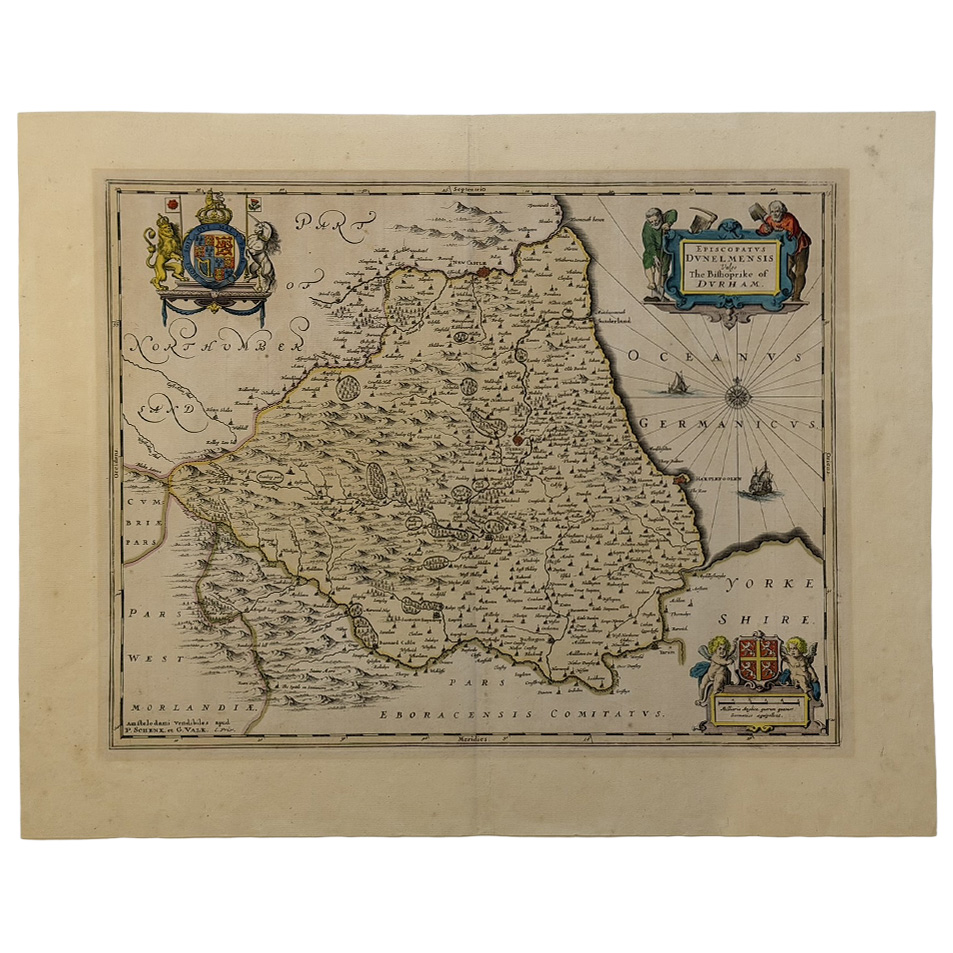
Episcopatus Dunelmensis Vulgo – The Bishoprike Of Durham – 1690-1700
Schenk, Peter & Valk, Gerard
£200.00
Availability: In stock
Product Description
Episcopatus Dunelmensis Vulgo – The Bishoprike Of Durham – 1690-1700
Author: Schenk, Peter & Valk, Gerard
Publisher: Amsterdam
Price: £200 including postage in the UK
Publication Date: 1690-1700
Edition: First edition
Sheet Size: 63cm x 51.3cm
Condition: Near fine
Condition:
Date: c.1690-1700. Original copper-engraved map. Early or original hand-colouring. Sheet size: 63cm x 51.3 margins. In very near fine, bright, clean condition overall and a lovely, strong impression
The County Palatine Of Durham In The Late 17th Century: A Brief Account
Orientation: why Durham looked different from most English counties
Late seventeenth-century County Durham remained constitutionally and culturally distinctive. It was still a county palatine, meaning that—within its bounds—the Bishop of Durham retained unusually extensive secular authority alongside ecclesiastical power. This long-established arrangement, originally justified by frontier defence and the need for swift local governance near Scotland, continued to shape Durham’s courts, office-holding, landholding politics, and the “feel” of authority on the ground even after the national crises of the mid-century.
At the same time, Durham was becoming more recognisably “modern” in economic terms. Coal, coastal shipping, and connected urban growth on the Wear and Tyne were pushing parts of the county towards a more commercial and wage-dependent society, while much of the interior remained agricultural and customary in outlook.
- Political and Administrative Life after 1660
Restoration settlement and the return of episcopal government
The Restoration of Charles II in 1660 re-established bishops nationally and restored Durham’s episcopal leadership after the Interregnum. In Durham this mattered more than elsewhere, because the bishop was not merely a senior churchman but also a key institutional pillar of civil authority.
Durham’s governance combined several overlapping layers:
- Palatine institutions: courts and officers operating under the bishop’s authority.
- County gentry and magistracy: justices of the peace increasingly central to everyday order (licensing, poor relief, vagrancy, alehouses, local disputes).
- Town corporations: in places such as Durham City and other boroughs, with varying degrees of independence but generally subject to the prevailing Restoration orthodoxy.
The late 17th century was a period of consolidation and re-normalisation after the disruptions of the 1640s–50s. Yet “normalisation” in Durham still meant palatine exceptionalism: central government policy arrived filtered through the county’s special legal and institutional arrangements.
Parliamentary representation and political culture
Durham’s parliamentary representation—established in the mid-century and then continuing—altered elite political horizons. County and borough elections, petitioning, and the politics of office became more closely tied to national party alignments by the end of the century (though local loyalties, churchmanship, and kinship continued to weigh heavily).
- The Economy: Coal at the Core, Agriculture still the Base
Coal production and export
Coal dominated the county’s trajectory. By the late 17th century:
- The Durham coalfield was among the most important fuel sources in England.
- Output supported both regional consumption and the expanding coastal trade to London and other markets.
- Coal wealth increasingly shaped land investment, patronage, and local influence.
Durham’s coal economy was not simply “mines”: it was a system.
Extraction
Pits varied from relatively shallow operations to deeper workings as methods improved. Ownership often sat with gentry, ecclesiastical landlords, and emergent commercial interests.
Transport
Coal moved via a developing infrastructure of routes to rivers and ports, including early wagonway technology in parts of the North East. The practical consequence was that landscapes around pits and haulage lines became increasingly industrialised.
Ports and shipping
The Wear and its outlets were crucial. Sunderland, in particular, was becoming more economically significant as a coal-exporting centre, even as nearby Newcastle’s broader commercial power remained formidable in the region. Port activity brought shipbuilding, rope-making, provisioning, and warehousing.
Labour: miners, keelmen, and the wage economy
Coal and shipping relied on labour that was more wage-dependent than the agricultural workforce.
- Miners worked under harsh conditions and faced constant risks: collapse, flooding, gas, and injury.
- Keelmen (who moved coal in keels on river systems, especially around the Tyne and Wear region) formed a distinct occupational community with its own customs and collective identity.
- Labour relations were shaped by seasonal demand, the bargaining power of organised groups, and periodic dispute—though the legal and coercive framework of the period tended to favour employers.
A late 17th-century Durham household in coal districts could be tied to a cash economy to a degree unusual in many other English counties.
Agriculture and rural continuity
Despite coal’s prominence, most land area and many livelihoods remained agricultural:
- Mixed farming dominated: oats and barley were widespread; cattle and sheep were important, particularly in upland and marginal land.
- Tenure and customary practice remained influential, even as commercial pressures increased.
- Enclosure and land improvement advanced unevenly. In some places, landlords sought greater profitability; in others, common rights and local resistance slowed change.
The result was a county of contrasts: industrialising corridors near coal and river transport, and more traditional rural communities inland.
- Society and Hierarchy: who held power, and how it was expressed
The elite: bishops, gentry, and coal-linked wealth
Durham’s elite was a composite:
- The bishop and cathedral establishment remained powerful landlords and patrons.
- Gentry families held local office, dominated the magistracy, and shaped parish life.
- Coal rents and coal investment created or reinforced wealth, tightening the bond between land, mineral rights, and political influence.
Social authority was expressed through:
- Control of appointments (church livings, local offices)
- Patronage networks
- Legal power via the magistracy and courts
- Visible status: houses, estate building, and urban property investment
Middling sorts and towns
The “middling sorts” (tradesmen, merchants, craftsmen, professionals) gained importance in towns and port communities:
- Merchants and shipowners clustered around shipping and provisioning
- Artisans served both domestic markets and the needs of a growing industrial and maritime economy
- Credit and debt became ever more central to local business life
In places like Sunderland and Stockton, commercial networks and maritime activity increasingly mattered to social standing alongside land.
The poor, poor relief, and the parish state
By the late 17th century, the parish was the key unit of welfare administration.
- Parish officers managed rates, relief, and the policing of mobility.
- Vulnerability was heightened for labouring families in years of dearth, sickness, or labour disruption.
- Settlement and removal practices could be severe: outsiders, seasonal workers, and the itinerant poor were frequently treated as problems of order as much as of welfare.
Durham’s shift towards wage labour in coal districts could amplify hardship when work faltered.
- Religion: Restoration Anglicanism, Dissent, and lingering Catholicism
The restored Church of England
After 1660, Anglicanism was reasserted with institutional confidence:
- Bishops returned; church courts and episcopal visitation regained force.
- Parish worship and conformity were emphasised.
- Cathedrals and ceremonial life symbolised stability after civil conflict.
In Durham, the cathedral and episcopal apparatus were not merely religious symbols but also public emblems of governance and hierarchy.
Nonconformity and local religious diversity
Nonconformity remained a significant undercurrent. The later Stuart period saw continued and sometimes growing presence of:
- Presbyterians and other Protestant Dissenters in towns and commercial communities
- Quakers in parts of the North East, whose meetings could be socially and economically influential despite legal pressures
Legal toleration increased after the Revolution settlement at the end of the century, but the lived reality varied by locality, magistracy, and neighbourly relations.
Catholic survival
Catholicism did not vanish. In parts of the North, including Durham, a portion of the gentry and some households retained Catholic identity or sympathies, though often discreetly. The late 17th century’s political-religious crises made Catholic association especially sensitive.
- Law, Order, and Everyday Governance
Courts and discipline
Durham’s palatine legal traditions sat alongside national structures. Law and order were enforced through:
- Quarter sessions and the magistracy
- Parish officers and constables
- Churchwardens and ecclesiastical oversight (though the intensity of moral discipline fluctuated)
Typical concerns included:
- Alehouse regulation and public disorder
- Vagrancy, settlement, and “masterless” persons
- Illegitimacy, marital disputes, and local scandal
- Property disputes, trespass, and minor theft
Violence, custom, and social negotiation
Everyday life was governed as much by social negotiation as by formal law. Honour, reputation, and kinship mattered. Disputes might be settled informally—or pushed into court when relationships broke down or property was at stake.
- Material Life: housing, consumption, and change
Housing and built environment
- Rural housing remained largely functional: stone or timber structures, often modest, with limited internal subdivision.
- In towns and prosperous villages, the later 17th century saw more brick and better-quality timber work, and more attention to comfort among those who could afford it.
- Coal districts and ports developed a more crowded, work-oriented housing landscape for labouring communities.
Consumption and “improvement”
Among the better-off, the period saw more consumer goods in circulation—textiles, household wares, and imported items arriving through coastal trade. This was not uniform, but the commercial districts of the county increasingly participated in broader English consumption patterns.
- The Later Stuart Crises and the Revolution Settlement
The politics of religion and loyalty
National events—Exclusion debates, the reign of James II, and the Revolution of 1688–89—reverberated in Durham through the county’s strong church institutions and its history of confessional tension.
Key dynamics included:
- Anxiety about Catholic influence under James II
- The mobilisation of church-and-king sentiment among Anglicans
- Recalibration of local authority after the Revolution settlement, with Protestant succession and a new framework for toleration
While local experience varied, the broad outcome by the 1690s was a more settled political order and, in many places, a somewhat less coercive environment for Protestant Dissent.
- What “late 17th-century Durham” amounted to in practice
By 1700, County Durham had:
- Retained its palatine distinctiveness, with the bishop and cathedral still central to authority and identity
- Deepened its coal-based economy, binding land, minerals, labour, and maritime trade into a powerful regional system
- Produced sharper social contrasts, especially between commercial-industrial districts and agrarian interiors
- Lived with religious plurality, dominated by Anglican institutions but with durable currents of Dissent and residual Catholicism
- Moved further into a cash and credit economy, especially in towns and coal areas, which altered patterns of work, risk, and poverty
Why buy from us?
At Hornseys, we are committed to offering items that meet the highest standards of quality and authenticity. Our collection is meticulously curated to ensure that each item is a valuable and authentic piece of history. Here’s what sets us apart:
- Authenticity and Provenance: Every item is researched, collated, and verified for authenticity.
- Expert Curation: Each item is selected with a keen eye for significance, condition, and rarity, ensuring a collection that is both diverse and distinguished.
- Customer Satisfaction: We strive to provide an exceptional customer experience, from detailed descriptions and provenance to secure and prompt delivery of your purchase.
- Returns Policy: We offer an unconditional guarantee on every item. If you wish to make a return, items may be sent back to us within fourteen days of receipt for any reason. We request advance notification of returns, and items must be returned in the same condition as sent for a full refund.
Explore Our Collection:
Visit Hornseys to explore our fine collection of rare and signed books, maps, artwork and objects. Whether you are an avid collector or looking for a special gift, our selection offers something truly unique. Located in the picturesque Yorkshire Dales, our Ripon gallery has been a haven for book lovers, art enthusiasts, and collectors since 1976.
Thank you for looking.
Related products

The Handy Series Of Pocket Maps – London And Four And Half Miles Round Charing Cross
£300.00George Philip & Son
Durham: Map Of The County Palatine Of Durham From An Actual Survey Made In The Years 1818 & 1819
£150.00Greenwood, C & I


You may also like…
Dunelmensis Episcopatus Qui Comitatus Est Palatinus Olim Pars Brigantum – 1607
£125.00Kip, William & Saxton, Christopher