
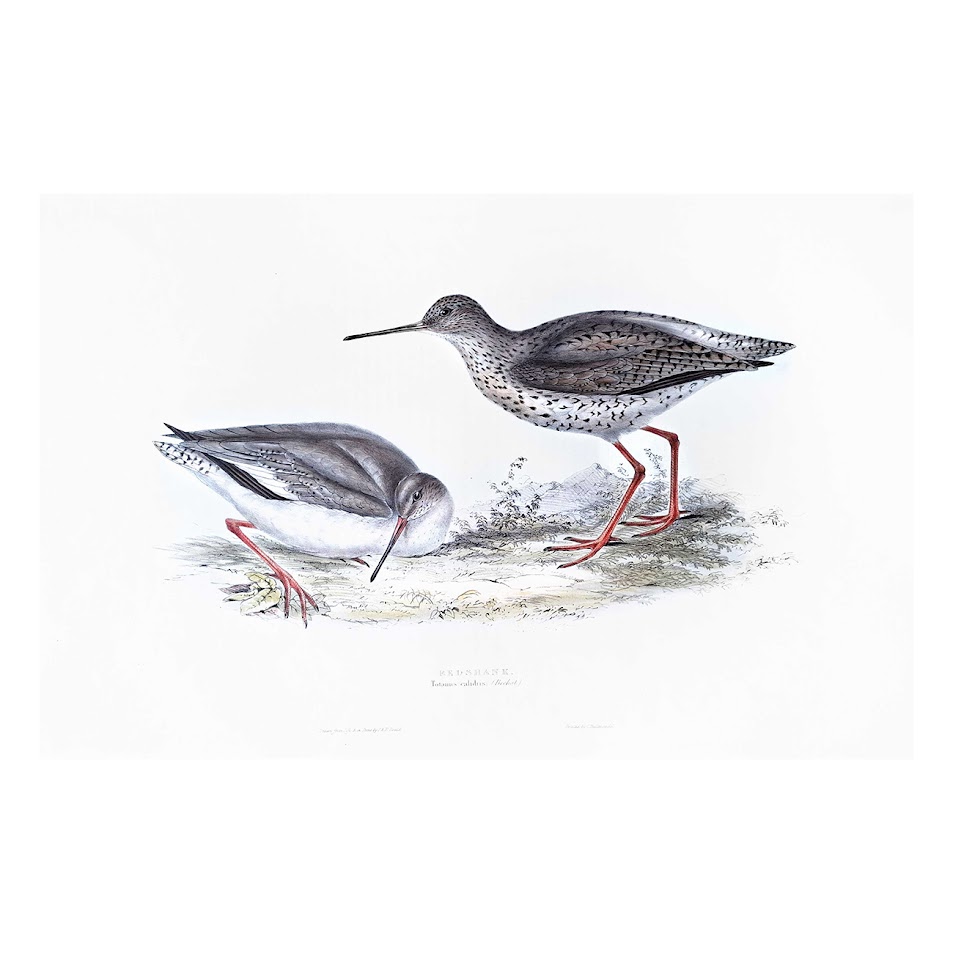
REDSHANK – TOTANUS CALIDRIS – ORIGINAL HAND-COLOURED LITHOGRAPH BY JOHN AND ELIZABETH GOULD
GOULD, JOHN & GOULD, ELIZABETH
£245.00
Availability: In stock
Product Description
REDSHANK – TOTANUS CALIDRIS – ORIGINAL HAND-COLOURED LITHOGRAPH BY JOHN AND ELIZABETH GOULD
Artists: John and Elizabeth Gould
Price: £245.00
Publisher: Printed by Hullmandel
Publication Date: 1832-1837
Format: Original hand-coloured lithograph heightened with gum arabic
Condition: Very good indeed, bright copy with good margins
Sheet Size: 54cm x 36.4cm
Series: From ‘The Birds of Europe’
This exquisite original hand-coloured lithograph from John and Elizabeth Gould’s magnificent work, ‘The Birds of Europe,’ produced between 1832 and 1837, showcases the Redshank in stunning detail. The artwork exhibits the meticulous detail and vibrant use of colour that define the Goulds’ lithographs, making it a desirable piece for both art collectors and ornithological enthusiasts. Drawn from life, it reflects the Goulds’ commitment to scientific accuracy combined with artistic elegance. Minor age toning. Very minor textual off-setting as usual. A very good indeed, bright, copy with good margins. Location: Map Drawer B: Folder 1006. 002026
The Story:
John Gould was an English ornithologist and bird artist. He and his wife, Elizabeth Gould, worked closely together to produce some of the most comprehensive and stunning ornithological works of the 19th century. Elizabeth, an accomplished artist, transferred many of John’s sketches into the lithographic prints that were then hand-coloured under her supervision. This piece not only captures the essence of the birds’ characteristics but also stands as a testament to the Goulds’ significant contributions to both art and science.
Condition Details:
- Overall Condition: Shows slight age toning and handling marks.
- Visual Appeal: Bright and vibrant colours, enhanced with gum arabic.
- Margins: Well-preserved with good margins, indicating careful handling over the years.
Key Features:
- Historical Significance: Part of John and Elizabeth Gould’s ‘The Birds of Europe,’ known for its scientific and artistic merit.
- Collector’s Item: Rare especially in such good condition.
- Artistic Detail: Demonstrates high-quality lithographic work and hand-colouring skills synonymous with John and Elizabeth Gould.
The Redshank: A Brief Description
The Redshank (Tringa totanus) is a medium-sized wading bird belonging to the sandpiper family, Scolopacidae. Known for its distinctive bright red legs and loud, piercing calls, the Redshank is a familiar sight in wetlands across Europe and Asia. It is a highly adaptable bird, often found along the coast as well as inland, inhabiting marshes, estuaries, and wet grasslands.
Physical Description
Size: The Redshank measures between 27 and 30 centimetres in length, with a wingspan of 47 to 53 centimetres. It typically weighs between 100 and 170 grams, with little size difference between males and females.
Plumage:
- Breeding Plumage: In the breeding season, the Redshank has a grey-brown back with darker streaks and spots, while the underparts are paler, often with faint streaking on the chest. The bird’s plumage provides excellent camouflage in its natural habitat.
- Non-breeding Plumage: During the winter, the plumage becomes duller, with more uniform grey-brown upperparts and white underparts. The head and neck are also paler, with less distinct markings.
Legs and Bill: The legs are long and bright red, a key identifying feature of the species. The bill is medium-length, straight, and red at the base with a black tip, well-suited for probing mud and sand in search of food.
Flight: In flight, the Redshank is easily recognisable by its striking white wing bars and white rump, which contrast with its darker upperparts. The bird’s flight is strong and direct, often accompanied by its distinctive, ringing call.
Habitat and Distribution
Geographical Range: The Redshank breeds across much of Europe and Asia, from Iceland and the British Isles to central Siberia and Mongolia. In the winter, it migrates to southern Europe, North Africa, the Middle East, and parts of South Asia. Some populations in milder regions, such as Western Europe, are resident or only undertake short-distance migrations.
Habitat: During the breeding season, the Redshank favours wet grasslands, salt marshes, and flooded meadows. It nests in areas with short vegetation and plenty of invertebrates for feeding. In the winter, it is commonly found along coasts, in estuaries, mudflats, and lagoons, where it feeds on the abundant marine life.
Behaviour
Diet: The Redshank is an omnivorous feeder, with a diet that includes insects, worms, crustaceans, and small molluscs. During the winter, it feeds mainly on marine invertebrates, while in the breeding season, it also consumes insects and their larvae. The bird uses its bill to probe the mud and sand or to pick prey from the surface.
Foraging: The Redshank is an active forager, often seen wading through shallow water or walking along the shore. It feeds both day and night, using its keen sense of sight to locate prey. The bird is known for its quick movements and can be quite vocal when disturbed.
Vocalisations: The Redshank is a highly vocal bird, especially during the breeding season. Its calls are loud and piercing, often described as a repetitive “teu-teu-teu” or “yoo-yoo-yoo.” It uses these calls to communicate with other Redshanks and to alert nearby birds of potential danger.
Social Structure
Breeding Behaviour: The Redshank is a monogamous species, with pairs forming territories during the breeding season. Males perform aerial displays, flying in loops and calling loudly to attract a mate and defend their territory. Once paired, the birds build a nest on the ground, hidden among vegetation.
Nesting: The nest is a simple scrape in the ground, lined with grass and other plant material. The female typically lays a clutch of 3 to 5 eggs, which are olive or buff-coloured with dark speckles. Both parents share incubation duties, which last for about 22 to 24 days.
Chick Development: The chicks are precocial and leave the nest soon after hatching. They are covered in down and well-camouflaged, able to feed themselves almost immediately. Both parents continue to care for and protect the chicks until they are capable of flight at around four weeks old.
Migration
Resident and Migratory Behaviour: Redshank populations in warmer climates are often resident, while those breeding in colder regions undertake long migrations to reach their wintering grounds. During migration, the birds travel in flocks and are often seen stopping at wetlands to rest and feed.
Conservation Status
The Redshank is currently listed as “Least Concern” by the IUCN, but it faces threats from habitat loss, particularly in its breeding grounds. Wetland drainage, agricultural intensification, and coastal development have reduced the availability of suitable nesting and foraging habitats. Conservation efforts focus on protecting and managing wetlands, as well as monitoring populations to ensure their long-term survival.
Similar Species
- Spotted Redshank (Tringa erythropus): The Spotted Redshank is larger and has a more slender build, with longer legs and a more upturned bill. In breeding plumage, it is almost entirely black, while in winter, it is paler and greyer than the Common Redshank.
- Common Greenshank (Tringa nebularia): The Greenshank is larger and has greenish legs, a more robust build, and a longer, upturned bill. Its calls are also different, being less piercing than those of the Redshank.
Importance and Ecological Role
The Redshank plays a crucial role in wetland ecosystems, helping to control populations of invertebrates and serving as an important indicator species for the health of wetland habitats. Its presence in a variety of environments highlights the importance of conserving wetlands for biodiversity and ecological balance.
Conclusion
The Redshank (Tringa totanus) is a vibrant and adaptable wading bird, easily recognisable by its bright red legs and loud calls. Its resilience in the face of habitat change is commendable, but conservation of wetland environments remains crucial to ensure its continued presence. The Redshank’s captivating displays and lively behaviour make it a favourite among birdwatchers and a valuable component of wetland biodiversity.
Why Collect This Lithograph?
Owning this lithograph means possessing a piece of ornithological and art history. Its blend of scientific accuracy and aesthetic beauty makes it a worthy addition to any collection of fine art or historical prints.
Why Buy from Us?
At Hornseys, we are committed to offering items that meet the highest standards of quality and authenticity. Our collection of rare lithographs is meticulously curated to ensure that each piece is both a valuable and authentic addition to your collection. Here’s what sets us apart:
- Authenticity and Provenance: Every lithograph is thoroughly researched and verified for authenticity.
- Expert Curation: We select each piece with an eye for historical significance, condition, and visual appeal.
- Customer Satisfaction: We strive to provide an exceptional customer experience, from detailed descriptions to secure and prompt delivery.
- Returns Policy: We offer an unconditional guarantee on every item. If you wish to make a return, any item may be sent back to us within fourteen days of receipt for any reason. We request advance notification of returns, and items must be returned in the same condition as sent for a full refund.
Explore Our Collection:
Visit Hornseys to explore our exceptional collection of original hand-coloured lithographs by John and Elizabeth Gould. Located in the picturesque Yorkshire Dales, our Ripon gallery has been a haven for art lovers and collectors since 1976
Related products


You may also like…

WHIMBREL – NUMENIUS PHAEOPUS – ORIGINAL HAND-COLOURED LITHOGRAPH BY JOHN AND ELIZABETH GOULD
£245.00GOULD, JOHN & GOULD, ELIZABETH
DOUBTFUL SPARROW – PYRGITA PETRONIA – ROCK SPARROW – ORIGINAL HAND-COLOURED LITHOGRAPH BY JOHN AND ELIZABETH GOULD
£95.00GOULD, JOHN & GOULD, ELIZABETH


Privacy Overview
| Cookie | Duration | Description |
|---|---|---|
| cookielawinfo-checkbox-analytics | 11 months | This cookie is set by GDPR Cookie Consent plugin. The cookie is used to store the user consent for the cookies in the category "Analytics". |
| cookielawinfo-checkbox-functional | 11 months | The cookie is set by GDPR cookie consent to record the user consent for the cookies in the category "Functional". |
| cookielawinfo-checkbox-necessary | 11 months | This cookie is set by GDPR Cookie Consent plugin. The cookies is used to store the user consent for the cookies in the category "Necessary". |
| cookielawinfo-checkbox-others | 11 months | This cookie is set by GDPR Cookie Consent plugin. The cookie is used to store the user consent for the cookies in the category "Other. |
| cookielawinfo-checkbox-performance | 11 months | This cookie is set by GDPR Cookie Consent plugin. The cookie is used to store the user consent for the cookies in the category "Performance". |
| viewed_cookie_policy | 11 months | The cookie is set by the GDPR Cookie Consent plugin and is used to store whether or not user has consented to the use of cookies. It does not store any personal data. |