

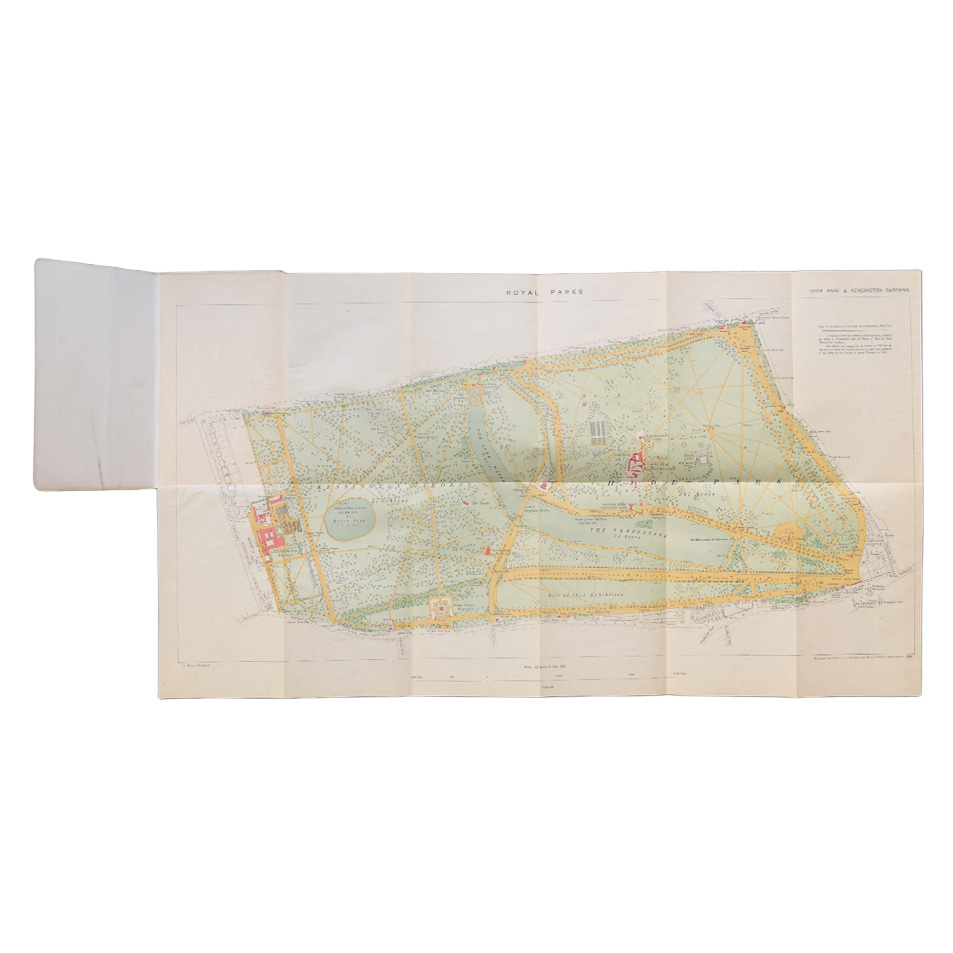


Royal Parks – Hyde Park And Kensington Gardens – Ordnance Survey – 1906 – 12 Inches To One Mile
Ordnance Survey
£95.00
Availability: In stock
Product Description
Royal Parks – Hyde Park And Kensington Gardens – Ordnance Survey – 1906 – 12 Inches To One Mile
Publisher: Ordnance Survey
Price: £95 (post-free in the UK)
Publication Date: 1906
Edition: 1st edition thus
Format: Engraving
Condition: Near fine
Sheet Size: 61cm x 33.8cm
Condition:
Original printed paper covered boards with cloth spine. Folded size: 11cm x 18cm. Sheet size: 61cm x 33.8cm. Engraved folding map with original colouring. The edition for 1906. Map very slightly creased and marked. Boards slightly creased and marked. In near fine, bright, clean condition overall.
Location: Book room: 003371
Hyde Park And Kensington Gardens: A Brief Overview
Hyde Park and Kensington Gardens together form one of the largest and most historically significant green spaces in central London. Although today they appear as a single continuous landscape, they have distinct origins, functions, and identities, shaped by royal power, urban growth, political change, and public life over more than five centuries.
- Medieval Origins: The Manor of Hyde
The story begins in the Middle Ages. The land that would become Hyde Park formed part of the Manor of Hyde, owned by Westminster Abbey. It consisted largely of:
- Fields
- Meadows
- Woodland
- Pasture used for agriculture and hunting
At this stage, the area lay well outside the built-up city of London and had no public or recreational role.
- Tudor Transformation: A Royal Hunting Ground
Henry VIII and Hyde Park
In 1536, Henry VIII seized the Manor of Hyde during the Dissolution of the Monasteries. He enclosed the land as a private royal hunting park, primarily for deer.
Hyde Park under Henry VIII:
- Was fenced and restricted
- Used exclusively by the monarch and court
- Functioned as a symbol of royal authority and privilege
This marked the beginning of Hyde Park as a distinct and defined landscape.
- Early Public Access (17th Century)
Opening to the Public
A major shift occurred in 1637, when Charles I opened Hyde Park to the general public. This was a significant moment in London’s social history.
Hyde Park quickly became:
- A fashionable place to promenade
- A space for riding and social display
- A meeting point for different classes, though still dominated by the elite
The Ring
One of the earliest formal features was the Ring, a circular carriage drive where aristocrats paraded in full view of society. Hyde Park became closely associated with:
- Court culture
- Fashion
- Political gossip
- The Creation of Kensington Gardens
Separation from Hyde Park
In the late 17th century, the western portion of Hyde Park was set aside as private royal gardens.
When William III and Mary II moved to Kensington Palace in 1689, this area was transformed into what became Kensington Gardens.
Formal Landscaping
Kensington Gardens developed as a formal, landscaped garden in contrast to the more open character of Hyde Park. Features included:
- Straight avenues
- Ornamental planting
- Carefully designed vistas
It remained a royal garden, closed to the public, while Hyde Park retained its more democratic role.
- Eighteenth-Century Landscape Change
Queen Caroline and the Serpentine
Under Queen Caroline, wife of George II, the parks underwent major redesign in the 1720s and 1730s.
Key developments included:
- Creation of the Serpentine, an artificial lake formed by damming the River Westbourne
- Removal of rigid formal gardens in favour of a more naturalistic style
- Visual unification of the landscape
The Serpentine physically links Hyde Park and Kensington Gardens, though the administrative boundary remains.
- Hyde Park as a Political and Social Arena (19th Century)
Public Assembly and Protest
By the 19th century, Hyde Park had become a recognised space for public gathering and political expression.
Major events included:
- Reform demonstrations
- Chartist meetings
- Mass protests reflecting the expansion of democratic culture
Speaker’s Corner
One of Hyde Park’s most distinctive traditions emerged in the late 19th century: Speaker’s Corner. This area became associated with:
- Free speech
- Political debate
- Religious and social argument
It symbolised Britain’s evolving relationship with civil liberties.
- The Great Exhibition of 1851
One of the most significant moments in the parks’ history was the Great Exhibition of 1851, held in Hyde Park.
The Crystal Palace
- A vast iron-and-glass structure was erected to house the exhibition
- It showcased industrial, artistic, and scientific achievements from around the world
- Millions of visitors attended
Although the Crystal Palace was later dismantled, the exhibition:
- Cemented Hyde Park’s role as a national stage
- Contributed to the creation of South Kensington’s museum district
- Kensington Gardens in the Victorian and Edwardian Periods
Gradual Opening to the Public
Kensington Gardens were gradually opened to public access, though they retained a more refined and tranquil character than Hyde Park.
They became associated with:
- Leisure and family recreation
- Cultural memorials
- Proximity to Kensington Palace and royal life
Notable features added over time include:
- The Albert Memorial
- The Italian Gardens
- Statues and ornamental structures
- Twentieth-Century Developments
War and Commemoration
During both World Wars:
- The parks were used for military training and defence
- Sections were cultivated for food production
After the wars, memorials and monuments were added, reinforcing the parks’ commemorative role.
Cultural and Recreational Use
In the later 20th century, Hyde Park became:
- A venue for major concerts and public events
- A space for national celebrations and mourning
Kensington Gardens retained a quieter identity, emphasising:
- Landscape design
- Cultural institutions
- Children’s recreation (including the Peter Pan statue and playground)
- Modern Hyde Park and Kensington Gardens
Today, the parks are managed as part of The Royal Parks and serve multiple roles:
- Urban green space
- Cultural venue
- Historic landscape
- Democratic forum
Distinct Characters
- Hyde Park: open, energetic, political, and performative
- Kensington Gardens: formal, reflective, and artistic
Together, they balance civic freedom with historical continuity.
Conclusion
Hyde Park and Kensington Gardens reflect the evolving relationship between monarchy, city, and public life in Britain. From medieval farmland to royal hunting ground, from private garden to democratic space of protest and recreation, the parks chart the transformation of London itself.
Their enduring importance lies not only in their beauty, but in their role as living historical spaces, where political expression, leisure, memory, and landscape coexist. Few urban parks in the world carry such a dense accumulation of social, cultural, and political meaning.
SHOP WITH CONFIDENCE AT HORNSEYS
At Hornseys, we are dedicated to offering items that uphold the highest standards of quality and authenticity. Our collection of artwork is carefully curated to ensure that each item we offer is authentic, collated, and complete.
Here’s what sets us apart:
- Authenticity and Provenance: Each map is researched and verified for authenticity.
- Expert Curation: We entirely own all our artworks. We trust our taste and have invested heavily in it. We have confidence in all artwork that we offer for sale.
- Customer Satisfaction: We strive to provide an exceptional customer experience, from detailed descriptions and provenance to secure and prompt delivery of your purchase.
- Returns Policy: We offer an unconditional guarantee on every item. If, however, you wish to make a return, artworks may be sent back to us within fourteen days of receipt for whatever reason. We request that we are notified in advance if you wish to do so. They must be returned to us in the same condition as they were sent for a full refund.
OUR COMMITMENT TO QUALITY AND SERVICE
Understanding the value and rarity of these items, we ensure that every aspect of your purchase meets the highest standards of quality and service. This includes:
- Free Expedited, Tracked, and Insured Delivery within the UK: Ensuring that your artwork arrives safely and promptly.
- Fully-Insured Worldwide Delivery: Offering peace of mind for international collectors with reliable and secure shipping options.
EXPLORE OUR COLLECTION
Visit Hornseys today to explore our fine collection of maps and other artworks. Whether you are an avid collector or looking for a special gift, our selection offers something truly unique. Located since 1976 in Ripon in the picturesque Yorkshire Dales, we are recognized as a destination gallery for tastefully curated artwork, rare maps, design, and fine books.
Related products

SCOTIA REGNUM CUM INSULIS ADJACENTIBUS ROBERTUS GORDONIUS A STRALOCH DESCRIPSIT – ORIGINAL COPPER ENGRAVED MAP PUBLISHED BY JOAN BLAEU
£650.00Blaeu, Joan & Gordon, Robert
Durham: Map Of The County Palatine Of Durham From An Actual Survey Made In The Years 1818 & 1819
£150.00Greenwood, C & I


