
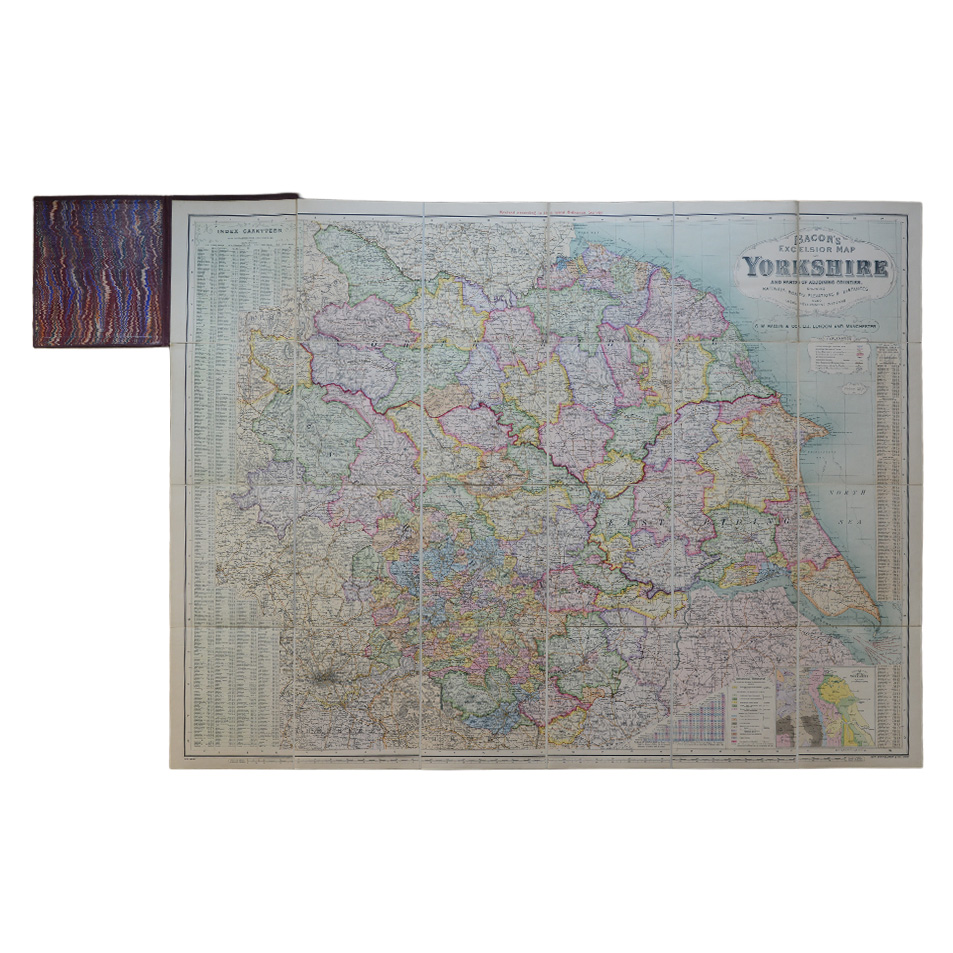
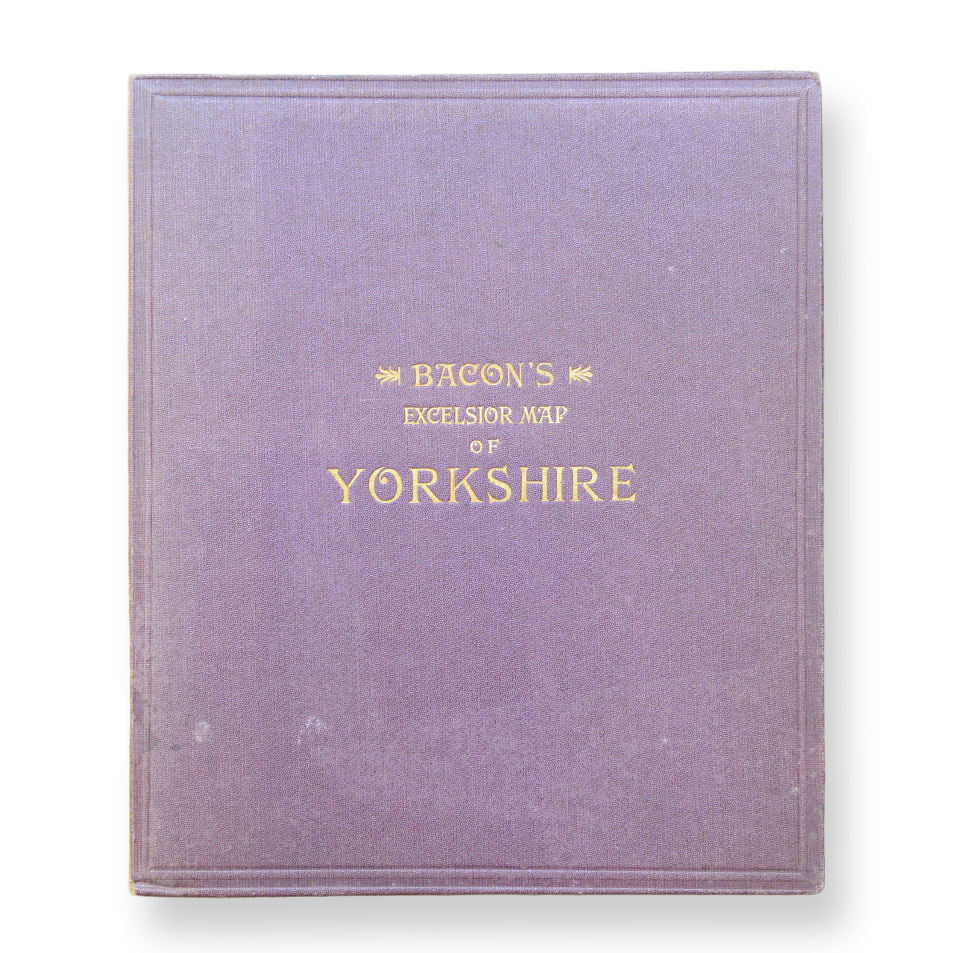
Bacon’s Excelsior Map Of Yorkshire And Part Of Adjoining Counties Showing Railways Roads Elevations And Distances Also Local Government Divisions
Bartholomew, John. G
£100.00
Availability: In stock
Product Description
Bacon’s Excelsior Map Of Yorkshire And Part Of Adjoining Counties Showing Railways Roads Elevations And Distances Also Local Government Divisions
Cartographer: Bartholomew, John. G
Publisher: G W Bacon & Co Ltd
Price: £100 including postage in the UK
Publication Date: c. 1901-1903
Edition: Revised edition
Map Size: 116.3cm x 89.9cm
Binding: Original cloth gilt
Condition: Fine in very good plus binding
Condition:
Date: c. 1901-1903. Revised according to the most recent Ordnance Survey. Includes populations from the last census of 1901. Size: 116.3cm x 89.9cm. Folding map. Dissected on linen. Map is very bright and clean and in lovely condition. The cloth binding is very slightly rubbed, faded and worn and in very good indeed condition overall. A very nice copy indeed which is in much brighter than usual condition.
Yorkshire in 1901: A Brief Overview
The year 1901 marks a highly significant moment in Yorkshire’s history: the end of the Victorian era following the death of Queen Victoria, and the dawn of the Edwardian period. Yorkshire at this time was a region of remarkable contrasts — a place where heavy industry, rapidly growing towns, and dense workers’ districts coexisted alongside ancient market towns, expansive farmland, and some of Britain’s most dramatic upland landscapes. The 1901 Census captures Yorkshire at the height of its population and industrial expansion before the structural changes of the later twentieth century altered its social and economic character.
- Administrative and Geographical Context
In 1901, Yorkshire was traditionally divided into its three historic Ridings:
- East Riding
- North Riding
- West Riding
Each Riding maintained distinct administrative traditions and socio-economic profiles, yet all shared a long-rooted identity shaped by geography, landscape, and centuries of county governance.
By 1901:
- The West Riding was the most populous and industrialised, containing major cities such as Leeds, Bradford, and Sheffield.
- The North Riding remained predominantly rural, with scattered market towns such as Northallerton, Thirsk, and Whitby, as well as moorland communities shaped by agriculture and mining.
- The East Riding balanced agriculture with growing coastal resorts, notably Bridlington, Withernsea, and the emerging popularity of Hornsea.
Yorkshire’s boundaries remained substantially those recognised earlier in the nineteenth century, and the county’s sense of identity — cultural, social, and linguistic — was exceptionally strong.
- Population and Demography
By 1901 Yorkshire had one of the largest populations of any English county, exceeding 3.5 million people. This rise resulted from:
- Natural population growth
- Continued urban migration from rural England
- Inward migration from Ireland, Scotland, Wales, and parts of Europe
- Settlement associated with industrial employment (coal, textiles, steel)
Urban areas in the West Riding in particular exhibited dense housing, expanding suburbs, and rising public health challenges, while rural districts retained smaller, more traditional communities.
- Economy and Industry
Yorkshire’s economic landscape in 1901 was shaped by its position at the heart of British heavy industry:
Textiles
- The Woollen and Worsted industries dominated the West Riding, especially in Bradford, Halifax, Dewsbury, Batley, and Huddersfield.
- Mills were large, mechanised, and often family-owned enterprises with international export networks.
- Skilled labour, including designers, spinners, dyers, and finishers, formed the backbone of the workforce.
Coal Mining
- The South Yorkshire Coalfield employed tens of thousands, providing fuel for furnaces, domestic use, and railway traction.
- Mining villages expanded quickly, often with company-built housing, chapels, and institutes.
Iron and Steel
- Sheffield was globally renowned for steel production, cutlery, and specialist metallurgical processes such as crucible steel and the pioneering of stainless steel (developed shortly after in 1913).
- Major works operated along the Don Valley, supported by engineering, toolmaking, and grinding workshops.
Engineering and Manufacturing
- Leeds and Bradford hosted locomotive works, machinery manufacturers, printing firms, and chemical industries.
- York had a longstanding railway heritage through the North Eastern Railway’s carriage and wagon works.
Agriculture
- In the North and East Ridings, dairy farming, arable production, and cattle rearing remained central to the economy.
- Agricultural shows, auction marts, and horse fairs were important community institutions.
- Urban Life in 1901
Yorkshire’s cities in 1901 reflected the height of Edwardian municipal ambition:
- Leeds had prominent civic buildings, electric trams, public libraries, technical colleges, and improved water supplies.
- Bradford exemplified multicultural industrial Britain, with a significant German community, strong Nonconformist traditions, and a rapidly growing Jewish population.
- Sheffield displayed a blend of heavy industry and civic improvement, including parks, museums, and expanding transport links.
- Hull (though a county borough associated with the East Riding) functioned as a major port for grain, timber, wool, and migrant passengers travelling to and from Europe.
Working-class life was shaped by long working hours, communal institutions such as working men’s clubs, chapels, Sunday schools, trade unions, and increasingly influential co-operative societies.
- Rural Yorkshire
Despite the dominance of industrial centres, much of Yorkshire in 1901 remained rural, especially:
- The North York Moors
- The Yorkshire Dales
- The Wolds
- The Vale of York
Rural communities were often agricultural, with village schools, estate-owned cottages, and traditional fairs. Transport infrastructure — especially the railway network — helped connect these areas to urban markets.
- Transport and Infrastructure
Yorkshire was exceptionally well served by railways in 1901:
- The North Eastern Railway (NER) covered the North and East Ridings, providing connections to the coast and the North Sea ports.
- The Midland Railway, Great Northern Railway, and Lancashire & Yorkshire Railway operated extensively in the West Riding.
- Railway hubs such as York, Leeds, and Sheffield were major national junctions.
Urban transport advanced with electric trams and improved road infrastructure, while canals still played a role in goods transport, especially around the textile towns.
- Society, Culture, and Public Life
Yorkshire in 1901 was culturally vibrant:
- Broad participation in cricket, with Yorkshire County Cricket Club enjoying considerable prestige.
- Strong Nonconformist traditions, especially in the West Riding, alongside established Anglican parish structures.
- Growth in education, with school attendance entrenched by late Victorian reforms.
- A flourishing print culture, including newspapers such as the Yorkshire Post and Sheffield Daily Telegraph.
- Expansion of seaside tourism, especially in Scarborough, Whitby, and Bridlington, popular with Edwardian families.
Social conditions varied widely. Urban poverty, overcrowding, and health problems remained significant concerns, prompting ongoing reforms in sanitation, housing, and welfare.
- Political Context
Politically, Yorkshire in 1901 exhibited a mixture of:
- Liberal strength, rooted in Nonconformity and industrial reform
- Growing Labour activism, linked to mining and trade union organisation
- Conservative influence in rural areas and among affluent urban middle classes
Debates around education, licensing laws, Irish Home Rule, and municipal reform shaped political engagement across the county.
Conclusion
Yorkshire in 1901 stood at a fascinating historical crossroads. The county embodied the achievements and contradictions of late Victorian Britain: industrial might alongside rural continuity; civic pride paired with pressing social challenges; and a strong regional identity set within an increasingly modern and interconnected nation.
Understanding Yorkshire at this moment offers valuable insight into the social, economic, and cultural foundations that shaped the twentieth century across the region.
Why buy from us?
At Hornseys, we are committed to offering items that meet the highest standards of quality and authenticity. Our collection is meticulously curated to ensure that each item is a valuable and authentic piece of history. Here’s what sets us apart:
- Authenticity and Provenance: Every item is researched, collated, and verified for authenticity.
- Expert Curation: Each item is selected with a keen eye for significance, condition, and rarity, ensuring a collection that is both diverse and distinguished.
- Customer Satisfaction: We strive to provide an exceptional customer experience, from detailed descriptions and provenance to secure and prompt delivery of your purchase.
- Returns Policy: We offer an unconditional guarantee on every item. If you wish to make a return, items may be sent back to us within fourteen days of receipt for any reason. We request advance notification of returns, and items must be returned in the same condition as sent for a full refund.
Explore Our Collection:
Visit Hornseys to explore our fine collection of rare and signed books, maps, artwork and objects. Whether you are an avid collector or looking for a special gift, our selection offers something truly unique. Located in the picturesque Yorkshire Dales, our Ripon gallery has been a haven for book lovers, art enthusiasts, and collectors since 1976.
Thank you for looking.


