
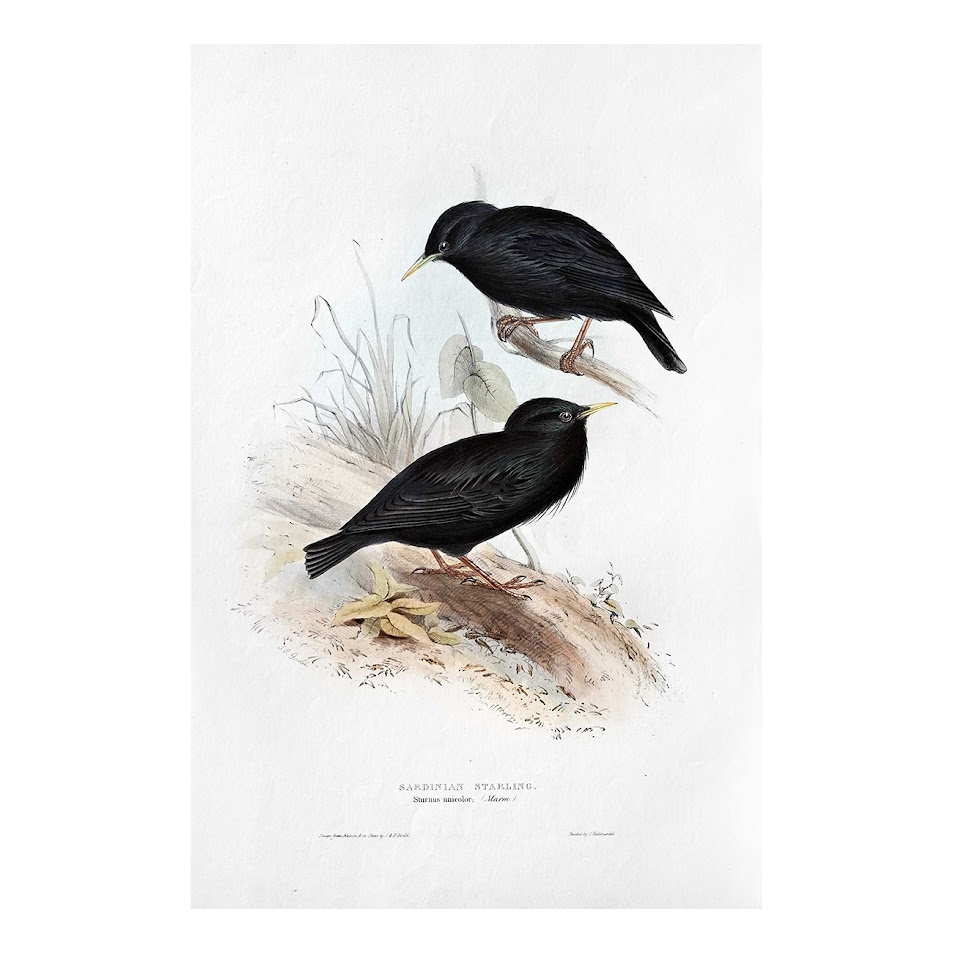
SARDINIAN STARLING – STURNUS UNICOLOR – ORIGINAL HAND-COLOURED LITHOGRAPH BY JOHN AND ELIZABETH GOULD
GOULD, JOHN & GOULD, ELIZABETH
£295.00
Availability: In stock
Product Description
SARDINIAN STARLING – STURNUS UNICOLOR – ORIGINAL HAND-COLOURED LITHOGRAPH BY JOHN AND ELIZABETH GOULD
Artists: John and Elizabeth Gould
Price: £295.00
Publisher: Printed by Hullmandel
Publication Date: 1832-1837
Format: Original hand-coloured lithograph heightened with gum arabic
Condition: Very good indeed, bright copy with good margins
Sheet Size: 54.9cm x 37.2cm
Series: From ‘The Birds of Europe’
This exquisite original hand-coloured lithograph from John and Elizabeth Gould’s magnificent work, ‘The Birds of Europe,’ produced between 1832 and 1837, showcases the Sardinian Starling in stunning detail. The artwork exhibits the meticulous detail and vibrant use of colour that define the Goulds’ lithographs, making it a desirable piece for both art collectors and ornithological enthusiasts. Drawn from life, it reflects the Goulds’ commitment to scientific accuracy combined with artistic elegance. Minor age toning and paper-handling. With a very minor amount of the usual textual off-setting. A very good indeed, bright, copy with good margins. Location: Map Drawer B: Folder 1006. 002160
The Story:
John Gould was an English ornithologist and bird artist. He and his wife, Elizabeth Gould, worked closely together to produce some of the most comprehensive and stunning ornithological works of the 19th century. Elizabeth, an accomplished artist, transferred many of John’s sketches into the lithographic prints that were then hand-coloured under her supervision. This piece not only captures the essence of the birds’ characteristics but also stands as a testament to the Goulds’ significant contributions to both art and science.
Condition Details:
- Overall Condition: Shows slight age toning and handling marks.
- Visual Appeal: Bright and vibrant colours, enhanced with gum arabic.
- Margins: Well-preserved with good margins, indicating careful handling over the years.
Key Features:
- Historical Significance: Part of John and Elizabeth Gould’s ‘The Birds of Europe,’ known for its scientific and artistic merit.
- Collector’s Item: Rare especially in such good condition.
- Artistic Detail: Demonstrates high-quality lithographic work and hand-colouring skills synonymous with John and Elizabeth Gould.
The Sardinian Starling: A Short Description
The Sardinian Starling (Sturnus unicolor), also known as the Spotless Starling, is a medium-sized passerine bird from the starling family (Sturnidae). It is closely related to the more widespread European Starling (Sturnus vulgaris) but can be distinguished by its nearly uniform dark plumage, hence its “spotless” name.
Physical Description
- Size: The Sardinian Starling is similar in size to the European Starling, measuring around 21 to 23 centimetres in length with a wingspan of approximately 37 to 42 centimetres. It typically weighs between 75 to 100 grams.
- Plumage: The bird’s plumage is its most defining characteristic. In adults, it is predominantly glossy black with an iridescent sheen that can appear green or purple depending on the light. Unlike the European Starling, which has pale spots in its winter plumage, the Sardinian Starling lacks these spots, which gives it the “spotless” appearance. During the breeding season, the plumage becomes even more glossy and striking.
- Bill: The bill of the Sardinian Starling changes colour with the seasons. It is yellow during the breeding season and turns dark grey or black outside of the breeding period.
- Legs: Its legs are a pinkish-red colour, adding to its distinctive look.
- Juveniles: Young Sardinian Starlings have duller, brownish plumage with faint streaking, and their bill remains dark throughout the year.
Distribution and Habitat
- Geographical Range: The Sardinian Starling is predominantly found in the Iberian Peninsula, including Spain and Portugal, as well as on several Mediterranean islands such as Sardinia, Corsica, and the Balearic Islands. Its range is mostly limited to these areas, and it is endemic to the Mediterranean region.
- Habitat: This bird favours open woodlands, farmland, and areas with scattered trees and pastureland. It is also commonly seen in urban and suburban areas, including parks, gardens, and agricultural landscapes. Sardinian Starlings often nest in rock crevices, buildings, and other artificial structures, similar to their European counterparts.
Behaviour
- Diet: The Sardinian Starling has an omnivorous diet, feeding on a variety of foods depending on availability. It forages for insects, earthworms, small invertebrates, and fruit. In agricultural areas, it is known to feed on crops, including grapes and olives, which can bring it into conflict with farmers.
- Foraging Behaviour: Like other starlings, the Sardinian Starling is a highly social bird that often forages in groups, especially outside the breeding season. It walks confidently on the ground, probing into soil or leaf litter with its sharp bill. Its diet is quite varied, and it adjusts its foraging behaviour depending on the season and available food sources.
- Social Structure: Sardinian Starlings are gregarious birds, especially in winter when they form large flocks. These flocks can often be seen flying in synchronised formations, a behaviour known as murmuration, which provides safety in numbers and protection from predators.
- Breeding Behaviour: The Sardinian Starling breeds in colonies, often in natural cavities in cliffs, rock crevices, or man-made structures. It is monogamous, and both parents take part in the care of the offspring.
Breeding
- Nesting: Sardinian Starlings typically nest in cavities, such as in rocks, walls, or man-made structures. They will use nest boxes if provided. The nest is a simple structure built from grass, leaves, and other plant material, sometimes lined with feathers.
- Eggs: The female lays a clutch of four to six pale blue eggs, which she incubates for around 12 to 14 days. Both parents help feed the chicks, which fledge about three weeks after hatching.
- Chick Development: The young are altricial, meaning they are born blind and helpless, depending entirely on their parents for food and protection during the early stages of life.
Vocalisation
The Sardinian Starling is an accomplished mimic, much like the European Starling. It produces a wide variety of sounds, including whistles, clicks, and imitations of other birds and even environmental sounds such as mechanical noises. Its song is a complex and varied combination of chirps, warbles, and whistles, which it often performs from an elevated perch, especially during the breeding season to attract a mate or establish territory.
Conservation Status
The Sardinian Starling is listed as a species of Least Concern on the IUCN Red List, thanks to its stable population and relatively wide distribution in the Mediterranean region. However, local populations can be affected by changes in agricultural practices, habitat loss, and the destruction of nesting sites due to urbanisation.
Despite these threats, the species remains common in its range, and its adaptability to both natural and urban environments has helped it maintain healthy population levels.
Similar Species
- European Starling (Sturnus vulgaris): The European Starling is the most similar species to the Sardinian Starling, but it can be distinguished by its spotted winter plumage and slightly larger size. During the breeding season, the two species look quite similar, but the Sardinian Starling remains uniformly glossy and dark throughout the year.
Importance and Ecological Role
As an omnivorous species, the Sardinian Starling plays an important role in pest control, particularly in agricultural areas where it feeds on insects and invertebrates that could damage crops. However, its diet can also bring it into conflict with farmers, as it may feed on cultivated fruits like grapes and olives.
The species also contributes to seed dispersal, as it consumes fruit and helps spread the seeds through its droppings. Additionally, its role as a prey species is important for maintaining the balance of the ecosystems in which it lives, providing food for birds of prey and other predators.
Conclusion
The Sardinian Starling is a fascinating and adaptable bird, well known for its glossy plumage, social behaviour, and vocal mimicry. Endemic to the Mediterranean region, it is a common sight in open landscapes, agricultural areas, and urban environments. Its stable population and adaptability to different habitats make it a successful species, but conservation efforts should continue to monitor its interactions with agricultural practices and habitat changes to ensure its long-term survival.
Why Collect This Lithograph?
Owning this lithograph means possessing a piece of ornithological and art history. Its blend of scientific accuracy and aesthetic beauty makes it a worthy addition to any collection of fine art or historical prints.
Why Buy from Us?
At Hornseys, we are committed to offering items that meet the highest standards of quality and authenticity. Our collection of rare lithographs is meticulously curated to ensure that each piece is both a valuable and authentic addition to your collection. Here’s what sets us apart:
- Authenticity and Provenance: Every lithograph is thoroughly researched and verified for authenticity.
- Expert Curation: We select each piece with an eye for historical significance, condition, and visual appeal.
- Customer Satisfaction: We strive to provide an exceptional customer experience, from detailed descriptions to secure and prompt delivery.
- Returns Policy: We offer an unconditional guarantee on every item. If you wish to make a return, any item may be sent back to us within fourteen days of receipt for any reason. We request advance notification of returns, and items must be returned in the same condition as sent for a full refund.
Explore Our Collection:
Visit Hornseys to explore our exceptional collection of original hand-coloured lithographs by John and Elizabeth Gould. Located in the picturesque Yorkshire Dales, our Ripon gallery has been a haven for art lovers and collectors since 1976.
Related products

BUFF-BREASTED TRINGA – TRINGA RUFESCENS – BUFF-BREASTED SANDPIPER – ORIGINAL HAND-COLOURED LITHOGRAPH BY JOHN AND ELIZABETH GOULD
£195.00GOULD, JOHN & GOULD, ELIZABETH


You may also like…
WHIMBREL – NUMENIUS PHAEOPUS – ORIGINAL HAND-COLOURED LITHOGRAPH BY JOHN AND ELIZABETH GOULD
£245.00GOULD, JOHN & GOULD, ELIZABETH
DOUBTFUL SPARROW – PYRGITA PETRONIA – ROCK SPARROW – ORIGINAL HAND-COLOURED LITHOGRAPH BY JOHN AND ELIZABETH GOULD
£95.00GOULD, JOHN & GOULD, ELIZABETH


