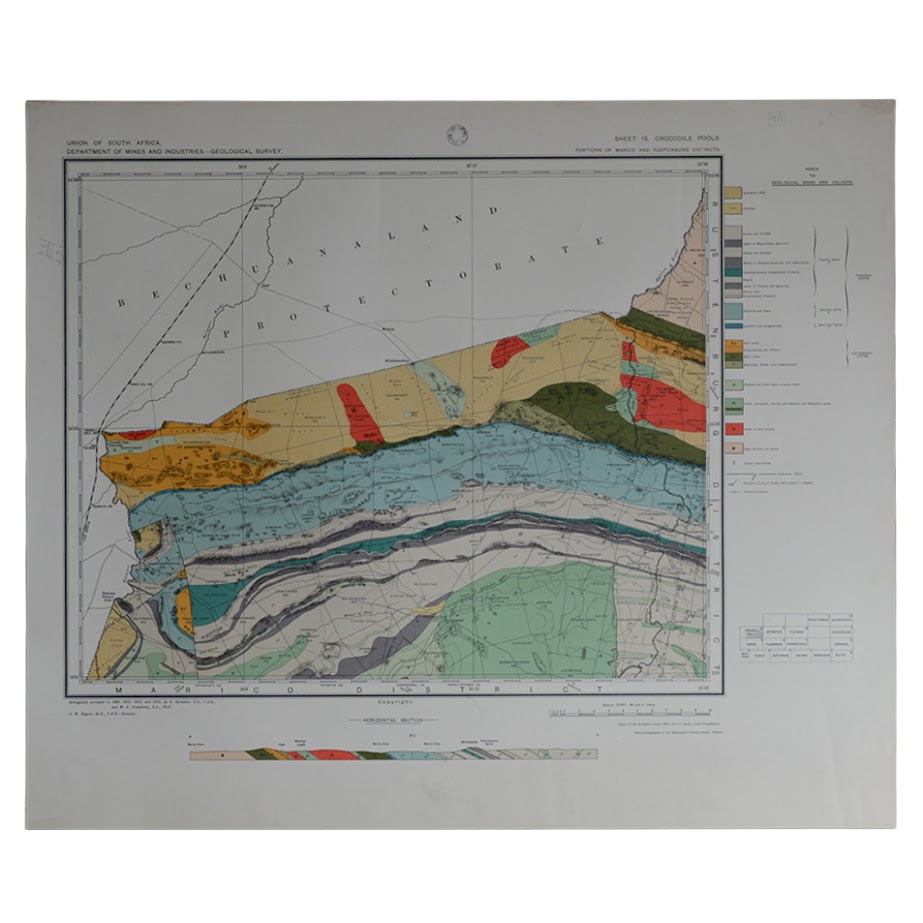
Sheet 15 – Crocodile Pools – Marico And Rustenburg Districts – Union Of South Africa Department Of Mines And Industries – Geological Survey
Cartographer: Eric H Banks
Publisher: Union Of South Africa Department Of Mines And Industries – Geological Survey
Price: £125 (post-free in the UK)
Publication Date: 1913
Edition: 1st edition thus
Format: Colour printed
Condition: In very good condition
Sheet Size: 63.5cm x 54.4cm
Condition:
Sheet Size: 63.5cm x 54.4cm. Small Institutional stamp to upper margin. Minor pencil marks to margins which could be easily removed. Very slightly creased, marked, dusty and rubbed but this is mainly confined to the margins. Colouration very bright and clean. A very good copy. Very scarce.
Location: Pocket RSAGEOL: SR: 002840
The Marico And Rustenburg Districts: An Historical Overview
Introduction
The Marico and Rustenburg regions, situated in the present-day North West Province of South Africa, have long histories marked by precolonial settlement, frontier conflict, Boer migration, and mineral-driven transformation. Located along the southern edge of the Waterberg Plateau and near the Magaliesberg mountain range, these regions offer a window into the complex interplay of land, identity, and resource economy in the interior of southern Africa.
Historically part of the Western Transvaal, the areas around Marico and Rustenburg were shaped by agricultural subsistence, cultural continuity, and later, the arrival of mining and mechanised farming. They remain closely linked in terms of geography, history, and shared socio-political developments.
Precolonial Landscape and Indigenous Presence
Before European encroachment, both the Marico and Rustenburg regions were inhabited by Tswana-speaking communities, notably the Bakwena, Bahurutshe, and Bafokeng. These groups practised:
- Mixed agriculture, including sorghum and millet cultivation
- Pastoralism, with cattle holding symbolic and economic importance
- Iron smelting, as seen in archaeological finds of furnaces and slag heaps
- Trade, including connections to eastern African networks via ivory and metals
Settlements were often situated along rivers such as the Marico River, using elevated ridges and valleys for both defence and cultivation. Chieftainship, land allocation, and kinship shaped the governance and social structure of these societies.
Arrival of the Voortrekkers and the Great Trek (1830s–1850s)
During the 1830s, Voortrekker groups began moving northward from the Cape Colony in what became known as the Great Trek. Seeking autonomy from British rule, many crossed into the interior, reaching the western Transvaal, including the Marico Valley and Rustenburg basin.
In these regions, Voortrekker settlers:
- Established farms on communal land through informal treaties or forced displacement
- Formed laagers and frontier settlements, sometimes leading to conflict with local chiefs
- Brought Calvinist religious practices, Dutch Reformed churches, and patriarchal governance
- Introduced ox-wagon transport networks, which opened up the interior for trade
The Rustenburg district was officially proclaimed in the 1850s, becoming one of the earliest formal districts of the South African Republic (ZAR).
Boer Republicanism and Rural Society (1850s–1890s)
Under the South African Republic (Transvaal Republic), both Marico and Rustenburg became predominantly agrarian Boer strongholds, typified by:
- Self-sufficient farms, reliant on mixed agriculture and labour from African tenants or servants
- Religious and cultural conservatism, centred around Dutch Reformed institutions
- A commando system used for defence, policing, and local governance
- Periodic conflict and negotiation with neighbouring African polities
Rustenburg developed into a small but influential town, home to President Paul Kruger, one of the most prominent figures in Boer history. His family farm, Boekenhoutfontein, located near Rustenburg, became a symbol of Boer resilience and leadership.
The Marico region, by contrast, remained more remote and sparsely settled, characterised by rugged bushveld terrain and isolated farming.
Anglo-Boer War and British Occupation (1899–1902)
The Second Anglo-Boer War had a significant impact on both regions. The British sought to subdue Boer resistance across the Transvaal, with Rustenburg and Marico witnessing:
- Skirmishes and guerrilla warfare, as local commandos operated in the bushveld
- The imposition of the British scorched earth policy, destroying farms and crops
- The establishment of concentration camps, particularly for Boer women and children
- Military outposts and garrisons to maintain control over transport routes and resources
After the war, the regions were incorporated into the Transvaal Colony, and later into the Union of South Africa (1910).
Early 20th Century: Agriculture and Racial Division
From the 1910s to 1940s, both Marico and Rustenburg remained largely rural, with economies based on:
- Cattle ranching, maize, tobacco, and citrus farming
- Increasing land alienation from African communities under the 1913 Land Act
- Limited industrialisation, though rail links and roads improved connectivity
- The formalisation of racial segregation in education, services, and land tenure
African communities, particularly in the Marico bushveld, were subjected to forced removals and confinement to “native reserves”. Many became migrant workers, travelling to urban mines and returning seasonally to family land.
Platinum Mining and Industrial Transformation (Mid-20th Century Onwards)
The discovery of platinum-group metals in the Bushveld Igneous Complex in the 1920s and its development in the 1950s dramatically transformed the Rustenburg region. Rustenburg became the global epicentre of platinum mining, with major mining operations by companies such as:
- Rustenburg Platinum Mines (later part of Anglo American Platinum)
- Impala Platinum
- Lonmin
This led to:
- Massive inward migration of black labourers, housed in single-sex hostels
- Rapid urban expansion, accompanied by informal settlements and service pressure
- Deepening economic inequality between mining companies and surrounding communities
The Bafokeng Nation, whose land overlies many of the platinum deposits, emerged as a key stakeholder, negotiating royalties and later ownership stakes in mining operations. Their story represents a rare instance of traditional authority leveraging mineral wealth for community development.
In contrast, the Marico region remained largely pastoral and marginalised, though its watercourses, conservation potential, and remoteness became valued in later years.
Post-Apartheid Developments and Present Day
Since 1994, both Marico and Rustenburg have undergone continued transformation:
- Rustenburg was incorporated into a major local municipality and now faces challenges of urban planning, infrastructure delivery, and social integration
- Marico has gained recognition for its ecological and cultural significance, including efforts to preserve the Marico River and protect its natural springs and wetlands
- Socio-economic disparities persist, with many communities still affected by unemployment, service backlogs, and land tenure insecurity
Heritage preservation has also become prominent, with Rustenburg promoting sites related to Paul Kruger, Boer republicanism, and platinum mining heritage, while Marico’s literary associations—notably with author Herman Charles Bosman, who romanticised the area—have drawn renewed interest.
Conclusion
The Marico and Rustenburg regions reflect the diverse historical trajectories of rural South Africa—from precolonial chiefdoms to Boer frontier farms, imperial conquest, and the mineral revolution. Today, they stand at a crossroads between tradition and development, with efforts underway to balance their natural, cultural, and economic assets for future generations.
SHOP WITH CONFIDENCE AT HORNSEYS
At Hornseys, we are dedicated to offering items that uphold the highest standards of quality and authenticity. Our collection of artwork is carefully curated to ensure that each item we offer is authentic, collated, and complete.
Here’s what sets us apart:
- Authenticity and Provenance: Each map is researched and verified for authenticity.
- Expert Curation: We entirely own all our artworks. We trust our taste and have invested heavily in it. We have confidence in all artwork that we offer for sale.
- Customer Satisfaction: We strive to provide an exceptional customer experience, from detailed descriptions and provenance to secure and prompt delivery of your purchase.
- Returns Policy: We offer an unconditional guarantee on every item. If, however, you wish to make a return, artworks may be sent back to us within fourteen days of receipt for whatever reason. We request that we are notified in advance if you wish to do so. They must be returned to us in the same condition as they were sent for a full refund.
OUR COMMITMENT TO QUALITY AND SERVICE
Understanding the value and rarity of these items, we ensure that every aspect of your purchase meets the highest standards of quality and service. This includes:
- Free Expedited, Tracked, and Insured Delivery within the UK: Ensuring that your artwork arrives safely and promptly.
- Fully-Insured Worldwide Delivery: Offering peace of mind for international collectors with reliable and secure shipping options.
EXPLORE OUR COLLECTION
Visit Hornseys today to explore our fine collection of maps and other artworks. Whether you are an avid collector or looking for a special gift, our selection offers something truly unique. Located since 1976 in Ripon in the picturesque Yorkshire Dales, we are recognized as a destination gallery for tastefully curated artwork, rare maps, design, and fine books.