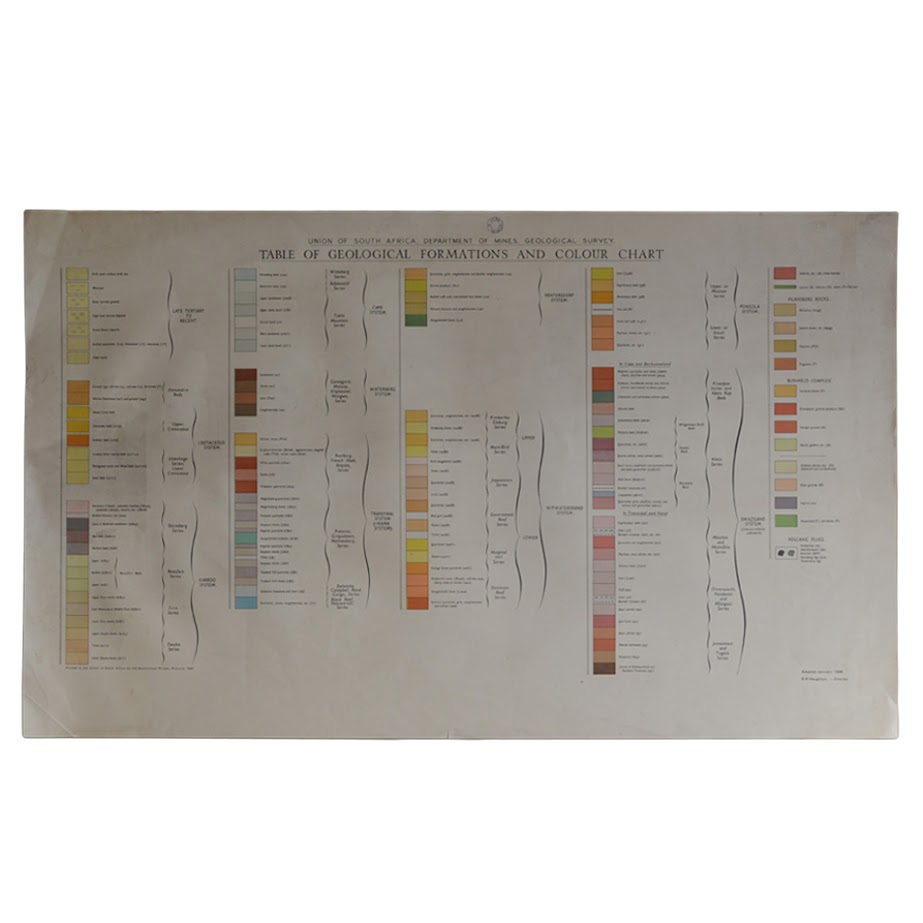
Table Of Geological Formations And Colour Chart – Union Of South Africa Department Of Mines And Industries – Geological Survey
Cartographer: S. H. Haughton
Publisher: Union Of South Africa Department Of Mines And Industries – Geological Survey
Price: £125 (post-free in the UK)
Publication Date: 1936
Edition: 1st edition thus
Format: Colour printed
Condition: In very good condition
Sheet Size: 81.5cm x 50cm
Condition:
Sheet Size: 81.5cm x 50cm. Small Institutional stamp to upper margin. Minor short closed tear. Creased, marked, dusty and rubbed but this is mainly confined to the margins. Colouration very bright and clean. A very good copy. Very scarce.
Location: Pocket RSAGEOL: SR: 002850
Geological Mapping: An Historical Overview
Introduction
Geological mapping is the process of systematically documenting the distribution, nature, and relationships of rock units and geological structures at the Earth’s surface. It underpins the study and management of natural resources, environmental planning, engineering, and scientific research. The practice has evolved over centuries from rudimentary sketches to highly sophisticated digital models, combining observation, measurement, and interpretation.
Origins in Antiquity and Early Observations
Although formal geological maps are a product of modern science, the roots of geological thinking stretch back to ancient civilisations. Philosophers in classical Greece, India, and China made early attempts to explain natural phenomena such as earthquakes, fossils, and mountain formation.
Early mining cultures—such as those in ancient Egypt, Mesopotamia, and pre-Columbian South America—had practical knowledge of rock types and mineral deposits, although these understandings were not recorded as maps in the modern sense.
In medieval Europe and the Islamic world, proto-geological ideas were embedded in cosmology, natural philosophy, and mining handbooks, but lacked systematic field observation or cartographic expression.
18th Century: The Emergence of Geological Science
The 18th century marked a turning point with the rise of empirical observation and the systematisation of natural history. Naturalists and mining engineers began to record strata and mineral occurrences, often in the context of coal mining or road and canal construction.
Among the earliest known examples of geological mapping were:
- Sketches of rock layers and mining seams in central Europe
- Cross-sections used in hydrological and civil engineering projects
- Descriptive diagrams in the service of natural theology, as scholars attempted to reconcile Earth’s structure with biblical chronologies
The concept of stratigraphy—the study of layered rock formations—emerged during this period, enabling naturalists to infer relative ages and depositional environments.
19th Century: The Golden Age of Geological Mapping
The 19th century is widely regarded as the golden age of geological mapping, driven by industrial expansion, mining, and the development of modern scientific institutions. Key developments during this era included:
William Smith and the Birth of Stratigraphic Mapping
In 1815, William Smith, a canal surveyor from England, produced the first nationwide geological map: “A Delineation of the Strata of England and Wales with Part of Scotland.” His pioneering use of fossils as stratigraphic markers allowed him to correlate rock layers across wide distances, laying the foundation for modern biostratigraphy.
Smith’s map was both scientifically groundbreaking and a practical tool for resource management. Despite limited formal education, his field-based methodology revolutionised geological thinking and inspired similar efforts across Europe.
Institutional and National Mapping Projects
Governments and scientific societies began to invest in systematic national surveys. Notable examples include:
- The establishment of the Geological Survey of Great Britain (1835)
- The Geological Survey of France, Prussia, and later, the United States Geological Survey (USGS)
- Extensive fieldwork in colonial territories, driven by interest in gold, diamonds, coal, and agricultural suitability
Geological maps became essential tools for railway construction, tunnel engineering, and military planning, as well as for the development of coalfields and metal mining operations.
20th Century: Scientific Consolidation and Technological Innovation
The 20th century saw a consolidation of geological mapping techniques, accompanied by new theoretical frameworks and technological advancements.
Advances in Structural Geology and Plate Tectonics
The integration of tectonic theory, especially following the mid-century acceptance of plate tectonics, transformed geological interpretation. Maps now reflected:
- Fault systems, fold belts, and tectonic boundaries
- Orogenic events, such as mountain-building processes
- Subsurface structures inferred from seismic and borehole data
This deeper understanding allowed geologists to construct cross-sections and 3D models, enhancing the predictive power of maps.
Aerial Photography and Remote Sensing
From the 1930s onwards, aerial photography became a vital mapping tool, especially in remote and inaccessible regions. Later, satellite imagery, multispectral sensors, and geophysical surveys enabled large-scale mapping of terrain, mineral deposits, and subsurface features.
Standardisation and Thematic Mapping
International bodies, such as the International Union of Geological Sciences (IUGS), promoted standardised mapping conventions. Geological maps were published at consistent scales (e.g., 1:50,000 or 1:250,000) and began to include themes such as:
- Hydrogeology
- Engineering geology
- Geohazards (earthquakes, landslides)
- Mineral resources and environmental geology
21st Century: Digital Mapping and Global Integration
The digital revolution has transformed geological mapping in the 21st century. Modern mapping relies on Geographic Information Systems (GIS), digital field devices, and remote data access, allowing geologists to:
- Collect, analyse, and visualise data in real time
- Overlay geological information with demographic, hydrological, and climate datasets
- Share maps across institutions, borders, and disciplines
Projects such as OneGeology aim to create a seamless global geological map, with data contributions from national surveys worldwide. 3D and 4D modelling (incorporating time-based changes) now support urban planning, mineral exploration, and climate resilience strategies.
Mapping has also become increasingly collaborative, involving not only scientists but also indigenous communities, engineers, environmentalists, and policy-makers.
Applications and Continuing Relevance
Geological mapping remains foundational to:
- Natural resource management (minerals, groundwater, fossil fuels)
- Infrastructure development (roads, dams, tunnels)
- Disaster risk reduction (earthquakes, landslides, volcanic hazards)
- Environmental conservation and rehabilitation
- Scientific education and public engagement
Whether guiding a mining operation, planning a city, or understanding Earth’s deep history, geological maps serve as vital records of both natural processes and human decisions.
SHOP WITH CONFIDENCE AT HORNSEYS
At Hornseys, we are dedicated to offering items that uphold the highest standards of quality and authenticity. Our collection of artwork is carefully curated to ensure that each item we offer is authentic, collated, and complete.
Here’s what sets us apart:
- Authenticity and Provenance: Each map is researched and verified for authenticity.
- Expert Curation: We entirely own all our artworks. We trust our taste and have invested heavily in it. We have confidence in all artwork that we offer for sale.
- Customer Satisfaction: We strive to provide an exceptional customer experience, from detailed descriptions and provenance to secure and prompt delivery of your purchase.
- Returns Policy: We offer an unconditional guarantee on every item. If, however, you wish to make a return, artworks may be sent back to us within fourteen days of receipt for whatever reason. We request that we are notified in advance if you wish to do so. They must be returned to us in the same condition as they were sent for a full refund.
OUR COMMITMENT TO QUALITY AND SERVICE
Understanding the value and rarity of these items, we ensure that every aspect of your purchase meets the highest standards of quality and service. This includes:
- Free Expedited, Tracked, and Insured Delivery within the UK: Ensuring that your artwork arrives safely and promptly.
- Fully-Insured Worldwide Delivery: Offering peace of mind for international collectors with reliable and secure shipping options.
EXPLORE OUR COLLECTION
Visit Hornseys today to explore our fine collection of maps and other artworks. Whether you are an avid collector or looking for a special gift, our selection offers something truly unique. Located since 1976 in Ripon in the picturesque Yorkshire Dales, we are recognized as a destination gallery for tastefully curated artwork, rare maps, design, and fine books.