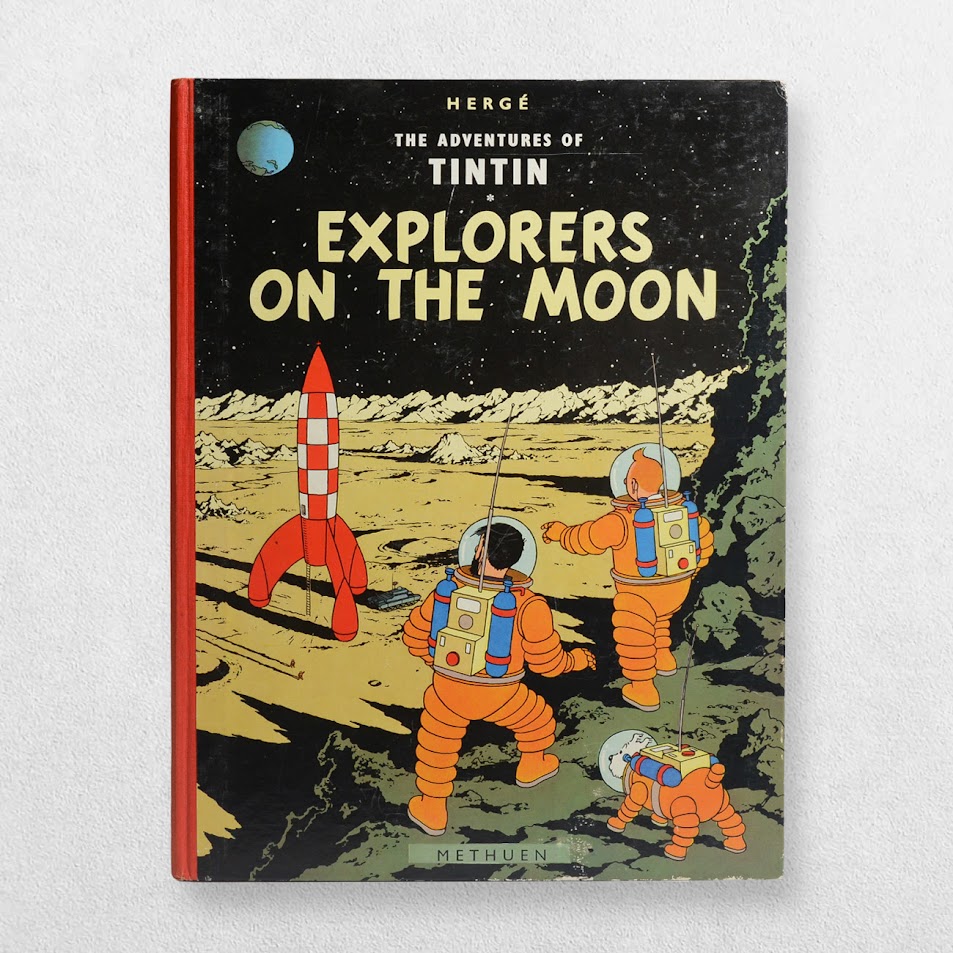
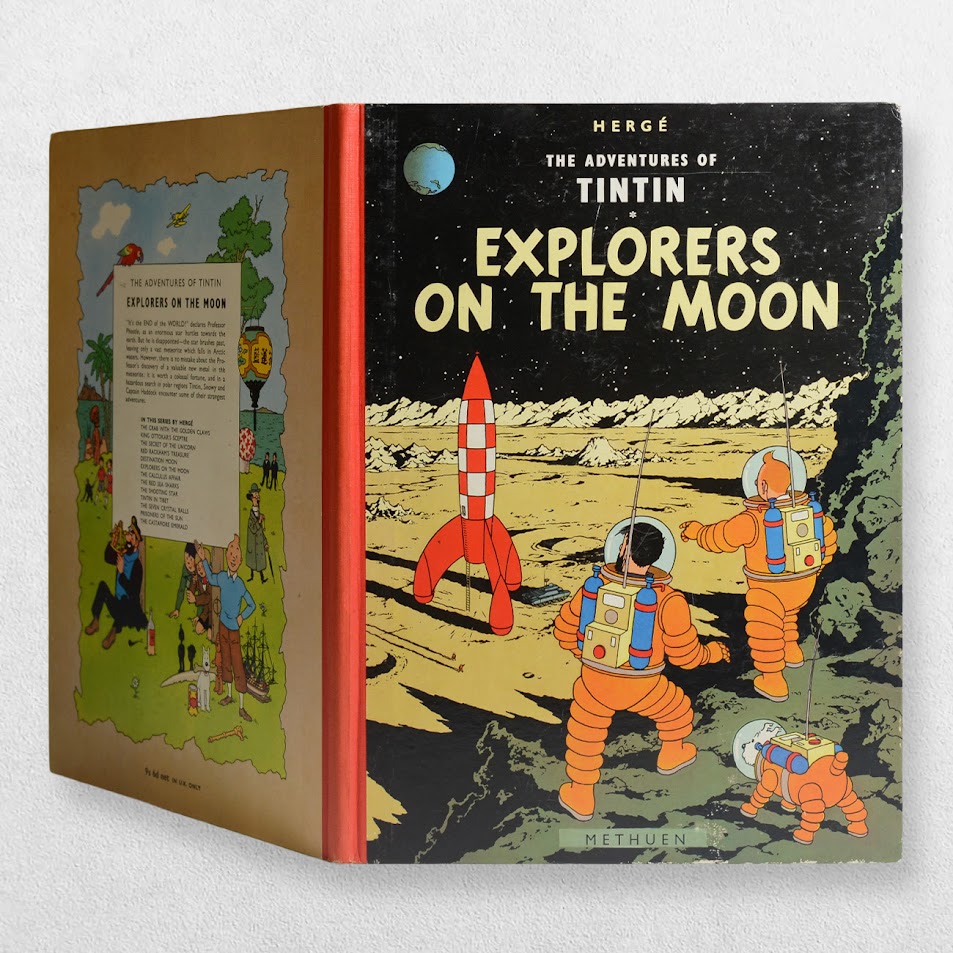
The Adventures Of Tintin – Explorers On The Moon – First Reprint – 1965
Hergé
£110.00
Availability: In stock
Product Description
The Adventures Of Tintin – Explorers On The Moon – First Reprint – 1965
Author: Hergé
Price: £110
Publisher: Methuen, London, UK
Publication date: 1965
Format: Original cloth-backed boards with pictorial endpapers
Condition: Near fine
Size: 23.2cm x 30.7cm
Pages: 62
Illustrations: Illustrated throughout in colour by the author
Description:
Published by Methuen, London, UK, 1965. 1st reprint. Original cloth-backed boards. Pictorial endpapers. Size: 23.2cm x 30.7cm. Pp. 62. Illustrated throughout in colour by the author. Very slight rubbing to the spine and edges. A very near fine, tight, clean copy. Scarce in this condition.
Explorers On The Moon: A Brief Summary
Explorers on the Moon (On a marché sur la Lune, first published 1954) is the seventeenth volume in The Adventures of Tintin by Hergé (Georges Remi). It continues directly from Destination Moon and completes what is often regarded as the pinnacle of Hergé’s creative maturity — a work that unites meticulous realism, emotional depth, and philosophical reflection.
With this two-part epic, Hergé accomplished what no other comic artist of his time had achieved: a scientifically credible and morally profound portrayal of humanity’s journey beyond Earth. Published fifteen years before Apollo 11, the story anticipates both the mechanics and the psychology of real space travel with astonishing foresight.
Background and Context
Following the publication of Destination Moon (1953), readers were left on a dramatic cliffhanger — Tintin, Captain Haddock, Professor Calculus, and their crew had just launched from Syldavia aboard the nuclear-powered rocket.
When Explorers on the Moon began serialisation in Tintin Magazine in 1952 and was published as an album in 1954, anticipation was immense.
Hergé, ever perfectionist, continued his collaboration with scientific consultants, including his brother Paul Remi, a nuclear physicist. He researched orbital dynamics, gravitational effects, and communication systems, producing an astonishingly accurate portrayal of space travel decades before NASA’s Apollo missions.
But beyond technical mastery, Hergé’s focus was human: courage, conscience, and wonder. The Moon voyage becomes an allegory of exploration itself — the conquest not only of space, but of fear, guilt, and moral responsibility.
Plot Summary
Into Space
The story opens with the rocket already en route to the Moon. Aboard are Tintin, Captain Haddock, Professor Calculus, Frank Wolff, and Thomson and Thompson, the latter having accidentally come along after fainting inside the rocket before take-off.
Hergé’s depiction of weightlessness is both humorous and precise: objects drift, liquids float, and even Snowy’s bones defy gravity. The scenes capture a delicate balance between scientific accuracy and comic relief.
The Voyage
During the journey, the crew faces numerous challenges — oxygen management, the physical disorientation of zero gravity, and Haddock’s impulsive behaviour. In one memorable sequence, Haddock sneaks a drink of whisky, floats out of the airlock, and drifts helplessly into space, forcing Tintin to execute a daring rescue.
Landing on the Moon
After complex manoeuvres, Calculus successfully pilots the rocket to a safe landing. Tintin becomes the first human to set foot on the Moon, declaring the historic words:
“This is it. I’ve walked on the Moon!”
Hergé illustrates the lunar surface with haunting beauty — silent, desolate, and vast. The grey landscapes, crater shadows, and distant Earth evoke both wonder and melancholy.
Exploration and Discovery
The crew conducts scientific experiments, collects rock samples, and explores caves beneath the lunar surface. The tone is one of reverence for discovery — part documentary, part dream.
However, the mission is jeopardised by the reappearance of Colonel Boris Jorgen, a foreign spy who has secretly stowed away on the rocket. His orders: to hijack the ship and deliver it — and its crew — to his government.
Conflict and Redemption
The tension escalates as Jorgen seizes control, forcing Wolff to cooperate. Wolff’s inner turmoil comes to the fore: having previously been blackmailed into betraying Calculus’s project, he is now consumed by guilt.
A violent struggle ensues, resulting in Jorgen’s death. But tragedy deepens when Wolff, recognising his own culpability, sacrifices himself to save the others by exiting the rocket to reduce its weight during re-entry — ensuring the crew’s survival.
Return to Earth
The survivors — Tintin, Haddock, Calculus, and the detectives — return safely, greeted as heroes. Yet their triumph is bittersweet. Wolff’s loss and the desolation of the Moon leave an aftertaste of solemnity.
The adventure ends not with fanfare but reflection — a meditation on the cost of human ambition and the fragility of life amid the immensity of space.
Principal Characters
Tintin
Tintin remains the moral and intellectual anchor of the story. His courage and compassion balance the dangers of exploration with ethical reflection. As the first human to step on the Moon, he represents not conquest but curiosity — the pure spirit of discovery.
Captain Haddock
Haddock provides warmth and humanity. His comic blunders (such as floating off into space) are offset by deep loyalty and courage. He embodies the everyman confronting the unknown — fearful, flawed, but ultimately noble.
Professor Calculus (Tryphon Tournesol)
Calculus is both genius and idealist. His vision has made the impossible possible, yet his absent-mindedness adds levity. He represents faith in science tempered by humility. His lunar achievement symbolises the triumph of intellect guided by ethics.
Frank Wolff
Wolff is one of Hergé’s most tragic and psychologically complex figures. Torn between guilt and redemption, he represents the human cost of scientific ambition. His self-sacrifice transforms him into a quiet hero — the moral heart of the story.
Thomson and Thompson
The detectives, as always, bring comic relief. Their confusion over gravity and magnetism contrasts sharply with the precision of Calculus’s world, yet they ground the story in humanity and absurdity.
Themes and Analysis
- Science and Morality
At its core, Explorers on the Moon explores the moral dimension of progress. Science achieves the impossible — walking on the Moon — but its purity is threatened by espionage, greed, and human weakness.
Hergé’s message is clear: knowledge without conscience endangers humanity. Calculus and Tintin’s ethics stand in contrast to Jorgen’s exploitation and Wolff’s tragic compromise.
- The Spirit of Exploration
The story celebrates curiosity as humanity’s defining virtue. Hergé presents exploration not as domination but as enlightenment — the drive to understand and connect, not to conquer.
Tintin’s awe before the Moon’s silent majesty reflects Hergé’s own reverence for discovery and humility before the unknown.
- Isolation and Existential Reflection
The lunar landscape becomes a metaphor for existential solitude. The emptiness of space evokes both beauty and dread — an echo of humanity’s isolation in the cosmos.
This emotional depth distinguishes Explorers on the Moon from mere science fiction: it is a meditation on what it means to be human amid infinite silence.
- Redemption and Sacrifice
Frank Wolff’s death gives the story moral gravitas. His atonement elevates the narrative from adventure to tragedy. Through self-sacrifice, he restores moral order, reminding readers that progress demands compassion as much as intellect.
- Humour and Humanity
Hergé maintains balance through humour: Haddock’s antics, Snowy’s confusion in zero gravity, and the detectives’ misunderstandings preserve warmth amid the grandeur of space. The human touch prevents the story from becoming sterile or technical.
Artistic and Technical Achievement
Explorers on the Moon is a masterpiece of visual storytelling and technical precision.
- Scientific Authenticity: Hergé’s portrayal of the rocket interior, spacesuits, and lunar physics remains impressively accurate, anticipating real-world designs later used in the 1960s.
- Ligne Claire Perfection: The clear-line style reaches full maturity here — crisp outlines, minimal shading, and perfect compositional balance.
- Atmospheric Realism: The Moon’s desolation is rendered with poetic precision — vast craters, endless horizons, and the distant Earth floating like a fragile jewel.
- Cinematic Storytelling: Hergé uses silent panels and wide frames to evoke awe and loneliness, achieving moments of pure visual poetry.
Moral and Philosophical Dimensions
The story transcends adventure to pose moral questions:
- What price does humanity pay for discovery?
- Can intellect alone guide civilisation without empathy?
- Does progress ennoble, or isolate, mankind?
Wolff’s sacrifice offers Hergé’s answer: only when conscience accompanies knowledge can humanity truly rise — not just above Earth, but above its own limitations.
Psychological Interpretation
The journey to the Moon mirrors Hergé’s own inner voyage towards clarity and renewal. After years of post-war anxiety, the controlled world of the lunar project offered him both escape and structure.
The silence of the Moon reflects his introspection: purity, emptiness, and solitude — a psychological landscape as much as a physical one.
Relation to Destination Moon
Where Destination Moon celebrates preparation and ambition, Explorers on the Moon confronts reality and consequence. Together, they form a perfect diptych: dream and awakening, ascent and descent, intellect and soul.
If the first is about reaching the stars, the second is about rediscovering humanity.
Legacy and Reception
Upon release, Explorers on the Moon was hailed as a landmark of graphic literature. Critics and scientists alike marvelled at its accuracy, artistry, and emotional power.
The album’s influence endures: its red-and-white rocket became a global symbol of space exploration, inspiring generations of engineers, astronauts, and artists.
Many regard it as Hergé’s masterpiece, the high point of The Adventures of Tintin — where entertainment, art, and moral philosophy unite seamlessly.
Summary
- Title: Explorers on the Moon (On a marché sur la Lune)
- First Published: 1952–1954 (Tintin Magazine; album 1954)
- Main Characters: Tintin, Captain Haddock, Professor Calculus, Frank Wolff, Thomson and Thompson
- Setting: Space and the lunar surface
- Themes: Science and morality, exploration and isolation, sacrifice, redemption, the meaning of progress
- Artistic Style: Ligne claire perfection; minimalist lunar landscapes; cinematic pacing
- Significance: The first realistic depiction of space travel in comics; the moral and artistic summit of Hergé’s career
Conclusion
Explorers on the Moon is more than a scientific fantasy — it is a hymn to humanity’s capacity for wonder, courage, and conscience.
By fusing technical precision with spiritual depth, Hergé transcended the boundaries of the adventure genre. The Moon, in his vision, is not simply a destination but a mirror — reflecting both the greatness and the fragility of humankind.
Tintin’s first step upon the lunar surface becomes a symbolic act: not the conquest of space, but the awakening of the human spirit.
In its beauty, sadness, and moral clarity, Explorers on the Moon remains one of the most visionary works in twentieth-century literature — a story of science illuminated by soul.
Why Buy from Us?
At Hornseys, we are committed to offering items that meet the highest standards of quality and authenticity. Our collection of rare books is carefully curated to ensure each edition is a valuable piece of bibliographical history. Here’s what sets us apart:
- Authenticity and Provenance: Each book is meticulously researched and verified for authenticity and collation.
- Expert Curation: Our selection process focuses on significance, condition, and rarity, resulting in a collection that is both diverse and distinguished.
- Customer Satisfaction: We aim to provide an exceptional customer experience, from detailed descriptions to secure and prompt delivery of your purchase.
- Returns Policy: We offer an unconditional guarantee on every item. If you wish to return a book, it may be sent back to us within fourteen days of receipt. Please notify us in advance if you wish to do so. The book must be returned in the same condition as it was sent for a full refund.
Cataloguer: Daniel Hornsey
Daniel Hornsey has specialised in fine and rare books, ephemera, and collectors’ editions for over thirty years. As a long-standing member of the antiquarian book trade, he has advised private collectors, curated catalogues, and sourced works for leading dealers, libraries and institutions across the world.
Hornseys’ exhibit regularly at book and map fairs in London and throughout the UK and are members of the Provincial Booksellers Fairs Association, the PBFA.
His fascination with Hergé’s work — especially ‘The Adventures of Tintin’ — began in childhood. Daniel recalls reading Tintin in original European editions and quickly recognising that these were not merely children’s books, but finely illustrated narratives crafted with artistic depth and wit.
As noted by the Musée Hergé in Louvain-la-Neuve, Hergé’s ‘ligne claire’ style has influenced generations of European comic artists and his original drawings and paintings command very high prices with his painting of ‘The Blue Lotus’ jar fetching £2.8m at auction in 2021.
By presenting these works through Hornseys’, he hopes to contribute to the continued appreciation of one of the 20th century’s most influential illustrators, helping new generations discover the artistry and legacy of Hergé.
Related products

The Crayon Box: The Day The Crayons Quit & The Day The Crayons Came Home: Includes Original Oliver Jeffers Art Print
£28.00Jeffers, Oliver & Daywalt, Drew
Paddington Marches On With Card Signed By Michael Bond Loosely Inserted
£545.00Bond, Michael Illustrated By Fortnum, Peggy