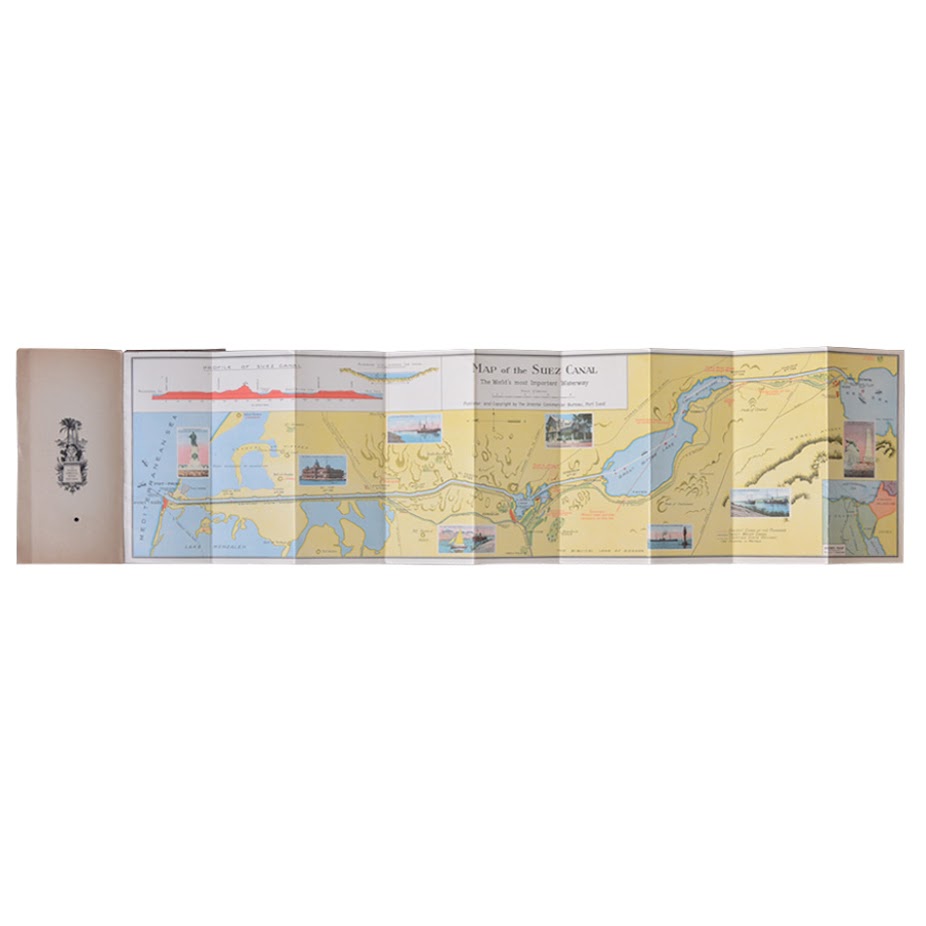
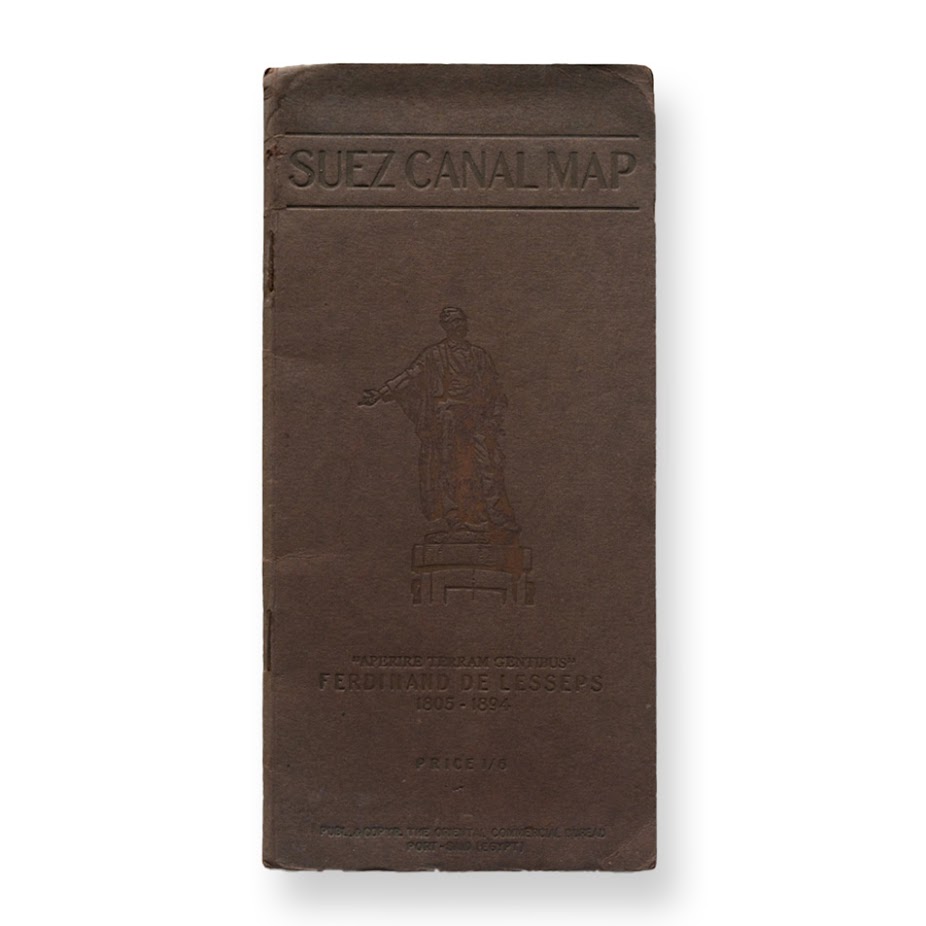
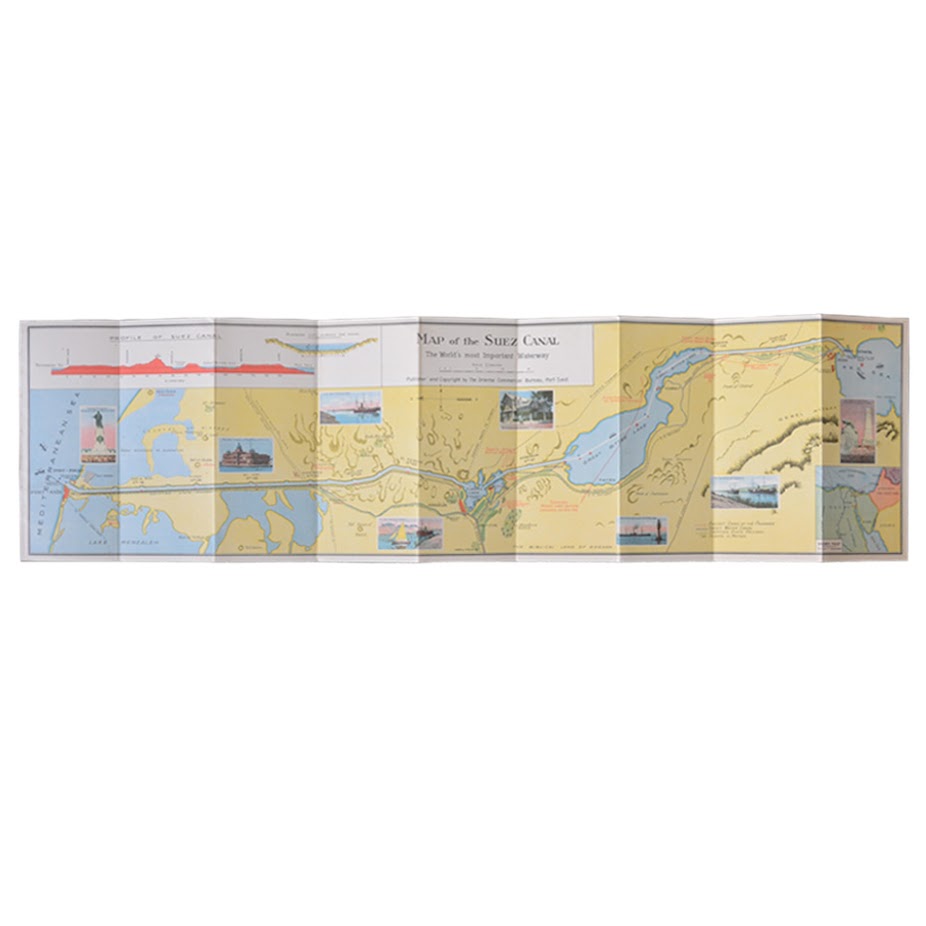
The Suez Canal – Map And Notes Of The World’s Most Important Waterway
Publisher: The Oriental Commercial Bureau
Price: £50.00
Publication Date: c.1926-7
Edition: Not stated
Format: Colour printed
Condition: In very good plus condition
Map Size: 84.4cm x 23.1cm
Condition:
Size: Not dated but c. 1926-7. pp. 12 + folding map. Map size: 84.4cm x 23.1cm. Includes a fine and detailed lithographic map of the region. Original printed wrappers. Covers very slightly dusty and marked. Original fold lines. Reverse is blank with very minor marks. Minor wear to a couple of fold lines. Map bright and clean. In very good indeed, original and un-restored condition.
Location: Book room: 002711
The Suez Canal In The 1920s: A Brief Description
The Suez Canal in the 1920s stood as a crucial artery of global maritime trade and a vivid symbol of imperial power. Stretching roughly 120 miles (193 kilometres) from Port Said on the Mediterranean to Suez on the Red Sea, the canal offered a direct sea route between Europe and Asia, eliminating the need to navigate around the Cape of Good Hope. Its significance in the 1920s—both strategic and economic—cannot be overstated.
Physical Structure and Operations
By the 1920s, the canal had undergone significant development since its opening in 1869. The channel had been widened and deepened to accommodate the increasing size and draught of ships, although it was still relatively narrow by modern standards. There were no locks, as the canal traversed flat terrain, but there were several passing bays to allow for two-way traffic, though one-way convoys remained common.
The transit typically took 12 to 16 hours, with a regulated schedule governed by the Suez Canal Company. Pilots were required aboard all ships, and strict rules governed speed and movement to prevent erosion of the canal banks and collisions.
Economic Importance
The 1920s marked a period of recovery and modernisation after the First World War. The Suez Canal was vital for the British Empire, particularly in maintaining access to India, the Far East, and the oilfields of the Persian Gulf. It was also a critical link in the global trade of textiles, spices, tea, and oil.
Traffic through the canal increased steadily during the decade. Steamships dominated, and the canal facilitated the passage of merchant fleets, military vessels, and liners. The revenues generated by tolls were substantial, and a large proportion of that income went to the shareholders of the Suez Canal Company—a Franco-Egyptian concern headquartered in Paris.
Political Context and Control
Although technically under Egyptian sovereignty, the Suez Canal was effectively controlled by Britain in the 1920s. Following the British occupation of Egypt in 1882 and despite nominal Egyptian independence declared in 1922, the British retained extensive control over the canal and its surrounding zones through military presence and political pressure.
This arrangement became a source of friction between Egyptian nationalists and British authorities. The canal zone—guarded by British troops—was treated almost as sovereign British territory, much to the resentment of Egyptian leaders. The canal’s strategic value, especially in safeguarding imperial communications and deploying naval power, meant Britain was reluctant to relinquish its grip.
Infrastructure and Settlements
Port Said and Suez were bustling port towns, characterised by cosmopolitan populations and a transient, often multilingual atmosphere. Port Said, in particular, was a hub of commerce, with goods warehouses, coaling stations, customs houses, and a growing tourist trade. The town featured European-style boulevards, cafés, and a mixture of architectural styles reflecting its colonial and international influences.
The canal itself was flanked by maintenance facilities, signal stations, and telegraph lines. Dredgers and support vessels were constantly at work maintaining navigability. Workers included Egyptian labourers and European technicians, often working under difficult conditions.
Cultural and Symbolic Resonance
To many in Europe, the Suez Canal represented the marvels of modern engineering and the supposed triumph of Western civilisation over nature. In contrast, to Egyptian nationalists and much of the wider Arab world, it was a symbol of exploitation and imperial domination.
Writers and travellers passing through the canal in the 1920s often remarked on the strangeness of the landscape—the narrow waterway cutting through the desert, lined with sandbanks, watchtowers, and military posts. It was simultaneously a mundane part of shipping logistics and a place freighted with geopolitical symbolism.
SHOP WITH CONFIDENCE AT HORNSEYS
At Hornseys, we are dedicated to offering items that uphold the highest standards of quality and authenticity. Our collection of artwork is carefully curated to ensure that each item we offer is authentic, collated, and complete.
Here’s what sets us apart:
- Authenticity and Provenance: Each map is researched and verified for authenticity.
- Expert Curation: We wholly own all our artworks. We trust our taste and have invested heavily in it. We have confidence in all artwork that we offer for sale.
- Customer Satisfaction: We strive to provide an exceptional customer experience, from detailed descriptions and provenance to secure and prompt delivery of your purchase.
- Returns Policy: We offer an unconditional guarantee on every item. If, however, you wish to make a return, artworks may be sent back to us within fourteen days of receipt for whatever reason. We request that we are notified in advance if you wish to do so. They must be returned to us in the same condition as they were sent for a full refund.
OUR COMMITMENT TO QUALITY AND SERVICE
Understanding the value and rarity of these items, we ensure that every aspect of your purchase meets the highest standards of quality and service. This includes:
- Free Expedited, Tracked, and Insured Delivery within the UK: Ensuring that your artwork arrives safely and promptly.
- Fully-Insured Worldwide Delivery: Offering peace of mind for international collectors with reliable and secure shipping options.
EXPLORE OUR COLLECTION
Visit Hornseys today to explore our fine collection of maps and other artworks. Whether you are an avid collector or looking for a special gift, our selection offers something truly unique. Located since 1976 in Ripon in the picturesque Yorkshire Dales, we are recognised as a destination gallery for tastefully curated artwork, rare maps, design, and fine books.