Tintin 1/24 Model Car 29909 – L’Amilcar des Soviets – Tintin au Pays des Soviets
Author: Hergé & Editions Moulinsart
Manufacturer: Editions Moulinsart / Tintinimaginatio
Format: 1/24 scale model car on display plinth with illustrated diorama and clear perspex case
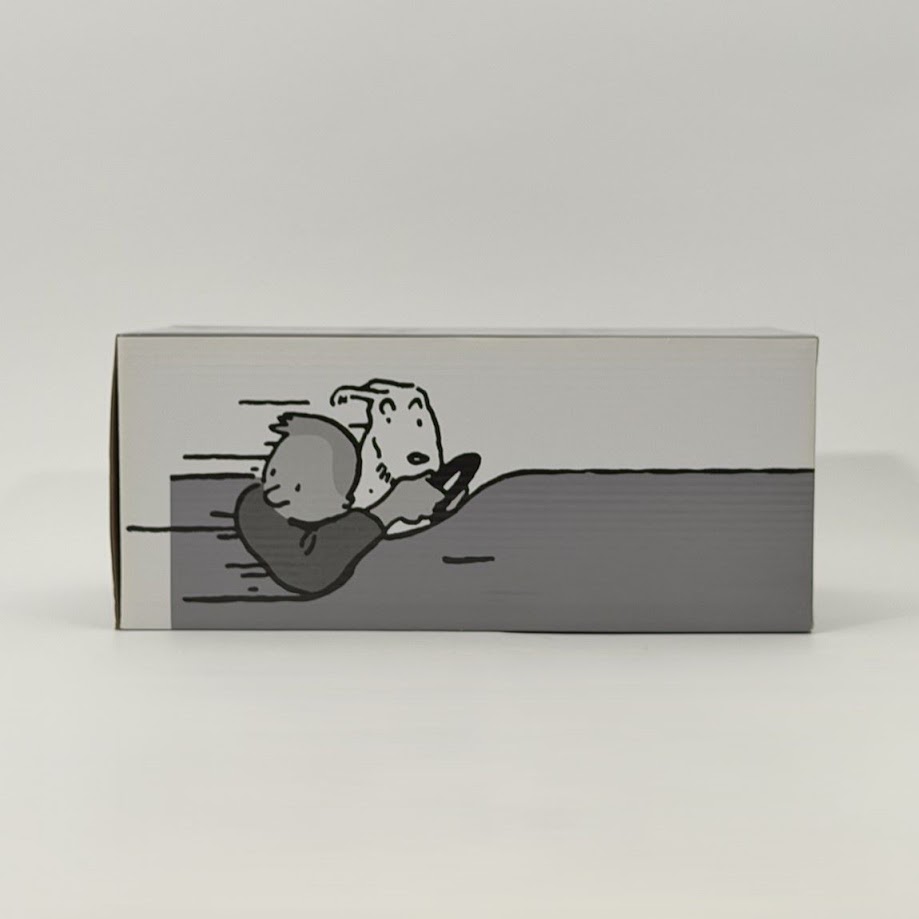
Condition: Fine. Ex-display model in fine condition. Complete with original grey and white outer box and explanatory booklet. The outer box has minor shelf-wear.
Description:
From the official Les Voitures de Tintin collection, this substantial 1/24 scale model of L’Amilcar des Soviets, reference 29909, recreates the blue sports car driven by Tintin in Tintin au pays des Soviets (Tintin in the Land of the Soviets).
The model depicts Tintin at the wheel with Snowy beside him, the compact pale-blue open sports car presented on its original display plinth beneath a clear perspex case. A monochrome woodland backdrop derived from Hergé’s artwork completes the presentation and gives the model the effect of a three-dimensional comic-strip scene.
The vehicle is based upon the Amilcar CGSS, one of the best-known small French sporting cars of the 1920s. Specialist references for the official model identify it specifically as the 1926 Amilcar CGSS, while Editions Moulinsart issued the model as number 9 in the 1/24 Tintin vehicle collection.
The model corresponds to the blue Amilcar as it appears in the 2017 colourised edition of Tintin au pays des Soviets. Contemporary specialist descriptions identify the scene as one of the later motoring sequences in the album, with Tintin and Snowy travelling at speed in the little sports car.
The 1/24 model was issued in 2020 and is constructed from resin and plastic. It was supplied with double packaging comprising the clear display case and outer cardboard box, together with a substantial illustrated booklet in French and English.
This example has previously been displayed but remains in fine condition. It retains its original clear presentation case, grey and white outer box and explanatory booklet. The outer box displays minor shelf-wear, consistent with careful storage and handling.
Reference: 29909
Scale: 1/24
Date: 2020
Model: L’Amilcar des Soviets
Album: Tintin au pays des Soviets
Vehicle: Amilcar CGSS
Vehicle date: 1926
Colour: Blue
Material: Resin and plastic
Presentation: Display plinth with illustrated diorama and clear perspex case
Packaging: Original grey and white outer box, with minor shelf-wear
Documentation: Original illustrated booklet in French and English
Condition: Fine; ex-display
EAN: 2990900000003
L’Amilcar des Soviets: A Brief Account
The Amilcar is especially significant because it belongs to Tintin’s very first adventure.
Tintin au pays des Soviets introduced Tintin and Snowy to readers in 1929, when the story began appearing in the children’s supplement Le Petit Vingtième. Hergé was still developing the visual language that would ultimately become the mature ligne claire style, but many of the characteristics that would define the series are already present: rapid travel, mechanical action, comic escapes and a succession of cars, trains and aircraft.
The Amilcar appears during one of the adventure’s fast-moving road sequences. Tintin is shown in command of the little open sports car, with Snowy beside him, the compact vehicle perfectly suited to Hergé’s early taste for speed and physical comedy.
The version represented by this model is particularly interesting because it follows the colourised edition of 2017 rather than the original black-and-white appearance of the album. Specialist descriptions of the Moulinsart model explicitly identify it with that colour edition.
The pale blue finish therefore connects the model not only with the original 1929–30 adventure but also with the later history of the work and its re-presentation to a twenty-first-century readership.
The Amilcar CGSS
Amilcar was one of the most important French makers of small sporting cars during the 1920s. Founded in 1921, the company became closely associated with lightweight voiturettes and cyclecars that combined modest engine capacity with lively performance and sporting appearance.
The CGSS, introduced during the middle of the decade, was among the marque’s most attractive sporting models. Specialist references associated with the Tintin model identify the prototype as a 1926 Amilcar CGSS, fitted with a four-cylinder engine of approximately 1,074 cc.
Its compact proportions, narrow body, exposed wheels and open cockpit make it instantly evocative of inter-war sporting motoring. The design was ideally suited to Hergé’s graphic language: visually simple enough to read immediately in a comic-strip panel, but distinctive enough to convey speed, character and period atmosphere.
The vehicle also demonstrates how quickly automobiles became central to Tintin’s world. Even in this first adventure, Tintin is constantly on the move, and cars provide Hergé with a means of accelerating both narrative and visual rhythm.
Tintin au Pays des Soviets: A Brief Account
Tintin au pays des Soviets was Hergé’s first full-length Tintin adventure and consequently occupies a unique place in the history of European comics.
The story follows Tintin, presented as a reporter for Le Petit Vingtième, as he travels into the Soviet Union accompanied by Snowy. The book was created in a very different political and journalistic environment from Hergé’s later works and reflects the strongly anti-communist editorial outlook of the Belgian Catholic newspaper for which he worked.
Artistically, the album is fascinating because it records Hergé at the beginning of a process that would eventually transform European graphic storytelling. The drawing is looser and more exuberant than in the later albums, and the plot proceeds at remarkable speed through a succession of arrests, escapes, disguises, chases and mechanical catastrophes.
Vehicles play an unusually prominent part in that rhythm. Tintin commandeers and encounters cars, trains, motorcycles and aircraft as the story progresses, and Hergé repeatedly uses mechanical movement to propel the action forwards.
The Amilcar is therefore particularly representative of the young Hergé’s approach. It is small, sporting, fast and immediately readable — precisely the kind of machine suited to Tintin’s energetic escape sequences.
From Black and White to the 2017 Colour Edition
For decades, Tintin au pays des Soviets remained the exceptional early Tintin album that continued to circulate essentially in its original monochrome form.
The later 2017 colourised edition gave the adventure a substantially different visual appearance while retaining Hergé’s original drawings. The Moulinsart 1/24 model of the Amilcar adopts the blue colouring from this later version, which explains the striking pale-blue bodywork seen here.
This makes reference 29909 rather interesting within the vehicle collection. Rather than simply reproducing a colour from one of Hergé’s classic post-war albums, it represents a modern colour interpretation of imagery dating from the very beginning of Tintin’s publication history.
Hergé and the Motor Car
Cars are among the most persistent objects in The Adventures of Tintin. They supply transport, period detail, comedy and danger, and Hergé’s increasing interest in mechanical accuracy can be traced across the development of the series.
In Tintin au pays des Soviets, the representation of vehicles is still comparatively free and spontaneous. Yet the fascination with machinery is already evident. By the time of the later albums, vehicles would be researched and drawn with extraordinary precision.
The Amilcar therefore occupies an interesting position in that evolution: it belongs to the earliest stage of Tintin while anticipating the strong relationship between the series and the motor car that would continue throughout Hergé’s career.
The 1/24 Moulinsart model makes particularly effective use of that association. Its larger scale allows the compact sports body, wheels, open cockpit and sculpted figures of Tintin and Snowy to be appreciated clearly, while the illustrated background reconnects the three-dimensional object directly with Hergé’s artwork.
Why Buy from Us?
At Hornseys, we are committed to offering collectible Tintin models, books and related objects that meet high standards of authenticity, condition and presentation. Every item is handled, inspected and authenticated in-house at our Ripon gallery.
Our Tintin collection is personally curated by Daniel Hornsey, whose interest in Hergé and The Adventures of Tintin extends back to childhood. Individual models are examined for condition, correct accessories, packaging and documentation before being offered for sale.
We wholly own all our stock. Postage is free within the UK, with tracked and insured worldwide shipping available. Every purchase is covered by our 14-day unconditional return guarantee.
Cataloguer: Daniel Hornsey
Daniel Hornsey has specialised in fine and rare books, maps, ephemera, artworks and collectors’ items for over thirty years. Hornseys was established in 1976 and, in its fiftieth year, continues to research and catalogue every item individually from its gallery and bookshop in Ripon, North Yorkshire.