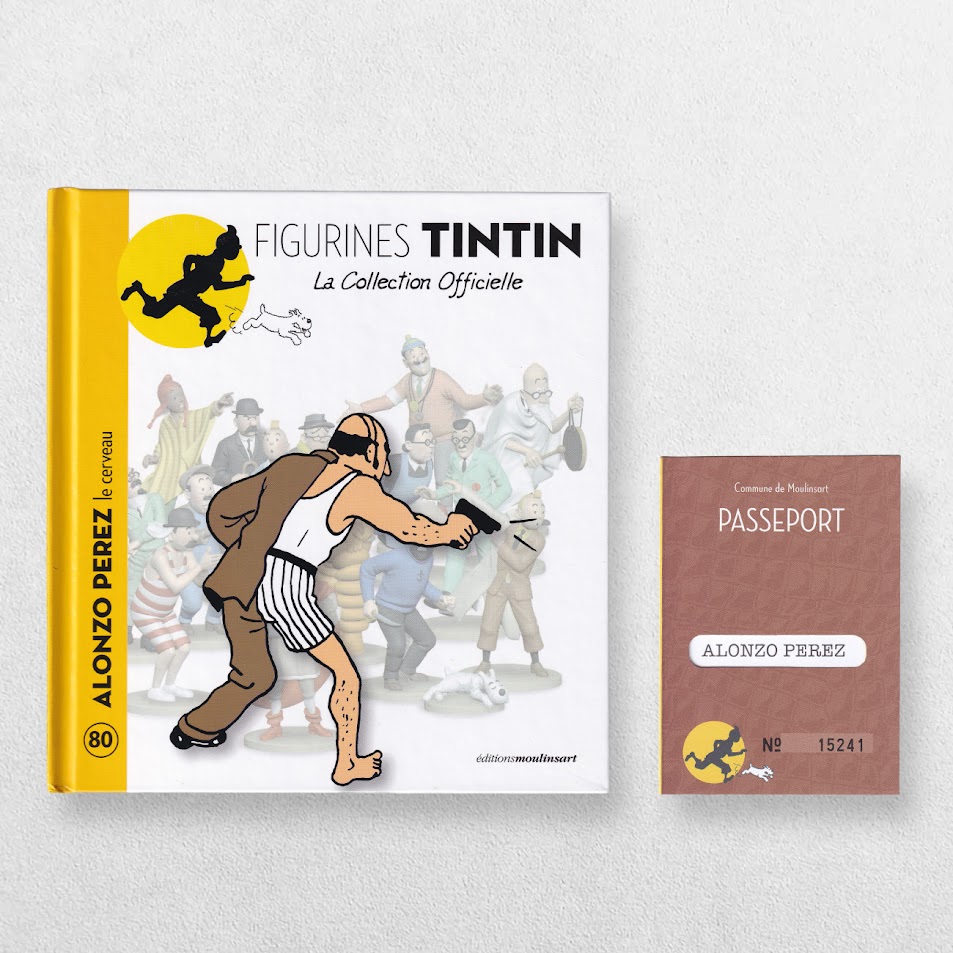
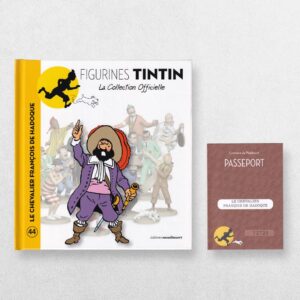
Alonzo Perez – Figurines Tintin La Collection Officielle – 80 – Alonzo Perez Le Cerveau
Author: Hergé & Editions Moulinsart
Price: £80.00
Publisher: Editions Moulinsart
Publication date: 2014
Format: Original pictorial boards with passport and figurine
Condition: In near fine condition
Illustrations: Illustrated throughout
Description:
Original pictorial boards. Includes passport loosely inserted. Text in French. Includes the accompanying figurine. One from the collection of 111 books and figurines. Very slight wear. In very near fine, clean condition overall.
Alonzo Perez: A Short Biography
Alonzo Pérez is a minor but distinctive antagonist appearing in The Adventures of Tintin – The Broken Ear (L’Oreille cassée, 1937). Alongside his accomplice Ramon Bada, Pérez serves as one of the story’s recurring villains — a pair of shady, opportunistic criminals whose greed and duplicity embody the darker side of colonial-era adventure fiction.
Though not among Hergé’s major figures, Pérez’s role is essential to the tone and texture of The Broken Ear. He represents both the comic and the corrupt, functioning as a narrative link between European opportunism and South American instability.
Character Overview
Alonzo Pérez, usually referred to simply as Pérez, is introduced as a cunning and deceitful South American who teams up with Ramon Bada to steal a valuable Arumbaya fetish from a Brussels museum. This small wooden idol, whose missing ear gives the album its title, conceals a precious diamond — a secret known only to a few.
Pérez’s primary traits are avarice, cunning, and moral flexibility. He is capable of charm and politeness when necessary, but behind his urbane manner lies opportunism and cruelty. His partnership with Ramon Bada operates on mutual greed rather than loyalty, and their relationship ultimately ends in betrayal and destruction.
Role in The Broken Ear
Theft of the Arumbaya Fetish
The story begins with the mysterious theft of the fetish from the Museum of Ethnography in Brussels. Pérez and Bada, posing as art dealers, orchestrate the crime, intending to sell or ransom the idol.
Tintin’s investigation quickly brings him into conflict with them, revealing their duplicity and greed.
Pursuit in South America
The trail leads Tintin to the fictional Republic of San Theodoros, a thinly disguised parody of Latin American states often subject to coups and revolutions. Pérez and Bada also travel there, hoping to recover the fetish after it changes hands.
In San Theodoros, the pair become entangled in the region’s endemic political chaos — switching allegiances between General Alcazar and his rival General Tapioca depending on who offers better opportunities.
Greed and Betrayal
Their greed leads them into increasingly desperate acts. Pérez’s partnership with Bada unravels as each seeks to secure the diamond for himself. Ultimately, both meet their demise — poetic justice for their moral corruption.
Hergé’s narrative thus fuses colonial adventure with moral allegory: crime leads inevitably to ruin, and greed devours itself.
Character Traits and Analysis
- Opportunistic and Amoral
Pérez personifies opportunism. He adapts easily to circumstance, whether posing as a respectable dealer in Europe or a political sympathiser in San Theodoros. For him, loyalty is transactional — a reflection of Hergé’s cynical view of power and greed.
- A Foil to Tintin
In moral terms, Pérez and Bada are perfect foils to Tintin. Where Tintin is selfless, they are selfish; where Tintin seeks truth, they chase profit. Their amorality highlights Tintin’s integrity and compassion.
- Cultural Stereotyping and Evolution
Hergé’s early work, including The Broken Ear, reflects the cultural attitudes of 1930s Europe. Pérez’s portrayal draws on stereotypes of the “Latin rogue” — suave, quick-tempered, and treacherous.
While problematic by modern standards, such depictions were part of Hergé’s early satirical style, aimed at caricaturing types rather than individuals. By the 1940s and beyond, Hergé’s characterisations grew more nuanced, reflecting his maturing worldview.
- Greed and Fate
Pérez’s downfall follows a moral pattern familiar in Hergé’s universe: those driven by greed or deceit are undone by their own flaws. His and Bada’s deaths are not portrayed with malice but with inevitability — a form of moral justice.
Themes Associated with Pérez
- The Corruption of Greed
Pérez’s defining motive is greed — the insatiable desire for wealth at any cost. This greed drives him across continents, into betrayal, and ultimately into death. In The Broken Ear, the fetish becomes a symbol of avarice: an object of beauty that brings destruction to all who covet it.
- Colonial Satire
Through Pérez and Bada, Hergé satirises not only individual corruption but also the broader absurdity of Western interference in South America. The fetish — stolen, sold, and fought over by outsiders — mirrors the exploitation of indigenous culture.
Pérez, though not European, participates in this exploitation, blurring the moral line between coloniser and opportunist.
- Moral Justice and Irony
Hergé’s moral universe is built on poetic justice. Pérez’s scheming collapses under its own weight, and his fate reinforces a central Tintin theme: evil destroys itself.
Artistic and Narrative Significance
In visual terms, Pérez and Bada mark Hergé’s transition from simple caricature to more expressive realism. Their appearances, gestures, and dialogue reflect growing sophistication in character design and pacing.
- Design: Pérez’s slick hair, narrow moustache, and expressive eyes convey cunning and vanity.
- Dialogue: His speech patterns oscillate between politeness and menace, adding tension to scenes of confrontation with Tintin.
- Comic Timing: The pair’s misadventures offer moments of dark humour, contrasting with the story’s colonial and political undertones.
The ligne claire style allows Hergé to depict Latin American settings — from jungles to battlefields — with striking clarity, situating Pérez within a vivid and dynamic world.
Moral and Philosophical Dimensions
Pérez’s story is, at its core, a moral fable. He illustrates how greed erodes humanity and how deceit isolates the individual. Hergé, through Tintin’s incorruptibility, suggests that integrity and compassion are the only lasting currencies.
Pérez and Bada’s deaths — swallowed by the river they exploited — evoke an almost biblical sense of retribution. Nature itself seems to reclaim the balance disturbed by human greed.
Legacy and Interpretation
Though a secondary figure, Alonzo Pérez has enduring symbolic importance within the Tintin canon. His character helps establish the pattern of dual antagonists — two criminals united by avarice, undone by betrayal — that Hergé revisited in later works (for instance, Allan and Rastapopoulos in The Red Sea Sharks).
For readers and scholars, Pérez represents Hergé’s early engagement with the moral complexities of global adventure: not simply the hero’s triumph, but the exposure of human folly beneath exotic escapism.
Summary
- Name: Alonzo Pérez
- First Appearance: The Broken Ear (L’Oreille cassée, 1937)
- Occupation: Smuggler, thief, and con artist
- Associates: Ramon Bada (partner in crime)
- Nationality: South American (fictionalised)
- Character Type: Opportunistic villain; foil to Tintin
- Themes: Greed, moral justice, betrayal, colonial satire
- Fate: Dies in pursuit of the Arumbaya fetish’s diamond
Conclusion
Alonzo Pérez may not rank among Hergé’s most famous villains, yet he plays a crucial part in shaping the moral and narrative architecture of The Adventures of Tintin.
His story, intertwined with deceit, greed, and downfall, epitomises the cautionary tone of The Broken Ear — a tale where avarice consumes itself, and purity of purpose, embodied by Tintin, stands unshaken amid corruption.
Through Pérez, Hergé begins his long exploration of moral ambiguity: the idea that villainy is not monstrous but human — born of weakness, desire, and the tragic blindness that greed brings.
Why Buy from Us?
At Hornseys, we are committed to offering items that meet the highest standards of quality and authenticity. Our collection of objects and rare books are carefully curated to ensure each edition is a valuable piece of bibliographical history. Here’s what sets us apart:
- Authenticity and Provenance: Each item is meticulously researched and verified for authenticity and collation.
- Expert Curation: Our selection process focuses on significance, condition, and rarity, resulting in a collection that is both diverse and distinguished.
- Customer Satisfaction: We aim to provide an exceptional customer experience, from detailed descriptions to secure and prompt delivery of your purchase.
- Returns Policy: We offer an unconditional guarantee on every item. If you wish to return an item, it may be sent back to us within fourteen days of receipt. Please notify us in advance if you wish to do so. The item must be returned in the same condition as it was sent for a full refund.
Cataloguer: Daniel Hornsey
Daniel Hornsey has specialised in fine and rare books, ephemera, and collectors’ editions for over thirty years. As a long-standing member of the antiquarian book trade, he has advised private collectors, curated catalogues, and sourced works for leading dealers, libraries and institutions across the world.
Hornseys’ exhibit regularly at book and map fairs in London and throughout the UK and are members of the Provincial Booksellers Fairs Association, the PBFA.
His fascination with Hergé’s work — especially ‘The Adventures of Tintin’ — began in childhood. Daniel recalls reading Tintin in original European editions and quickly recognising that these were not merely children’s books, but finely illustrated narratives crafted with artistic depth and wit.
As noted by the Musée Hergé in Louvain-la-Neuve, Hergé’s ‘ligne claire’ style has influenced generations of European comic artists and his original drawings and paintings command very high prices with his painting of ‘The Blue Lotus’ jar fetching £2.8m at auction in 2021.
By presenting these works through Hornseys’, he hopes to contribute to the continued appreciation of one of the 20th century’s most influential illustrators, helping new generations discover the artistry and legacy of Hergé.