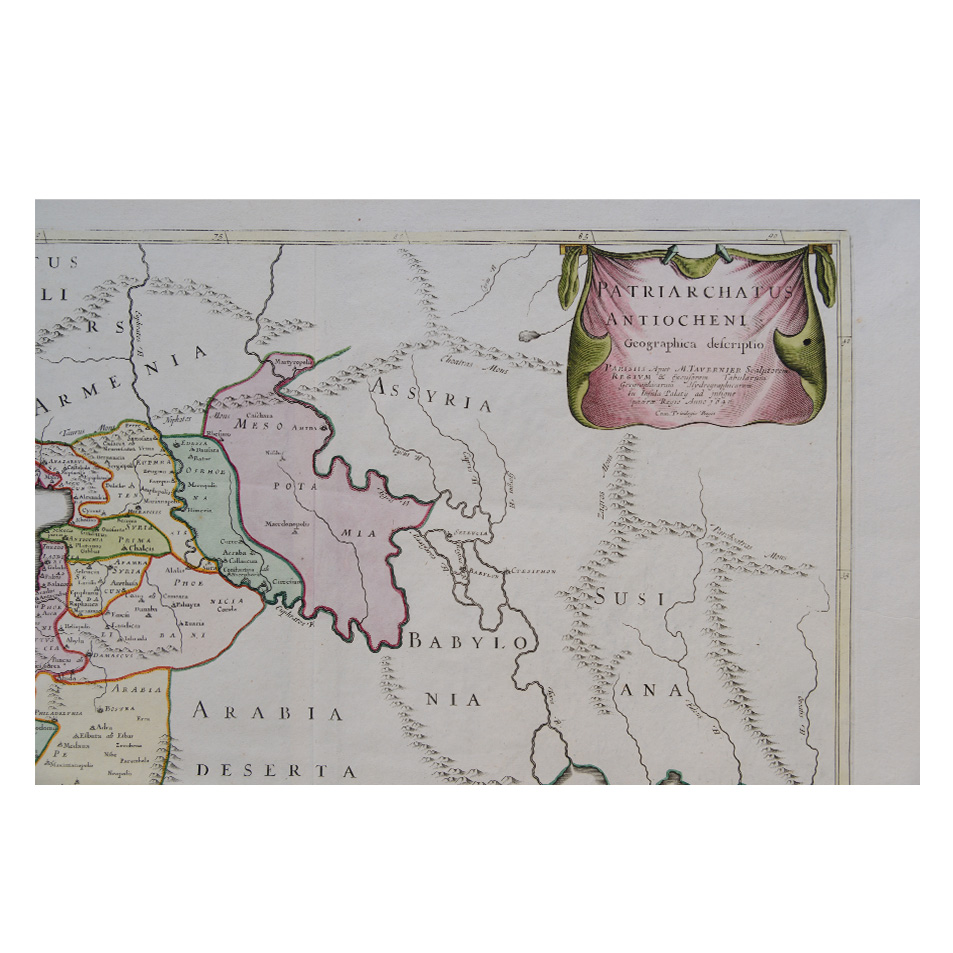
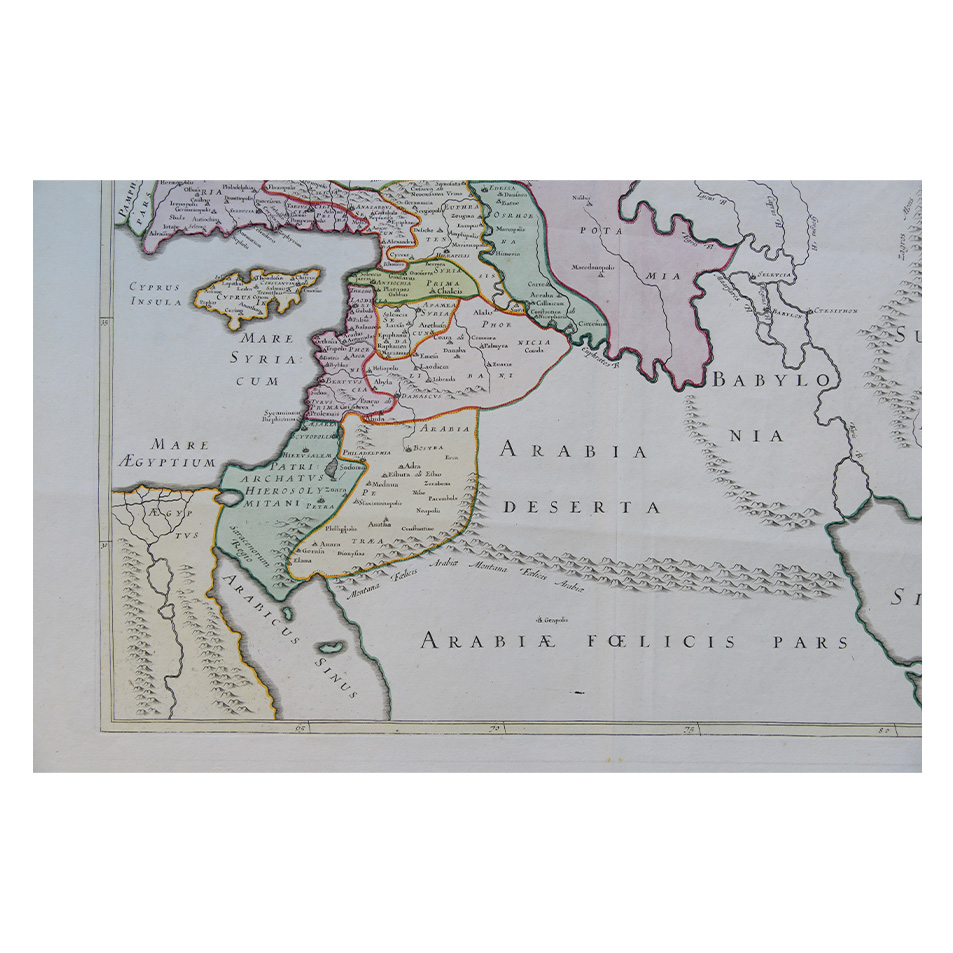
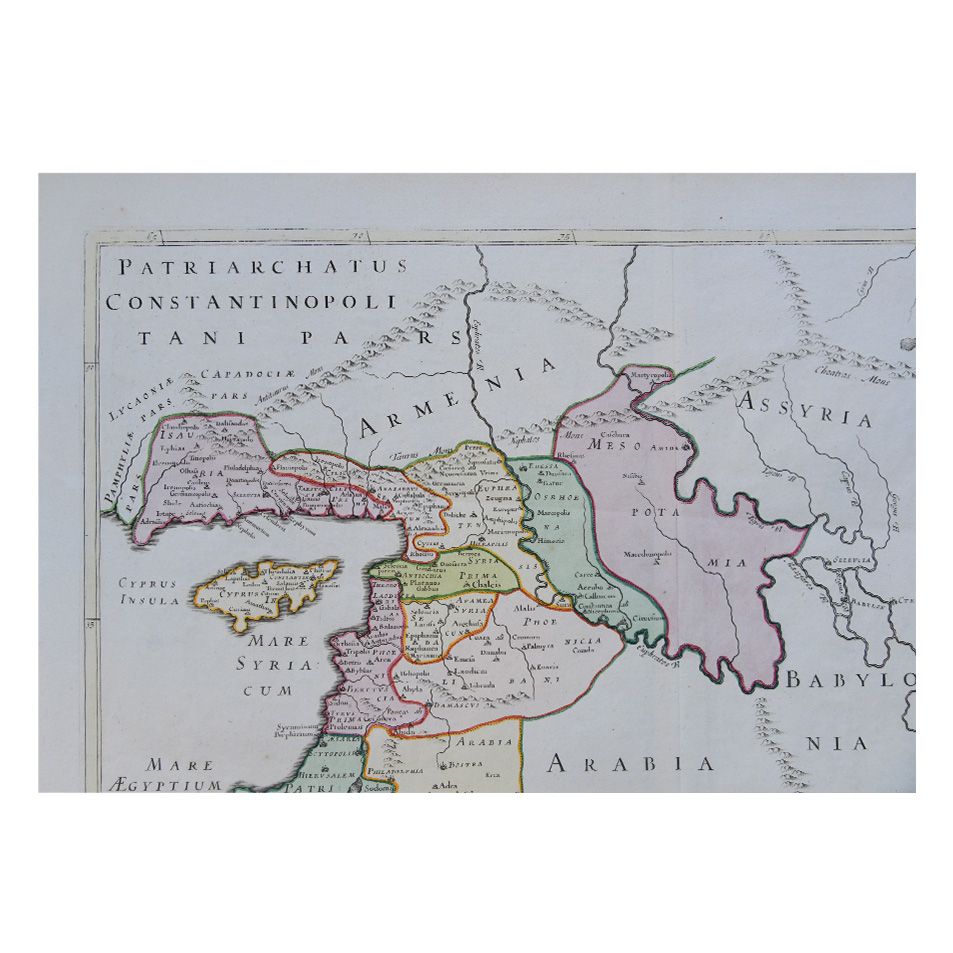
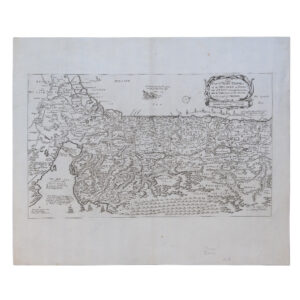
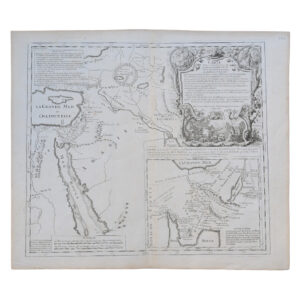
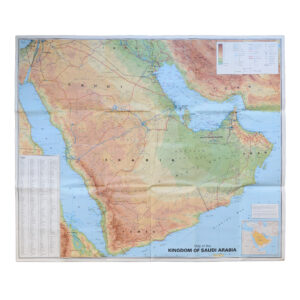
Arabia – North Africa – The Holy Land – The Near East – The Persian Gulf – Patriarchautus Antiocheni Geographica Descriptio – 1640
Cartographer: Tavernier, Melchior
Place: Paris, France
Price: £225 including postage in the UK
Publication Date: 1640
Edition: Not stated
Sheet Size: 60.4cm x 44.8cm
Condition: Near fine
Condition:
Original copper engraved map. Date: 1640. Sheet size: 60.4cm x 44.8cm. An ecclesiastical map of the region showing the Patriarchate of Jerusalem in Roman times. Covers from Cyprus and the Holy Land in the west to the Persian Gulf in the east, with the Tigris and Euphrates named. Contemporary and probably original colour. Slightly creased. Light age-toning to the edges of the paper, otherwise a near fine example. Scarce.
The Patriarchate Of Jerusalem In Roman Times: A Brief Overview
In Roman times, the Christian leadership of Jerusalem developed gradually from a local episcopal community into one of the most symbolically important sees in Christendom. The Patriarchate of Jerusalem, as it would later be formally recognised, did not yet exist in its mature institutional form during the Roman period, but its foundations—spiritual, ecclesiastical, and political—were laid between the 1st and early 4th centuries AD.
Jerusalem’s unique status derived not from administrative power, but from its unmatched theological and historical significance as the city of Christ’s crucifixion, resurrection, and the birth of the Christian Church.
- Jerusalem in the Early Roman Period (1st Century AD)
Roman Rule
Jerusalem came under Roman control in 63 BC and, during the lifetime of Jesus, formed part of the Roman province of Judaea, governed through client kings (such as Herod the Great) and later Roman prefects.
At this time:
- Christianity emerged as a Jewish movement within Second Temple Judaism
- The earliest Christian community was centred in Jerusalem
- Leadership was informal, charismatic, and communal
The First Christian Leadership
The earliest Christian leaders of Jerusalem were known as bishops, though the office was not yet formalised.
- James the Just, traditionally identified as the brother of Jesus, is regarded as the first leader of the Jerusalem church
- Leadership emphasised continuity with Jewish law and practice
- The community worshipped in Jerusalem while maintaining links with synagogues
This early phase was marked by Jewish-Christian identity, not separation from Judaism.
- The Destruction of Jerusalem (AD 70)
The First Jewish–Roman War
In AD 66–70, revolt against Roman rule culminated in:
- The siege and destruction of Jerusalem
- The destruction of the Second Temple
- Massive loss of life and displacement
For the Christian community, this was a decisive rupture.
Impact on the Church
- Jerusalem lost its position as a functioning Jewish city
- The Christian community dispersed temporarily
- Leadership continuity was maintained, but under radically altered conditions
The destruction weakened Jerusalem’s political importance but paradoxically strengthened its spiritual centrality in Christian memory.
- Aelia Capitolina and Exclusion (2nd Century AD)
Hadrian’s Rebuilding of Jerusalem
Following the Bar Kokhba Revolt (AD 132–135), Emperor Hadrian:
- Rebuilt Jerusalem as a Roman city named Aelia Capitolina
- Banned Jews from entering the city
- Established pagan temples, including one on the Temple Mount
Transformation of the Christian Community
This period marked a major shift:
- The Christian population became increasingly Gentile rather than Jewish
- Bishops of Jerusalem were now Greek-speaking rather than Jewish Christians
- The church adapted to Roman urban life
From this point, the Jerusalem church became structurally similar to other Roman Christian communities.
- Jerusalem’s Ecclesiastical Status under Roman Rule
A Suffragan See
Throughout most of the Roman period:
- Jerusalem’s bishop was subordinate to the Metropolitan of Caesarea Maritima, the provincial capital of Syria Palaestina
- Administratively, Jerusalem was not a leading centre of authority
This subordinate status contrasts sharply with Jerusalem’s symbolic prestige.
Tension Between Authority and Sanctity
Jerusalem’s importance rested on:
- The holy sites associated with Christ
- Apostolic memory
- Pilgrimage
Yet formal power lay elsewhere, especially in Caesarea, Antioch, Alexandria, and Rome.
This tension would define Jerusalem’s ecclesiastical identity for centuries.
- Persecution and Survival (2nd–3rd Centuries)
Roman Persecutions
Christians in Jerusalem, like elsewhere, faced intermittent persecution:
- Especially under emperors such as Decius and Diocletian
- Martyrdom narratives contributed to Jerusalem’s spiritual authority
Continuity of the Bishopric
Despite hardship:
- A continuous line of bishops was maintained
- The Jerusalem church preserved traditions linked to apostolic origins
- Local Christian memory of holy sites endured, even when sites were obscured by pagan structures
- The Turning Point: Constantine and the Early 4th Century
Legalisation of Christianity
With Constantine’s conversion and the Edict of Milan (313):
- Christianity became legally protected
- Jerusalem’s Christian community emerged from obscurity
Helena and the Holy Places
Constantine’s mother, Helena, sponsored:
- The identification of holy sites
- Construction of major churches, notably the Church of the Holy Sepulchre
This transformed Jerusalem into:
- A major pilgrimage centre
- A focal point of imperial Christian patronage
- Toward Patriarchal Status
Council of Nicaea (325)
At Nicaea:
- Jerusalem was granted special honour, recognising its unique spiritual role
- However, it remained administratively subordinate to Caesarea
This formalised Jerusalem’s exceptional status without granting full independence.
End of the Roman Period
By the late Roman / early Byzantine period:
- Jerusalem’s bishop exercised increasing influence
- Pilgrimage expanded rapidly
- The city’s Christian identity was fully established
Formal recognition as a Patriarchate would come later, at the Council of Chalcedon (451).
- Character of the Jerusalem Church in Roman Times
The Jerusalem church in Roman times was defined by:
- Apostolic memory rather than administrative dominance
- Marginalisation followed by resurgence
- Deep association with martyrdom and holy geography
- A unique balance between humility and spiritual authority
Its leaders were guardians of sacred memory more than governors of empire.
Conclusion
In Roman times, the Patriarchate of Jerusalem existed in embryo rather than in full institutional form. From its origins as a Jewish-Christian community, through destruction, exclusion, and gradual Gentile transformation, the Jerusalem church survived immense upheaval. Although lacking political or administrative power for much of the Roman period, it accumulated unparalleled spiritual prestige, rooted in the life, death, and resurrection of Christ.
By the early fourth century, under Christian imperial rule, Jerusalem emerged as a central pillar of the Christian world—poised to become one of the great patriarchates of late antiquity.
Why buy from us?
At Hornseys, we are committed to offering items that meet the highest standards of quality and authenticity. Our collection is meticulously curated to ensure that each item is a valuable and authentic piece of history. Here’s what sets us apart:
- Authenticity and Provenance: Every item is researched, collated, and verified for authenticity.
- Expert Curation: Each item is selected with a keen eye for significance, condition, and rarity, ensuring a collection that is both diverse and distinguished.
- Customer Satisfaction: We strive to provide an exceptional customer experience, from detailed descriptions and provenance to secure and prompt delivery of your purchase.
- Returns Policy: We offer an unconditional guarantee on every item. If you wish to make a return, items may be sent back to us within fourteen days of receipt for any reason. We request advance notification of returns, and items must be returned in the same condition as sent for a full refund.
Explore Our Collection:
Visit Hornseys to explore our fine collection of rare and signed books, maps, artwork and objects. Whether you are an avid collector or looking for a special gift, our selection offers something truly unique. Located in the picturesque Yorkshire Dales, our Ripon gallery has been a haven for book lovers, art enthusiasts, and collectors since 1976.
Thank you for looking.