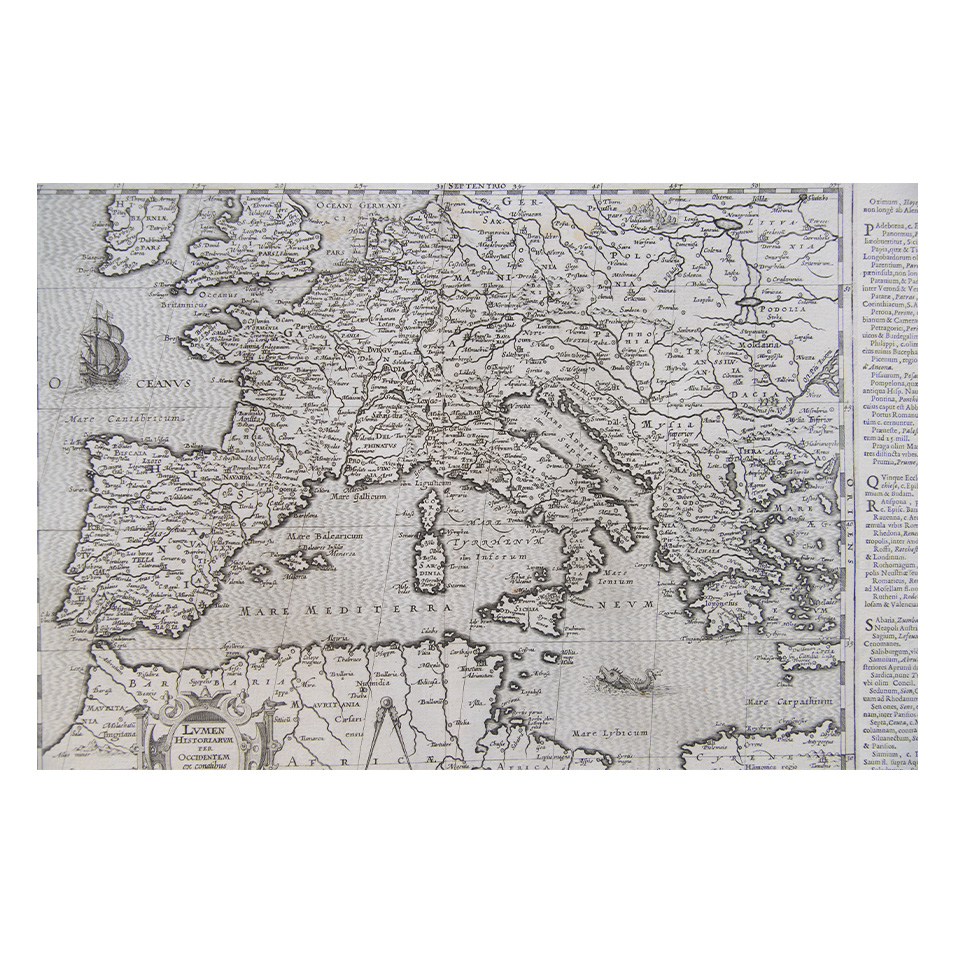
The Mediterranean Sea – North Africa – Europe – The Near East – Lumen Historiarum per Occidentem ex Conatibus Fran. Haraei Antverpiae
Ortelius, Abraham
£275.00
Availability: In stock
Product Description
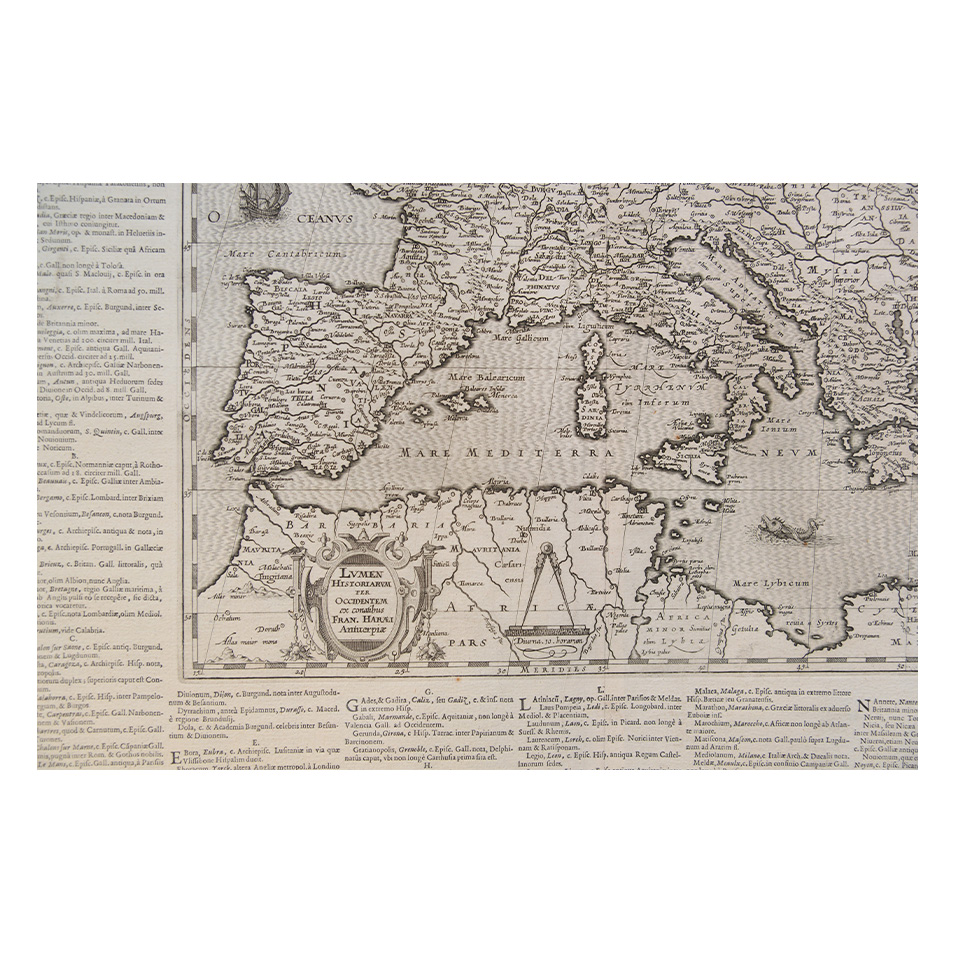
The Mediterranean Sea – North Africa – Europe – The Near East – Lumen Historiarum per Occidentem ex Conatibus Fran. Haraei Antverpiae
Cartographer: Ortelius, Abraham
Publisher: Fran. Hareio
Price: £275 including postage in the UK
Publication Date: 1624
Edition: Not stated
Sheet Size: 57.8cm x 45.8cm
Condition: Near fine
Condition:
Original copper engraved map. Not dated but 1624. Sheet size: 57cm x 45.8cm. A map of the Middle East from the Black Sea to the Persian Gulf from the ‘Parergon’, the last edition of 1624. Inset map of the World in an oval cartouche. Appears to show California as an island and notes the arrival of Columbus in 1492. Also includes an inset map of the Holy Land. A good, dark impression. Uncoloured and with some minor spotting and rust mark. Light toning to the edges of the paper, otherwise a near fine example. Scarce.
The Mediterranean Sea In The Early 17th Century: A Brief Overview
The Mediterranean in the early seventeenth century (c. 1600–1650) remained one of the most strategically important and culturally dynamic regions in the world. Although no longer the uncontested centre of global trade — a position challenged by Atlantic expansion — the Mediterranean continued to sustain dense commercial networks, imperial rivalries, naval conflict, religious competition and rich cultural interchange. It was a sea where Ottoman, Spanish, Italian, North African, French and emerging Northern European maritime powers interacted constantly.
- Geopolitical Landscape
Ottoman Empire
The Ottomans controlled the eastern and much of the southern Mediterranean:
- Anatolia, the Levant and Egypt
- Cyprus
- Coastal North Africa (Algiers, Tunis, Tripoli) via semi-autonomous regencies
- Key islands (Rhodes and others)
Ottoman power remained formidable, though internal tensions and Janissary unrest affected long-term stability.
Spanish Monarchy
Spain presided over a vast but overextended empire:
- Naples, Sicily and Sardinia
- The Balearic Islands
- Influence in western Mediterranean waters
However, Spain faced economic strain, military commitments in Europe, and growing rivalry with maritime powers such as the Dutch Republic.
Italian States
Italy was politically fragmented but economically active:
- Venice remained a major maritime republic with strong Levantine connections.
- Genoa maintained financial and naval influence, especially in relation to Spain.
- Tuscany, Savoy, and smaller states participated in regional commerce and naval activity.
France
Though not yet a dominant naval power, France expanded its Mediterranean presence, creating naval bases and cultivating alliances with the Ottomans through the long-standing Franco-Ottoman relationship.
North African Regencies
Algiers, Tunis and Tripoli were governed by Ottoman-appointed officials (beys, deys or pashas) but enjoyed practical autonomy. Their maritime fleets and corsair activities shaped the region’s political economy.
- Maritime Conflict and Corsairing
The Age of Corsairs
The early seventeenth century was the height of corsair activity, especially from:
- Barbary ports (Algiers, Tunis, Tripoli)
- Malta, controlled by the Knights Hospitaller
Corsairs targeted merchant shipping, seized goods, and took captives for ransom or slavery. This activity was not mere piracy but part of a semi-formalised maritime economy integrated with state interests.
Naval Warfare
The period saw:
- Frequent clashes between Ottoman fleets and Christian coalitions.
- Naval engagements involving Spain, the Venetians and the Knights of Malta.
- Defensive alliances and convoy systems to protect trade.
Christian–Muslim Rivalry
Maritime conflict retained a religious dimension, though political and economic interests often outweighed ideological motives. Alliances frequently crossed religious boundaries, such as French co-operation with the Ottomans.
- Trade and Economic Networks
Commercial Shifts
While the Atlantic economies were rising due to the Americas, the Mediterranean still played a vital role in:
- Grain exports from the Black Sea and Egypt
- Silk, spices, and luxury goods moving from the Levant and Persia
- Timber, pitch and naval supplies from the Balkans and Anatolia
- Textiles and manufactured goods from Italy and France
Key Trading Cities
- Venice: With declining but still significant Levantine trade.
- Marseille: An emerging French Mediterranean gateway.
- Livorno (Leghorn): A flourishing free port attracting Jewish and foreign merchant communities.
- Istanbul, Alexandria and Aleppo: Major Ottoman economic hubs linking Europe, Asia and Africa.
- Valletta: A fortified port tied to the Hospitaller order and Christian naval strategy.
Merchant Communities
The Mediterranean hosted an extraordinary diversity of merchants:
- Italians (Venetians, Genoese, Florentines)
- Ottomans (Turks, Greeks, Armenians, Jews)
- North Africans and Levantines
- English and Dutch companies expanding into the region
Their presence created a cosmopolitan economic environment.
- Religion and Cultural Interaction
Religious Diversity
The Mediterranean was a meeting point of:
- Roman Catholic Christianity (Italy, Spain, Malta, France)
- Eastern Orthodoxy (Greece, Balkans)
- Islam (Ottoman Empire and North Africa)
- Judaism, flourishing in Ottoman lands and cosmopolitan ports like Livorno and Salonica
Pilgrimage Routes
Jerusalem, Rome and Mecca linked the sea to wider religious networks. Pilgrims travelled by land and sea, stimulating local economies.
Cultural Syncretism
Despite political conflict, the Mediterranean was an area of cultural blending:
- Architectural styles, textile patterns and food traditions travelled widely.
- Multilingual populations lived in many cities.
- Diplomatic and commercial contact facilitated artistic and intellectual exchange.
- The Decline of Portuguese Influence and Rise of Northern European Powers
By the early seventeenth century:
- Portuguese influence in the eastern Mediterranean had diminished, especially after the loss of Hormuz.
- The Dutch Republic and England increased their presence, initially through commerce and diplomacy rather than territorial control.
- These nations secured trading privileges (capitulations) from the Ottomans, enabling the growth of Levant Company and VOC activity.
Their arrival signalled the beginning of a long-term shift toward northern European maritime dominance.
- Diplomatic Systems and Treaties
Diplomacy in the Mediterranean involved:
- Negotiation between Christian and Muslim states.
- Use of dragomans (interpreters) and merchant intermediaries.
- Ransoming agreements, crucial for recovering captives taken by corsairs.
- Long-term treaties (capitulations) granting safe passage, trading rights and legal protections to foreign merchants.
The Mediterranean diplomatic world was pragmatic, multilingual and transactional.
- Shipping, Navigation and Maritime Technology
Naval Vessels
The period used a mix of:
- Galleys, still prominent in warfare due to manoeuvrability in calm seas.
- Galleons and square-rigged ships, increasingly preferred for long-distance trade or heavy armament.
- Hybrid forms such as galley-galleons.
Navigation
Mediterranean sailors used:
- Coastal piloting
- Portolan charts
- Astrolabes and early navigational instruments
Though Atlantic techniques were evolving quickly, Mediterranean navigation remained highly skilled and sophisticated.
- Social and Demographic Patterns
Urban Centres
Cities were densely populated, culturally diverse and economically active. Centres such as:
- Istanbul
- Alexandria
- Venice
- Tunis
- Aleppo
served as melting pots of traders, sailors, artisans and scholars.
Coastal and Island Life
Life depended heavily on fishing, small-scale trade, agriculture and maritime labour. Islands such as Crete, Cyprus, Malta and the Balearics played crucial roles as naval bases, trading stations or contested borderlands.
Slavery and Captivity
Slavery was a pervasive institution:
- Christian and Muslim states both captured and enslaved prisoners taken at sea.
- Many coastal communities lived in fear of raids.
- Ransom societies and charitable networks emerged to redeem captives.
- Intellectual and Artistic Activity
The Mediterranean fostered:
- Scholarship in centres like Istanbul, Cairo, Rome and Venice
- Printing presses in Hebrew, Arabic, Turkish and various European languages
- Architectural development, notably in Ottoman cities
- Artistic exchange through diplomacy and trade
This cultural vibrancy made the region an intellectual crossroads.
Conclusion
The Mediterranean Sea in the early seventeenth century was a complex, interconnected maritime world characterised by:
- Imperial rivalry between the Ottomans, Spanish and various Italian states
- The dynamism of trade networks linking Europe, Africa and Asia
- The rise of corsairing and naval conflict
- Deep religious pluralism and cultural exchange
- The emergence of English and Dutch maritime influence
- Persistent piracy, captivity and diplomatic negotiation
Despite the Atlantic world’s ascendancy, the Mediterranean remained a vital arena of global politics, commerce and cultural creativity — a region where old powers persisted and new ones sought entry, and where diverse peoples interacted in ways that shaped the modern era.
Why buy from us?
At Hornseys, we are committed to offering items that meet the highest standards of quality and authenticity. Our collection is meticulously curated to ensure that each item is a valuable and authentic piece of history. Here’s what sets us apart:
- Authenticity and Provenance: Every item is researched, collated, and verified for authenticity.
- Expert Curation: Each item is selected with a keen eye for significance, condition, and rarity, ensuring a collection that is both diverse and distinguished.
- Customer Satisfaction: We strive to provide an exceptional customer experience, from detailed descriptions and provenance to secure and prompt delivery of your purchase.
- Returns Policy: We offer an unconditional guarantee on every item. If you wish to make a return, items may be sent back to us within fourteen days of receipt for any reason. We request advance notification of returns, and items must be returned in the same condition as sent for a full refund.
Explore Our Collection:
Visit Hornseys to explore our fine collection of rare and signed books, maps, artwork and objects. Whether you are an avid collector or looking for a special gift, our selection offers something truly unique. Located in the picturesque Yorkshire Dales, our Ripon gallery has been a haven for book lovers, art enthusiasts, and collectors since 1976.
Thank you for looking.
Related products


You may also like…

Saudi Arabia With City Maps Of Riyadh Jeddah And Dammam – Second Edition
£250.00GEOprojects Arab World Map Library