
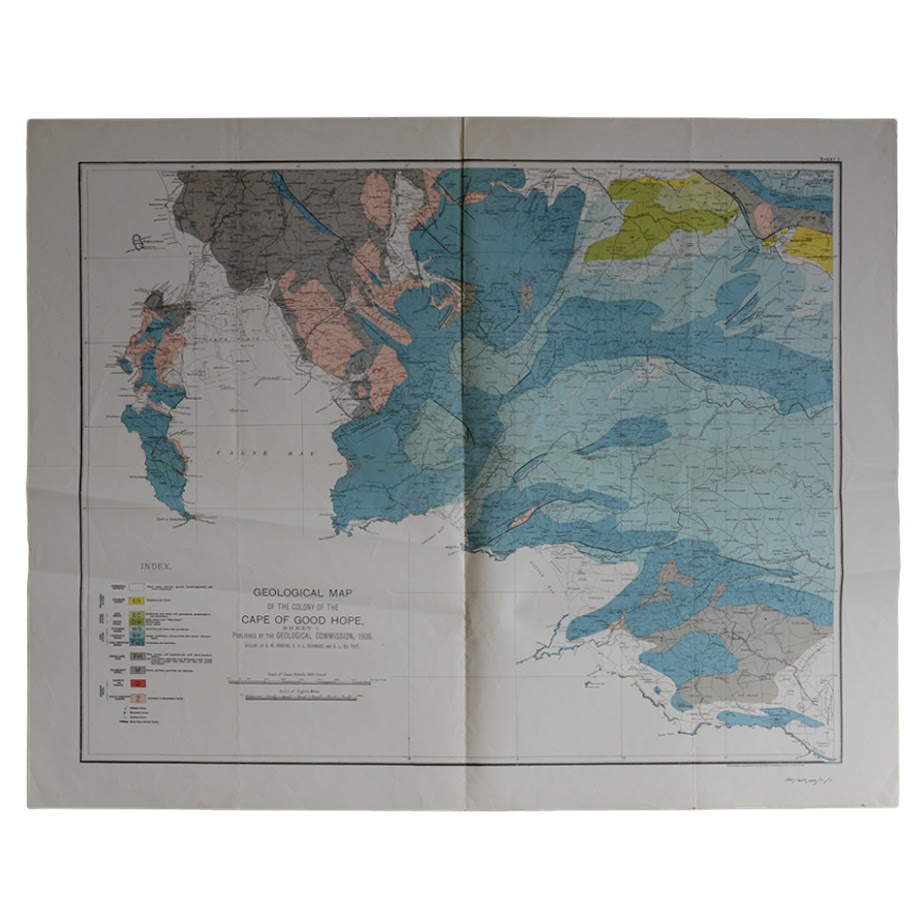
Geological Map Of The Colony Of The Cape Of Good Hope Sheet 1: Cape Town – Stellenbosch – Somerset West – Robertson – Napier
Rogers, A. W, Schwarz, E. H. L & Du Toit, A. L
£175.00
Availability: In stock
Product Description
Geological Map Of The Colony Of The Cape Of Good Hope Sheet 1: Cape Town – Stellenbosch – Somerset West – Robertson – Napier
Cartographer: Rogers, A. W, Schwarz, E. H. L & Du Toit, A. L
Publisher: The Geological Commission
Price: £175 (post-free in the UK)
Publication Date: 1906
Edition: 1st edition thus
Format: Lithograph
Condition: In very good condition
Sheet Size: 79.2cm x 63.5cm
Condition:
Lithograph. Sheet Size: 79.2cm x 63.5cm. Neat ink number to lower right margin. Old fold lines. Creased, marked, dusty and rubbed. Colouration very bright and clean. A very good copy. Very scarce.
Location: Pocket RSAGEOL: SR: 002851
Geology Of The Cape Of Good Hope Region: An Historical Overview
Introduction and Geographic Setting
The Cape of Good Hope, located at the south-western tip of South Africa, forms part of the Cape Peninsula, a rugged and mountainous landmass extending south from the city of Cape Town. This region lies within the broader Cape Fold Belt, a geological province characterised by its folded mountain ranges, steep coastal cliffs, and ancient sedimentary rocks.
Geologically, the Cape of Good Hope is a showcase of tectonic history, erosion processes, and stratigraphic development, offering a window into Earth’s distant past. It also forms part of the Cape Floral Kingdom, whose unique biodiversity is deeply tied to the region’s underlying geology.
Pre-Cape Supergroup Basement: The Malmesbury and Granite Foundations
Beneath the prominent cliffs of the Cape Peninsula lies a much older basement complex, composed of Malmesbury Group metasediments and Cape Granite Suite intrusions.
- The Malmesbury Group dates back over 550 million years to the late Precambrian, and consists of shales, greywackes, and turbiditic sandstones, deposited in a deep marine environment.
- These rocks were later folded, faulted, and metamorphosed during the Saldanian Orogeny, a period of mountain-building linked to the amalgamation of the ancient supercontinent Gondwana.
- Around 540–515 million years ago, the Cape Granite plutons intruded the Malmesbury rocks. These granitic bodies crystallised at depth, forming rounded outcrops such as those at Sea Point, Stellenbosch, and Simon’s Town.
These formations constitute the geological foundation of the Cape region and provided the structural platform upon which the younger rocks of the Cape Supergroup were deposited.
Cape Supergroup: Origins of the Fold Mountains
Overlying the basement complex is the Cape Supergroup, a thick succession of sedimentary rocks formed between approximately 490 and 330 million years ago, spanning the Ordovician to early Carboniferous periods.
The Cape Supergroup is divided into several sub-groups, the most significant of which in the Cape of Good Hope region is the Table Mountain Group.
Table Mountain Group
- Composed mainly of quartzitic sandstones, shales, and occasional conglomerates
- These rocks were deposited in ancient river, deltaic, and shallow marine environments
- The sequence includes well-known formations such as the Graafwater Formation (fine-grained reddish beds) and the Peninsula Formation (massive, resistant sandstones)
The hardness and resistance of these rocks to weathering has given rise to the iconic flat-topped relief of Table Mountain and the high cliffs of Cape Point. Their silica-rich composition limits soil fertility but supports the fynbos biome, which thrives on nutrient-poor substrates.
Cape Fold Belt Formation
The defining geological event that shaped the region’s topography was the Cape Orogeny, which occurred around 270–230 million years ago during the late Palaeozoic.
This mountain-building episode resulted from:
- The collision of the Falkland Plateau and Gondwana’s southern margin
- Intense compressional forces that folded the Cape Supergroup into a series of east-west trending anticlines and synclines
- Development of thrust faults, cleavage zones, and tight folds, visible in spectacular outcrops at Cape Point, Chapman’s Peak, and along the Garden Route
The Cape Fold Belt extends from Cape Town eastwards to Port Elizabeth, but is most dramatically expressed in the mountainous terrain of the Peninsula, where geological structures directly influence the landscape.
Mesozoic to Cenozoic: Post-Orogenic Erosion and Coastal Development
Following the Cape Orogeny, the region entered a long period of erosion and peneplanation, reducing ancient mountains to subdued plains. Later geological developments include:
- Break-up of Gondwana (~180–130 million years ago), which initiated the opening of the South Atlantic Ocean
- Uplift of the southern African plateau, rejuvenating rivers and enhancing erosion
- Formation of marine terraces, raised beaches, and wave-cut platforms along the Cape’s rugged coastline during the Cenozoic era
The fluctuating sea levels of the Pleistocene glacial cycles further sculpted the coastline, depositing marine sands, shell beds, and creating caves and overhangs inhabited by early humans.
Quaternary Processes and Present Landscape
The modern landscape of the Cape of Good Hope reflects a dynamic interplay of tectonic stability, climatic variation, and marine processes:
- The coastal cliffs and sandy bays result from a combination of wave erosion and longshore drift
- Inland, weathering of sandstone ridges produces tors, boulder fields, and nutrient-poor soils
- Wind-blown dune systems such as those near Noordhoek and Cape Flats indicate active aeolian processes
These geological features support a range of microhabitats, crucial to the Cape Floristic Region, a UNESCO World Heritage Site.
Human Interaction with Geology
The geology of the Cape has profoundly influenced human settlement, culture, and infrastructure:
- The hard quartzites provided material for building stone and early road construction
- The cliffs at Sea Point were among the first localities studied in South African geology, famously examined by Charles Darwin during his voyage on the HMS Beagle
- Caves in the False Bay area preserve archaeological evidence of Middle Stone Age habitation, linking geological features to the evolution of modern humans
Modern challenges include land use planning on geologically sensitive terrain, water management in fractured rock aquifers, and geoconservation of sites of scientific and cultural importance.
Conclusion
The Cape of Good Hope region presents a geological narrative stretching back over half a billion years, from ancient seabeds and mountain-building to modern coastal evolution. Its rocks and structures are not only spectacularly scenic but also key to understanding the geological evolution of southern Africa and the emergence of modern ecosystems.
Geology here is not merely academic—it is a living presence in the landscape, vegetation, heritage, and even the identity of the Cape itself.
A. L. Du Toit: A Short Biography
Early Life and Education
Alexander Logie du Toit was born on 14 March 1878 in Newlands, Cape Town, within the then Cape Colony of South Africa. He was raised in a cultured and academically inclined household of Scots descent, and from an early age demonstrated a marked interest in the natural world.
Du Toit received his schooling at the South African College School and later enrolled at the South African College (now the University of Cape Town), where he pursued studies in geology, chemistry, and physics. He continued his education in Britain, studying mining engineering at the Royal Technical College in Glasgow and gaining practical experience in geological fieldwork and mapping.
Early Career and Geological Survey Work
Upon returning to South Africa in the early 1900s, du Toit joined the Geological Commission of the Cape of Good Hope, later absorbed into the Geological Survey of the Union of South Africa. His initial assignments took him to the Karoo Basin, where he began conducting detailed fieldwork and geological mapping, especially in the semi-arid interior of the country.
His early work included:
- Mapping of coal-bearing strata in the Karoo Supergroup
- Detailed studies of stratigraphy and sedimentology
- Investigations into the economic potential of South Africa’s coal and mineral resources
Du Toit rapidly distinguished himself through his meticulous field observations, clear cartographic skills, and interpretive insights. He played a major role in the development of South Africa’s first comprehensive geological maps of key economic regions.
Pioneering Work on Continental Drift
Du Toit’s greatest contribution to science lay in his early and robust support for the then-controversial theory of continental drift. Building upon the ideas of Alfred Wegener, the German meteorologist and geophysicist who proposed that continents had once formed a single landmass (Pangaea), du Toit became one of the theory’s most articulate and respected advocates.
In 1923, he undertook an ambitious geological expedition to South America, specifically to Argentina and Brazil, to compare geological formations with those in southern Africa. His comparative analysis of:
- Fossil flora (notably Glossopteris)
- Stratigraphic sequences
- Glacial deposits
- Petrological similarities
provided compelling evidence for the idea that Africa and South America had once been joined as part of the southern supercontinent Gondwana.
This work culminated in the publication of his landmark book, “Our Wandering Continents” (1937), in which he elaborated on the geological, palaeontological, and climatological data supporting continental drift theory. Although controversial at the time, the book would later be seen as a foundational text in support of what would evolve into the theory of plate tectonics.
Scientific Recognition and International Engagement
Despite initial scepticism from many geologists, particularly in North America and Britain, du Toit’s work earned widespread respect for its rigour, clarity, and global vision. He was known not only for the detail of his fieldwork but also for his ability to synthesise large bodies of data across continents—an approach that was well ahead of its time.
He received numerous honours and appointments, including:
- Fellowship of the Royal Society of South Africa
- Membership in the Geological Society of London
- Honorary doctorates from South African and international universities
Du Toit remained a modest and disciplined scholar, focused on the scientific method and the global implications of geological phenomena. His dedication to field-based observation and intercontinental comparison made him a model of methodological integrity.
Later Life and Legacy
Alexander du Toit retired from official survey work in the 1940s but continued to publish, correspond, and advise until his death in Cape Town in 1948. At the time of his passing, the theory of continental drift remained controversial, yet within two decades it would be revitalised and universally accepted under the framework of plate tectonics—a scientific revolution to which du Toit had made a crucial early contribution.
Today, du Toit is recognised as one of South Africa’s most distinguished geologists, and one of the key transitional figures in the history of Earth science. His legacy includes:
- The Du Toit Nunataks in Antarctica, named in his honour
- His enduring role in Gondwana studies and palaeogeographic reconstruction
- The development of modern geological mapping and stratigraphic correlation in southern Africa
Conclusion
L. du Toit was a geologist of remarkable vision, discipline, and intellectual courage. At a time when the idea of drifting continents was ridiculed, he pursued a global, integrative approach to geological science, based on painstaking fieldwork and comparative analysis.
His work not only advanced understanding of South Africa’s geological foundations, but also helped lay the groundwork for the most significant paradigm shift in Earth sciences in the 20th century. Du Toit’s life exemplifies the qualities of curiosity, persistence, and scientific integrity, making him a figure of enduring importance in both national and international geological history.
SHOP WITH CONFIDENCE AT HORNSEYS
At Hornseys, we are dedicated to offering items that uphold the highest standards of quality and authenticity. Our collection of artwork is carefully curated to ensure that each item we offer is authentic, collated, and complete.
Here’s what sets us apart:
- Authenticity and Provenance: Each map is researched and verified for authenticity.
- Expert Curation: We entirely own all our artworks. We trust our taste and have invested heavily in it. We have confidence in all artwork that we offer for sale.
- Customer Satisfaction: We strive to provide an exceptional customer experience, from detailed descriptions and provenance to secure and prompt delivery of your purchase.
- Returns Policy: We offer an unconditional guarantee on every item. If, however, you wish to make a return, artworks may be sent back to us within fourteen days of receipt for whatever reason. We request that we are notified in advance if you wish to do so. They must be returned to us in the same condition as they were sent for a full refund.
OUR COMMITMENT TO QUALITY AND SERVICE
Understanding the value and rarity of these items, we ensure that every aspect of your purchase meets the highest standards of quality and service. This includes:
- Free Expedited, Tracked, and Insured Delivery within the UK: Ensuring that your artwork arrives safely and promptly.
- Fully-Insured Worldwide Delivery: Offering peace of mind for international collectors with reliable and secure shipping options.
EXPLORE OUR COLLECTION
Visit Hornseys today to explore our fine collection of maps and other artworks. Whether you are an avid collector or looking for a special gift, our selection offers something truly unique. Located since 1976 in Ripon in the picturesque Yorkshire Dales, we are recognized as a destination gallery for tastefully curated artwork, rare maps, design, and fine books.
Related products


You may also like…

Tectonic Map Of Australia – First Edition – Map On Four Sheets
£650.00Bureau of Mineral Resources, Geology and Geophysics


