
Related products
You may also like…
-

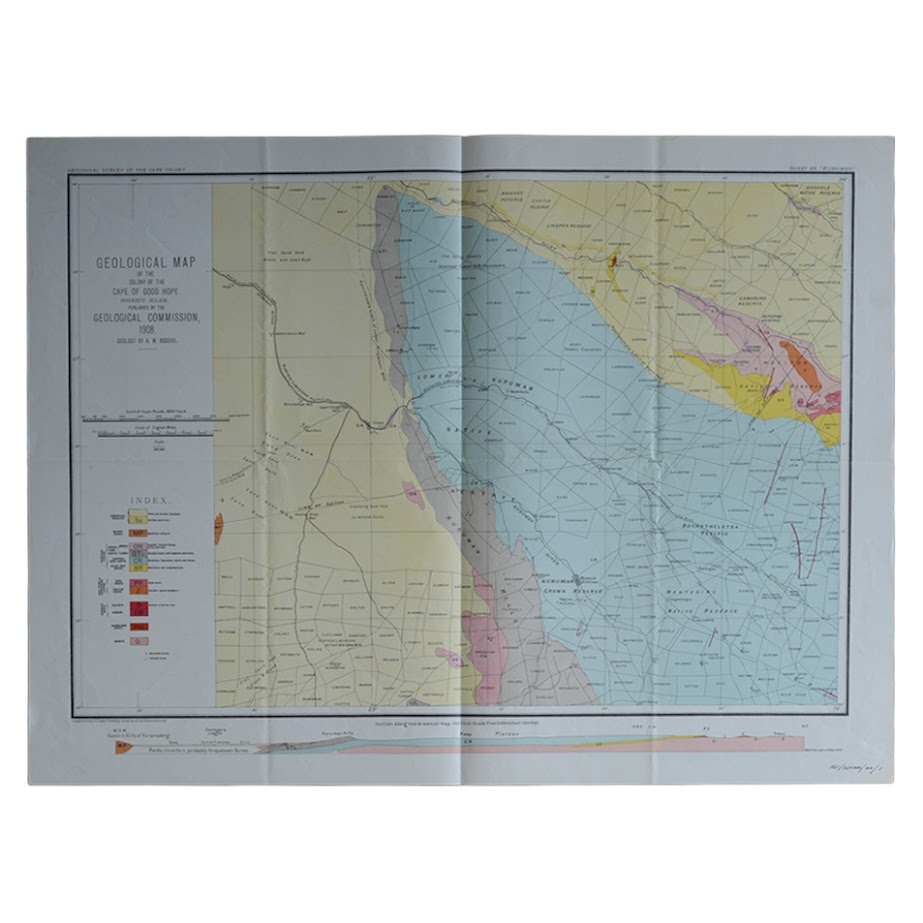
Geological Map Of The Colony Of The Cape Of Good Hope Sheet 50 – Vryburg
£125.00Du Toit, A. L & Rogers, A. W.
-

-

-

-

-

-

Rogers, A. W.
£125.00
Availability: In stock
Cartographer: Rogers, A. W.
Publisher: The Geological Commission
Price: £125 (post-free in the UK)
Publication Date: 1908
Edition: 1st edition thus
Format: Lithograph
Condition: In very good condition
Sheet Size: 74.1cm x 56.6cm
Lithograph. Sheet Size: 74.1cm x 56.6cm. Neat ink number to lower right margin. Old fold lines. Closed tears to a couple of fold lines to the margins. Creased, marked, dusty and rubbed. Colouration very bright and clean. A very good copy. Very scarce.
Location: Pocket RSAGEOL: SR: 002857
The town of Kuruman, located in the Northern Cape Province of South Africa, sits within one of the most geologically significant and mineral-rich regions on the African continent. It lies at the southern edge of the Kalahari Basin, where the ancient rocks of the Griqualand West Basin and the Transvaal Supergroup come to the surface beneath the more recent Kalahari sands.
Kuruman is globally renowned for its well-preserved Banded Iron Formations (BIFs), manganese deposits, and its important contribution to the understanding of the early Earth’s atmosphere and biosphere.
The geological foundations of the Kuruman region rest upon the Kaapvaal Craton, one of Earth’s oldest and most stable crustal blocks, formed over 3 billion years ago. This ancient continental core underlies much of the interior of southern Africa and provides a stable platform upon which younger geological sequences were deposited.
Although these Archaean basement rocks are mostly buried beneath younger strata in Kuruman itself, they are essential in understanding the tectonic and geodynamic setting that allowed the formation of extensive sedimentary basins in the Palaeoproterozoic era.
The most geologically important and exposed rocks in the Kuruman region belong to the Transvaal Supergroup, particularly the Ghaap Group, which was deposited between 2.6 and 2.2 billion years ago. The sedimentary succession here is part of the Griqualand West Basin, a major depositional feature along the western margin of the Kaapvaal Craton.
This group consists mainly of:
Located stratigraphically above the carbonates, the Asbestos Hills Subgroup is composed of:
Perhaps the most internationally renowned unit, the Kuruman Banded Iron Formation (BIF) is a thick, regionally extensive layer of:
The Kuruman BIF extends across hundreds of kilometres and is crucial in our understanding of early atmospheric oxygenation, as well as being a major economic resource.
Overlying the iron formations is the Postmasburg Group, a younger sequence of sedimentary rocks that includes the Hotazel Formation, which hosts the region’s famous manganese ore bodies.
This economic geology has driven both historic and contemporary mining activities, centred around towns such as Hotazel and Kathu.
Above the Proterozoic formations, the Kuruman area is draped by a blanket of much younger, Cenozoic Kalahari Group sediments, deposited over the last 65 million years. These include:
These unconsolidated deposits obscure the underlying geology but are integral to the region’s surface hydrology and soil profile.
The Kuruman region, although tectonically stable today, exhibits evidence of past structural deformation, particularly in the form of:
Structural control is also evident in the location of manganese and iron ore bodies, which are often concentrated along palaeofaults or synsedimentary growth faults.
The geology of the Kuruman region has a direct influence on its water resources. The dolomitic formations of the Chuniespoort Group are highly permeable due to karstification, which gives rise to important springs, including:
Aquifers in the region are commonly confined to:
Water quality is generally good but may be affected by iron and manganese levels, depending on the host geology.
The Kuruman region is not only economically vital due to its mineral deposits but is also scientifically valuable for:
Mining and geological research have coexisted in the area for decades, with ongoing geophysical surveys, drilling programmes, and stratigraphic correlations continuing to refine knowledge of the region.
Conclusion
The geology of the Kuruman region is a story of deep time—of ancient marine environments, microbial life, and tectonic quietude that preserved some of the best geological archives on the planet. Its banded iron formations and manganese deposits are internationally renowned, both for their economic value and their significance in tracing Earth’s early biosphere and atmosphere.
From the quiet emergence of the Eye of Kuruman to the vast manganese mines of the Kalahari Basin, this region’s geological identity is both ancient and alive, offering insight into processes that shaped the very foundation of the modern Earth.
At Hornseys, we are dedicated to offering items that uphold the highest standards of quality and authenticity. Our collection of artwork is carefully curated to ensure that each item we offer is authentic, collated, and complete.
Here’s what sets us apart:
Understanding the value and rarity of these items, we ensure that every aspect of your purchase meets the highest standards of quality and service. This includes:
EXPLORE OUR COLLECTION
Visit Hornseys today to explore our fine collection of maps and other artworks. Whether you are an avid collector or looking for a special gift, our selection offers something truly unique. Located since 1976 in Ripon in the picturesque Yorkshire Dales, we are recognized as a destination gallery for tastefully curated artwork, rare maps, design, and fine books.


Du Toit, A. L & Rogers, A. W.
| Cookie | Duration | Description |
|---|---|---|
| cookielawinfo-checkbox-analytics | 11 months | This cookie is set by GDPR Cookie Consent plugin. The cookie is used to store the user consent for the cookies in the category "Analytics". |
| cookielawinfo-checkbox-functional | 11 months | The cookie is set by GDPR cookie consent to record the user consent for the cookies in the category "Functional". |
| cookielawinfo-checkbox-necessary | 11 months | This cookie is set by GDPR Cookie Consent plugin. The cookies is used to store the user consent for the cookies in the category "Necessary". |
| cookielawinfo-checkbox-others | 11 months | This cookie is set by GDPR Cookie Consent plugin. The cookie is used to store the user consent for the cookies in the category "Other. |
| cookielawinfo-checkbox-performance | 11 months | This cookie is set by GDPR Cookie Consent plugin. The cookie is used to store the user consent for the cookies in the category "Performance". |
| viewed_cookie_policy | 11 months | The cookie is set by the GDPR Cookie Consent plugin and is used to store whether or not user has consented to the use of cookies. It does not store any personal data. |