Johannes Herolt (Discipulus) – Sermones de Sanctis – “Posui vos ut eatis et fructum afferatis” – Original Early Printed Latin Sermon Leaf – c.1500
Description
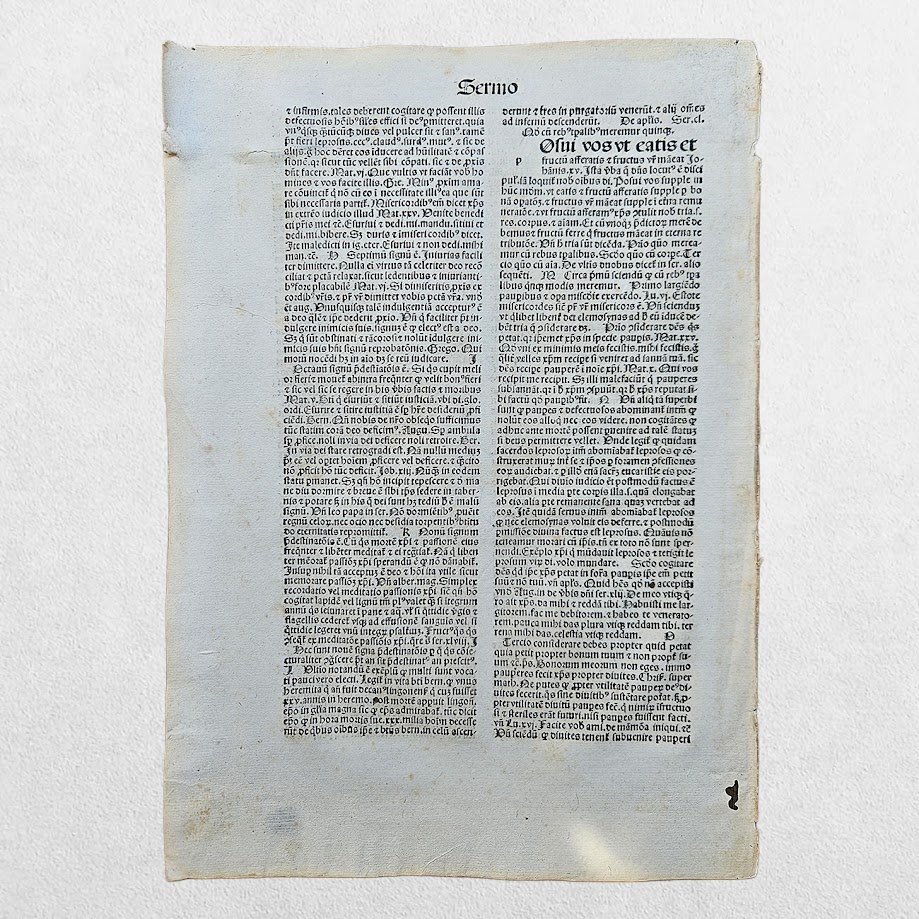
An original early printed leaf from the enormously influential sermon collection of Johannes Herolt, known as “Discipulus”, containing part of his Sermones de Sanctis and opening a sermon based upon John 15:16: “Posui vos ut eatis et fructum afferatis, et fructus vester maneat” – “I have appointed you that you should go, and bring forth fruit, and that your fruit should remain.”
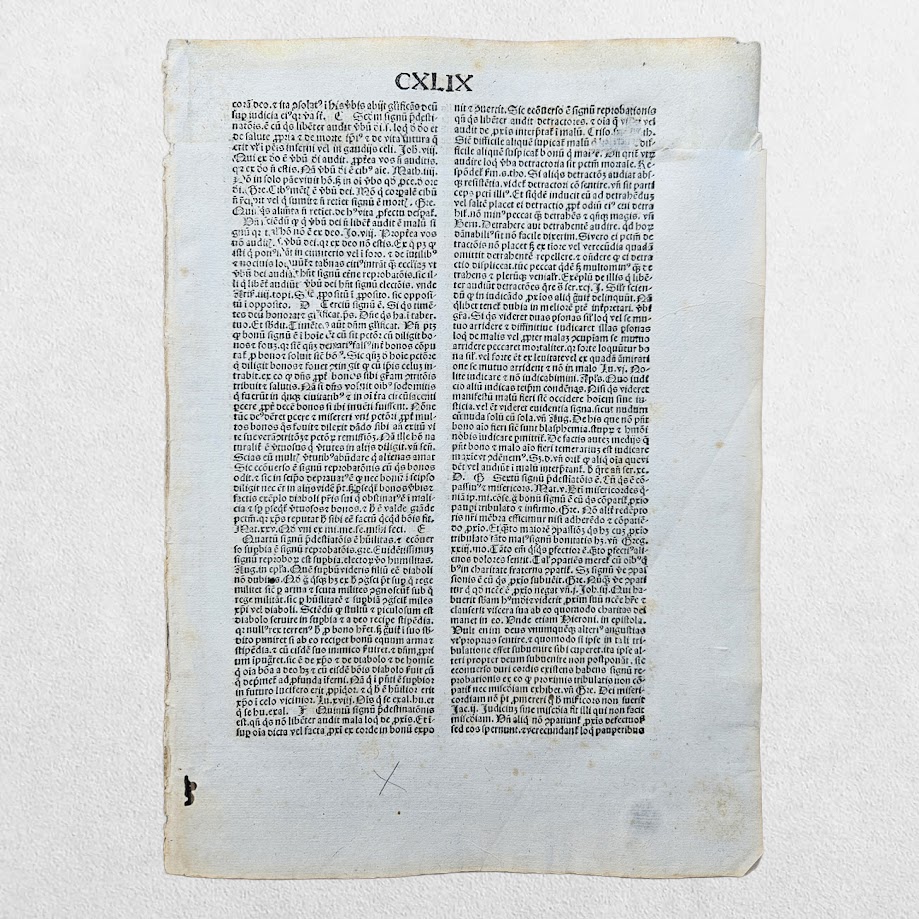
Printed in Latin in two closely set columns of Gothic type, the leaf measures approximately 30.3 x 21.5 cm. One side is headed with the Roman numeral CXLIX, while the reverse carries the running heading “Sermo” and introduces the new sermon with the biblical text prominently set in a larger Gothic type: “Posui vos ut eatis et fructum afferatis et fructus vester maneat”. The opening continues, in abbreviated late-medieval Latin, with the characteristic wording “Ista verba quae dominus locutus est discipulis iam loquitur nobis omnibus…” – explaining that the words spoken by Christ to his disciples are now addressed to all Christians.
This incipit provides a particularly useful means of identification. Medieval manuscript catalogues record the same sermon amongst the works of Johannes Herolt, beginning “Posui vos ut eatis et fructum afferatis et fructus vester maneat. Ioh. 15. Ista verba quae dominus locutus est discipulis iam loquitur nobis omnibus…”.
Johannes Herolt (d. 1468) was a Dominican friar and preacher associated with Nuremberg and one of the most widely circulated sermon writers of the later Middle Ages. His collections, conventionally known as the Sermones Discipuli, supplied clergy with model sermons organised around the liturgical year and the feasts of the saints. Their extraordinary popularity is demonstrated by their survival in numerous manuscripts and by repeated printed editions during the final decades of the fifteenth century. The University of Notre Dame notes that Herolt’s sermon sequences were printed more than forty times during the fifteenth century alone.
Herolt deliberately described these works as sermons of the “Discipulus” – the disciple or student – rather than of the master, explaining that they were compiled from the sayings of saints and other books in a straightforward form useful to preachers. This practical character helped make the Sermones Discipuli one of the major preaching manuals of late-medieval Europe.
The present sermon is particularly concerned with the spiritual “fruit” expected of the Christian life. Herolt develops Christ’s command in John 15:16 through discussions of merit, charity, mercy and good works, with particular emphasis upon the treatment of the poor. The text visible on the leaf repeatedly invokes pauperes and misericordia, characteristic of the strongly pastoral and practical moral theology for which Herolt’s preaching collections were valued.
Numerous early editions of Herolt survive. Bibliographical records document, among others, Lyon editions of 1485 and 1487, further fifteenth-century printings, a 1504 edition and a Cologne edition printed by Quentel in 1510. The precise edition from which this detached leaf originated has not been established conclusively; we therefore catalogue it responsibly as an early printed leaf, c.1500, rather than assigning an unsupported printer or exact year.
The typography remains strongly rooted in the manuscript tradition: dense Gothic letterpress, extensive scribal-style contractions and abbreviations, two-column composition, Roman-numeral foliation and an enlarged textual incipit. It provides an excellent tangible example of the transitional period during which texts that had circulated for generations in manuscript were being disseminated on a much greater scale through movable-type printing.
Condition
Good condition for an early printed leaf of this age. General age-toning and light surface marking, with scattered spotting and some marginal discolouration. Minor edge wear and irregularity, including a small loss or indentation towards the upper left edge and slight wear at the corners. A horizontal old crease or paper disturbance is visible towards the upper portion of the leaf, together with a few small historical marks and annotations, including a small ink mark towards the lower margin and a faint graphite or manuscript-style cross near the foot.
The printed area remains remarkably well preserved. The Gothic type is dark, crisp and extensively legible, with no substantial textual loss. Both columns retain generous surrounding margins and the prominent sermon opening on the reverse displays particularly well.
Please study the photographs carefully as they form an important part of the condition description.
Author: Johannes Herolt, known as Discipulus
Dominican preacher, died 1468.
Work: Sermones Discipuli / Sermones de Sanctis
Text: Sermon beginning “Posui vos ut eatis et fructum afferatis…”, based upon John 15:16.
Date: c.1500: The exact printing has not yet been established; Herolt’s sermons were repeatedly printed during the incunable and early post-incunable periods.
Language: Latin.
Size: 30.3 x 21.5 cm
Printing: Letterpress in Gothic type, arranged in two columns.
Material: Early laid paper.
Subject: Late-medieval preaching; Dominican theology; Christian pastoral instruction; John 15:16; apostles; charity; mercy; poverty; sermon literature; early printing.
Authentication and Research
This leaf has been handled, inspected and catalogued in-house at our Ripon gallery. Identification has been made through direct examination of the printed text and comparison of the sermon incipit with institutional manuscript and bibliographical records for Johannes Herolt’s Sermones. Austrian manuscript catalogues preserve the same sequence beginning “Posui vos ut eatis…” followed by “Ista verba quae dominus locutus est discipulis iam loquitur nobis omnibus”, supporting the attribution to Herolt.
Because numerous closely related editions appeared in the late fifteenth and early sixteenth centuries, no specific printer or year has been asserted without a definitive typographical collation.
Why buy from us?
At Hornseys, we are committed to offering items that meet the highest standards of quality and authenticity. Our book collection is meticulously curated to ensure that each edition is a valuable and authentic piece of bibliographical history. Here’s what sets us apart:
- Authenticity and Provenance: Every book is researched, collated, and verified for authenticity.
- Expert Curation: Each book is selected with a keen eye for significance, condition, and rarity, ensuring a collection that is both diverse and distinguished.
- Customer Satisfaction: We strive to provide an exceptional customer experience, from detailed descriptions and provenance to secure and prompt delivery of your purchase.
- Returns Policy: We offer an unconditional guarantee on every item. If you wish to make a return, books may be sent back to us within fourteen days of receipt for any reason. We request advance notification of returns, and books must be returned in the same condition as sent for a full refund.
Explore Our Collection:
Visit Hornseys to explore our fine collection of rare and signed books. Whether you are an avid collector or looking for a special gift, our selection offers something truly unique. Located in the picturesque Yorkshire Dales, our Ripon gallery has been a haven for book lovers, art enthusiasts, and collectors since 1976.