
Les Aventures De Jo Zette Et Jocko – L’Éruption Du Karamako – The Adventures Of Jo Zette And Jocko – The Eruption Of Karamako – First Or Very Early Issue – 1952
Hergé
£300.00
Availability: In stock
Product Description
Les Aventures De Jo Zette et Jocko – Le Rayon Du Mystère 2me Episode – L’Éruption Du Karamako – The Adventures Of Jo Zette And Jocko – The Ray Of Mystery Part Two – The Eruption Of Karamako – First Or Very Early Issue – 1952
Author: Hergé
Price: £300.00
Publisher: Casterman
Publication date: 1952
Format: Original cloth-backed boards with pictorial endpapers
Condition: Very good plus
Pages: 52
Illustrations: Illustrated throughout in colour by the author
Description:
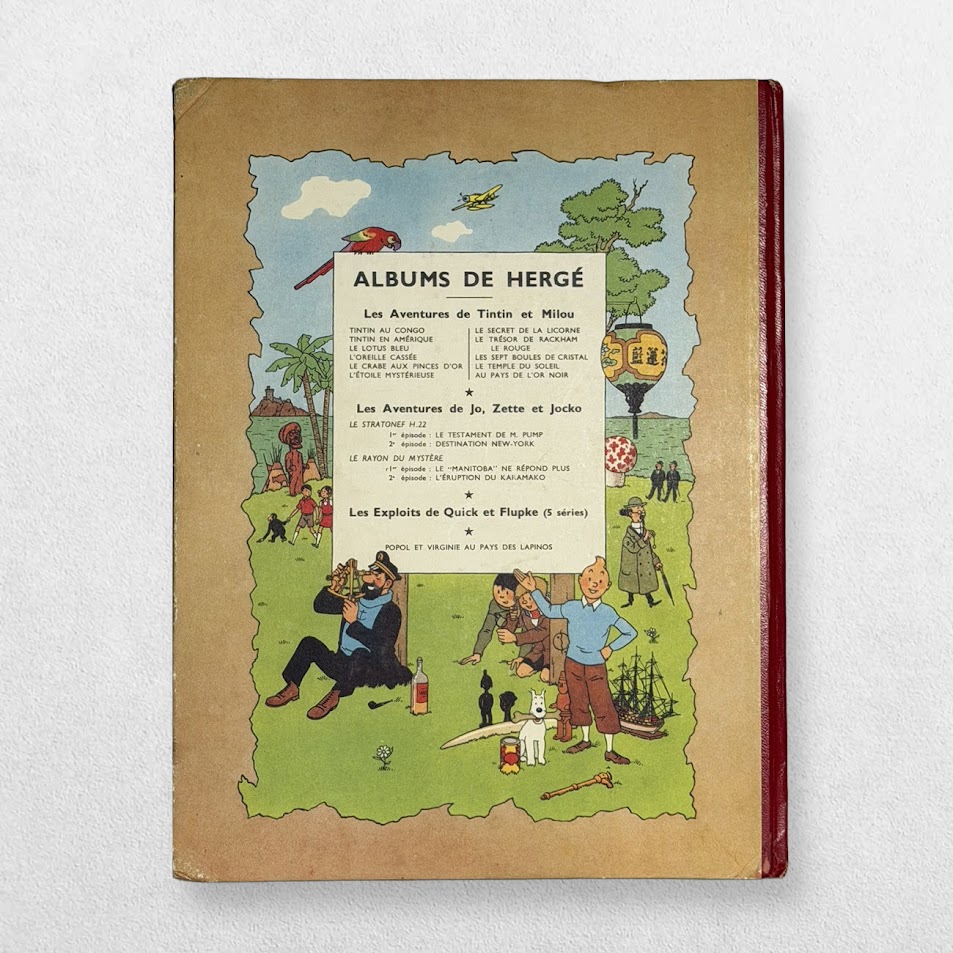
First or very early edition. Editions Casterman, 1952, Printed in Belgium. Copyright page dated 1952. Original cloth-backed boards. Pictorial red and white chequered endpapers. Red spine cloth. Pp. 52. Illustrated throughout in colour by the author. Rear panel shows last printed Tintin title as ‘Au Pays De L’Or Noir’. Neat contemporary inscription. Binding nice and tight with minor rubbing and creasing to the spine and edges of the boards. Slight age toning to the pages as usual. A very good plus, tight, clean copy.
Les Aventures De Jo Zette et Jocko: A Brief Summary
Overview
Les aventures de Jo, Zette et Jocko is a secondary but significant series by Hergé, created between 1935 and 1957. Although often overshadowed by The Adventures of Tintin, the Jo, Zette and Jocko stories occupy a distinct place in Hergé’s work, revealing both his technical development and his experimentation with different narrative constraints.
The series consists of five completed albums (plus one abandoned project) and was originally created for the Catholic youth magazine Cœurs Vaillants. Its intended audience, editorial context, and moral framework strongly shaped its tone and structure.
Origins and editorial context
Why Hergé created the series
Jo, Zette and Jocko were created at the request of Cœurs Vaillants, whose editors wanted:
- Child protagonists with a traditional family
- Clear moral authority and obedience to adults
- Stories suitable for younger readers
Tintin, by contrast, was:
- Independent and parentless
- Often defiant of authority
- Increasingly complex and morally ambiguous
Hergé therefore designed Jo and Zette as ordinary children, firmly embedded in family life.
The main characters
Jo Legrand
- The elder sibling
- Brave, resourceful, but clearly a child
- Acts protectively towards his sister
Jo is courageous but never infallible. He lacks Tintin’s near-superhuman competence.
Zette Legrand
- Younger than Jo
- Intelligent, practical, and emotionally perceptive
- Often the voice of caution
Zette is notably less stereotyped than many female child characters of the period. She contributes actively to problem-solving rather than serving merely as a passive companion.
Jocko
- A pet chimpanzee
- Source of comedy, chaos, and occasional rescue
Jocko functions as both comic relief and a narrative device, frequently creating complications or unexpected solutions.
Monsieur and Madame Legrand
- The children’s parents
- Especially important is Monsieur Legrand, an engineer or inventor in several stories
The presence of parents is a defining difference from Tintin: adults are central, competent, and authoritative.
The albums
- Le Stratonef H.22 (1936)
The debut story introduces Jo and Zette when their father invents a revolutionary aircraft, the Stratonef. Criminals attempt to steal the plans, forcing the children into danger.
Key features:
- Strong emphasis on technology
- Clear moral division between heroes and villains
- Conventional adventure structure
This album establishes the series’ core tone: family-based adventure rather than lone heroism.
- Le Rayon du Mystère (1939)
A science-driven plot involving a mysterious energy beam and industrial espionage. The children are drawn into a conflict between rival scientific powers.
Notable aspects:
- Early exploration of scientific ethics
- Clear influence from contemporary anxieties about technology
- Increasing narrative sophistication
- La Vallée des Cobras (1953)
Set in Asia, this story centres on smuggling, animal trafficking, and criminal exploitation. Jo and Zette are kidnapped and must rely on ingenuity rather than force.
Themes include:
- Vulnerability of children
- Moral responsibility of adults
- Environmental and animal protection
This album shows Hergé’s more mature approach to suspense and danger.
- Le Testament de M. Pump (1955)
An eccentric millionaire leaves his fortune to Jo and Zette under strange conditions. The inheritance triggers a series of pursuits, traps, and criminal schemes.
This is the most playful and puzzle-driven of the series, closer in spirit to Tintin but still rooted in family dynamics.
- Destination New York (1957)
The final completed album involves international crime and transatlantic travel. The story is tighter and darker than earlier entries, reflecting Hergé’s post-war narrative maturity.
It also marks the end of the series, as Hergé increasingly focused on Tintin alone.
Unfinished project: Le “Manitoba” ne répond plus
An abandoned story begun in the late 1950s. Its incompletion reflects Hergé’s growing creative exhaustion and shifting priorities.
Narrative and stylistic characteristics
Differences from Tintin
Jo, Zette and Jocko differs from Tintin in several fundamental ways:
- Children behave like children
- Adults are central and competent
- Less irony and satire
- More conventional morality
Tintin often reshapes the world; Jo and Zette must survive within it.
Visual style
Visually, the series reflects Hergé’s development of ligne claire:
- Clean outlines
- Careful perspective
- Increasing architectural and mechanical accuracy
However, it lacks the experimental minimalism of late Tintin albums.
Thematic concerns
Key recurring themes include:
- Family cohesion
- Science and responsibility
- Childhood vulnerability
- Trust in rational authority
Unlike Tintin, the series rarely questions the legitimacy of institutions or adults.
Place in Hergé’s career
Jo, Zette and Jocko occupies an ambivalent position in Hergé’s legacy:
- Artistically competent
- Narratively conservative
- Emotionally restrained
Hergé himself regarded the series as technically successful but emotionally limiting. He missed Tintin’s freedom, ambiguity, and independence.
Yet the series is crucial for understanding:
- Hergé’s discipline as a storyteller
- His ability to adapt to editorial constraints
- The evolution of his visual language
Concluding assessment
Les aventures de Jo, Zette et Jocko is not a lesser Tintin, but a parallel experiment. It shows what Hergé could achieve when asked to prioritise family values, clear authority, and child realism over mythic heroism.
While it lacks Tintin’s symbolic depth and moral complexity, the series remains an accomplished example of mid-twentieth-century European adventure comics—precise, controlled, and revealing of its creator’s craft under constraint.
Why Buy from Us?
At Hornseys, we are committed to offering items that meet the highest standards of quality and authenticity. Our collection of rare books is carefully curated to ensure each edition is a valuable piece of bibliographical history. Here’s what sets us apart:
- Authenticity and Provenance: Each book is meticulously researched and verified for authenticity and collation.
- Expert Curation: Our selection process focuses on significance, condition, and rarity, resulting in a collection that is both diverse and distinguished.
- Customer Satisfaction: We aim to provide an exceptional customer experience, from detailed descriptions to secure and prompt delivery of your purchase.
- Returns Policy: We offer an unconditional guarantee on every item. If you wish to return a book, it may be sent back to us within fourteen days of receipt. Please notify us in advance if you wish to do so. The book must be returned in the same condition as it was sent for a full refund.
Cataloguer: Daniel Hornsey
Daniel Hornsey has specialised in fine and rare books, ephemera, and collectors’ editions for over thirty years. As a long-standing member of the antiquarian book trade, he has advised private collectors, curated catalogues, and sourced works for leading dealers, libraries and institutions across the world.
Hornseys’ exhibit regularly at book and map fairs in London and throughout the UK and are members of the Provincial Booksellers Fairs Association, the PBFA.
His fascination with Hergé’s work — especially ‘The Adventures of Tintin’ — began in childhood. Daniel recalls reading Tintin in original European editions and quickly recognising that these were not merely children’s books, but finely illustrated narratives crafted with artistic depth and wit.
As noted by the Musée Hergé in Louvain-la-Neuve, Hergé’s ‘ligne claire’ style has influenced generations of European comic artists and his original drawings and paintings command very high prices with his painting of ‘The Blue Lotus’ jar fetching £2.8m at auction in 2021.
By presenting these works through Hornseys’, he hopes to contribute to the continued appreciation of one of the 20th century’s most influential illustrators, helping new generations discover the artistry and legacy of Hergé.
Related products

Newt Scamander: Fantastic Beasts And Where To Find Them: Signed By The Illustrator: Includes Promotional Poster
£175.00Rowling, J K & Gill, Olivia Lomenech
The Crayon Box: The Day The Crayons Quit & The Day The Crayons Came Home: Includes Original Oliver Jeffers Art Print
£28.00Jeffers, Oliver & Daywalt, Drew