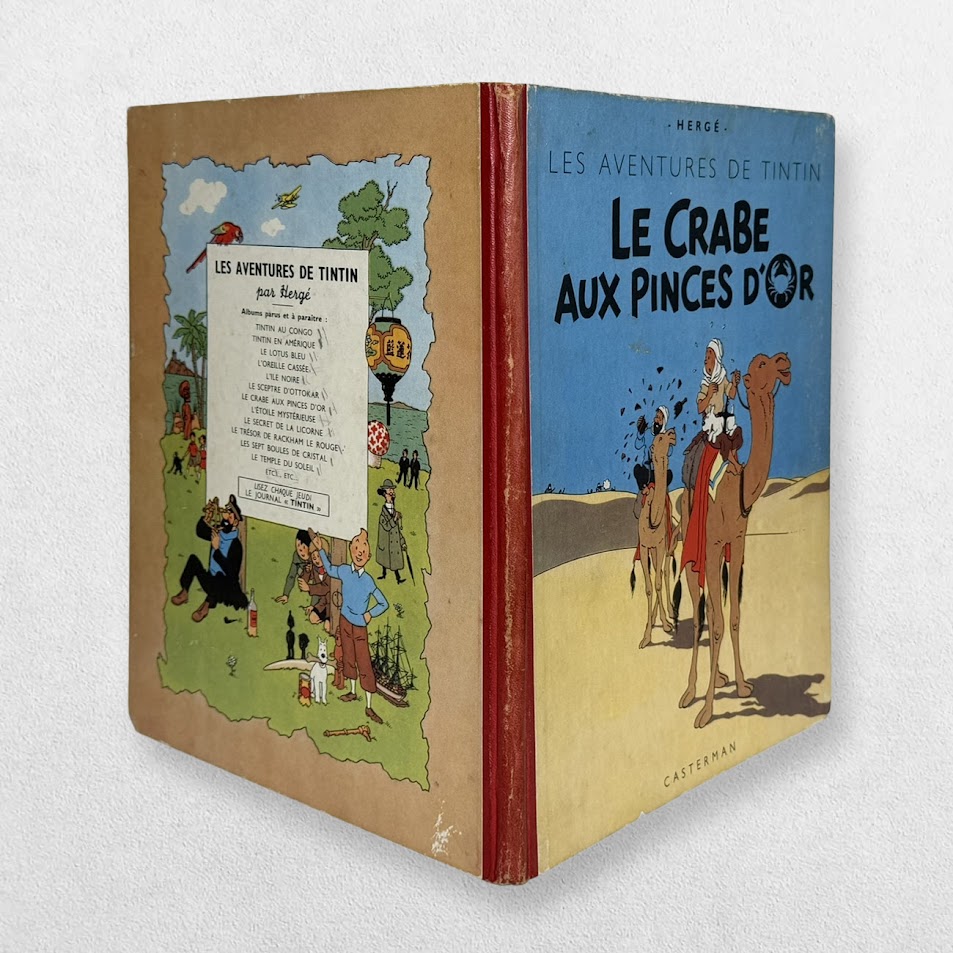
Les Aventures De Tintin – Le Crabe Aux Pinces D’Or – The Adventures Of Tintin – The Crab With The Golden Claws – Early Edition – 1949
Hergé
£275.00
Availability: In stock
Product Description
Les Aventures De Tintin – Le Crabe Aux Pinces D’Or – The Adventures Of Tintin – The Crab With The Golden Claws – Early Edition – 1949
Author: Hergé
Price: £275.00
Publisher: Casterman
Publication date: 1949
Format: Original cloth-backed boards with pictorial endpapers
Condition: Very good
Pages: 62
Illustrations: Illustrated throughout in colour by the author
Description:
Casterman Tournai Paris, 1949. Printed in Belgium. Early edition. Original cloth-backed boards. Pictorial blue endpapers. Pp. 62. Illustrated throughout in colour by the author. Binding nice and tight with minor rubbing and creasing to the spine and edges of the boards. Minor pencil marks to the rear panel. Slight age toning to the pages as usual. A very good, tight, copy. Scarce.
Le Crabe Aux Pinces D’Or: A Brief Summary
The story begins with Tintin investigating a seemingly trivial detail: a discarded crab tin bearing the label “Crab with the Golden Claws”. The tin is linked to a case of unexplained disappearances and suspected drug trafficking. Tintin traces the label to a cargo ship, the Karaboudjan, where he is promptly captured after uncovering suspicious activity among the crew.
From the outset, the tone is darker and more grounded than earlier Tintin adventures, with criminal networks and real physical danger replacing exotic fantasy.
The Karaboudjan and Captain Haddock
On board the Karaboudjan, Tintin discovers that the ship is being used to smuggle opium, concealed inside sealed crab tins. The vessel’s captain, Archibald Haddock, is introduced here for the first time.
Haddock is not a villain but a broken and manipulated man. He is:
- Chronically drunk
- Intimidated by the ship’s first mate, Allan
- Unaware of the full extent of the criminal operation
Allan and his accomplices use Haddock as a figurehead while running the smuggling operation themselves.
Tintin attempts to reason with Haddock, gradually realising that the captain is both victim and liability.
Escape at sea
Tintin and Haddock are imprisoned by the crew, but manage to escape during a violent storm. In a desperate bid for freedom, they launch themselves onto a lifeboat. The escape is chaotic and nearly fatal, underscoring Haddock’s fragility and Tintin’s resolve.
The Karaboudjan sails on, abandoning them to the open sea.
Ordeal in the desert
The lifeboat washes up on the coast of North Africa, and Tintin and Haddock are captured by soldiers, narrowly avoiding execution as spies. Once released, they attempt to cross the desert to reach safety.
This section of the story is dominated by hallucination, dehydration, and exhaustion. Haddock’s alcoholism becomes both a danger and a tragic vulnerability: he suffers severe withdrawal, imagining bottles and oases that do not exist.
Tintin keeps Haddock alive through discipline and ingenuity, reinforcing their developing bond.
Discovery of the criminal network
The pair eventually reach a coastal city, where Tintin uncovers the wider scope of the smuggling operation. The crab tins are part of an international narcotics network, with distribution extending far beyond the Karaboudjan.
Tintin exposes the operation’s infrastructure, while Haddock begins to recover a sense of responsibility and dignity, recognising how completely he has been exploited.
Confrontation and resolution
Allan and the other smugglers are finally confronted and arrested. The opium ring is dismantled, and the criminal conspiracy collapses.
Haddock is offered the chance to reclaim command of his ship and his life. Although still flawed and prone to excess, he has taken a decisive step away from helplessness.
Ending: the beginning of a partnership
The story concludes with Tintin and Haddock returning to Europe together. Haddock is no longer merely a rescued victim; he has become Tintin’s companion.
This ending marks a turning point in the Tintin series. Haddock’s introduction fundamentally alters its emotional and narrative texture.
Narrative significance
Le Crabe aux Pinces d’Or is one of the most important albums in the Tintin canon because it introduces Captain Haddock, who becomes Tintin’s closest ally and emotional counterweight.
The story also signals a shift towards:
- More realistic criminal plots
- Greater psychological depth
- Moral ambiguity, particularly around weakness and responsibility
Haddock is neither hero nor villain, but a deeply human figure.
Thematic overview
Key themes include:
- Exploitation and control
- Addiction and vulnerability
- Moral courage versus physical strength
- Friendship forged under pressure
Unlike many earlier adventures, the enemy here is not a caricatured tyrant but an organised criminal system that thrives on manipulation.
Concluding assessment
Le Crabe aux Pinces d’Or marks the moment when The Adventures of Tintin grow up. Its grounded danger, sustained tension, and introduction of Captain Haddock transform the series from episodic adventure into character-driven narrative. Haddock’s struggle—comic, tragic, and unresolved—adds a layer of emotional realism that would define the series thereafter.
Why Buy from Us?
At Hornseys, we are committed to offering items that meet the highest standards of quality and authenticity. Our collection of rare books is carefully curated to ensure each edition is a valuable piece of bibliographical history. Here’s what sets us apart:
- Authenticity and Provenance: Each book is meticulously researched and verified for authenticity and collation.
- Expert Curation: Our selection process focuses on significance, condition, and rarity, resulting in a collection that is both diverse and distinguished.
- Customer Satisfaction: We aim to provide an exceptional customer experience, from detailed descriptions to secure and prompt delivery of your purchase.
- Returns Policy: We offer an unconditional guarantee on every item. If you wish to return a book, it may be sent back to us within fourteen days of receipt. Please notify us in advance if you wish to do so. The book must be returned in the same condition as it was sent for a full refund.
Cataloguer: Daniel Hornsey
Daniel Hornsey has specialised in fine and rare books, ephemera, and collectors’ editions for over thirty years. As a long-standing member of the antiquarian book trade, he has advised private collectors, curated catalogues, and sourced works for leading dealers, libraries and institutions across the world.
Hornseys’ exhibit regularly at book and map fairs in London and throughout the UK and are members of the Provincial Booksellers Fairs Association, the PBFA.
His fascination with Hergé’s work — especially ‘The Adventures of Tintin’ — began in childhood. Daniel recalls reading Tintin in original European editions and quickly recognising that these were not merely children’s books, but finely illustrated narratives crafted with artistic depth and wit.
As noted by the Musée Hergé in Louvain-la-Neuve, Hergé’s ‘ligne claire’ style has influenced generations of European comic artists and his original drawings and paintings command very high prices with his painting of ‘The Blue Lotus’ jar fetching £2.8m at auction in 2021.
By presenting these works through Hornseys’, he hopes to contribute to the continued appreciation of one of the 20th century’s most influential illustrators, helping new generations discover the artistry and legacy of Hergé.
Related products
-

I Will Not Ever Never Eat A Tomato Ten Year Anniversary Edition Signed By Lauren Child
£145.00Child, Lauren
-
Snowy The Half-Angel – Figurines Tintin La Collection Officielle – 40 – Milou Mi-Ange
£65.00Hergé & Editions Moulinsart
-

The Crayon Box: The Day The Crayons Quit & The Day The Crayons Came Home: Includes Original Oliver Jeffers Art Print
£28.00Jeffers, Oliver & Daywalt, Drew
-