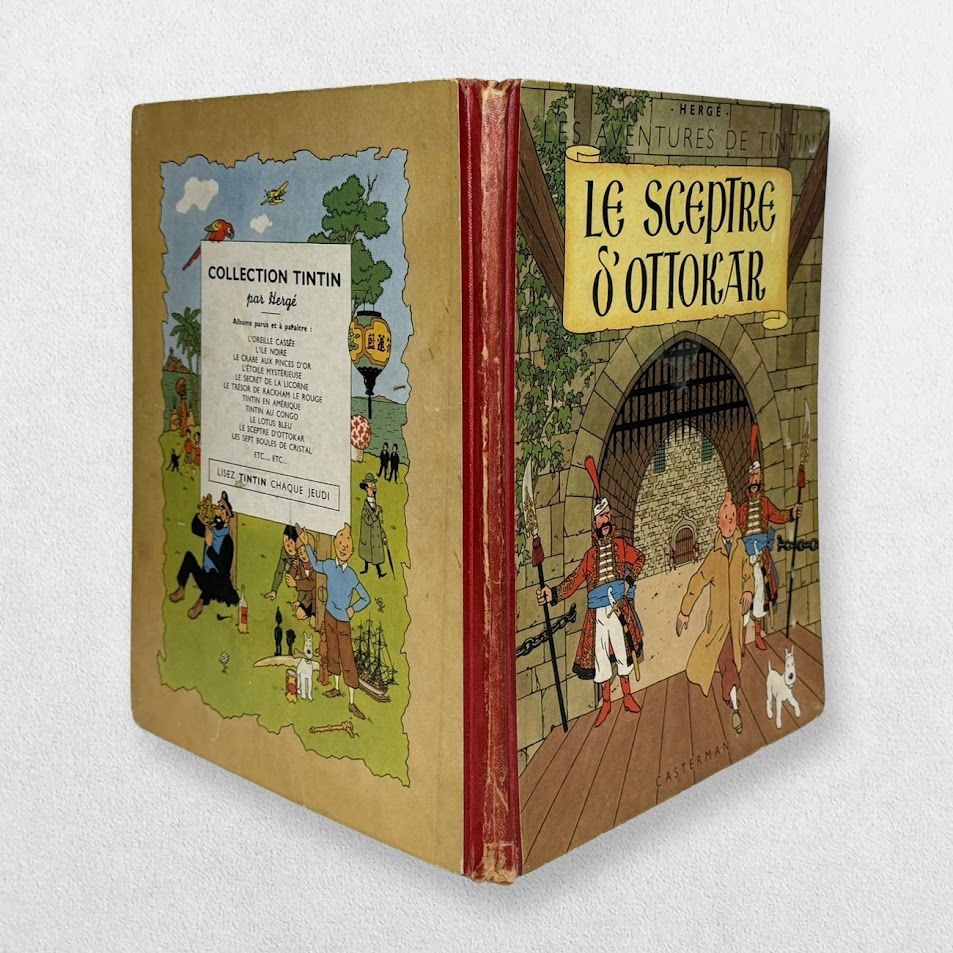
Les Aventures De Tintin – Le Sceptre D’Ottokar – The Adventures Of Tintin – King Ottokar’s Sceptre – Early Edition – 1948
Hergé
£275.00
Availability: In stock
Product Description
Les Aventures De Tintin – Le Sceptre D’Ottokar – The Adventures Of Tintin – King Ottokar’s Sceptre – Early Edition – 1948
Author: Hergé
Price: £275.00
Publisher: Casterman
Publication date: 1948
Format: Original cloth-backed boards with pictorial endpapers
Condition: Very good
Pages: 62
Illustrations: Illustrated throughout in colour by the author
Description:
Casterman Tournai Paris, 1948. Printed in Belgium. Very early edition. Original cloth-backed boards. Pictorial blue endpapers. Pp. 62. Illustrated throughout in colour by the author. Binding nice and tight with minor rubbing and creasing to the spine and edges of the boards. Base of spine worn with a short closed tear. Slight age toning to the pages as usual. A very good, tight, copy. Scarce.
Le Sceptre D’Ottokar: A Brief Summary
The story begins in Belgium, where Tintin encounters a courteous but absent-minded man who accidentally drops his briefcase. Tintin returns it, thinking little of the incident. Shortly afterwards, Tintin himself is accused of theft and becomes entangled in a web of misunderstandings, forged documents, and surveillance.
What initially appears to be a minor case of mistaken identity soon reveals itself as the opening move in a carefully planned political conspiracy.
Journey to Syldavia
Tintin discovers that the briefcase belongs to Professor Hector Alembick, a scholar specialising in Syldavian history. When Tintin follows Alembick’s trail, he learns that the professor is travelling to the Balkan kingdom of Syldavia, a small constitutional monarchy with a strong sense of tradition and national symbolism.
Tintin travels to Syldavia, quickly realising that he is being followed. From the moment he arrives, the atmosphere is tense: he is watched by secret agents, his movements are restricted, and the authorities appear both vigilant and anxious.
The importance of the sceptre
Tintin learns that Syldavia’s political stability depends on a single ancient object: the sceptre of King Ottokar IV, the medieval founder of the nation. By long-standing law, if the reigning monarch cannot present the sceptre during the annual national festival, he is deemed unfit to rule.
The current king, Muskar XII, is popular but vulnerable. The sceptre is not merely ceremonial; it is the legal and symbolic foundation of Syldavian sovereignty.
The plot uncovered
Tintin discovers that Professor Alembick is an impostor. He has been replaced by a lookalike working for a foreign power intent on annexing Syldavia. The plot involves stealing the sceptre and ensuring it cannot be returned in time for the festival, thereby forcing the king’s abdication under Syldavian law.
The conspirators are linked to the neighbouring state of Borduria, an authoritarian regime seeking territorial expansion. Although Borduria’s involvement is officially denied, its agents operate openly and aggressively behind the scenes.
Pursuit, espionage, and resistance
Tintin embarks on a tense pursuit across Syldavia, tracking the stolen sceptre while evading capture. He uncovers hidden communications, coded messages, and underground networks supporting the conspiracy.
Despite repeated attempts to silence him, Tintin persists, aided by loyal Syldavian officials and ordinary citizens who embody the country’s strong patriotic identity. The narrative balances suspense with procedural detail, emphasising intelligence, patience, and courage rather than brute force.
The festival and the race against time
As Syldavia’s national day approaches, the pressure intensifies. The conspirators believe victory is assured: the sceptre has been smuggled out of the country, and Tintin is presumed neutralised.
In a dramatic final sequence, Tintin recovers the sceptre and races against time to return it to the capital. The climax unfolds during the public ceremony itself, with the fate of the kingdom hanging on a single object and a few decisive minutes.
Resolution: sovereignty preserved
Tintin succeeds in restoring the sceptre to King Muskar XII moments before the critical deadline. The legal basis for the coup collapses instantly. The conspirators are exposed, Borduria’s ambitions are thwarted, and Syldavia’s independence is preserved without the need for open warfare.
Tintin is publicly honoured by the king, receiving an order of merit for his service. More importantly, he departs knowing that a small nation has been saved through intelligence, vigilance, and respect for law.
Narrative significance
Le Sceptre d’Ottokar is one of the most politically sophisticated Tintin albums. It marks a clear evolution in the series towards:
- Realistic international intrigue
- Plausible mechanisms of state subversion
- Nuanced portrayal of nationalism and legality
The story is notable for its restraint: victory comes not through violence, but through the restoration of lawful continuity.
Thematic overview
Key themes include:
- Sovereignty and legitimacy
- Law as a defence against tyranny
- Identity, impersonation, and deception
- Small states under pressure from expansionist powers
Although set in fictional countries, the narrative unmistakably reflects contemporary European anxieties about authoritarianism and territorial aggression.
Concluding assessment
Le Sceptre d’Ottokar stands as one of Hergé’s most prescient and disciplined works. It demonstrates how adventure storytelling can engage seriously with political reality without sacrificing pace or clarity. Tintin acts not as a conqueror or spy, but as a defender of constitutional order—making this album one of the clearest expressions of his moral role in the series.
Why Buy from Us?
At Hornseys, we are committed to offering items that meet the highest standards of quality and authenticity. Our collection of rare books is carefully curated to ensure each edition is a valuable piece of bibliographical history. Here’s what sets us apart:
- Authenticity and Provenance: Each book is meticulously researched and verified for authenticity and collation.
- Expert Curation: Our selection process focuses on significance, condition, and rarity, resulting in a collection that is both diverse and distinguished.
- Customer Satisfaction: We aim to provide an exceptional customer experience, from detailed descriptions to secure and prompt delivery of your purchase.
- Returns Policy: We offer an unconditional guarantee on every item. If you wish to return a book, it may be sent back to us within fourteen days of receipt. Please notify us in advance if you wish to do so. The book must be returned in the same condition as it was sent for a full refund.
Cataloguer: Daniel Hornsey
Daniel Hornsey has specialised in fine and rare books, ephemera, and collectors’ editions for over thirty years. As a long-standing member of the antiquarian book trade, he has advised private collectors, curated catalogues, and sourced works for leading dealers, libraries and institutions across the world.
Hornseys’ exhibit regularly at book and map fairs in London and throughout the UK and are members of the Provincial Booksellers Fairs Association, the PBFA.
His fascination with Hergé’s work — especially ‘The Adventures of Tintin’ — began in childhood. Daniel recalls reading Tintin in original European editions and quickly recognising that these were not merely children’s books, but finely illustrated narratives crafted with artistic depth and wit.
As noted by the Musée Hergé in Louvain-la-Neuve, Hergé’s ‘ligne claire’ style has influenced generations of European comic artists and his original drawings and paintings command very high prices with his painting of ‘The Blue Lotus’ jar fetching £2.8m at auction in 2021.
By presenting these works through Hornseys’, he hopes to contribute to the continued appreciation of one of the 20th century’s most influential illustrators, helping new generations discover the artistry and legacy of Hergé.
Related products
-

I Will Not Ever Never Eat A Tomato Ten Year Anniversary Edition Signed By Lauren Child
£145.00Child, Lauren
-

-

The Crayon Box: The Day The Crayons Quit & The Day The Crayons Came Home: Includes Original Oliver Jeffers Art Print
£28.00Jeffers, Oliver & Daywalt, Drew
-