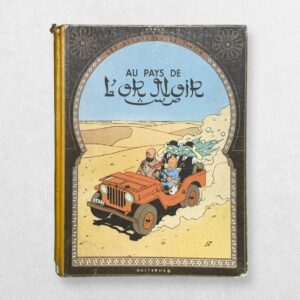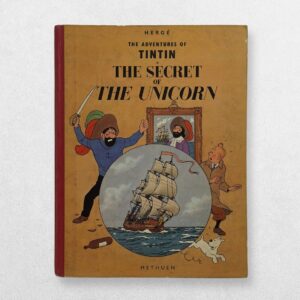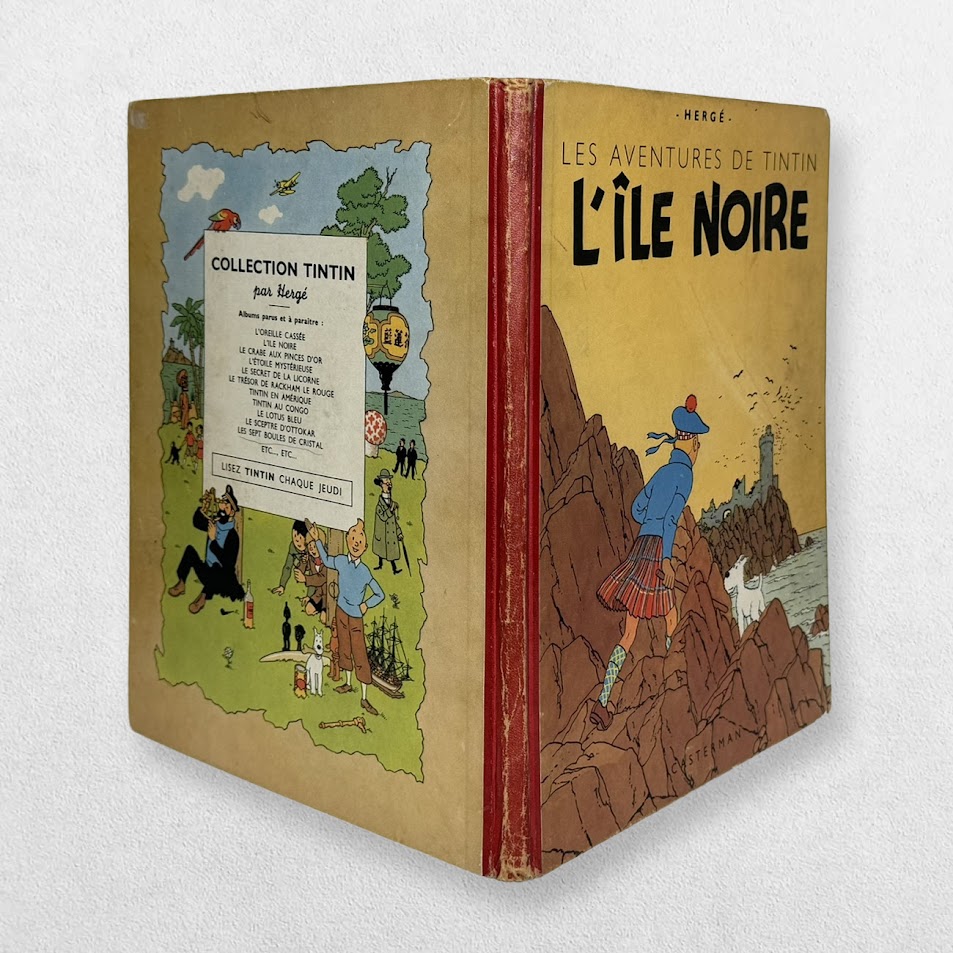
Les Aventures De Tintin – L’Ile Noire – The Adventures Of Tintin – The Black Island – Early Edition – 1948
Hergé
£300.00
Availability: In stock
Product Description
Les Aventures De Tintin – L’Ile Noire – The Adventures Of Tintin – The Black Island – Early Edition – 1948
Author: Hergé
Price: £300.00
Publisher: Casterman
Publication date: 1948
Format: Original cloth-backed boards with pictorial endpapers
Condition: Very good
Pages: 62
Illustrations: Illustrated throughout in colour by the author
Description:
Casterman Tournai Paris, 1948. Printed in Belgium. Very early edition. Original cloth-backed boards. Pictorial blue endpapers. Pp. 62. Illustrated throughout in colour by the author. Binding nice and tight with minor rubbing and creasing to the spine and edges of the boards. Minor pencil marks to the boards. Slight age toning to the pages as usual. A very good, tight, copy. Scarce.
L’Ile Noire: A Brief Summary
The story opens in Belgium, where Tintin witnesses a suspicious encounter involving two men and a small aircraft. When he attempts to investigate, he is shot at, and shortly afterwards he is wrongly accused of counterfeiting. The police arrest him, apparently convinced of his guilt.
Tintin escapes custody, not out of defiance of justice, but to prove his innocence. From the outset, the narrative establishes a key theme: truth obscured by deception, and authority manipulated by criminal intelligence.
Flight across Britain
Tintin’s attempt to uncover the truth leads him across the United Kingdom, from the Channel coast through England and into Scotland. He is pursued relentlessly by the police, who remain convinced of his guilt, and by unseen enemies determined to silence him.
Throughout this journey, Tintin survives a series of near-fatal incidents: sabotaged vehicles, train chases, ambushes, and false leads. Each episode reinforces the sense that a well-organised criminal network is operating across borders.
Discovery of the counterfeiting operation
Tintin gradually uncovers evidence pointing to a sophisticated counterfeiting ring, producing forged banknotes of extremely high quality. The organisation’s reach extends into financial institutions, transport networks, and law enforcement vulnerabilities.
Despite his progress, Tintin remains isolated. His warnings are dismissed, and his reputation is damaged. The narrative builds tension through repeated frustration: the truth is always just out of reach, concealed behind layers of misdirection.
Arrival in Scotland and the Black Island
Clues eventually lead Tintin to the Scottish coast, where rumours circulate about a mysterious island known as the Black Island. The island is widely feared by locals, who believe it to be cursed or haunted.
Tintin reaches the island under cover of night. Its bleak isolation, ruined castle, and hostile terrain create an atmosphere of menace and foreboding. The island functions almost as a character in its own right: remote, secretive, and resistant to intrusion.
The gorilla and the illusion of terror
On the island, Tintin encounters what appears to be a ferocious gorilla, known locally as a monster. This creature has been deliberately used to reinforce superstition and keep outsiders away.
Tintin discovers that the gorilla, named Ranko, is not a wild beast but a trained animal exploited by criminals. The supposed supernatural terror surrounding the island is revealed to be a carefully engineered illusion, designed to protect the counterfeiters’ operations.
Confrontation with the criminals
Tintin uncovers the island’s true purpose: it houses the central production site of the counterfeiting network. The operation is led by Dr Müller, a recurring antagonist in the Tintin series, whose intelligence and ruthlessness make him particularly dangerous.
After a tense confrontation involving pursuit through the castle ruins and surrounding cliffs, the counterfeiters are exposed. Tintin manages to contact the authorities with definitive proof of his innocence and the criminals’ guilt.
Resolution and vindication
The police finally recognise Tintin’s innocence. Dr Müller and his accomplices are arrested, and the counterfeiting operation is dismantled. Ranko the gorilla is spared, implicitly freed from exploitation rather than punished.
Tintin’s name is cleared, and order is restored—not through brute force, but through persistence, observation, and moral clarity.
Narrative significance
L’Île Noire is notable for its sustained atmosphere of paranoia and pursuit. Tintin spends much of the story on the run, isolated and mistrusted, which heightens suspense and sharpens his role as an outsider hero.
The album is also distinctive for its British setting, carefully rendered in later revisions to reflect real locations, customs, and infrastructure. It stands as one of Hergé’s most geographically grounded adventures.
Thematic overview
Key themes include:
- Illusion versus reality
- Abuse of fear and superstition
- Justice obstructed by bureaucracy
- Persistence in the face of mistrust
The gorilla, far from being a monster, becomes a symbol of how power manipulates appearances to conceal exploitation.
Concluding assessment
L’Île Noire is a tightly structured thriller that combines crime fiction with gothic atmosphere. It refines Tintin’s role as an investigator who must often act outside formal authority in order to serve justice. By exposing a criminal empire built on fear, falsehood, and impersonation, the story reinforces a central principle of the series: that truth, patiently pursued, ultimately dismantles even the most elaborate deceptions.
Why Buy from Us?
At Hornseys, we are committed to offering items that meet the highest standards of quality and authenticity. Our collection of rare books is carefully curated to ensure each edition is a valuable piece of bibliographical history. Here’s what sets us apart:
- Authenticity and Provenance: Each book is meticulously researched and verified for authenticity and collation.
- Expert Curation: Our selection process focuses on significance, condition, and rarity, resulting in a collection that is both diverse and distinguished.
- Customer Satisfaction: We aim to provide an exceptional customer experience, from detailed descriptions to secure and prompt delivery of your purchase.
- Returns Policy: We offer an unconditional guarantee on every item. If you wish to return a book, it may be sent back to us within fourteen days of receipt. Please notify us in advance if you wish to do so. The book must be returned in the same condition as it was sent for a full refund.
Cataloguer: Daniel Hornsey
Daniel Hornsey has specialised in fine and rare books, ephemera, and collectors’ editions for over thirty years. As a long-standing member of the antiquarian book trade, he has advised private collectors, curated catalogues, and sourced works for leading dealers, libraries and institutions across the world.
Hornseys’ exhibit regularly at book and map fairs in London and throughout the UK and are members of the Provincial Booksellers Fairs Association, the PBFA.
His fascination with Hergé’s work — especially ‘The Adventures of Tintin’ — began in childhood. Daniel recalls reading Tintin in original European editions and quickly recognising that these were not merely children’s books, but finely illustrated narratives crafted with artistic depth and wit.
As noted by the Musée Hergé in Louvain-la-Neuve, Hergé’s ‘ligne claire’ style has influenced generations of European comic artists and his original drawings and paintings command very high prices with his painting of ‘The Blue Lotus’ jar fetching £2.8m at auction in 2021.
By presenting these works through Hornseys’, he hopes to contribute to the continued appreciation of one of the 20th century’s most influential illustrators, helping new generations discover the artistry and legacy of Hergé.
Related products
-

-

The Gruffalo & The Gruffalo’s Child: First Deluxe Miniature Editions Both Signed By Julia Donaldson & Axel Scheffler
£495.00Donaldson, Julia & Scheffler, Axel
-

-