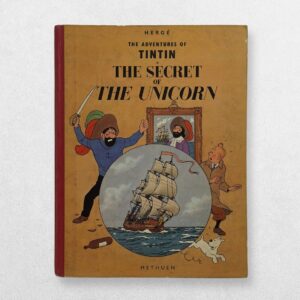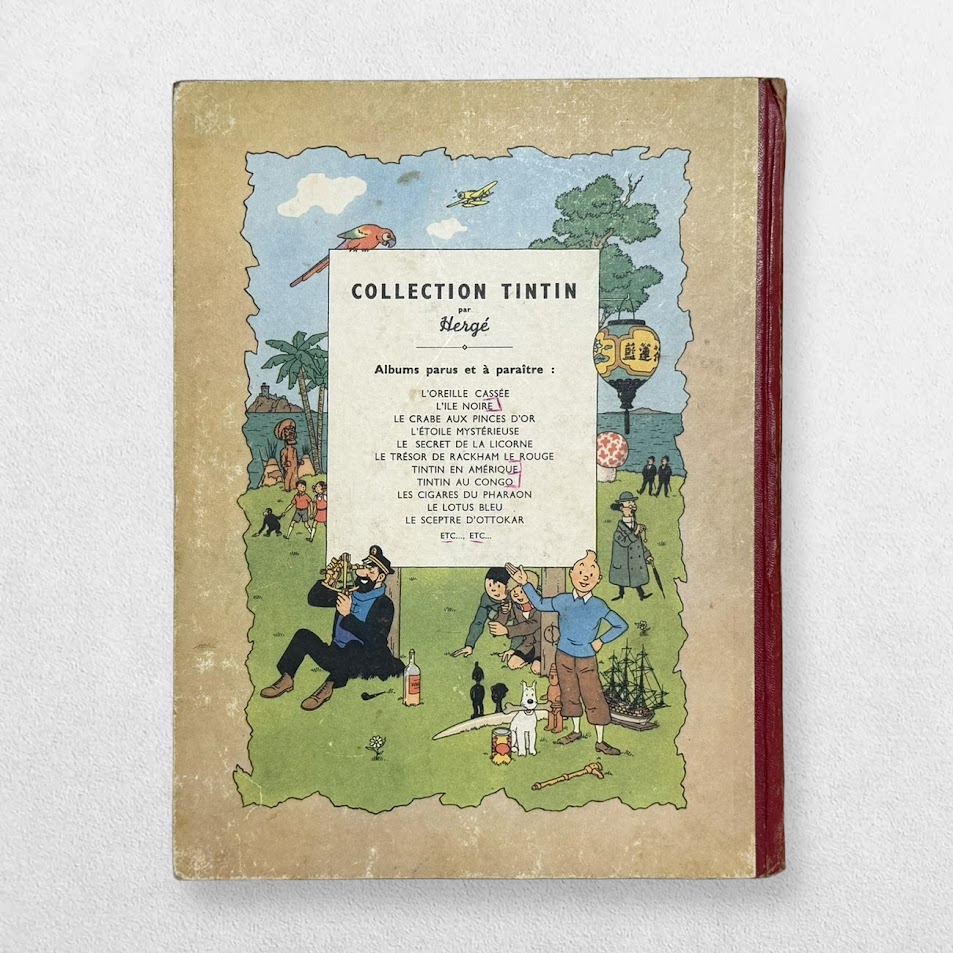
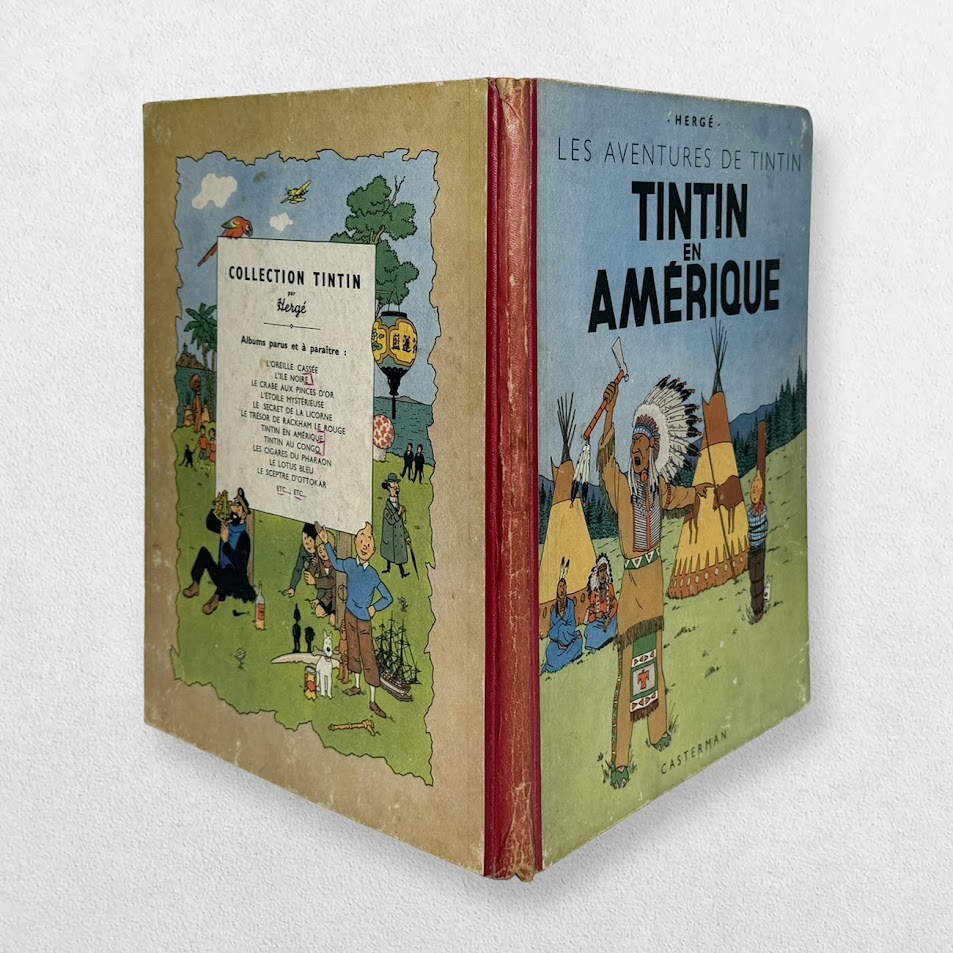
Les Aventures De Tintin – Tintin En Amérique – The Adventures Of Tintin – Tintin In America – First Edition – 1946
Hergé
£950.00
Availability: In stock
Product Description
Les Aventures De Tintin – Tintin En Amérique – The Adventures Of Tintin – Tintin In America – First Edition – 1946
Author: Hergé
Price: £950.00
Publisher: Casterman
Publication date: 1946
Format: Original cloth-backed boards with pictorial endpapers
Condition: Very good
Pages: 62
Illustrations: Illustrated throughout in colour by the author
Description:
Casterman Tournai Paris, 1946 but dated 1945 to the copyright page. Printed in Belgium. First colour edition. Original cloth-backed boards. Red spine. Pictorial blue endpapers. Title lettered in red to the title page. Pp. 62. Illustrated throughout in colour by the author. Binding very slightly loose with minor rubbing and creasing to the spine and edges of the boards. Slight age toning to the pages as usual. Minor pen marks to the rear board and rear endpapers. A very good copy. Scarce.
Tintin En Amérique: A Brief Summary
The story opens immediately after the events of Tintin au Congo. Tintin travels to the United States to confront the American branch of the criminal organisation led by Al Capone, who has previously appeared as a shadowy antagonist. Tintin arrives in Chicago, a city portrayed as dominated by gangsters, corruption, and violence.
From the outset, Tintin is marked for death. Gang leaders recognise him as a threat, and attempts to assassinate him begin almost immediately.
Chicago: crime, corruption, and survival
Tintin moves through a city controlled by organised crime. He survives repeated ambushes, car chases, and kidnappings, often escaping through ingenuity rather than force. Police and judicial institutions appear compromised or powerless, reinforcing the impression of a society where criminal power rivals that of the state.
Tintin directly confronts Al Capone, who orders his execution. Although Capone himself is eventually arrested, this does little to reduce the overall criminal threat. Other gangsters step seamlessly into his place, suggesting that crime is systemic rather than personal.
The city and the wilderness
After escaping Chicago, Tintin travels west, and the narrative shifts dramatically in tone and setting. Urban crime gives way to vast open landscapes, including plains, deserts, and territories associated with Native American communities.
This structural division—city versus wilderness—allows the story to explore different American myths: industrial modernity on one hand, and the frontier on the other.
Encounter with Native Americans
Tintin becomes involved with a Native American tribe whose land is threatened by oil prospectors. Initially welcomed as an ally, Tintin helps expose the greed and manipulation behind the forced displacement of the tribe.
However, despite Tintin’s intervention, the discovery of oil leads to rapid and irreversible change. The tribe is expelled from its land, and a modern city is built almost overnight. Tintin can do little to prevent this outcome.
This episode stands out as one of the rare moments in early Tintin where injustice is acknowledged as inevitable rather than solvable.
Return to gangster conflict
The narrative eventually circles back to organised crime. Tintin is captured once again, escapes once again, and dismantles yet another criminal operation. His victories are tactical rather than transformative: individual plots are stopped, but the broader system remains intact.
Snowy continues to provide comic relief and practical assistance, particularly during moments of escape and pursuit.
Resolution and departure
The story concludes with Tintin leaving America. He has survived, exposed criminal schemes, and helped individuals along the way, but he does not reform the society he encounters. The United States is depicted as energetic, wealthy, and innovative, yet morally chaotic and driven by unchecked greed.
Tintin departs not as a conquering hero, but as an observer who has briefly intervened in a deeply flawed system.
Narrative structure and tone
Tintin en Amérique remains episodic, like Hergé’s earlier works, but it introduces greater moral complexity than Tintin au Congo. The album juxtaposes:
- Organised crime and lawlessness
- Industrial progress and social injustice
- Individual heroism and systemic failure
The pacing is rapid, with frequent reversals of fortune and little pause for reflection.
Thematic overview
Key themes include:
- Capitalism and corruption
- The myth of the American frontier
- Displacement of indigenous peoples
- Power without accountability
Although still shaped by stereotypes of its time, the album is more critical in tone than Hergé’s earlier work, particularly in its portrayal of exploitation.
Historical and cultural context
Created during the early 1930s, Tintin en Amérique reflects European perceptions of the United States during the Prohibition era: gang violence, rapid urbanisation, and aggressive expansion. It also anticipates later shifts in Hergé’s work, where the hero’s ability to impose order is increasingly limited.
Concluding assessment
Tintin en Amérique marks a transitional stage in the Tintin series. While still driven by action and caricature, it introduces a sobering idea: that intelligence and courage are sometimes insufficient against structural injustice. Tintin can defeat gangsters, but he cannot halt exploitation powered by wealth and momentum.
This tension—between heroic action and moral limitation—points forward to the greater depth and realism of Hergé’s later adventures.
Why Buy from Us?
At Hornseys, we are committed to offering items that meet the highest standards of quality and authenticity. Our collection of rare books is carefully curated to ensure each edition is a valuable piece of bibliographical history. Here’s what sets us apart:
- Authenticity and Provenance: Each book is meticulously researched and verified for authenticity and collation.
- Expert Curation: Our selection process focuses on significance, condition, and rarity, resulting in a collection that is both diverse and distinguished.
- Customer Satisfaction: We aim to provide an exceptional customer experience, from detailed descriptions to secure and prompt delivery of your purchase.
- Returns Policy: We offer an unconditional guarantee on every item. If you wish to return a book, it may be sent back to us within fourteen days of receipt. Please notify us in advance if you wish to do so. The book must be returned in the same condition as it was sent for a full refund.
Cataloguer: Daniel Hornsey
Daniel Hornsey has specialised in fine and rare books, ephemera, and collectors’ editions for over thirty years. As a long-standing member of the antiquarian book trade, he has advised private collectors, curated catalogues, and sourced works for leading dealers, libraries and institutions across the world.
Hornseys’ exhibit regularly at book and map fairs in London and throughout the UK and are members of the Provincial Booksellers Fairs Association, the PBFA.
His fascination with Hergé’s work — especially ‘The Adventures of Tintin’ — began in childhood. Daniel recalls reading Tintin in original European editions and quickly recognising that these were not merely children’s books, but finely illustrated narratives crafted with artistic depth and wit.
As noted by the Musée Hergé in Louvain-la-Neuve, Hergé’s ‘ligne claire’ style has influenced generations of European comic artists and his original drawings and paintings command very high prices with his painting of ‘The Blue Lotus’ jar fetching £2.8m at auction in 2021.
By presenting these works through Hornseys’, he hopes to contribute to the continued appreciation of one of the 20th century’s most influential illustrators, helping new generations discover the artistry and legacy of Hergé.
Related products
-

-

-

The House At Pooh Corner Signed By Christopher Robin Milne.
£695.00Milne, A. A. With Decorations By Shepard, E. H
-