Lieutenant-General A. E. Percival – The War in Malaya – First Edition, First Impression, 1949 – The Fall of Singapore and Japanese Invasion, 1941–1942
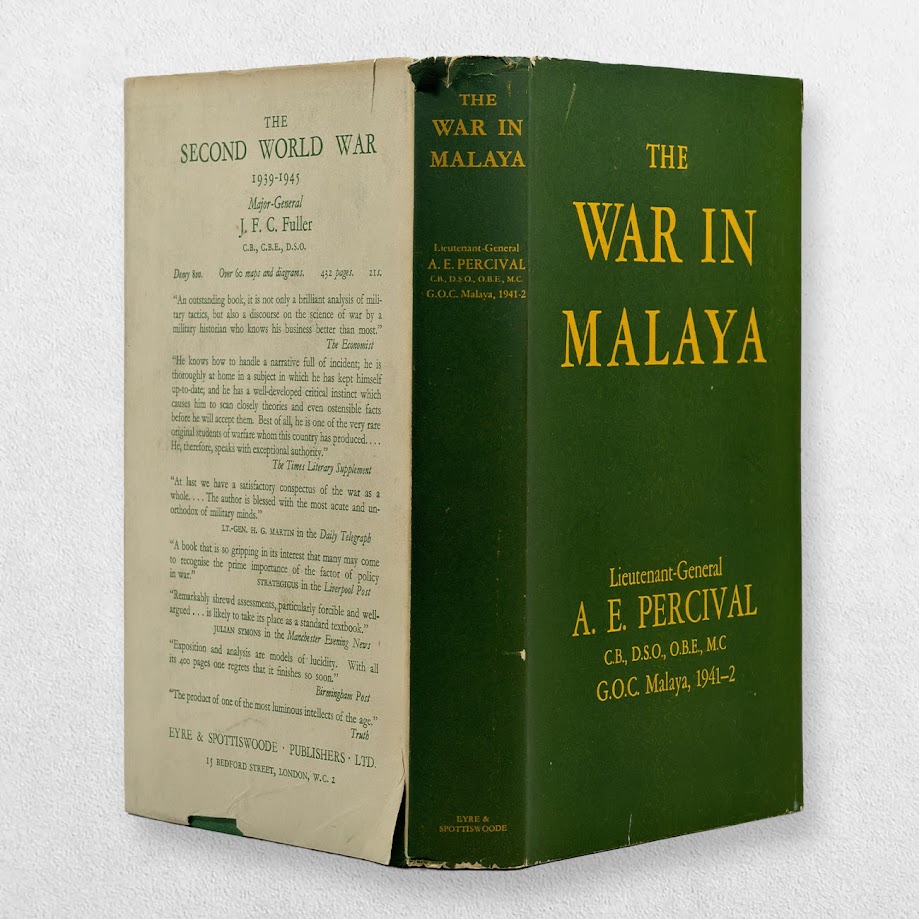
PERCIVAL, LIEUTENANT-GENERAL ARTHUR ERNEST. THE WAR IN MALAYA. FIRST EDITION, FIRST IMPRESSION, APRIL 1949. THE IMPORTANT FIRST-HAND ACCOUNT OF THE MALAYAN CAMPAIGN, THE JAPANESE INVASION AND THE FALL OF SINGAPORE IN FEBRUARY 1942, WRITTEN BY THE BRITISH COMMANDER RESPONSIBLE FOR THE DEFENCE OF MALAYA. ORIGINAL CLOTH AND DUSTWRAPPER.
Author: Lieutenant-General Arthur Ernest Percival, C.B., D.S.O., O.B.E., M.C. (1887–1966).
Publisher: Eyre & Spottiswoode, London, England.
Publication Date: April 1949.
Edition: First edition, first impression.
Format: Octavo. Original publisher’s green cloth binding with gilt spine lettering, in the original green and yellow printed dustwrapper.
Pagination: x, 336 pages.
Illustrations: Maps illustrating the Malayan campaign and its military operations.
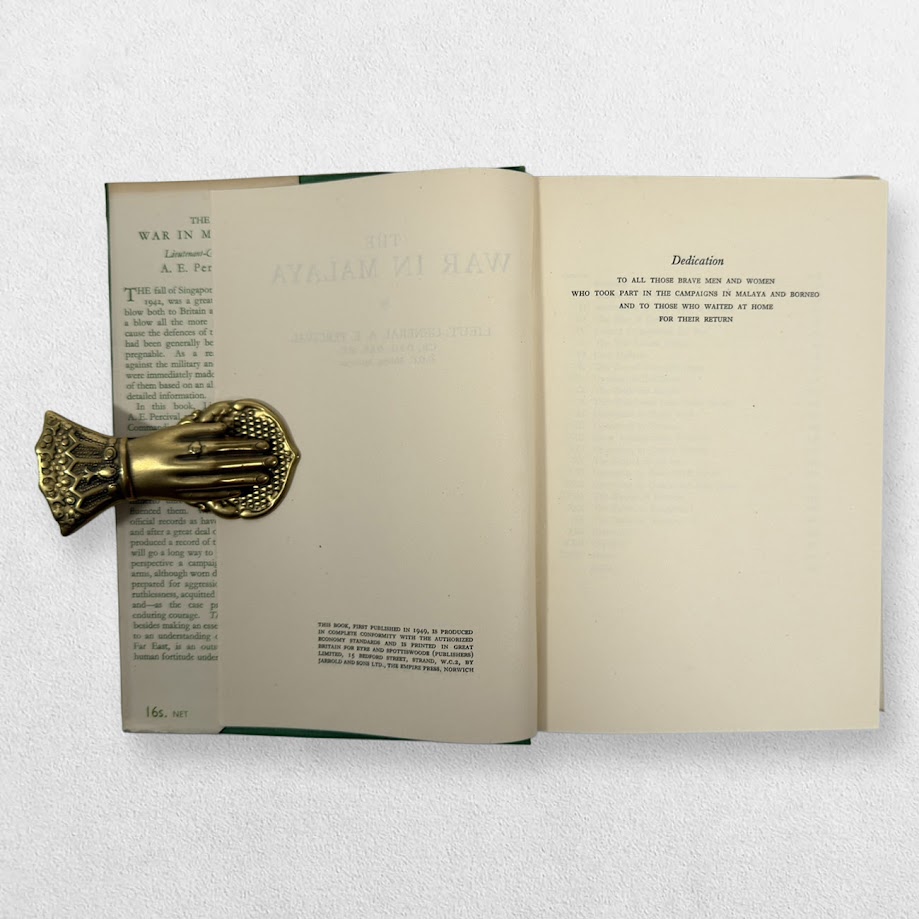
Condition: Near fine in a very good original dustwrapper. Slight foxing to the text-block edges and preliminary leaves, otherwise the pages are exceptionally clean. Dustwrapper slightly creased, nicked, faded, marked and rubbed, with a few short closed tears.
Stock Code: 004236.
Location: Bookroom.
Description
An attractive first edition, first impression of The War in Malaya, Lieutenant-General A. E. Percival’s important account of the disastrous British and Commonwealth campaign against Japan in Malaya and Singapore between December 1941 and February 1942. Published by Eyre & Spottiswoode in April 1949, this substantial volume provides the personal account of the officer who commanded British and Commonwealth land forces in Malaya during one of the most consequential military defeats in British history.
Percival was General Officer Commanding Malaya from May 1941 and remained in command throughout the Japanese invasion, the retreat down the Malay Peninsula and the final battle for Singapore. On 15 February 1942, following the collapse of the island’s defences and faced with a deteriorating military and civilian situation, Percival surrendered the British and Commonwealth garrison to Japanese forces under Lieutenant-General Tomoyuki Yamashita. The defeat had profound military, political and psychological consequences.
Singapore had long been regarded as a principal fortress of the British Empire in Asia. Its surrender exposed the weakness of Britain’s Far Eastern defensive arrangements, brought tens of thousands of Allied servicemen into captivity and fundamentally damaged the prestige of European colonial power in Southeast Asia. The War in Malaya is particularly important because it was written by the commander who bore direct responsibility for the campaign’s final decisions. Rather than being a retrospective history assembled solely from official records, the book provides Percival’s own account of his preparations, the progress of the fighting, the operational difficulties confronting his forces and the circumstances that led to the surrender.
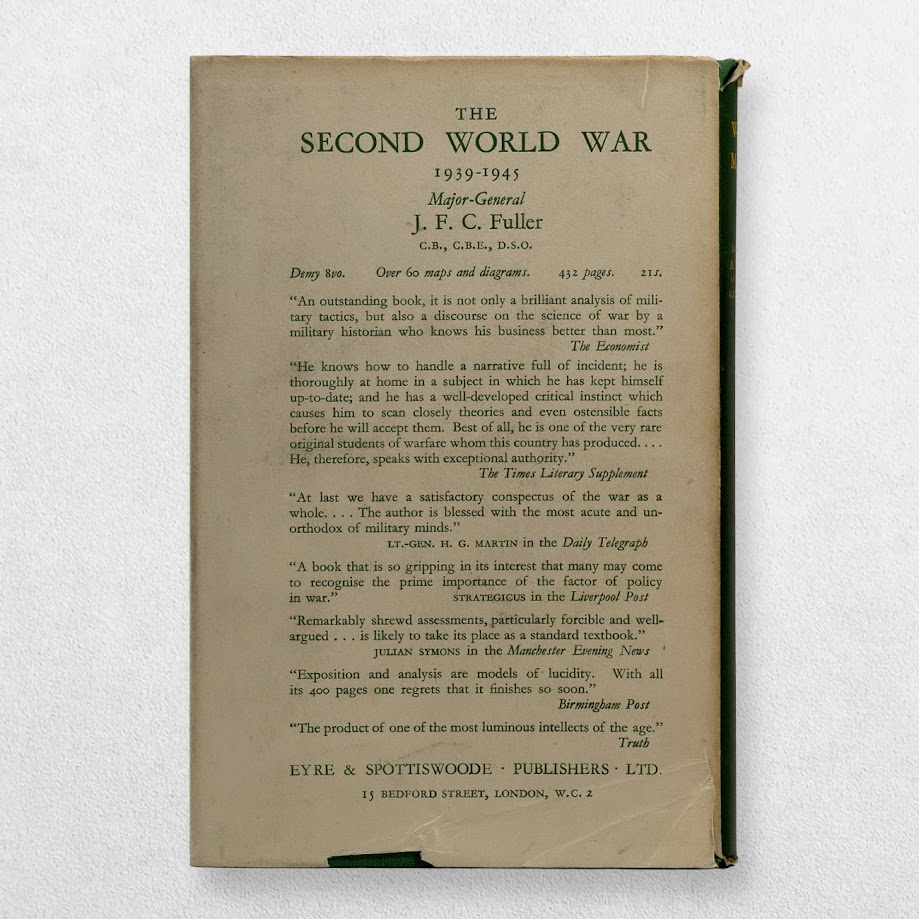
The narrative also includes his experiences as a prisoner of war. The present copy is the original first impression of April 1949, not the reprint issued later that year. It retains its attractive original green dustwrapper, with yellow lettering and advertisements for other military histories on the rear panel.
The book is in near fine condition, with slight foxing to the text-block edges and preliminary pages, otherwise exceptionally clean. The original dustwrapper is very good, with the relatively modest wear and short closed tears described below. An important original publication for collectors of the Second World War, the Malayan Campaign, the fall of Singapore, British military history and the history of Southeast Asia.
The Japanese Invasion of Malaya, December 1941
The Japanese invasion of Malaya began in December 1941 as part of Japan’s wider offensive against British, American and Dutch possessions in Southeast Asia and the Pacific. Japanese forces landed in northern Malaya and southern Thailand, initiating a rapid campaign that would overwhelm British and Commonwealth defences in little more than two months. The defending forces included British, Indian, Australian and Malayan units, supported by local volunteer formations and other military personnel.
Although the Allied forces possessed considerable numerical strength, their effectiveness was compromised by shortages of modern equipment, inadequate air support, uneven training, dispersed defensive positions and difficulties coordinating operations. Japanese troops demonstrated considerable skill in jungle warfare, infiltration and rapid movement, frequently bypassing defensive positions and threatening Allied communications. Their tactical flexibility, use of bicycles and effective coordination of infantry, armour and aircraft contributed substantially to the speed of their advance. The British and Commonwealth forces were repeatedly compelled to withdraw southwards.
The campaign included important engagements in Kedah, Perak, Johore and other areas of the Malay Peninsula. Percival’s book provides detailed accounts of these operations, examining their development from the perspective of the senior commander responsible for directing the defence.
The Defence of Malaya: Planning and Preparation
One of the central themes of The War in Malaya is the question of whether the British military authorities had adequately prepared for a Japanese invasion. Before the war, British strategic planning in the Far East had placed considerable emphasis upon Singapore as a major naval base. However, the successful defence of the island depended upon maintaining control of the surrounding sea approaches, sufficient air protection and an effective land defence extending into Malaya. The Japanese offensive exposed serious weaknesses in these arrangements.
Percival discusses the defensive plans available to him, the resources required to implement them and the difficulties created by competing military priorities elsewhere in the British Empire. During 1941, Britain was already heavily committed to operations in Europe, the Mediterranean and North Africa. Modern aircraft, armoured vehicles, trained formations and other resources were consequently in short supply. Percival’s account explores the extent to which these deficiencies affected his ability to organise an effective defence. His discussion is particularly valuable because it provides evidence of the assumptions, calculations and operational difficulties facing the military command before the Japanese attack. It must, nevertheless, be read alongside subsequent research, which has questioned both the decisions made by senior commanders and the explanations offered after the defeat.
The Retreat Through Malaya
The campaign developed into a succession of withdrawals as Japanese forces advanced rapidly towards Singapore. The defending troops faced considerable difficulties in maintaining coherent defensive positions. Japanese successes in northern Malaya allowed their forces to exploit the peninsula’s transport routes and threaten Allied units attempting to establish successive defensive lines. Fighting in Perak and Johore became particularly important as the campaign approached its final stages. The battles around Muar and the subsequent withdrawal through Johore illustrated the growing pressure upon Commonwealth formations.
The book examines these engagements, the movement of troops and the operational decisions taken by senior commanders. Percival also addresses administrative and logistical problems, including the organisation of supplies, communications, civil defence and military support services.
The Fall of Singapore, 15 February 1942
The fall of Singapore was one of the most significant events of the Second World War in Asia. After the withdrawal from mainland Malaya, British and Commonwealth forces attempted to defend Singapore Island. Japanese troops crossed the Johore Strait on the night of 8–9 February 1942 and established positions on the island’s north-western coast.
Despite determined resistance in several sectors, the Japanese advanced towards strategically important positions, including the Bukit Timah area. The defending forces experienced increasing difficulties with communications, the movement of reserves and the availability of water and other essential supplies. The situation of the civilian population also became increasingly desperate. On 15 February, Percival decided to surrender.
The decision brought the campaign to an end and resulted in the captivity of tens of thousands of British, Australian, Indian and other Allied servicemen. The defeat was subsequently described by Winston Churchill as one of the greatest disasters in British military history. It became a defining moment in the decline of British imperial authority in Southeast Asia. Percival’s explanation of the final battle and his decision to surrender forms one of the most historically significant sections of the book. Because it was written by the commander directly responsible, the account possesses considerable primary-source importance.
Its value is not dependent upon accepting Percival’s conclusions without question. Rather, it provides essential evidence of how he understood the defeat and wished the circumstances of his command to be remembered.
Captivity and the Experience of Japanese Prisoners of War
An important aspect of the book is Percival’s account of his captivity following the fall of Singapore. The treatment of Allied prisoners of war under Japanese authority remains one of the most disturbing aspects of the conflict in Asia. Prisoners experienced a wide range of conditions, frequently including inadequate food, disease, forced labour and physical abuse.
The experiences of those held in camps throughout Southeast Asia and elsewhere have become central to the historical study of the Pacific War. Percival’s circumstances as a captured senior officer differed substantially from those of many ordinary servicemen, particularly prisoners compelled to undertake forced labour. Nevertheless, his account provides an additional perspective upon the consequences of the surrender and the experiences of senior Allied prisoners during the remaining years of the war. His narrative concludes with the final stages of captivity and the end of the conflict.
Condition
Near fine in a very good original dustwrapper. The original publisher’s cloth binding is clean and well preserved. There is slight foxing to the text-block edges and preliminary leaves, but the remainder of the pages are exceptionally clean and attractive. The binding remains tidy and the volume presents very well. The original green dustwrapper is in very good condition, retaining its distinctive yellow lettering and original printed design. There is slight creasing, nicking, fading, marking and rubbing, with a few short closed tears, particularly around the edges and extremities. There is some minor wear at the upper spine and corners. The rear panel remains clearly legible, including the contemporary publisher’s advertisement.
Condition: Near fine in a very good original dustwrapper. Slight foxing to text-block and preliminaries, otherwise exceptionally clean. Dustwrapper slightly creased, nicked, faded, marked and rubbed, with a few short closed tears.
Stock Code: 004236.
Location: Bookroom.
Why Buy From Hornseys?
Established in 1976, Hornseys is an independent, family-run antiquarian bookshop and gallery in the historic cathedral city of Ripon, North Yorkshire. Celebrating our fiftieth year in 2026, we specialise in carefully selected first editions, military history, travel and exploration, original maps, photographs and historically significant books and ephemera.
Authenticity and Bibliographical Accuracy
Every book offered by Hornseys is individually examined and catalogued. We pay particular attention to edition and impression statements, original bindings, dustwrappers, illustrations and other significant bibliographical details. We distinguish first impressions from later printings and reprints, recognising the importance of accurate identification to collectors.
Historical Research
Our cataloguing seeks to explain both the historical importance of a book and its position within subsequent scholarship. For military memoirs and personal accounts, we distinguish the author’s first-hand testimony from later historical interpretations.
Detailed Condition Reporting
Every book is examined carefully before sale. We describe relevant condition issues, including foxing, dustwrapper wear, fading, tears and other defects, providing photographs of the actual item offered.
Established Since 1976
Hornseys has served collectors and readers for fifty years, building our reputation upon knowledgeable service, careful stock selection and accurate descriptions.
Free UK Tracked Delivery
We offer free tracked delivery throughout the United Kingdom, with secure packaging appropriate to the nature of each item.
Fourteen-Day Unconditional Returns
We offer a fourteen-day unconditional returns policy. Please notify us within fourteen days of receipt if you wish to return an item. Returned books must be received in the same condition in which they were supplied.
Visit Hornseys
Our bookshop and gallery is located at 3 Kirkgate, Ripon, North Yorkshire. We welcome enquiries from collectors of Second World War history, original military memoirs, the history of Singapore and Southeast Asia.
Hornseys – Established 1976. Celebrating Fifty Years of Specialist Antiquarian Bookselling.