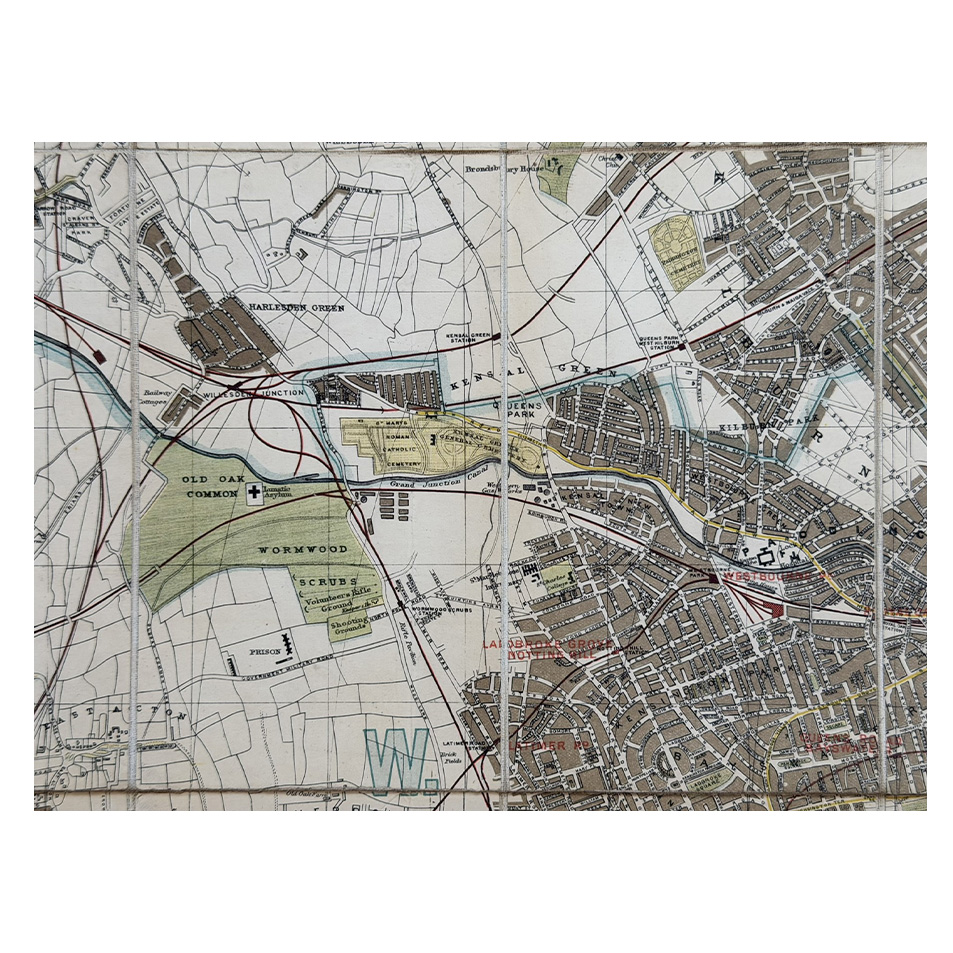
Mason & Payne’s Popular Map Of London – 1887
Publisher: Mason & Payne
Price: £600 including postage in the UK
Publication Date: 1887
Edition: First edition thus
Sheet Size: 105cm x 64.5cm
Condition: Very good plus
Condition:
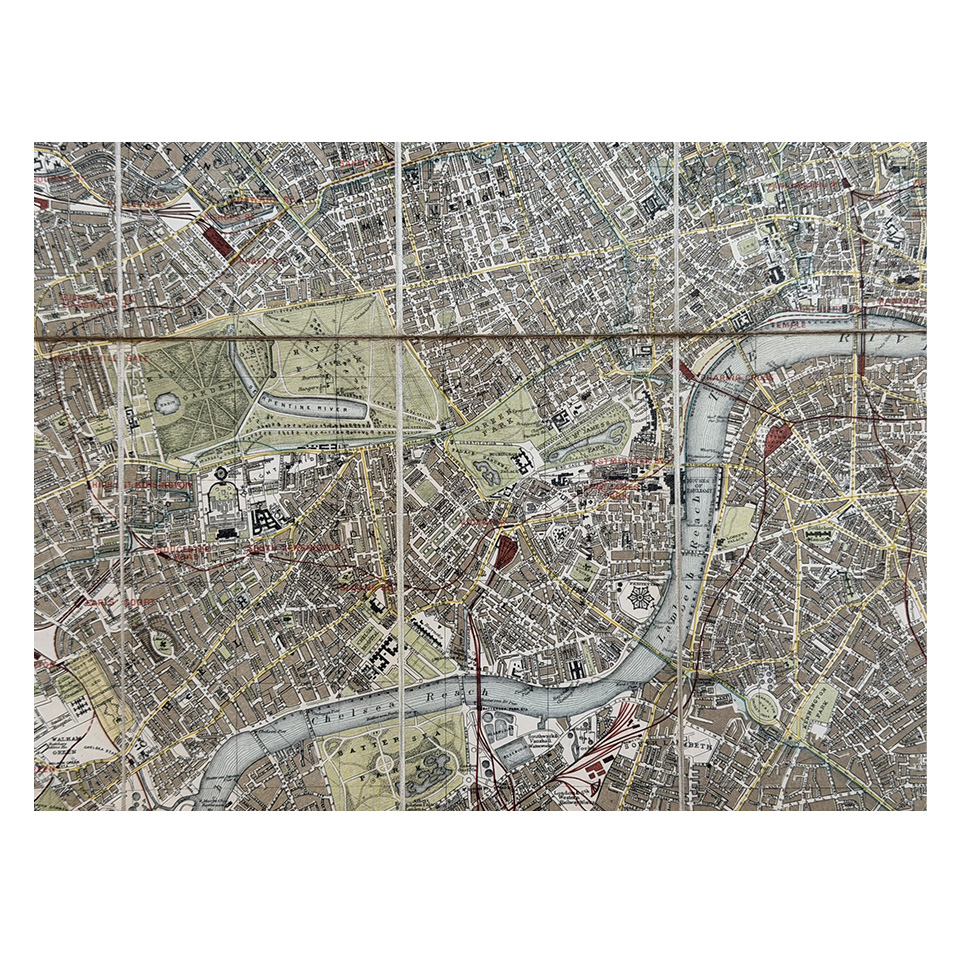
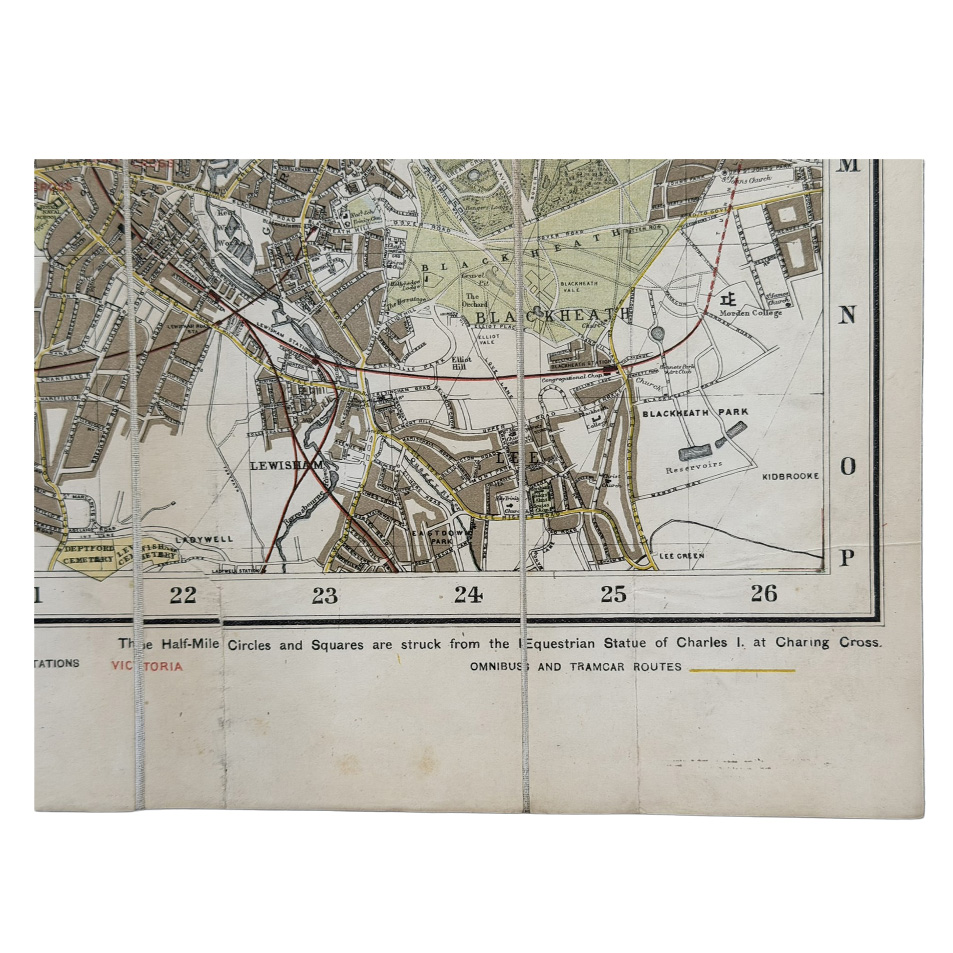
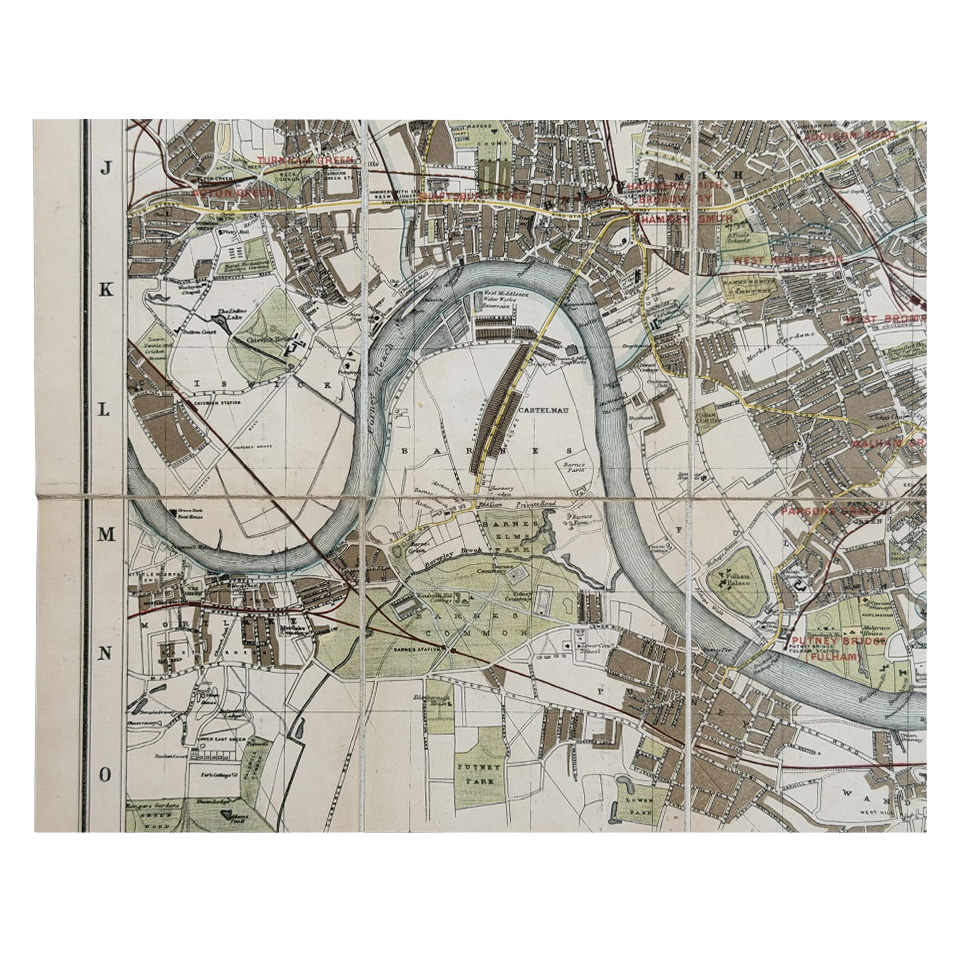
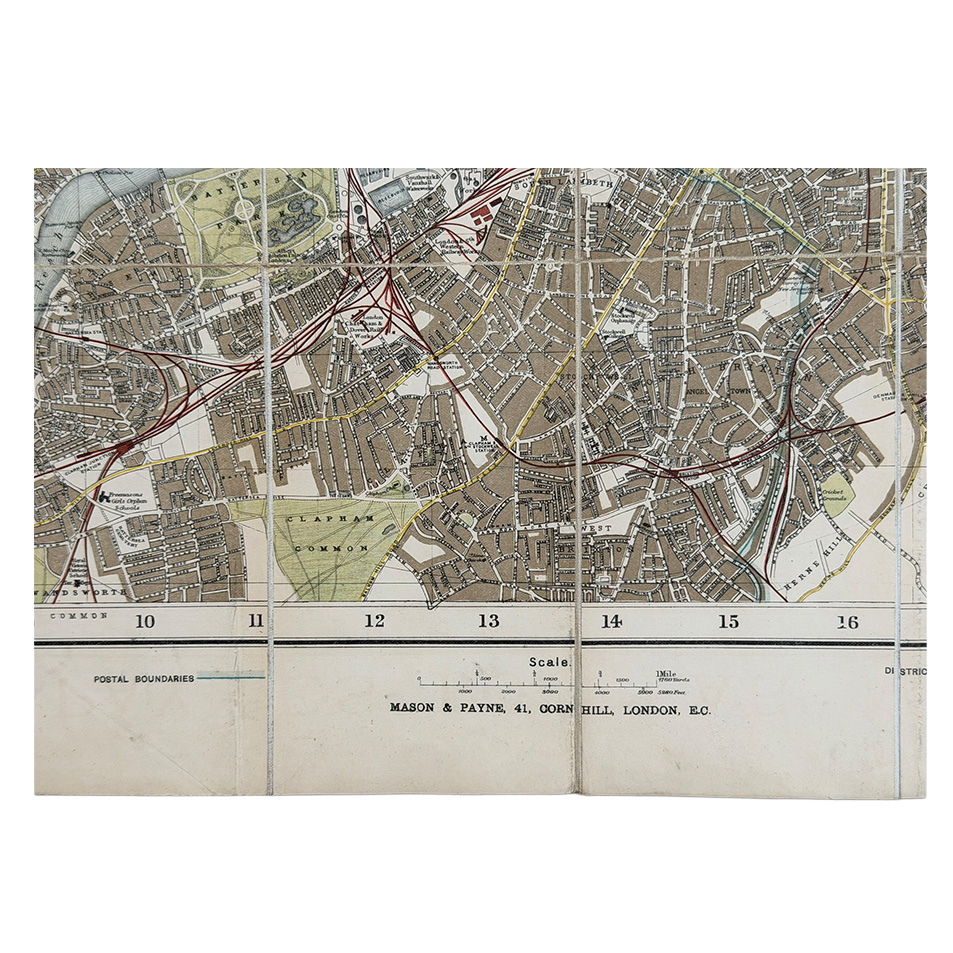
Date: c.1887. A rare and highly detailed folding map of late Victorian London, with title at the head and a comprehensive key below. The map clearly delineates all major railway termini, with the District and Metropolitan railways marked and stations named in red. The key further identifies tram routes, postal districts, cemeteries, and public parks. The area covered extends from Upper Holloway to Brixton, and from Acton to West Ham, offering a broad and practical view of the capital at a period of rapid expansion. Lithographed in colours. Size: 64.5cm × 105cm. Scale: 3 inches to one mile. Dissected and backed on linen for durability. Folds into the publisher’s original pictorial cloth boards. Covers slightly rubbed. Lacks the index. Very minor surface dustiness to the map but in very good plus, bright, clean condition. Scarce in any form and a very nice copy indeed.
London In The 1880s: A Brief Account
Overview
London in the 1880s was the largest city in the world and the administrative, financial, and symbolic centre of the British Empire. With a population approaching five million, it was a city of extraordinary contrasts: wealth and poverty, innovation and congestion, confidence and anxiety. The decade sits at a transitional moment—late Victorian in character, but already anticipating the social, political, and technological pressures of the twentieth century.
This was a London that functioned, but only just: a metropolis constantly adapting to its own scale.
Urban form and expansion
A city beyond the City
By the 1880s, London was no longer defined by the historic City of London. Urban life extended across a vast metropolitan area including Westminster, Southwark, Lambeth, Paddington, Islington, Hackney, Chelsea, and Kensington, with suburbs spreading rapidly along railway lines.
Development followed transport:
- Railways drove suburban growth
- New housing estates spread outward
- The city became increasingly polycentric
Londoners were now as likely to live miles from their place of work as within walking distance.
Streets and housing
The built environment varied sharply:
- West End: wide streets, stuccoed terraces, clubs, theatres, and shops
- East End: dense courts, lodging houses, warehouses, and docks
- Inner suburbs: rows of brick terraced housing for clerks and skilled workers
Overcrowding remained severe in poorer districts. Many working-class families lived in single rooms, often without proper sanitation.
Transport and mobility
Railways
By the 1880s, London was a railway city:
- Major termini (Paddington, Euston, King’s Cross, Liverpool Street, Waterloo, Victoria) structured movement and commerce
- Mainline railways brought commuters from newly developed suburbs
Rail travel transformed daily life, allowing social separation between residence and labour.
Underground and surface transport
The Metropolitan Railway and District Railway were firmly established, though still partially steam-operated, creating smoky, noisy journeys. Horse-drawn omnibuses and hansom cabs dominated surface transport, while tramways expanded in outer districts.
Movement through London was constant, crowded, and increasingly regulated.
Economy and labour
Commercial and financial power
London in the 1880s was the world’s leading:
- Financial centre
- Insurance market
- Shipping and trading hub
The City functioned as a global clearing house for capital. Decisions made in London shaped economies across Europe, Asia, Africa, and the Americas.
Work and inequality
Employment ranged from secure clerical and professional roles to casual, insecure labour:
- Dock work was irregular and poorly paid
- Sweated industries employed women and children
- Clerks formed a growing lower-middle class
The decade exposed deep structural inequality. The phrase “the abyss” was increasingly used to describe the urban poor, whose existence challenged Victorian assumptions about progress.
Poverty, reform, and social anxiety
The East End
The East End of London became the focus of national attention. Journalists, reformers, and investigators documented:
- Extreme overcrowding
- Poor sanitation
- Chronic underemployment
Charles Booth’s pioneering poverty surveys, begun in the late 1880s, revealed that a substantial proportion of Londoners lived in or near destitution.
Philanthropy and intervention
The 1880s saw:
- Expanded charitable activity
- Settlement houses and missions
- Early municipal housing experiments
Yet responses were often fragmented, moralising, and insufficient. The scale of need increasingly demanded state involvement, a notion still controversial at the time.
Public health and infrastructure
Sanitation and water
Following mid-century reforms, London’s water supply and sewage systems were vastly improved, reducing epidemic disease. However:
- Localised outbreaks persisted
- Poor districts benefited unevenly
- Air pollution from coal smoke was severe
The infamous London fogs—often thickened by industrial smoke—were a defining feature of winter life.
Policing and order
The Metropolitan Police were well established by the 1880s. Policing focused on:
- Crowd control
- Public order
- Surveillance of poorer districts
Despite this, crime—real and imagined—loomed large in the public imagination.
Politics and governance
Fragmented authority
London lacked a single, unified governing body. Power was divided between:
- Vestries
- Boards
- Parishes
- The Metropolitan Board of Works
This fragmentation hindered large-scale reform. Calls for metropolitan government grew louder, leading eventually to the creation of the London County Council in 1889.
Political ferment
The 1880s were politically charged:
- Irish nationalism affected London politics
- Socialism gained a foothold among workers
- Mass demonstrations became more common
The city increasingly served as a stage for national political conflict.
Culture, leisure, and daily life
Entertainment
Londoners enjoyed a vast range of leisure activities:
- Theatres and music halls
- Pleasure gardens and parks
- Exhibitions and lectures
Music halls, in particular, were central to popular culture, offering satire, sentiment, and social commentary.
Reading and information
Cheap newspapers, pamphlets, and illustrated magazines proliferated. Literacy rates were high, and Londoners were deeply engaged with:
- News
- Sensation
- Reform debates
The city was saturated with print.
Fear, crime, and the imagination
The Ripper murders
The Whitechapel murders of 1888 crystallised anxieties about:
- Urban anonymity
- Class division
- Policing and social breakdown
Although exceptional, they became emblematic of wider fears about modern city life.
London at the end of the decade
By the late 1880s, London was:
- Economically dominant
- Socially unstable
- Administratively inadequate for its size
It was a city that worked through improvisation, habit, and sheer scale rather than coherent planning.
Concluding assessment
London in the 1880s was a city at a threshold. It embodied Victorian confidence in progress while simultaneously exposing the limits of that belief. Its railways, markets, and institutions projected imperial power, yet its slums, labour unrest, and governance failures demanded new responses.
The decade forced London—and Britain—to confront the reality that modern urban life required systemic reform, not charity alone. In doing so, it laid the foundations for the social and political transformations of the decades to come.
Why buy from us?
At Hornseys, we are committed to offering items that meet the highest standards of quality and authenticity. Our collection is meticulously curated to ensure that each item is a valuable and authentic piece of history. Here’s what sets us apart:
- Authenticity and Provenance: Every item is researched, collated, and verified for authenticity.
- Expert Curation: Each item is selected with a keen eye for significance, condition, and rarity, ensuring a collection that is both diverse and distinguished.
- Customer Satisfaction: We strive to provide an exceptional customer experience, from detailed descriptions and provenance to secure and prompt delivery of your purchase.
- Returns Policy: We offer an unconditional guarantee on every item. If you wish to make a return, items may be sent back to us within fourteen days of receipt for any reason. We request advance notification of returns, and items must be returned in the same condition as sent for a full refund.
Explore Our Collection:
Visit Hornseys to explore our fine collection of rare and signed books, maps, artwork and objects. Whether you are an avid collector or looking for a special gift, our selection offers something truly unique. Located in the picturesque Yorkshire Dales, our Ripon gallery has been a haven for book lovers, art enthusiasts, and collectors since 1976.
Thank you for looking.