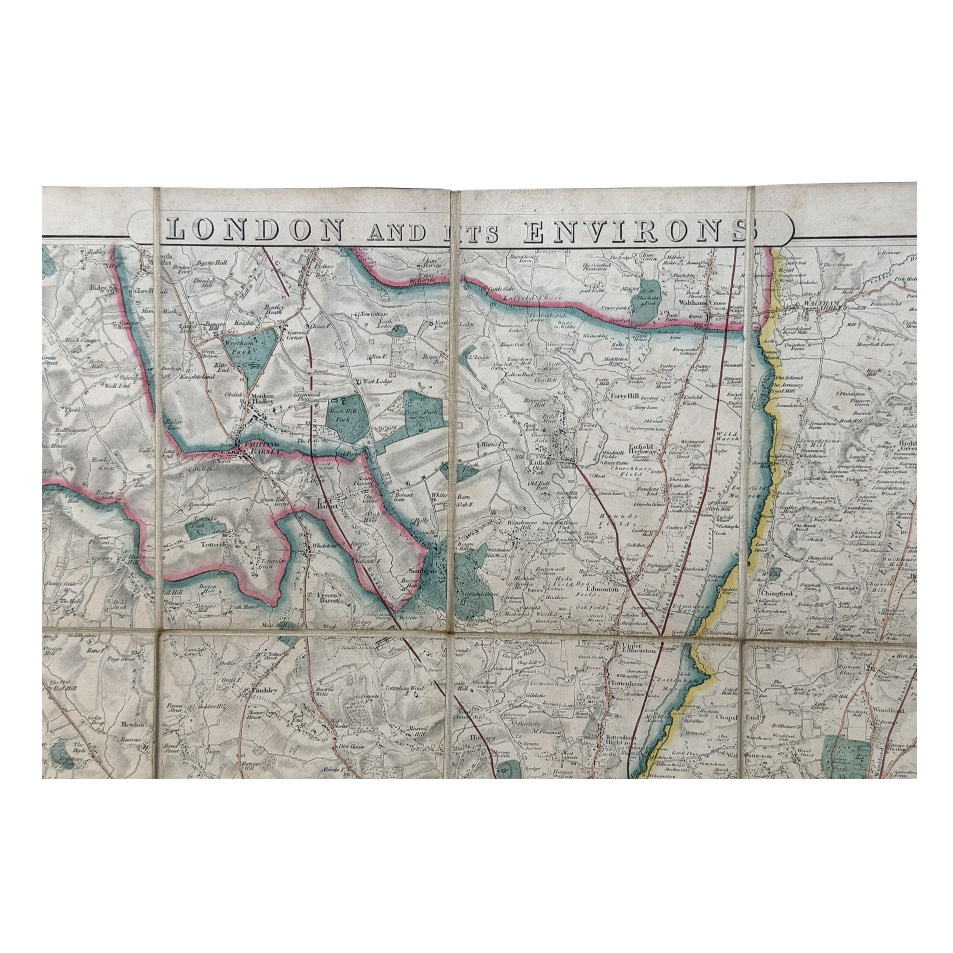
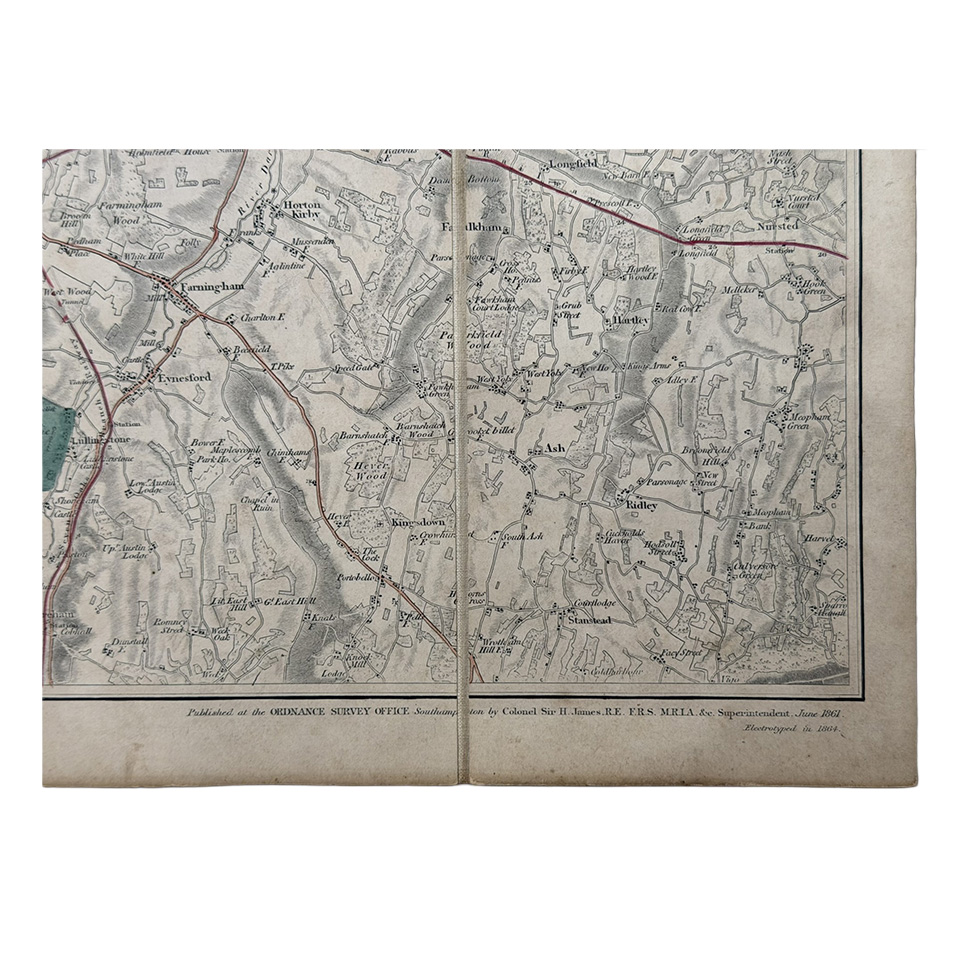
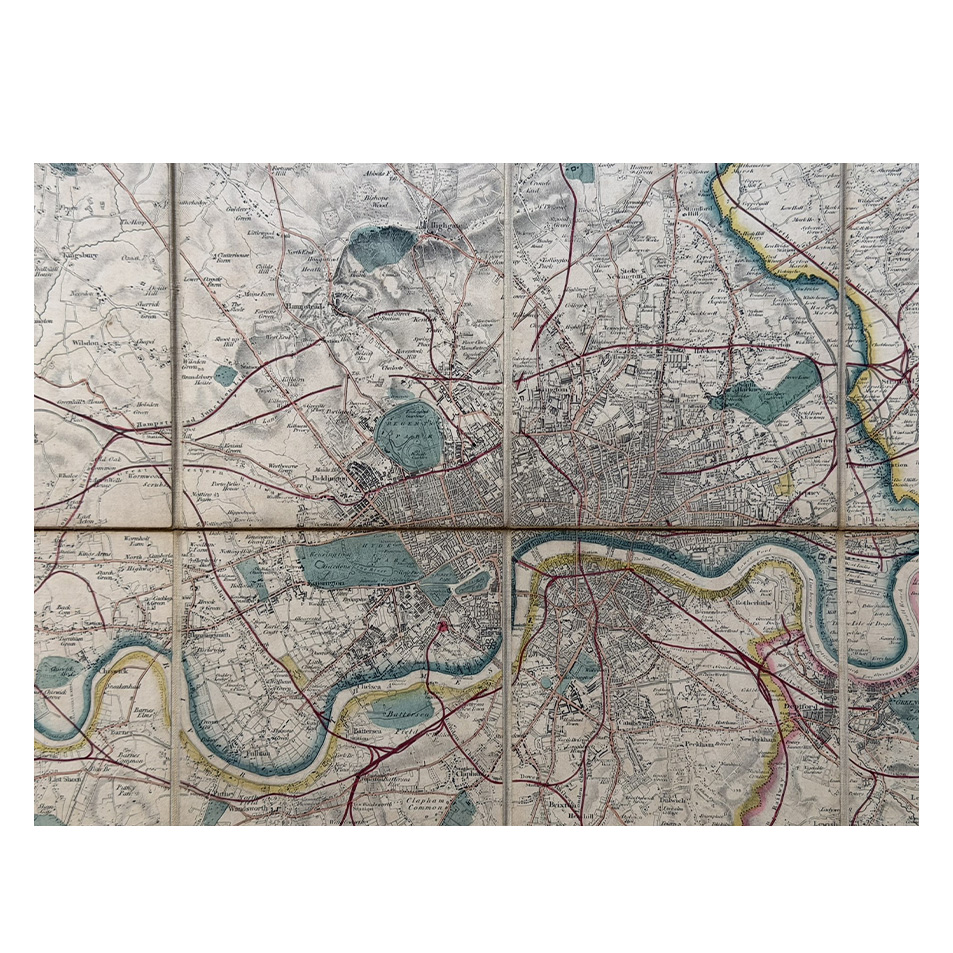
London And Its Environs – 1864
Publisher: The Ordnance Survey
Price: £225 including postage in the UK
Publication Date: 1864
Edition: Not stated
Sheet Size: 114.4cm x 75cm
Condition: Very good
Condition:
Date: 1864. Original steel engraving. Sheet size: 114.4cm x 75cm. Backed on linen. Original hand-colouring. Minor age toning and marking and dustiness. In very good condition overall.
London In The Mid-19th Century: A Brief Account
Overview
By the mid-nineteenth century, London was the largest city in the world, the administrative heart of a global empire, and the financial centre of an expanding industrial economy. Its population grew from just over one million at the start of the century to well above two million by the 1850s, producing a city that was unprecedented in scale, complexity, and influence.
Mid-Victorian London embodied extraordinary contrasts: wealth and poverty, innovation and squalor, reform and inertia. It was a city struggling to govern itself, to house its people, and to reconcile rapid growth with social order, yet it was also a place of confidence, ambition, and cultural authority.
- Urban Growth and the Physical City
Expansion and Sprawl
London in this period expanded outwards rather than upwards. The city spread into Middlesex, Surrey, Kent, and Essex, absorbing former villages and fields into an ever-widening metropolitan zone.
Key features of this growth included:
- Dense inner districts of older housing and courts
- New terraces and squares for the middle classes
- Peripheral suburbs connected by rail and omnibus
The lack of a single municipal authority meant expansion was largely uncoordinated, driven by speculative building rather than comprehensive planning.
Housing Conditions
Housing quality varied sharply by class and location.
- West End and newer suburbs: brick terraces, improved sanitation, greater domestic privacy
- Inner East and South London: overcrowded courts, subdivided houses, poor ventilation
- Rookeries: districts of extreme poverty characterised by dilapidation and density
Overcrowding was endemic. Multiple families often shared rooms, and lodgers were common, especially among the working poor.
- Population and Social Structure
Demographic Change
London’s population was sustained not only by natural increase but by constant inward migration:
- Rural migrants seeking work
- Irish migrants fleeing famine and poverty
- Skilled artisans drawn to urban trades
This produced a young, mobile, and socially diverse population, but also heightened competition for housing and employment.
Class Structure
Mid-nineteenth-century London was rigidly stratified:
- Elite and upper middle classes: landowners, financiers, senior professionals
- Middle classes: clerks, shopkeepers, teachers, civil servants
- Working classes: artisans, labourers, dockworkers, domestic servants
- The poor and destitute: casual labourers, widows, the sick, the unemployed
Class divisions were spatially visible, reinforced by residence, dress, occupation, and patterns of leisure.
- Economy and Work
London as an Economic Hub
London was not primarily a manufacturing city like Manchester or Birmingham. Its economic strength lay in:
- Finance and banking
- Trade and shipping
- Administration and government
- Skilled craft production
The City of London functioned as the financial nerve centre of Britain and its empire, handling credit, insurance, and international trade.
Labour and Employment
Employment was often insecure:
- Casual labour was widespread, especially in docks and construction
- Many trades were seasonal
- Women and children formed a significant part of the workforce
Workplaces ranged from large docks and warehouses to small workshops and home-based labour.
Domestic service was the single largest employer of women, shaping gendered experiences of urban life.
- Transport and Infrastructure
Railways and Mobility
The arrival of railways transformed London:
- Major termini (Euston, Paddington, King’s Cross, Waterloo) reshaped districts
- Suburban commuting became possible for the middle classes
- Goods could be moved rapidly across the city and beyond
Railways accelerated both urban sprawl and economic integration.
Streets, Omnibuses, and River Traffic
Horse-drawn omnibuses, cabs, and carts crowded London’s streets. Congestion was severe, especially in central areas. The Thames remained a vital artery for goods and people, though it was also heavily polluted.
- Sanitation, Health, and Reform
Public Health Crisis
Mid-nineteenth-century London faced profound sanitary challenges:
- Inadequate drainage and cesspits
- Contaminated water supplies
- Frequent outbreaks of disease, including cholera and typhoid
Mortality rates were high, particularly among infants and the urban poor.
Reform and Engineering
Public health crises forced reform. Gradually, London saw:
- Construction of large-scale sewer systems
- Improved water supply management
- Growing acceptance of state intervention in urban health
These changes marked a shift towards modern urban governance, though progress was uneven and contested.
- Governance and Policing
Fragmented Authority
Before the creation of a unified metropolitan government, London was governed by:
- Parish vestries
- Improvement commissions
- Ancient city corporations
This fragmentation complicated responses to housing, sanitation, and poverty.
Policing and Order
The Metropolitan Police, established earlier in the century, became a visible presence by mid-century. Policing aimed not only to control crime but to regulate public behaviour, reflecting anxieties about crowding, disorder, and class tension.
- Poverty, Welfare, and Social Anxiety
The Poor Law and Workhouses
Relief for the poor was structured around the workhouse system, which was deliberately harsh in order to deter dependency. For many Londoners, the workhouse symbolised shame and social failure.
Charitable organisations, religious missions, and reformers sought to alleviate suffering, but assistance was often moralised and conditional.
Crime and Perception
Crime was a constant concern, though its scale was often exaggerated in the press. The city’s size and anonymity fed fears of criminality, moral decay, and social breakdown.
- Culture, Leisure, and Intellectual Life
Cultural Capital
London was the cultural heart of Britain:
- Theatres, concert halls, and opera houses flourished
- Museums and galleries expanded
- Newspapers and periodicals reached mass audiences
The city shaped national taste, opinion, and debate.
Leisure Across Classes
- The elite attended theatres, clubs, and private entertainments
- The middle classes favoured lectures, exhibitions, and respectable amusements
- The working classes frequented pubs, music halls, fairs, and sporting events
Leisure spaces were often sites of moral concern and regulation.
- London and Empire
Mid-nineteenth-century London was an imperial capital. Goods, people, and information flowed through the city from across the globe. Imperial wealth underpinned finance and trade, while imperial subjects and visitors added to London’s diversity.
Empire reinforced London’s sense of destiny and authority, even as it obscured the sources of inequality and exploitation.
Concluding Characterisation
London in the mid-nineteenth century was a city of immense energy and deep instability. It was:
- Economically dominant but socially fractured
- Culturally confident yet morally anxious
- Technologically advancing but administratively underdeveloped
It stood at the threshold of modern urban life, forcing new ways of thinking about governance, health, class, and responsibility. The problems London faced—and the solutions it began to develop—would shape cities across the world for generations.
Why buy from us?
At Hornseys, we are committed to offering items that meet the highest standards of quality and authenticity. Our collection is meticulously curated to ensure that each item is a valuable and authentic piece of history. Here’s what sets us apart:
- Authenticity and Provenance: Every item is researched, collated, and verified for authenticity.
- Expert Curation: Each item is selected with a keen eye for significance, condition, and rarity, ensuring a collection that is both diverse and distinguished.
- Customer Satisfaction: We strive to provide an exceptional customer experience, from detailed descriptions and provenance to secure and prompt delivery of your purchase.
- Returns Policy: We offer an unconditional guarantee on every item. If you wish to make a return, items may be sent back to us within fourteen days of receipt for any reason. We request advance notification of returns, and items must be returned in the same condition as sent for a full refund.
Explore Our Collection:
Visit Hornseys to explore our fine collection of rare and signed books, maps, artwork and objects. Whether you are an avid collector or looking for a special gift, our selection offers something truly unique. Located in the picturesque Yorkshire Dales, our Ripon gallery has been a haven for book lovers, art enthusiasts, and collectors since 1976.
Thank you for looking.