Sue Lyon as Lolita – Original MGM Press Photograph for the British Release of Lolita – 1962 – Vladimir Nabokov
Description
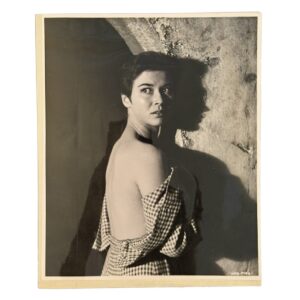
An exceptionally evocative original 1962 black-and-white press photograph of Sue Lyon as Dolores “Lolita” Haze, issued in connection with the British release and publicity campaign for Stanley Kubrick’s controversial adaptation of Vladimir Nabokov’s Lolita.
The photograph shows Lyon outdoors in character, turning towards the camera in a knitted top against a dark wooded background. It is a far more atmospheric image than the familiar studio publicity portraits: quiet, psychologically charged and immediately associated with the film’s uneasy presentation of adolescence, performance and adult projection.
The reverse transforms the photograph from an attractive film still into a particularly interesting piece of contemporary literary and cinematic history.
It retains its original typed press caption headed:
“‘LOLITA’ COMING TO BRITAIN”
and dated 28 August 1962.
The caption identifies:
“SUE LYON as ‘Lolita’, in the MGM film from the book.”
It goes on to state that the sixteen-year-old actress was coming to Britain to attend the London premiere and to see the film for the first time, because she was under eighteen and therefore had not been allowed to attend United States screenings.
The caption further names James Mason, Peter Sellers and Shelley Winters, and carries the highly specific publication instruction:
“FOR FIRST PUBLICATION IN EVENING PAPERS OF WEDNESDAY, AUGUST 29TH, 1962.”
This is precisely the kind of surviving newsroom documentation that gives an original press photograph genuine historical value. Rather than merely dating the print broadly to the year of release, it places it inside the actual British publicity campaign for the film.
The reverse also carries a Shields Gazette Library stamp and a later archive date of 19 November 1962, demonstrating its subsequent working life within a British newspaper photographic archive.
Nabokov, Censorship and the Scandal of Lolita
The significance of this photograph cannot really be understood without the extraordinary publishing history of Vladimir Nabokov’s 1955 novel.
Lolita had been rejected by several American and British publishers because of its subject matter: the narrative is told by Humbert Humbert, an unreliable middle-aged narrator who sexually abuses and exploits the twelve-year-old Dolores Haze while attempting to transform his actions, through elaborate and seductive prose, into a romantic narrative.
Unable initially to secure publication in Britain or America, Nabokov’s novel first appeared in Paris through Olympia Press in 1955. It was subsequently banned in France, while copies entering Britain were ordered seized by the Home Office. The novel was finally published in the United States in 1958 and Britain in 1959.
The controversy did not end with publication. Lolita became simultaneously a major literary achievement and one of the most disputed novels of the twentieth century. Its extraordinary prose, Nabokov’s manipulation of the unreliable narrator and the moral horror concealed beneath Humbert’s self-justification have generated decades of critical argument over the relationship between aesthetic beauty, manipulation, abuse and reader complicity. Modern criticism has increasingly emphasised Dolores as the abused child whose voice is repeatedly obscured by Humbert’s narration.
When Kubrick adapted the novel for cinema, the central problem was obvious. Contemporary censorship restrictions made a literal adaptation impossible. The film therefore softened, obscured and displaced much of the novel’s sexual content; the character’s apparent age was increased, and the finished picture relied heavily upon implication, satire and black comedy. Even the film’s famous advertising campaign acknowledged the difficulty with the provocative question: “How did they ever make a movie of Lolita?”
Sue Lyon and the Film
Sue Lyon was only in her mid-teens when she took the role that would define her career. The production deliberately presented her as older than Nabokov’s twelve-year-old Dolores, partly in response to censorship constraints.
Her casting became inseparable from the controversy surrounding the film. The surviving press caption on this photograph makes that tension unusually tangible: it openly states that Lyon was sixteen years old and that she had been unable to attend American screenings because she was under eighteen.
That is a remarkable piece of contemporary publicity history. The publicity campaign was simultaneously selling Lyon as the face of one of the most provocative films of the period while acknowledging that the actress herself was legally too young to attend screenings in the United States.
Later records confirm that Lyon travelled to London in early September 1962 for publicity connected with the British premiere. Getty records her at a reception at London’s Dorchester Hotel on 2 September 1962, describing her as being in Britain to attend the UK premiere.
Release records place the London premiere on 6 September 1962, suggesting that this 28 August press caption was issued in advance specifically to prepare British newspapers for Lyon’s arrival and the forthcoming premiere.
Lyon subsequently won the 1963 Golden Globe for New Star of the Year – Actress for Lolita.
Stanley Kubrick and Britain
Lolita was also a pivotal film in Kubrick’s career. Although set principally in the United States, it was the first of his films made largely in Britain. The BFI notes that much of the picture was shot at Elstree Studios, with British locations standing in for America.
The film starred:
James Mason as Humbert Humbert
Sue Lyon as Dolores “Lolita” Haze
Shelley Winters as Charlotte Haze
Peter Sellers as Clare Quilty
It was directed by Stanley Kubrick, with a screenplay credited to Vladimir Nabokov, although Kubrick substantially reshaped the material during production.
This photograph consequently has multiple collecting constituencies: Stanley Kubrick, Vladimir Nabokov, Sue Lyon, MGM, controversial cinema, censorship history and twentieth-century literary adaptation.
Condition
Very good condition overall for an original working press photograph dating from 1962.
The image remains sharp and strongly contrasted, with excellent definition to Sue Lyon’s face, hair and clothing. There is light age-related toning, minor handling wear and modest edge and corner wear consistent with contemporary newspaper use.
The reverse retains the original blue typed press caption dated 28 August 1962, the Shields Gazette Library stamp and archive date of 19 November 1962. There is minor age-related marking and adhesive residue associated with the caption.
The surviving verso material is an integral and important part of the photograph’s provenance.
Please study the photographs carefully, as they form part of the description.
Subject: Sue Lyon
Character: Dolores “Lolita” Haze
Film: Lolita
Director: Stanley Kubrick
Author / source: Vladimir Nabokov
Date: 1962
Press-caption date: 28 August 1962
First-publication instruction: 29 August 1962
Shields Gazette archive date: 19 November 1962
Studio / distributor: MGM
Photographer: Uncredited
Provenance: Shields Gazette photographic archive
Size: 21.6 × 15.3 cm
Format: Original black-and-white press photograph
Verso: Original typed British-release publicity caption, Shields Gazette Library stamp and archive date
Authenticity
This photograph has been handled, inspected and catalogued in-house at Hornseys.
Its identification, date and contemporary purpose are supported directly by the original press caption on the reverse, which identifies Sue Lyon as Lolita, records the British publicity campaign and specifies first publication in British evening newspapers on 29 August 1962.
It is an original contemporary press photograph and not a later reproduction.
Why Buy From Us?
At Hornseys, we only offer items that meet the highest standards of quality and authenticity. Our collection of prints and photographs is carefully curated to ensure each piece is authentic.
Here’s what sets us apart:
- Authenticity and Provenance: Every photograph is researched, collated, and verified for authenticity.
- Expert Curation: Each photograph is selected with a keen eye for historical significance, condition, and rarity, ensuring a collection that is both diverse and distinguished.
- Customer Satisfaction: We strive to provide an exceptional customer experience, from detailed descriptions and provenance to secure and prompt delivery of your purchase.
- Returns Policy: We offer an unconditional guarantee on every item. If you wish to make a return, items may be sent back to us within fourteen days of receipt for any reason. We request advance notification of returns, and items must be returned in the same condition as sent for a full refund.
Explore Our Collection:
Visit Hornseys to explore our fine collection of rare and antique prints and photographs. Whether you are an avid collector or looking for a unique historical piece, our selection offers something truly exceptional. Located in the picturesque Yorkshire Dales, our Ripon gallery has been a haven for art enthusiasts, historians, and collectors since 1976.
Thank you for looking.