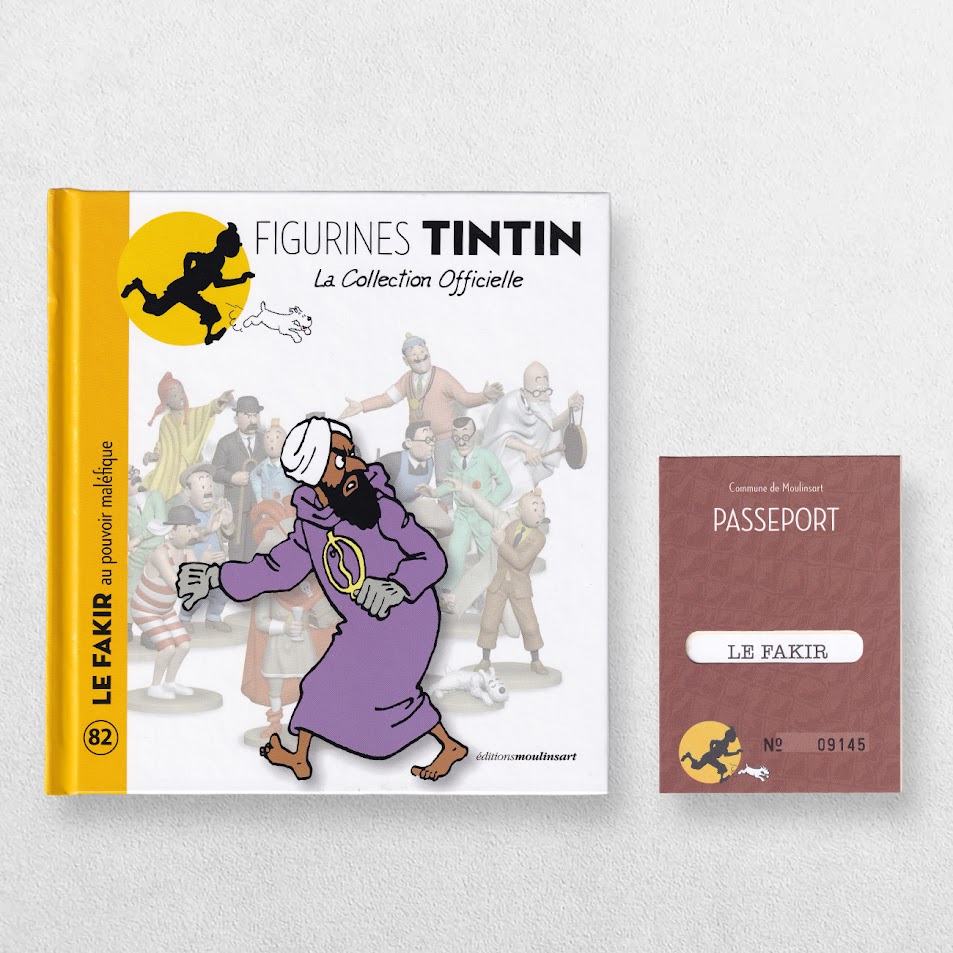
The Fakir With Evil Powers – Figurines Tintin La Collection Officielle – 82 – Le Fakir Au Pouvoir Maléfique
Author: Hergé & Editions Moulinsart
Price: £95.00
Publisher: Editions Moulinsart
Publication date: 2014
Format: Original pictorial boards with passport and figurine
Condition: In near fine condition
Illustrations: Illustrated throughout
Description:
Original pictorial boards. Includes passport loosely inserted. Text in French. Includes the accompanying figurine. One from the collection of 111 books and figurines. Very slight wear. In very near fine, clean condition overall.
The Fakir: A Short Biography
The Fakir is a secondary antagonist in The Adventures of Tintin – Cigars of the Pharaoh (Les Cigares du Pharaon, first serialised 1932–34, revised 1955*). He is one of Hergé’s earliest depictions of the “mystical villain” — a man combining superstition, manipulation, and exotic menace. Although he appears only briefly, the Fakir plays a crucial role in the narrative as an agent of the secret organisation known as Kih-Oskh.
Through this character, Hergé explores Western anxieties and fascinations with the East, blending elements of colonial adventure, espionage, and occult imagery within a story that marks Tintin’s transition from light-hearted journalism to international investigation.
Character Overview
- Full Title: The Fakir (unnamed in the story)
- Occupation: Hypnotist, mystic, and agent of the secret society Kih-Oskh
- First Appearance: Cigars of the Pharaoh
- Nationality: Indian
- Affiliation: Criminal network linked to the smuggling of opium
- Known For: Hypnosis, mind-control, and his association with a global drug-trafficking conspiracy
Role in Cigars of the Pharaoh
- The Enigmatic Servant of Kih-Oskh
The Fakir is first introduced as an apparently mystical figure working for Allan Thompson and Rastapopoulos, who secretly control a massive opium-smuggling network. His task is to silence or eliminate anyone who discovers the truth behind the Cigars of the Pharaoh — the trademark containers concealing drugs.
- Hypnotism and Manipulation
In one of the most memorable early scenes, the Fakir uses hypnosis to paralyse Tintin’s friend Professor Sophocles Sarcophagus, driving him into a delusional state. This act demonstrates both his power and his ruthlessness: the Fakir’s “evil power” (pouvoir maléfique) is rooted not in supernatural magic, but in psychological domination.
Later, he attempts to use the same method on Tintin, illustrating the hero’s vulnerability to mental and emotional coercion.
- Capture and Escape
Tintin eventually captures the Fakir and exposes his links to the Kih-Oskh cult, but the man escapes justice — an open narrative thread that contributes to the aura of mystery surrounding Hergé’s early villains. His sudden disappearance reflects both his elusiveness and the global reach of the network he serves.
Character Traits and Analysis
- Hypnotic and Sinister
The Fakir’s defining quality is his hypnotic control over others. Hergé’s visual storytelling exaggerates his stare — wide-eyed, intense, and unsettling — to convey psychological menace without overt violence. His calm, composed demeanour contrasts sharply with the chaos he creates.
- Symbol of the Exotic Unknown
When Hergé first conceived Cigars of the Pharaoh, European popular culture was steeped in fascination with “Oriental mysticism.” The Fakir embodies this fascination, but also its darker edge: the notion of secret knowledge used for harm.
Though drawn from colonial stereotypes of the time, Hergé’s fakir is more than a caricature. He functions as a metaphor for hidden power — knowledge twisted to serve greed and corruption.
- The Face of Subtle Evil
Unlike overt villains such as Rastapopoulos, the Fakir represents the intellectual or spiritual dimension of evil. He does not fight physically; his weapon is control. In this sense, he prefigures later Tintin adversaries such as Dr Müller and Colonel Sponsz, who manipulate others through psychology and ideology rather than brute force.
- A Link in a Larger Network
The Fakir is one cog in the machinery of Kih-Oskh, the secretive organisation smuggling opium in the guise of Egyptian artefacts. His presence bridges the mystical imagery of the pharaoh’s tomb with the modern reality of drug trafficking — a collision of superstition and organised crime that typifies Hergé’s growing narrative complexity.
Themes and Interpretation
- Power and Illusion
The Fakir’s power lies in illusion. He deceives both mind and perception, symbolising how appearances conceal truth — a recurring Tintin theme. The hypnotised victims around him serve as visual metaphors for manipulation by ideology, propaganda, or greed.
- The Clash of Rationality and Superstition
Tintin, as a journalist and rational hero, stands for modern reason and empirical thinking. The Fakir represents the opposite: superstition and psychological control. Their confrontation dramatises the struggle between enlightenment and ignorance — a key motif in Hergé’s early work.
- The Globalisation of Crime
Although the Fakir is an exotic figure, his crime is modern: he is part of a global drug ring run by Western businessmen. This irony — that “mystical” villainy masks an entirely materialist enterprise — reflects Hergé’s developing critique of colonial hypocrisy and international corruption.
Artistic Depiction
In the ligne claire style, Hergé renders the Fakir with minimal lines but maximum impact:
- Visual Traits: Bare torso, turban, intense eyes, and long fingers used in hypnotic gestures.
- Symbolism: His gaze becomes a visual motif of mental domination; the turban and robes evoke timelessness and mystery.
- Composition: He is often placed in dark or symmetrical frames, reinforcing his ritualistic aura and control over the scene.
These choices heighten tension while maintaining clarity — an early example of Hergé’s ability to convey psychological threat through line and layout rather than explicit violence.
Moral and Philosophical Reading
Hergé’s portrayal of the Fakir invites reflection on the morality of knowledge and belief. The character’s “evil power” is knowledge abused — a theme that recurs in The Calculus Affair and Explorers on the Moon, where science or intellect is misused for domination.
The Fakir is therefore an early prototype for the morally corrupt intellectual — a warning against the seductive power of secret knowledge divorced from compassion or ethics.
Legacy and Influence
Though the Fakir never reappears in later albums, his image remains iconic. He established a tone of mystery and menace that influenced later Hergé villains. The combination of mysticism, mind-control, and organised crime would echo in later works like The Blue Lotus and The Red Sea Sharks, where political and spiritual corruption intertwine.
For readers and scholars, the Fakir marks a transitional point in Hergé’s art — from simple adventure to allegory, from the colonial pulp of Tintin in the Congo to the psychological and moral sophistication of The Blue Lotus and The Calculus Affair.
Summary
- Name: The Fakir (unnamed)
- First Appearance: Cigars of the Pharaoh (Les Cigares du Pharaon, 1932–34; revised 1955)
- Occupation: Hypnotist, mystic, criminal agent
- Affiliation: Secret organisation Kih-Oskh
- Character Type: Mystical antagonist, manipulator, psychological villain
- Themes: Power, illusion, superstition versus reason, global corruption
- Fate: Captured and escapes; final whereabouts unknown
Conclusion
The Fakir is one of the most atmospheric figures in Hergé’s early Tintin adventures — a villain whose menace comes not from physical strength, but from intellect and influence.
He stands at the crossroads of mysticism and modernity, representing both the allure and the danger of knowledge detached from conscience.
In the evolution of The Adventures of Tintin, the Fakir’s shadow falls long: he is the first embodiment of the “mind as weapon” theme that would shape Hergé’s later masterpieces. Beneath his hypnotic calm lies a warning still resonant today — that power, when wielded without morality, becomes its own form of darkness.
Why Buy from Us?
At Hornseys, we are committed to offering items that meet the highest standards of quality and authenticity. Our collection of objects and rare books are carefully curated to ensure each edition is a valuable piece of bibliographical history. Here’s what sets us apart:
- Authenticity and Provenance: Each item is meticulously researched and verified for authenticity and collation.
- Expert Curation: Our selection process focuses on significance, condition, and rarity, resulting in a collection that is both diverse and distinguished.
- Customer Satisfaction: We aim to provide an exceptional customer experience, from detailed descriptions to secure and prompt delivery of your purchase.
- Returns Policy: We offer an unconditional guarantee on every item. If you wish to return an item, it may be sent back to us within fourteen days of receipt. Please notify us in advance if you wish to do so. The item must be returned in the same condition as it was sent for a full refund.
Cataloguer: Daniel Hornsey
Daniel Hornsey has specialised in fine and rare books, ephemera, and collectors’ editions for over thirty years. As a long-standing member of the antiquarian book trade, he has advised private collectors, curated catalogues, and sourced works for leading dealers, libraries and institutions across the world.
Hornseys’ exhibit regularly at book and map fairs in London and throughout the UK and are members of the Provincial Booksellers Fairs Association, the PBFA.
His fascination with Hergé’s work — especially ‘The Adventures of Tintin’ — began in childhood. Daniel recalls reading Tintin in original European editions and quickly recognising that these were not merely children’s books, but finely illustrated narratives crafted with artistic depth and wit.
As noted by the Musée Hergé in Louvain-la-Neuve, Hergé’s ‘ligne claire’ style has influenced generations of European comic artists and his original drawings and paintings command very high prices with his painting of ‘The Blue Lotus’ jar fetching £2.8m at auction in 2021.
By presenting these works through Hornseys’, he hopes to contribute to the continued appreciation of one of the 20th century’s most influential illustrators, helping new generations discover the artistry and legacy of Hergé.