Tintin 1/24 Model Car 29907 – Le Taxi de Chicago – Tintin en Amérique
Author: Hergé & Editions Moulinsart
Manufacturer: Editions Moulinsart / Tintinimaginatio
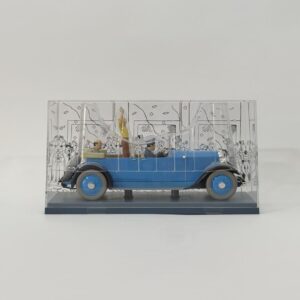
Format: 1/24 scale model car on display plinth with illustrated diorama and clear acetate case
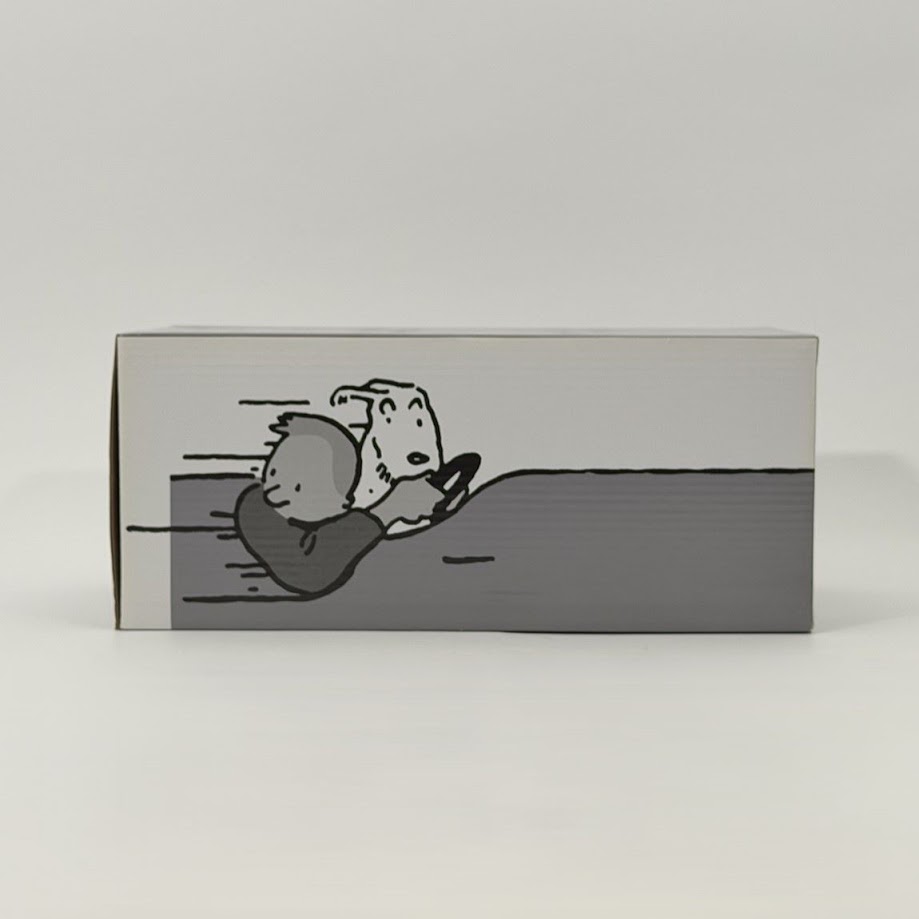
Condition: Fine. Ex-display model in fine condition. Complete with original grey and white outer box and explanatory booklet. The outer box has very minor shelf-wear.
Description:
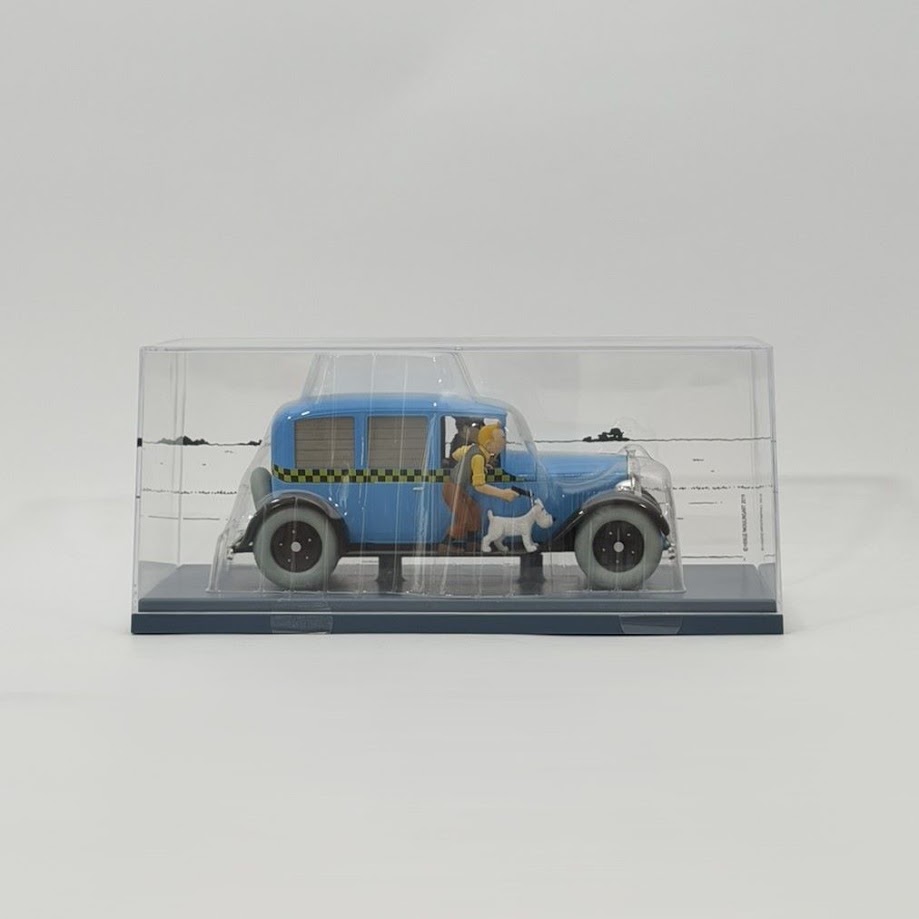
From the official Les Voitures de Tintin collection, this substantial 1/24 scale model of Le Taxi de Chicago, reference 29907, recreates the blue Chicago taxi used by Tintin and Snowy near the beginning of Hergé’s Tintin en Amérique (Tintin in America).
The model depicts Tintin and Snowy beside the open rear door of the blue taxi, with the uniformed driver at the wheel. The distinctive black-and-yellow chequered band runs around the body of the vehicle, immediately identifying it as the Chicago cab illustrated by Hergé. It is presented on its original display plinth beneath a clear acetate case, with a monochrome background derived from the album artwork.
The official Tintin archive identifies this as number 7 in the 1/24 vehicle collection and describes the vehicle as one of the Checker Cabs then associated with the streets of Chicago. Hergé used the taxi as an important narrative device very early in Tintin en Amérique, establishing immediately the pace, urban setting and gangster atmosphere of the adventure. Tintin
The model corresponds to the taxi Tintin and Snowy take shortly after arriving in Chicago. Specialist descriptions place the reproduced scene at page 4, panel A2, when Tintin, pistol in hand, is pursuing one of Al Capone’s men through the city. Orient Express
Produced in 2020, reference 29907 was issued in resin and plastic and supplied with its display plinth, clear case, grey and white cardboard outer box and a substantial explanatory booklet in French and English. Contemporary product information records the edition as non-numbered and gives the packaging dimensions as approximately 26 x 12 x 12 cm. La Marque Zone
This example has previously been displayed but remains in fine condition. It retains its original grey and white outer cardboard box and explanatory booklet. The outer box shows only very minor shelf-wear.
Reference: 29907
Scale: 1/24
Date: 2020
Model: Le Taxi de Chicago
Album: Tintin en Amérique
Vehicle: Chicago Checker Cab, generally identified as a 1929 model
Colour: Blue with black-and-yellow chequered band
Material: Resin and plastic
Presentation: Display plinth with illustrated diorama and clear acetate case
Packaging: Original grey and white outer box, with very minor shelf-wear
Documentation: Original explanatory booklet in French and English
Condition: Fine; ex-display
EAN: 2990700000005 La Marque Zone
Le Taxi de Chicago: A Brief Account
The Chicago taxi belongs to one of the most immediately recognisable sequences in Tintin en Amérique. Tintin arrives in Chicago at the height of Prohibition and almost immediately finds himself embroiled in the city’s criminal underworld.
The official Tintin archive describes the taxi as a vehicle surrounded by a black-and-yellow chequered band and driven by a chauffeur prepared to do almost anything for a $500 reward. It notes that Hergé’s drawing appears to represent one of the Checker Cabs then operating throughout Chicago. Tintin
The scene is important because the taxi becomes one of the first major vehicles to carry the narrative of Tintin en Amérique. Hergé uses it not simply as transport but as part of the action itself, immediately placing Tintin within a world of gangsters, pursuit and danger.
In the model, Tintin is shown standing at the open door with Snowy alongside, while the driver sits inside the cab. The composition gives the model considerable narrative interest and distinguishes it from more static vehicle reproductions in the series.
The Checker Cab
The taxi is generally identified as a Checker Cab, the kind of purpose-built American taxi strongly associated with large US cities during the inter-war years.
Checker vehicles were designed specifically for commercial taxi work and became familiar features of the urban landscape. Their upright bodies, generous passenger compartments and practical construction made them particularly suitable for intensive city use.
Specialist descriptions of reference 29907 identify the model as a 1929 Checker Cab, which is consistent with the late-1920s American setting that Hergé was evoking. selectionrs.com
For Hergé, the shape of such a taxi had an additional advantage: it could be read instantly by the viewer. A few bold lines, the high roof and the chequered belt were enough to establish both location and function.
That economy of visual information is fundamental to the later ligne claire style. Even at this relatively early stage of Hergé’s career, the vehicle contributes directly to the clarity and speed of the storytelling.
Tintin en Amérique: A Brief Account
Tintin en Amérique was published in album form in 1932 and follows Tintin to the United States, where he confronts organised crime in Prohibition-era Chicago.
The official Tintin site describes the adventure as one in which Tintin opposes Al Capone, the gangsters of Chicago and a succession of other criminals. His arrival in the city provokes an immediate hostile response from the organised underworld, forcing Tintin to rely upon courage, improvisation and ingenuity to survive. Tintin
The album occupies an important place in the development of the series. It is still an early Tintin adventure, with a rapid, episodic structure and broad comedy, but it also contains themes and visual ideas that Hergé would continue to develop throughout his career.
Motor vehicles are especially prominent. Taxis, racing cars, motorcycles and other machines repeatedly propel the story forward, helping to create the sensation of speed that characterises much of the album.
The Chicago taxi is therefore representative of one of the central features of Tintin en Amérique: Hergé’s fascination with modern urban America and its machinery.
Hergé and American Motoring
Hergé’s vision of America in the early Tintin adventures was formed largely through newspapers, magazines, photographs and cinema rather than direct personal experience.
Chicago, in particular, was strongly associated in the European imagination with Prohibition, Al Capone, gangsters, high-rise buildings and fast cars. Hergé drew upon this visual vocabulary energetically.
The taxi is a perfect example. The chequered band, uniformed driver and large enclosed body instantly suggest American metropolitan transport, while remaining simple enough to fit Hergé’s increasingly clear graphic language.
The official Tintin vehicle collection later returned to this relationship between narrative and machinery, including Le Taxi de Chicago among the important vehicles selected for reproduction at 1/24 scale. Tintin
At this larger scale, the unusual body form, taxi markings, passenger compartment and figures can be appreciated much more readily than in smaller Tintin car series.
Why Buy from Us?
At Hornseys, we are committed to offering collectible Tintin models, books and related objects that meet high standards of authenticity, condition and presentation. Every item is handled, inspected and authenticated in-house at our Ripon gallery.
Our Tintin collection is personally curated by Daniel Hornsey, whose interest in Hergé and The Adventures of Tintin extends back to childhood. Individual models are examined for condition, correct accessories, packaging and documentation before being offered for sale.
We wholly own all our stock. Postage is free within the UK, with tracked and insured worldwide shipping available. Every purchase is covered by our 14-day unconditional return guarantee.
Cataloguer: Daniel Hornsey
Daniel Hornsey has specialised in fine and rare books, maps, ephemera, artworks and collectors’ items for over thirty years. Hornseys was established in 1976 and, in its fiftieth year, continues to research and catalogue every item individually from its gallery and bookshop in Ripon, North Yorkshire.