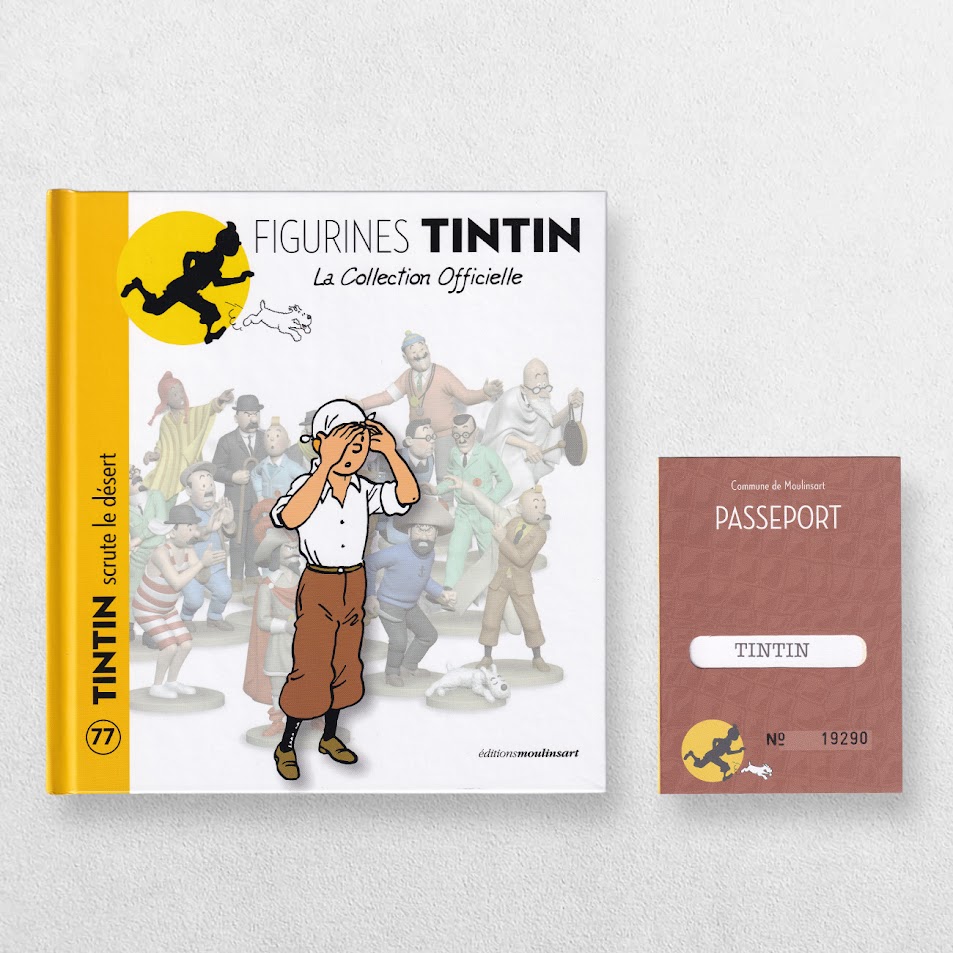
Tintin Surveys The Desert – Figurines Tintin La Collection Officielle – 77 – Tintin Scrute Le Désert
Author: Hergé & Editions Moulinsart
Price: £45.00
Publisher: Editions Moulinsart
Publication date: 2014
Format: Original pictorial boards with passport and figurine
Condition: In near fine condition
Illustrations: Illustrated throughout
Description:
Original pictorial boards. Includes passport loosely inserted. Text in French. Includes the accompanying figurine. One from the collection of 111 books and figurines. Very slight wear. In very near fine, clean condition overall.
Tintin: A Short Biography
Tintin is the young Belgian reporter and adventurer who serves as the protagonist of The Adventures of Tintin, the celebrated comic-book series created by Georges Remi, better known by his pen name Hergé.
Since his first appearance in Tintin in the Land of the Soviets (Tintin au pays des Soviets, 1929), Tintin has become an enduring symbol of curiosity, courage, and integrity. His adventures — spanning continents, cultures, and historical eras — have been translated into more than a hundred languages and continue to captivate readers through their combination of realism, humour, and moral clarity.
Tintin is not merely a character; he is a cultural archetype: the embodiment of youthful optimism, journalistic integrity, and the spirit of discovery.
Character Overview
- Full Name: Tintin
- Occupation: Investigative reporter, adventurer
- Nationality: Belgian
- First Appearance: Tintin in the Land of the Soviets (1929)
- Companions: Snowy (Milou), Captain Haddock, Professor Calculus, Thomson and Thompson, Bianca Castafiore
- Creator: Hergé (Georges Remi, 1907–1983)
- Personality: Brave, honest, intelligent, resourceful, compassionate
- Moral Traits: Integrity, altruism, respect for justice and truth
Origins and Development
Tintin first appeared in the Belgian Catholic newspaper Le Vingtième Siècle in 1929, at a time when the comic strip (bande dessinée) was emerging as a modern European art form. Initially conceived as a patriotic Boy Scout figure — clean-living, courageous, and loyal — Tintin quickly evolved beyond propaganda into a fully realised human character.
Hergé’s meticulous research, artistic discipline, and growing moral vision transformed Tintin into a credible journalist and world traveller. By the late 1930s, in works such as The Blue Lotus and The Black Island, Tintin had become an international symbol of curiosity and moral courage.
Appearance and Personality
Tintin’s appearance is deliberately timeless: a round, youthful face, quiffed hair, blue jumper, plus-fours, and brown shoes. His design is minimalist yet instantly recognisable — an example of Hergé’s ligne claire (“clear line”) technique, in which simplicity of line conveys universality.
Tintin’s personality blends idealism and practicality. He is calm under pressure, polite yet assertive, and shows compassion even towards his enemies. His physical bravery is matched by moral courage: he opposes tyranny, exploitation, and cruelty wherever he encounters them.
Though seemingly flawless, Tintin’s lack of vanity and emotional restraint make him a projection of the reader’s better self — a moral constant in a changing and often cynical world.
Tintin as Reporter and Explorer
Although Tintin’s occupation as a journalist provides the pretext for his travels, he rarely files stories. Instead, journalism becomes a narrative metaphor for curiosity and truth-seeking.
From uncovering political conspiracies (King Ottokar’s Sceptre) to exposing scientific crime (The Calculus Affair), Tintin’s investigative instincts drive the plots. His curiosity is active, not passive: he observes, questions, and acts.
As an explorer, he represents the human drive for knowledge — whether delving into the Inca tombs of Prisoners of the Sun, venturing beneath the sea in Red Rackham’s Treasure, or travelling to the Moon in Explorers on the Moon.
Each adventure combines the excitement of discovery with ethical awareness, portraying exploration as a quest for understanding rather than conquest.
Companions and Relationships
Snowy (Milou)
Tintin’s faithful fox terrier is both companion and conscience. Snowy embodies loyalty and humour, often rescuing Tintin from danger while providing ironic commentary.
Captain Haddock
Introduced in The Crab with the Golden Claws (1941), Captain Archibald Haddock becomes Tintin’s closest friend and emotional counterpart. Haddock’s impulsiveness, temper, and humanity complement Tintin’s composure and idealism. Their friendship anchors the later stories in emotional depth.
Professor Calculus (Cuthbert Calculus)
The absent-minded scientist symbolises reason and intellect. His inventions, such as the lunar rocket, embody the moral neutrality of science — a theme explored through Tintin’s ethical framework.
Thomson and Thompson
These near-identical detectives provide comic relief while representing bureaucracy and human fallibility. Their constant blunders contrast with Tintin’s precision and logic.
Bianca Castafiore
The operatic diva adds glamour and satire. Her melodrama highlights the contrast between vanity and humility — traits Tintin consistently resists.
Moral and Philosophical Dimensions
- Integrity and Justice
Tintin’s defining trait is moral integrity. He never seeks wealth or power; his motivation is truth. Whether confronting colonial exploitation (The Broken Ear) or totalitarianism (The Blue Lotus), Tintin acts from empathy, not ideology.
His impartiality makes him a symbol of universal ethics — a hero guided by conscience rather than nationality or creed.
- The Humanist Ideal
Tintin’s worldview reflects the Enlightenment spirit: curiosity, tolerance, and rational optimism. He engages respectfully with other cultures, often challenging Western stereotypes — as seen in his friendship with Chang Chong-Chen in The Blue Lotus.
Through Tintin, Hergé celebrates human diversity while condemning prejudice and exploitation.
- The Search for Truth
At its core, The Adventures of Tintin is a philosophical quest. Each mystery — whether criminal, political, or scientific — becomes a test of integrity. Tintin’s unwavering pursuit of truth positions him as both journalist and moral philosopher.
Artistic Significance
Hergé’s artistic innovation lies in the ligne claire style: clean lines, flat colours, and realistic detail. Tintin’s world, though fictional, is meticulously researched — from architecture and clothing to geography and technology.
This visual clarity mirrors moral clarity. Tintin inhabits a world where truth, though often obscured, can be revealed through observation, reason, and courage.
Psychological Reading
Tintin’s calm detachment has invited psychological interpretation. He is self-effacing — an observer rather than a participant — which allows readers to project themselves into his role. His androgynous design and lack of romantic interest enhance his universality.
Hergé described Tintin as his “ideal self” — a figure of innocence and decisiveness, embodying virtues he admired but sometimes found difficult to live by. Tintin’s moral constancy, therefore, is both aspirational and therapeutic, representing order amid chaos.
Cultural and Historical Context
Tintin emerged in the interwar years, reflecting Europe’s fascination with progress and its anxiety about political extremism. The series evolved alongside twentieth-century history:
- 1930s: Colonialism, fascism, and adventure narratives.
- 1940s: Occupation and moral ambiguity.
- 1950s: The atomic age and exploration.
Tintin’s adaptability allowed him to remain relevant while maintaining ethical consistency.
Legacy and Influence
Tintin has become one of the most recognisable characters in world literature. His adventures have inspired films, radio dramas, television series, and academic studies.
The moral clarity, artistic precision, and humanism of the Tintin stories influenced generations of writers, illustrators, and journalists. His legacy lies in showing that adventure can coexist with conscience — that courage is not merely physical but moral.
Symbolism
Tintin symbolises the eternal explorer:
- The Seeker: He represents humanity’s desire to know and to understand.
- The Witness: As a journalist, he bears witness to injustice and truth.
- The Conscience: His actions remind readers that compassion and fairness must guide knowledge and power.
Summary
- Name: Tintin
- Occupation: Reporter and adventurer
- Nationality: Belgian
- First Appearance: Tintin in the Land of the Soviets (1929)
- Companion: Snowy
- Notable Traits: Bravery, curiosity, integrity, empathy
- Themes: Truth, justice, friendship, humanism, exploration
- Symbolism: The quest for moral and intellectual clarity
Conclusion
Tintin remains one of literature’s purest embodiments of moral curiosity. Neither a superhero nor a cynic, he stands for decency, reason, and hope — virtues that transcend time and nationality.
Through Tintin, Hergé offered the twentieth century a new kind of hero: intelligent rather than invincible, ethical rather than ideological, human rather than mythic.
Nearly a century after his first appearance, Tintin still speaks to the best within us — the courage to seek truth, the humility to listen, and the conviction that integrity can illuminate even the darkest corners of the world.
Why Buy from Us?
At Hornseys, we are committed to offering items that meet the highest standards of quality and authenticity. Our collection of objects and rare books are carefully curated to ensure each edition is a valuable piece of bibliographical history. Here’s what sets us apart:
- Authenticity and Provenance: Each item is meticulously researched and verified for authenticity and collation.
- Expert Curation: Our selection process focuses on significance, condition, and rarity, resulting in a collection that is both diverse and distinguished.
- Customer Satisfaction: We aim to provide an exceptional customer experience, from detailed descriptions to secure and prompt delivery of your purchase.
- Returns Policy: We offer an unconditional guarantee on every item. If you wish to return an item, it may be sent back to us within fourteen days of receipt. Please notify us in advance if you wish to do so. The item must be returned in the same condition as it was sent for a full refund.
Cataloguer: Daniel Hornsey
Daniel Hornsey has specialised in fine and rare books, ephemera, and collectors’ editions for over thirty years. As a long-standing member of the antiquarian book trade, he has advised private collectors, curated catalogues, and sourced works for leading dealers, libraries and institutions across the world.
Hornseys’ exhibit regularly at book and map fairs in London and throughout the UK and are members of the Provincial Booksellers Fairs Association, the PBFA.
His fascination with Hergé’s work — especially ‘The Adventures of Tintin’ — began in childhood. Daniel recalls reading Tintin in original European editions and quickly recognising that these were not merely children’s books, but finely illustrated narratives crafted with artistic depth and wit.
As noted by the Musée Hergé in Louvain-la-Neuve, Hergé’s ‘ligne claire’ style has influenced generations of European comic artists and his original drawings and paintings command very high prices with his painting of ‘The Blue Lotus’ jar fetching £2.8m at auction in 2021.
By presenting these works through Hornseys’, he hopes to contribute to the continued appreciation of one of the 20th century’s most influential illustrators, helping new generations discover the artistry and legacy of Hergé.