


William Hone, George Cruikshank and Contemporary Political Satire — Six Radical Pamphlets, 1819–1820
Hone, William, Fairburn, John, Greenland, G, Johnston, J & Cruikshank, George
£225.00
Availability: In stock
Product Description
William Hone, George Cruikshank and Contemporary Political Satire — Six Radical Pamphlets, 1819–1820
Contents: Six separately published political satires bound together
Principal Authors / Publishers: William Hone; John Fairburn; G. Greenland; J. Johnston
Illustrator: George Cruikshank and others
Dates: 1819–1820
Edition: Various editions; one apparent first edition
Format: Octavo
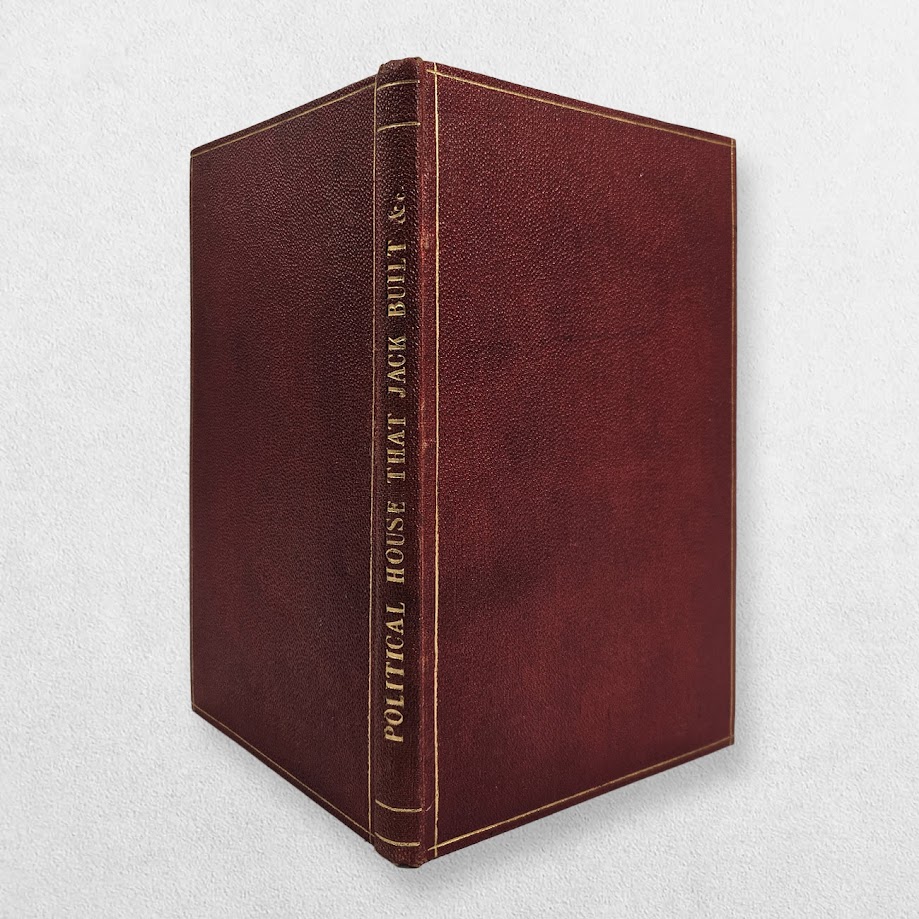
Binding: Later burgundy morocco, gilt ruled, gilt-lettered spine
Stock Code: 004195
Location: Bookroom
A highly attractive sammelband containing six illustrated political satires published in London during the extraordinary explosion of radical print culture surrounding Peterloo, the accession of George IV and the Queen Caroline affair of 1820. The volume brings together several of the most successful popular political pamphlets of the period, principally associated with the radical publisher and satirist William Hone (1780–1842) and the young George Cruikshank (1792–1878), whose vigorous caricatures helped define British political satire in the Regency period.
The pamphlets are valuable survivals of material that was originally cheaply produced, heavily read and frequently discarded. Their high edition numbers should not be mistaken for later nineteenth-century reprints: several of these satires passed through numerous editions within weeks or months of first publication, reflecting extraordinary contemporary demand. Hone and Cruikshank’s combination of nursery-rhyme parody, topical verse and instantly recognisable caricature made complex political arguments accessible to a broad popular audience.
Contents
- HONE, William. The Political House that Jack Built. A Rebus—Through up to show which way the wind blows. With Thirteen Cuts. London: Printed by and for William Hone, Ludgate Hill, 1819. Thirty-sixth edition.
One of the most celebrated political pamphlets of the Regency period and a landmark in the careers of both William Hone and George Cruikshank. First published in the aftermath of the Peterloo Massacre, it adapts the cumulative structure of the nursery rhyme The House that Jack Built into a sustained attack on political repression, corruption and the governing establishment. Cruikshank supplied thirteen cuts, including the famous title-page image “The Pen and the Sword.” The extraordinary designation “Thirty-sixth Edition” illustrates the speed and scale of its reprinting in 1819.
- The Palace of John Bull, Contrasted with the Poor “House that Jack Built”. With Eight Copper-Plates: Radical Balance—The Place—Radical Reform—England’s Pyramid—Radical Pyramid—Radical’s Triumph—Urban Amenities—Vessel of State, and Radical Ledger. London: Published by G. Greenland, 3 Finsbury Place; printed by G. Hazard, 50 Beech Street, 1820.
Apparently the first edition. A comparatively uncommon contemporary response to the enormous success of Hone’s Political House that Jack Built. Unlike the Hone pamphlets, this work adopts a counter-radical position and attempts to turn the imagery and rhetoric of The House that Jack Built against the reform movement. Its presence is particularly useful because the volume preserves political satire from both sides of the contemporary argument.
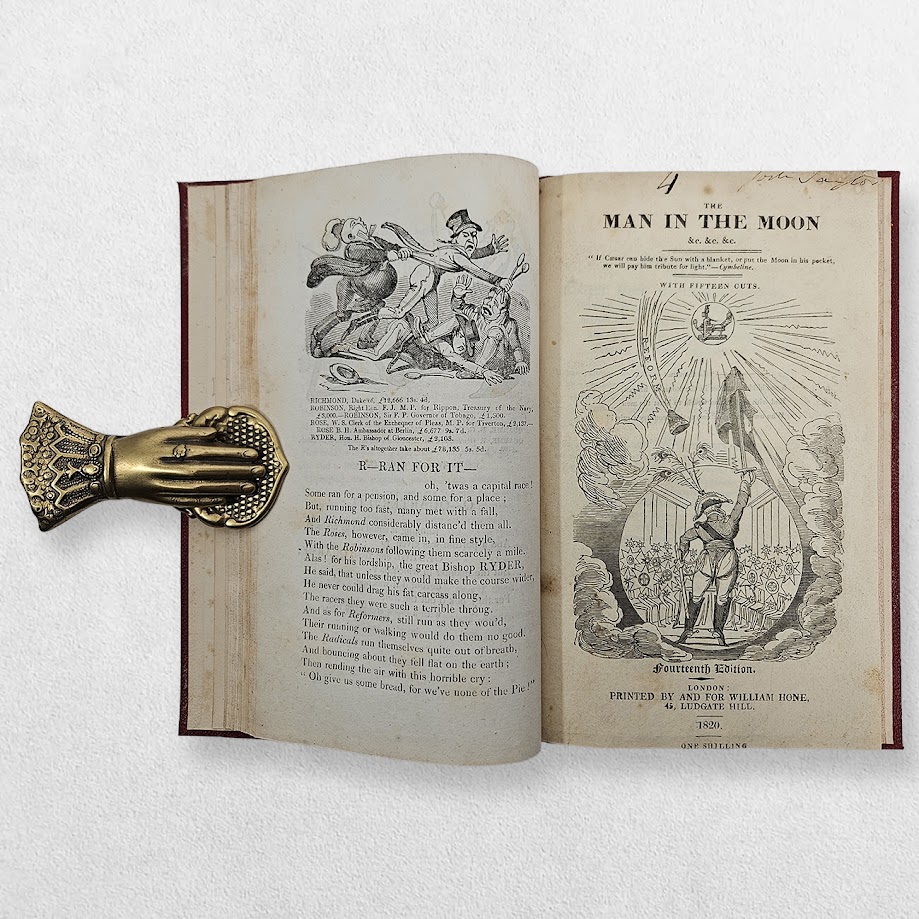
- HONE, William. The Man in the Moon, &c. &c. &c. With Fifteen Cuts. London: Printed by and for William Hone, 45 Ludgate Hill, 1820. Fourteenth edition.
Another highly successful Hone satire from the year of the Queen Caroline crisis. The work attacks the Crown, ministers and the political establishment through verse and caricature and belongs to the same extraordinarily fertile sequence of cheap illustrated political pamphlets issued by Hone in 1819–20.
- The Queen that Jack Found. With Thirteen Cuts. London: Printed and published by John Fairburn, Broadway, Ludgate Hill, 1820. Eighth edition.
A pro-Caroline satire belonging to the remarkable body of popular literature generated by the Queen Caroline controversy. The pamphlet uses the familiar “Jack” formula and thirteen illustrations to contrast the perceived innocence and mistreatment of Caroline of Brunswick with the conduct of George IV and his supporters.
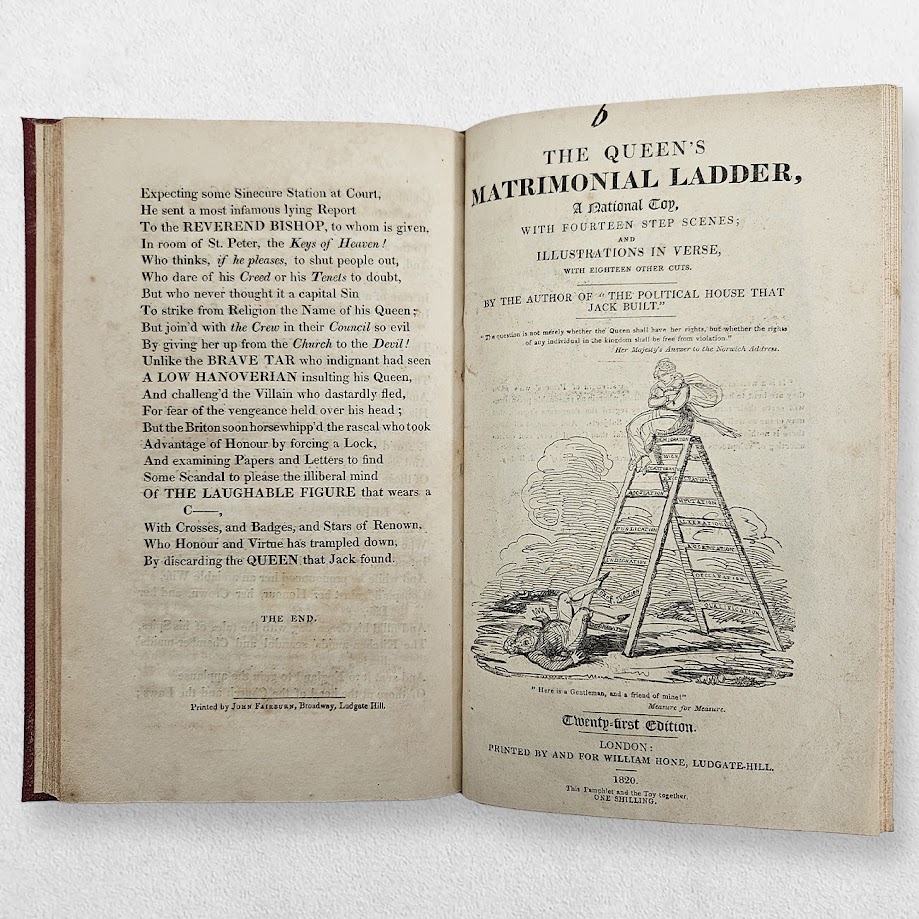
- HONE, William. The Queen’s Matrimonial Ladder: A National Toy, with Fourteen Step Scenes; and Illustrations in Verse, with Eighteen Other Cuts. London: Printed by and for William Hone, Ludgate Hill, 1820. Twenty-first edition.
One of Hone and Cruikshank’s most inventive and successful publications relating to Queen Caroline. The pamphlet satirises the marital and political history of George IV and Caroline, presenting successive stages of the affair as the rungs of a matrimonial ladder. The high edition number again reflects the enormous contemporary popularity of this material.
- HONE, William. The Political “A, Apple-Pie”; or, The “Extraordinary Red Book” Versified; for the Instruction and Amusement of the Rising Generation. By the Author of “The House that Jack Built”. With Twenty-Three Cuts. London: Printed for the Author and sold by J. Johnston, 97 Cheapside, 1820. Fifth edition.
A witty political adaptation of the traditional alphabet rhyme, using the structure of a children’s primer to satirise government patronage, taxation, office-holding and the distribution of public money. This copy is incomplete, lacking five of the twenty-three cuts called for. That defect should be taken into account when assessing the completeness of the volume, although the pamphlet remains bibliographically and historically useful within the group.
William Hone, George Cruikshank and Radical Print Culture
The importance of the collection lies in the conjunction of Hone’s radical publishing and Cruikshank’s early political caricature. Hone had become nationally known following his acquittals at three successive trials for blasphemous and seditious libel in 1817. By 1819–20 he had perfected an exceptionally effective form of inexpensive political publishing in which familiar literary forms were combined with bold caricature and sold at prices accessible to a broad readership.
George Cruikshank was still in his twenties when these pamphlets appeared. His illustrations for Hone were among the works that established his reputation as one of the outstanding caricaturists and illustrators of his generation, long before his later associations with Charles Dickens. The immediacy of his drawing, combined with Hone’s topical verse, made these pamphlets powerful instruments of political communication.
The historical circumstances were equally important. The Political House that Jack Built emerged directly from the climate created by Peterloo in August 1819 and the subsequent governmental response. The 1820 pamphlets belong principally to the bitter national dispute between George IV and Queen Caroline, when the King’s attempt to exclude and divorce his estranged wife became a focus for wider arguments concerning monarchy, ministerial power, corruption, reform and popular political rights.
The result is an unusually coherent collection spanning two interconnected crises in British political culture, 1819–20.
Binding, Provenance and Condition
The six pamphlets have been preserved together in a handsome later burgundy cloth binding, with gilt rule to the boards and gilt lettering to the spine, reading Political House that Jack Built &c. An earlier owner has carefully recorded the individual contents and dates on the front endpapers, together with notes concerning the numbers of illustrations.
There are also early ownership inscriptions to several title-pages, adding evidence of the pamphlets’ collecting history.
The binding is nice and firm and presents very well. The pages are generally nice and clean with occasional age-related marking, wear, spotting and foxing. The illustrations remain strong and clear. The Political “A, Apple-Pie” is incomplete, lacking five cuts.
Now housed in an easily removable clear acetate cover.
Very good indeed overall, subject to the incompleteness noted above.
A highly appealing collection of original Regency political satire, bringing together William Hone, George Cruikshank, Peterloo, Queen Caroline and the radical politics of 1819–20, and particularly notable for containing an apparent first edition of The Palace of John Bull alongside contemporary high-edition states of several of Hone’s most famous pamphlets.
Stock code: 004195. Location: Bookroom.
Why Buy from Hornseys?
Established in 1976, Hornseys is an independent specialist bookseller and gallery based in Ripon, North Yorkshire, on the edge of the Yorkshire Dales. For nearly fifty years, we have bought and sold rare books, first editions, signed and inscribed books, manuscripts, historical documents, maps, prints and unusual works on paper to private collectors, libraries, institutions and clients throughout the United Kingdom and internationally.
Our approach is based on careful research, accurate identification, detailed condition assessment and transparent cataloguing. Every item is individually examined before being offered for sale. We believe that rarity alone does not make an object important: the strongest books, manuscripts and historical material combine rarity with provenance, condition, historical context, bibliographical significance and collector appeal.
Research, Expertise and Authenticity
Every book, manuscript, map, print or piece of historical ephemera offered by Hornseys is researched and catalogued individually. We examine the features that determine both authenticity and value, including edition and impression, issue points, bindings, dustwrappers, signatures, inscriptions, annotations, provenance, printing history, completeness and condition.
Where appropriate, we compare items against bibliographical references, institutional catalogues, library holdings, auction records, archival sources and other reliable evidence. Where a point cannot be established with certainty, we distinguish clearly between documented fact and informed interpretation rather than presenting an assumption as fact.
All items are offered with an unconditional guarantee of authenticity.
Accurate and Detailed Descriptions
We aim to describe each item as precisely as possible. Condition is assessed individually, with defects, restoration, incompleteness or other significant characteristics noted where relevant.
For books, this may include collation, edition and impression, dustwrapper state, binding condition and significant ownership marks. For maps and works on paper, we assess the exact edition or state, printing information, dimensions, institutional representation, provenance and physical condition.
Our photographs form an important part of each description and are intended to allow collectors to examine the item closely before purchase.
Provenance and Historical Context
Provenance can transform the significance of a book or document. We therefore place particular emphasis on establishing previous ownership, presentation inscriptions, authorial associations, institutional provenance and connections with historical individuals or events.
Where research allows, we trace these associations through contemporary records, archives and published sources. This can reveal information that is not immediately apparent from the object itself and allows us to catalogue material within its proper historical and bibliographical context.
We are equally careful not to overstate provenance. Documented ownership is distinguished from attribution, possibility or association.
Carefully Curated Stock
Hornseys does not buy simply by category. We select material because we believe it has something distinctive to offer: rarity, condition, design, provenance, historical importance, unusual subject matter or enduring collector interest.
Our stock includes particular strengths in:
Rare and collectible books; literary first editions; signed and inscribed books; children’s and illustrated books; military history; Churchilliana; fine bindings; manuscripts and historical documents; rare and historical maps; travel and exploration; original prints and works on paper; unusual historical ephemera; and specialist collecting areas including Tintin and the Collins New Naturalist series.
This breadth allows us to recognise connections between books, archives, maps and other historical material that might otherwise be overlooked.
Specialist Experience Since 1976
Hornseys has traded since 1976. That longevity matters. The rare-book and collecting markets are built not only on reference works and databases but on experience: understanding how editions differ, recognising unusual states and bindings, judging condition, identifying material that is genuinely difficult to find and distinguishing real scarcity from apparent scarcity.
We combine that long-standing experience with modern research methods and extensive comparison of institutional and commercial records. The result is cataloguing intended to be both scholarly and practical for collectors.
Condition and Completeness
Every item is physically examined before cataloguing. Where relevant, books are checked for completeness, maps and plates are counted, folding material is inspected, and bindings and dustwrappers are assessed separately.
We do not use age alone as an excuse for faults. A seventeenth-century book, a wartime map and a twentieth-century first edition are judged according to the standards appropriate to their type, while significant defects are described clearly.
Customer Service
We aim to make buying from Hornseys straightforward and informed. We are happy to answer questions about condition, provenance, edition, rarity, bibliographical points or collecting significance, and additional photographs can be provided where required.
Orders are carefully packed, with UK delivery tracked and insured and international orders sent by appropriate tracked and insured services.
Collectors are also welcome to visit our gallery in Ripon to view material in person.
Returns Guarantee
All items are offered with our guarantee of authenticity and may be returned within fourteen days of receipt for any reason, provided they are returned in the same condition in which they were supplied.
We simply ask that you contact us before returning an item. If an item has been incorrectly described or supplied in error, we will also cover the appropriate return postage.
Buy with Confidence from Hornseys
Whether you are acquiring a first edition, building a specialist collection, researching a historical association or simply buying an object that fascinates you, our aim is the same: to offer carefully selected material, accurately researched and honestly described.
After nearly fifty years in the trade, Hornseys continues to seek out books, maps, manuscripts, prints and historical material that combine rarity, provenance, condition and genuine cultural or historical interest.
Related products

Cave Birds – An Alchemical Cave Drama Signed And Dated By Ted Hughes
£250.00Hughes, Ted & Baskin, Leonard
Neither Here Nor There, The Art Of Oliver Jeffers: Signed By The Artist
£145.00Jeffers, Oliver Edited By Seabrooke, Richard



You may also like…
Barnett Freedman — Fleece Press Sale Broadsheet for the Artist’s Personal Archive, 2008
£30.00Simon Lawrence & The Fleece Press
T. E. Lawrence – Seven Pillars of Wisdom – Cranwell Edition – Exhibition Notice – 1927
£900.00LAWRENCE, T. E. & Leicester Galleries