
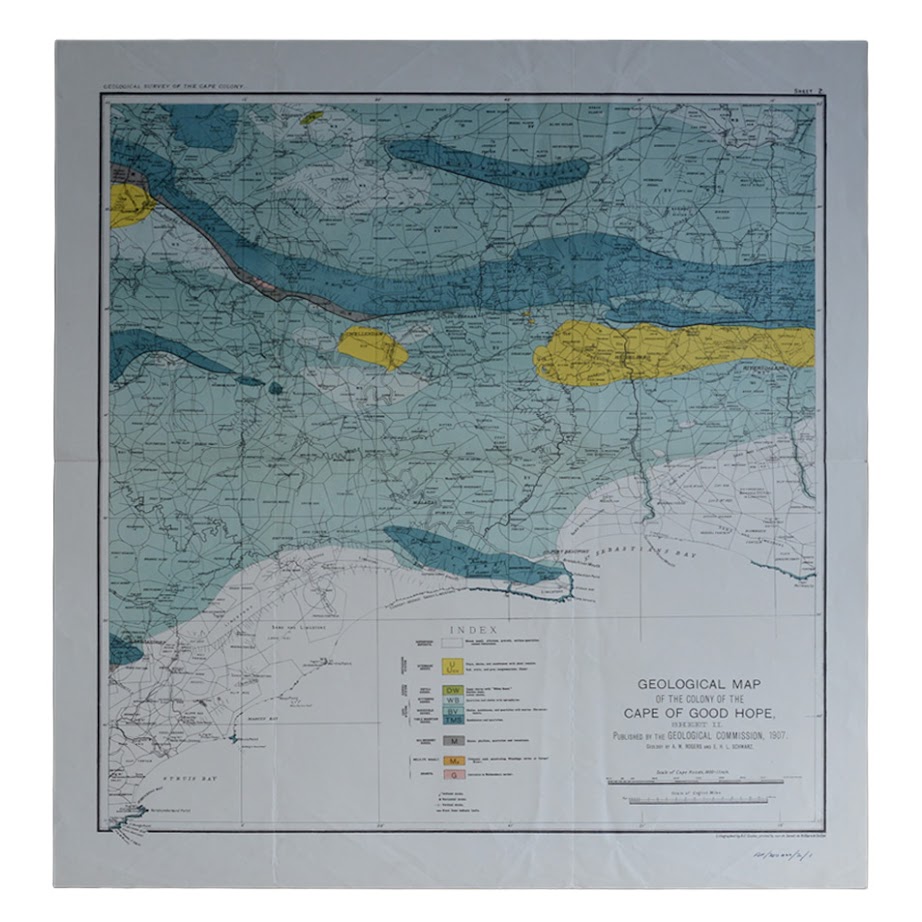
Geological Map Of The Colony Of The Cape Of Good Hope Sheet 2: Riversdale – Heidelberg – Port Beaufort – Swellendam – Bredasdorp
Rogers, A. W & Schwarz, E. H. L
£145.00
Availability: In stock
Product Description
Geological Map Of The Colony Of The Cape Of Good Hope Sheet 2: Riversdale – Heidelberg – Port Beaufort – Swellendam – Bredasdorp
Cartographer: Rogers, A. W & Schwarz, E. H. L
Publisher: The Geological Commission
Price: £145 (post-free in the UK)
Publication Date: 1907
Edition: 1st edition thus
Format: Lithograph
Condition: In very good condition
Sheet Size: 59.5cm x 63.8cm
Condition:
Lithograph. Sheet Size: 59.5cm x 63.8cm. Neat ink number to lower right margin. Old fold lines. Closed tears to a couple of fold lines to the margins. Creased, marked, dusty and rubbed. Colouration very bright and clean. A very good copy. Very scarce.
Location: Pocket RSAGEOL: SR: 002853
Geology Of The Western Cape Region: An Historical Overview
Introduction
The Western Cape, situated at the south-western edge of South Africa, possesses one of the most diverse and ancient geological landscapes on the African continent. This complex region showcases a variety of rock types, tectonic structures, and geomorphological features that span over 1 billion years of Earth history. Its geological foundations underpin the region’s topography, water systems, soils, and even the globally significant Cape Floristic Region.
The geology of the Western Cape is best understood through the interaction of three major elements:
- The basement rocks (Malmesbury Group and Cape Granite Suite)
- The Cape Supergroup (notably the Table Mountain Group)
- The effects of Mesozoic and Cenozoic tectonic activity and erosion
- The Basement Complex: Malmesbury Group and Cape Granite Suite
Malmesbury Group (Pre-Cambrian)
The oldest rocks in the Western Cape belong to the Malmesbury Group, formed during the Neoproterozoic era, over 550 million years ago. These are low-grade metamorphic rocks—predominantly greywackes, shales, and siltstones—deposited in deep marine environments associated with ancient oceanic subduction zones.
These sediments were later deformed and metamorphosed during the Saldanian Orogeny, a mountain-building event that affected much of southern Gondwana’s margin. The result is a folded and faulted assemblage of rocks that underlie much of the south-western Cape, especially around Cape Town, Paarl, and Stellenbosch.
Cape Granite Suite
Intruding into the Malmesbury rocks are massive bodies of granite plutons, collectively referred to as the Cape Granite Suite. These formed during the Pan-African tectonic cycle, approximately 540–500 million years ago, as the ancient crust was compressed and heated by tectonic convergence.
Prominent outcrops include:
- The Paarl Rock granite dome
- Granite cliffs around Sea Point and Simon’s Town
- Subsurface granite that supports much of the Cape Peninsula
These granites are coarse-grained, crystalline, and often exfoliated, forming rounded hills and tors—features that dominate the topography of many inland areas.
- The Cape Supergroup: Sedimentation and Folding
Following the stabilisation of the basement complex, the region experienced a long period of marine transgression and sedimentation, giving rise to the Cape Supergroup. This series of sedimentary rocks was deposited between approximately 485 and 300 million years ago, from the Ordovician to the Carboniferous period.
The Cape Supergroup is composed of three main units in the Western Cape:
- a) Table Mountain Group
The oldest and most prominent unit, the Table Mountain Group is made up of:
- Graafwater Formation: reddish mudstones and sandstones, representing tidal flats and shallow marine conditions.
- Peninsula Formation: thick, white to grey quartzitic sandstones, resistant to erosion and forming the core of Table Mountain, the Hottentots-Holland Mountains, and the Cederberg range.
These quartzites provide the scenic high cliffs and rugged peaks of the Cape and are famous for preserving trace fossils and ancient glacial features.
- b) Bokkeveld Group
Lying above the Table Mountain Group, the Bokkeveld Group consists of mudstones, siltstones, and fossil-rich shales deposited in deeper marine settings. These rocks, found predominantly in the Cape Fold valleys, are softer and more fertile, supporting agriculture, particularly vineyards and fruit orchards in areas such as Ceres and Worcester.
- c) Witteberg Group
Representing the youngest Cape Supergroup rocks, the Witteberg Group is composed of fine sandstones and quartzites deposited in deltaic to nearshore environments. It forms ridges and hills in more inland parts of the province.
- The Cape Fold Belt: Tectonics and Orogeny
The dramatic folding of the Cape Supergroup was the result of a major tectonic event, known as the Cape Orogeny, occurring between 270 and 230 million years ago. During this time, compressional forces generated by the collision of the Gondwana supercontinent margins created the Cape Fold Belt, a series of:
- East-west trending anticlines and synclines
- High-angle thrust faults
- Closely spaced fold limbs
The Cederberg, Hex River, Langeberg, and Outeniqua mountains are expressions of these structural folds. Erosion over tens of millions of years has exhumed the most resistant formations (notably the Peninsula quartzites), resulting in the high-relief terrain seen today.
- Mesozoic to Cenozoic: Rifting, Erosion, and Coastal Development
With the break-up of Gondwana in the Jurassic (~180 million years ago), the southern margin of Africa was subjected to rifting, leading to the development of the South Atlantic Ocean. This marked the onset of post-orogenic erosion, during which the Cape Fold Belt was extensively worn down.
Key features of this era include:
- Formation of fault-bound coastal basins, such as the Bredasdorp Basin and Mossel Bay Basin
- Deposition of marine and terrestrial sediments, now hosting groundwater and gas reserves
- Uplift of the Great Escarpment, enhancing river incision and sediment transport
Throughout the Tertiary and Quaternary periods, climate fluctuations, sea-level changes, and fluvial erosion further shaped the Cape’s valleys, estuaries, and dune fields.
- Modern Landscapes and Geology’s Influence on Ecology and Human Use
Today, the geology of the Western Cape plays a vital role in:
- Soil development: Quartzite-derived soils are acidic and nutrient-poor, favouring fynbos vegetation, while shales and granites support renosterveld and agricultural land
- Water resources: Groundwater aquifers and mountain catchments are tied to geological fractures and formations
- Natural hazards: Rockfalls and slope instability occur along folded sandstone ridges
- Cultural heritage: Caves, overhangs, and stone outcrops contain archaeological evidence of Middle Stone Age habitation
The geodiversity of the Western Cape also underpins its status as a global biodiversity hotspot, where ancient soils and complex microclimates have led to the evolution of unique plant species and endemic ecosystems.
Conclusion
The geology of the Western Cape is a tapestry of ancient oceanic sediments, granite intrusions, mountain-building, and post-tectonic erosion, resulting in one of the most varied and scenic landscapes in Africa. These geological foundations not only shape the physical environment, but also influence human settlement, agriculture, biodiversity, and cultural heritage.
From the dramatic folds of the Cape Fold Belt to the flat summits of Table Mountain, the rocks of the Western Cape record a history both profoundly ancient and immediately visible—a testament to the dynamic forces that continue to shape the Earth’s surface.
SHOP WITH CONFIDENCE AT HORNSEYS
At Hornseys, we are dedicated to offering items that uphold the highest standards of quality and authenticity. Our collection of artwork is carefully curated to ensure that each item we offer is authentic, collated, and complete.
Here’s what sets us apart:
- Authenticity and Provenance: Each map is researched and verified for authenticity.
- Expert Curation: We entirely own all our artworks. We trust our taste and have invested heavily in it. We have confidence in all artwork that we offer for sale.
- Customer Satisfaction: We strive to provide an exceptional customer experience, from detailed descriptions and provenance to secure and prompt delivery of your purchase.
- Returns Policy: We offer an unconditional guarantee on every item. If, however, you wish to make a return, artworks may be sent back to us within fourteen days of receipt for whatever reason. We request that we are notified in advance if you wish to do so. They must be returned to us in the same condition as they were sent for a full refund.
OUR COMMITMENT TO QUALITY AND SERVICE
Understanding the value and rarity of these items, we ensure that every aspect of your purchase meets the highest standards of quality and service. This includes:
- Free Expedited, Tracked, and Insured Delivery within the UK: Ensuring that your artwork arrives safely and promptly.
- Fully-Insured Worldwide Delivery: Offering peace of mind for international collectors with reliable and secure shipping options.
EXPLORE OUR COLLECTION
Visit Hornseys today to explore our fine collection of maps and other artworks. Whether you are an avid collector or looking for a special gift, our selection offers something truly unique. Located since 1976 in Ripon in the picturesque Yorkshire Dales, we are recognized as a destination gallery for tastefully curated artwork, rare maps, design, and fine books.
Related products


You may also like…

Geological Map Of The Colony Of The Cape Of Good Hope Sheet 4: Paternoster – Langebaan – Darling – Malmesbury
£175.00Rogers, A. W, Schwarz, E. H. L & Du Toit, A. L
Geological Map Of The Colony Of The Cape Of Good Hope Sheet 1: Cape Town – Stellenbosch – Somerset West – Robertson – Napier
£175.00Rogers, A. W, Schwarz, E. H. L & Du Toit, A. L


