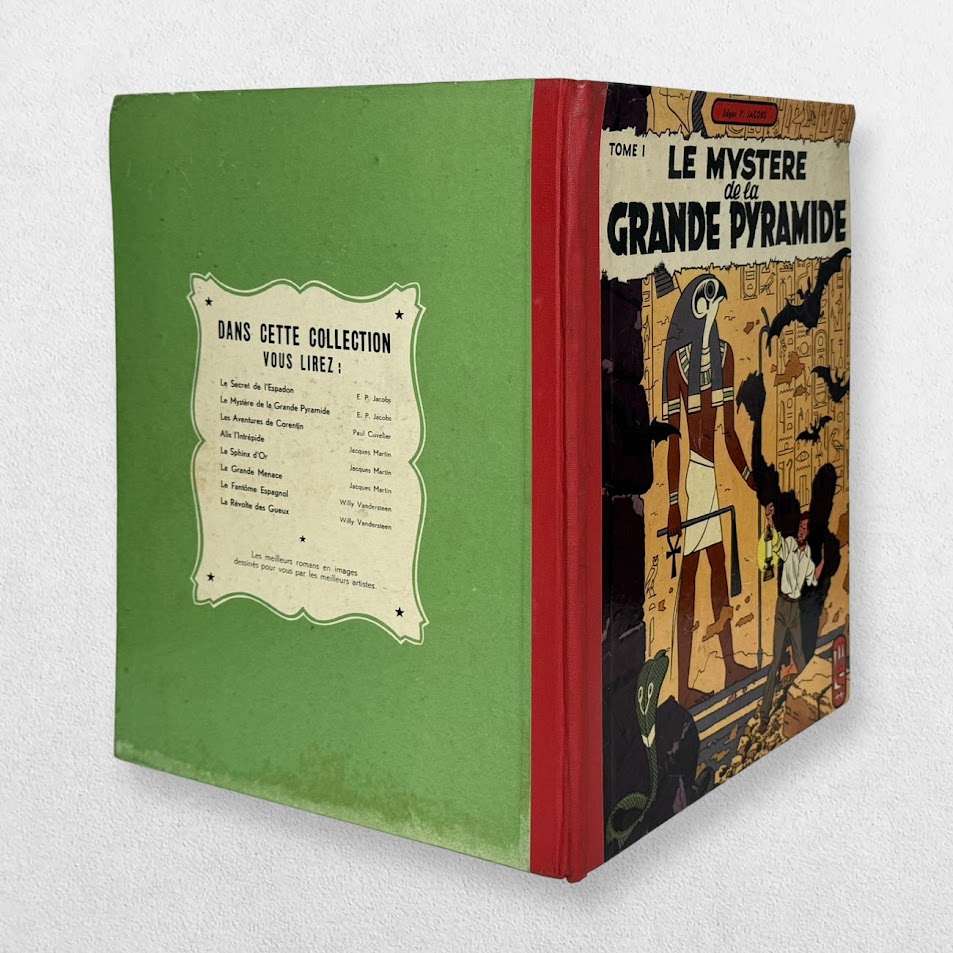
Le Mystère de la Grande Pyramide – Le Manuscrit de Manéthon – The Mystery of The Great Pyramid – The Manuscript of Manetho – First Edition – 1954
Jacobs, Edgar P
£300.00
Availability: In stock
Product Description
Le Mystère de la Grande Pyramide – Le Manuscrit de Manéthon – The Mystery of The Great Pyramid – The Manuscript of Manetho – First Edition – 1954
Author: Jacobs, Edgar P
Price: £300.00
Publisher: Les Editions Du Lombard
Publication date: 1954
Format: Original cloth-backed boards with pictorial endpapers
Condition: Very good plus
Pages: 56
Illustrations: Illustrated throughout in colour by the author
Description:
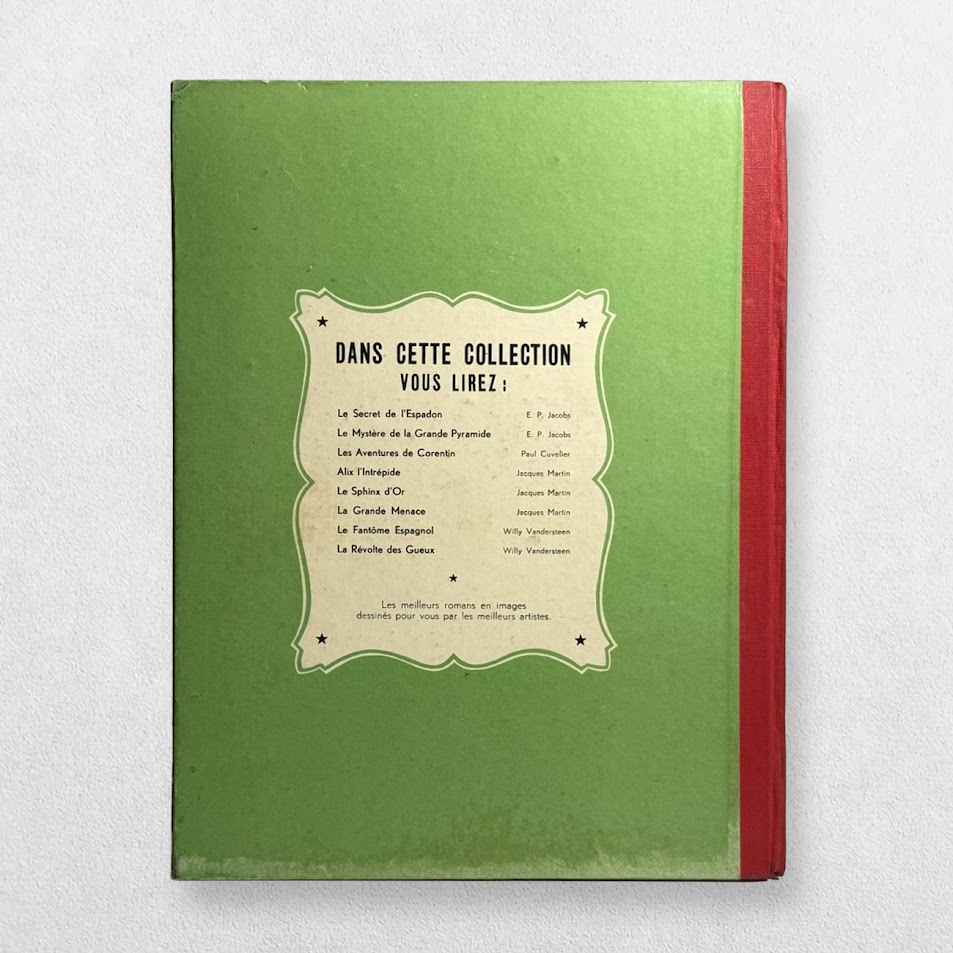
Printed in Belgium. First edition. Dated 1954 to the copyright page. Original cloth-backed boards. Red spine. Pictorial red endpapers. Pp. 56. Illustrated throughout in colour by the author. Binding with minor rubbing and creasing to the spine and edges of the boards. Very slight age toning to the pages as usual and minor fading to the base of the rear panel. A very good plus copy. Scarce.
Le Mystere De La Grande Pyramide: A Brief Summary
The story opens in Cairo, where Professor Philip Mortimer has arrived to pursue Egyptological research. He is soon joined by his friend Captain Francis Blake, who is travelling on official business. Their reunion is quickly overshadowed by disturbing news: a young archaeologist has been murdered, and a priceless ancient document—the Manuscript of Manetho—has vanished.
The manuscript, attributed to the ancient Egyptian historian Manetho, is believed to contain secret knowledge concerning the construction and hidden purpose of the Great Pyramid of Giza. Its existence is known only to a small circle of scholars, making its theft both targeted and ominous.
The Manuscript of Manetho
Mortimer explains the manuscript’s importance. Manetho’s writings suggest that the Great Pyramid was not merely a tomb, but part of a vast, deliberately concealed system—possibly involving hidden chambers and a profound symbolic or scientific purpose. If decoded correctly, the manuscript could reveal secrets deliberately erased or hidden since antiquity.
The murder and theft indicate that a powerful individual or organisation is determined to control this knowledge.
A shadowy antagonist emerges
Evidence soon points to the involvement of the enigmatic Olrik, Blake’s long-standing adversary. Olrik is operating in Egypt under an assumed identity and has assembled a network of mercenaries, smugglers, and corrupt officials. His aim is not academic curiosity, but power through ancient knowledge.
Blake and Mortimer realise that they are not merely investigating a crime, but racing against a rival who is prepared to kill to achieve his ends.
Investigation in Cairo
The narrative moves through the streets, bazaars, hotels, and archaeological sites of Cairo. Blake uses his intelligence training to trace clandestine movements, while Mortimer focuses on interpreting fragments of Manetho’s text and related inscriptions.
Their investigation reveals that:
- The manuscript contains coded references to specific architectural features of the Great Pyramid
- The clues rely on ancient measurements, symbolism, and alignments
- Only someone with deep Egyptological knowledge could fully exploit it
Meanwhile, witnesses are intimidated or eliminated, reinforcing the sense that the stakes are deadly.
Decoding the clues
Mortimer begins reconstructing the manuscript’s meaning from partial notes and surviving references. He concludes that the pyramid contains a hidden chamber whose location can be deduced only by following Manetho’s precise instructions.
These clues point towards an entrance that has been overlooked by centuries of explorers, concealed by architectural symmetry and deliberate misdirection.
Blake and Mortimer also realise that the manuscript is incomplete on its own: its instructions must be enacted physically within the pyramid itself.
Journey to Giza
The focus shifts from Cairo to the Giza Plateau. Blake and Mortimer, aware that Olrik is close behind them, prepare to enter the Great Pyramid. Tension escalates as both parties manoeuvre for advantage, each attempting to reach the hidden secret first.
The pyramid is presented not as a static monument, but as a living puzzle—a structure designed to test intelligence, patience, and moral intent.
Capture and reversal
Inside the pyramid, Blake and Mortimer are ambushed by Olrik and his men. Olrik reveals that he possesses the stolen manuscript and now holds the advantage. Blake and Mortimer are taken prisoner and left trapped within the pyramid’s interior passages.
This apparent defeat marks the end of the first volume. Olrik believes he has secured victory, and the secret of the pyramid appears to be on the brink of falling into ruthless hands.
Cliffhanger ending
Le Manuscrit de Manéthon concludes on a classic cliffhanger. Blake and Mortimer are imprisoned deep within the Great Pyramid, their fate uncertain, while Olrik prepares to unlock the final secret using the manuscript.
The central mystery—what the Great Pyramid truly conceals—remains unresolved, leading directly into Tome II: La Chambre d’Horus.
Narrative significance
This first volume establishes the tone and structure of one of the most celebrated Blake and Mortimer adventures. It combines:
- Meticulous historical and archaeological detail
- A strong sense of place and atmosphere
- Intellectual puzzle-solving alongside physical danger
Unlike many adventure stories, the tension derives as much from interpretation of knowledge as from action.
Thematic overview
Key themes include:
- Knowledge as power and responsibility
- The ethical use of ancient heritage
- Science versus exploitation
- Civilisation as a coded legacy rather than a vanished past
The Great Pyramid is presented not as a relic, but as a deliberate message from antiquity.
Concluding assessment
Le Mystère de la Grande Pyramide – Tome I: Le Manuscrit de Manéthon is a model of classical Franco-Belgian adventure storytelling. It builds suspense through scholarship, atmosphere, and moral tension rather than spectacle alone. By ending at the moment of apparent defeat, it ensures that the reader’s focus is fixed firmly on the question that matters most: what secret was important enough to be hidden for millennia—and dangerous enough to kill for?
Edgar P. Jacobs & Hergé: A Brief Account
Edgar P. Jacobs (1904–1987) and Hergé (Georges Remi, 1907–1983) stand as two central figures of the Franco-Belgian comics tradition. Their relationship was close, formative, and ultimately strained, marked by intense collaboration during a crucial period in the development of The Adventures of Tintin, followed by artistic separation and contrasting legacies.
Jacobs was neither a mere assistant nor a rival in the early years; he was a co-architect of Tintin’s post-war visual and narrative maturity, even though authorship and public recognition remained uneven.
- First contact and early collaboration
Meeting during the war
Jacobs and Hergé met during the Second World War, when Hergé was working for Le Soir. Jacobs, trained as an opera singer and deeply knowledgeable about theatre, classical art, and history, entered Hergé’s circle initially as a colourist and assistant.
At this stage, Hergé was revising and redrawing earlier Tintin albums for colour publication. These revisions were not cosmetic: they required structural rethinking, visual coherence, and pacing, especially as Tintin moved from newspaper serials to album format.
Jacobs quickly became indispensable.
- Jacobs’s role in the Tintin albums
Visual and atmospheric contribution
Jacobs made substantial contributions to several key Tintin works, particularly:
- Le Secret de La Licorne
- Le Trésor de Rackham le Rouge
- Les 7 Boules de Cristal
- Le Temple du Soleil
His influence is most evident in:
- Architectural precision (interiors, monuments, historical settings)
- Dramatic lighting and shadow
- Theatrical staging and suspense
- A heightened sense of gravity and menace
The darker, more operatic atmosphere of Les 7 Boules de Cristal in particular owes a great deal to Jacobs’s sensibility.
Narrative thinking
Jacobs also contributed at the level of story logic and continuity. He was skilled at long-form plotting, cliffhangers, and the management of multiple narrative threads—skills that align closely with the structure of later Tintin diptychs.
While Hergé remained the principal author, Jacobs was often involved in problem-solving narrative impasses, refining transitions and dramatic beats.
- Unequal recognition and growing tension
The question of credit
Despite his substantial involvement, Jacobs received little public credit. Tintin albums appeared solely under Hergé’s name, reinforcing the idea of a single, unified genius.
This imbalance became increasingly painful for Jacobs, particularly as Tintin’s international prestige grew. The situation was compounded by:
- Hergé’s perfectionism and control
- Jacobs’s strong personality and artistic confidence
- The absence of clear contractual recognition of creative contribution
The collaboration, though productive, became emotionally unsustainable.
- Separation and Jacobs’s independent career
Birth of Blake et Mortimer
In the late 1940s, Jacobs left Hergé’s studio and created Blake et Mortimer, beginning with Le Secret de l’Espadon. This series can be read, in part, as Jacobs’s assertion of full authorship.
Blake et Mortimer displays clear continuities with his Tintin-period work:
- Complex, often geopolitical plots
- Strong emphasis on science, history, and archaeology
- Operatic dialogue and high moral seriousness
- A slower, denser narrative rhythm than Tintin
Where Tintin moved towards psychological restraint and visual economy, Jacobs embraced verbosity, grandeur, and intellectual density.
- Diverging artistic philosophies
Hergé
- Increasing minimalism and clarity
- Psychological introspection (Tintin au Tibet, Les Bijoux de la Castafiore)
- Suspicion of spectacle and melodrama
- Emphasis on silence, ambiguity, and interiority
Jacobs
- Monumental settings and high stakes
- Explicit moral conflict
- Love of exposition and rhetoric
- Faith in civilisation, science, and rational order
Their divergence was not merely personal, but philosophical.
- Later relations and legacy
Relations between the two men remained cool but respectful. There was no public reconciliation, but neither engaged in open hostility. Each recognised the other’s importance, even if privately burdened by unresolved grievances.
In retrospect:
- Hergé is increasingly understood as a studio artist, whose greatness was enhanced by collaborators
- Jacobs is recognised as one of the few collaborators who fundamentally shaped Tintin’s mature form
Modern scholarship no longer treats Jacobs as a footnote, but as a structural influence on mid-century Franco-Belgian comics.
Concluding assessment
The relationship between Edgar P. Jacobs and Hergé was creative, asymmetrical, and transformative. Jacobs helped Tintin grow up—visually, structurally, and atmospherically—at a decisive moment. Hergé, in turn, provided the framework within which Jacobs refined his own voice before asserting full independence.
Their collaboration illustrates a broader truth about artistic creation: that even the most singular visions are often forged through intense, imperfect partnerships. Tintin without Jacobs would have been different; Blake et Mortimer without Hergé would not exist at all.
Why Buy from Us?
At Hornseys, we are committed to offering items that meet the highest standards of quality and authenticity. Our collection of rare books is carefully curated to ensure each edition is a valuable piece of bibliographical history. Here’s what sets us apart:
- Authenticity and Provenance: Each book is meticulously researched and verified for authenticity and collation.
- Expert Curation: Our selection process focuses on significance, condition, and rarity, resulting in a collection that is both diverse and distinguished.
- Customer Satisfaction: We aim to provide an exceptional customer experience, from detailed descriptions to secure and prompt delivery of your purchase.
- Returns Policy: We offer an unconditional guarantee on every item. If you wish to return a book, it may be sent back to us within fourteen days of receipt. Please notify us in advance if you wish to do so. The book must be returned in the same condition as it was sent for a full refund.
Cataloguer: Daniel Hornsey
Daniel Hornsey has specialised in fine and rare books, ephemera, and collectors’ editions for over thirty years. As a long-standing member of the antiquarian book trade, he has advised private collectors, curated catalogues, and sourced works for leading dealers, libraries and institutions across the world.
Hornseys’ exhibit regularly at book and map fairs in London and throughout the UK and are members of the Provincial Booksellers Fairs Association, the PBFA.
His fascination with Hergé’s work — especially ‘The Adventures of Tintin’ — began in childhood. Daniel recalls reading Tintin in original European editions and quickly recognising that these were not merely children’s books, but finely illustrated narratives crafted with artistic depth and wit.
As noted by the Musée Hergé in Louvain-la-Neuve, Hergé’s ‘ligne claire’ style has influenced generations of European comic artists and his original drawings and paintings command very high prices with his painting of ‘The Blue Lotus’ jar fetching £2.8m at auction in 2021.
By presenting these works through Hornseys’, he hopes to contribute to the continued appreciation of one of the 20th century’s most influential illustrators, helping new generations discover the artistry and legacy of Hergé.
Related products
-
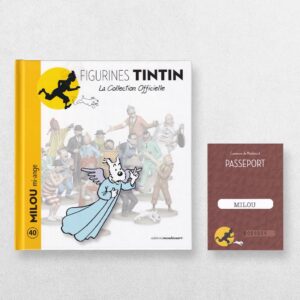
Snowy The Half-Angel – Figurines Tintin La Collection Officielle – 40 – Milou Mi-Ange
£65.00Hergé & Editions Moulinsart
-

The Crayon Box: The Day The Crayons Quit & The Day The Crayons Came Home: Includes Original Oliver Jeffers Art Print
£28.00Jeffers, Oliver & Daywalt, Drew
-

-

Paddington Marches On With Card Signed By Michael Bond Loosely Inserted
£545.00Bond, Michael Illustrated By Fortnum, Peggy