Les Aventures De Tintin – L’Oreille Cassée – The Adventures Of Tintin – The Broken Ear – Early Edition – 1946
Author: Hergé
Price: £350.00
Publisher: Casterman
Publication date: 1946-47
Format: Original cloth-backed boards with pictorial endpapers
Condition: Very good
Pages: 62
Illustrations: Illustrated throughout in colour by the author
Description:
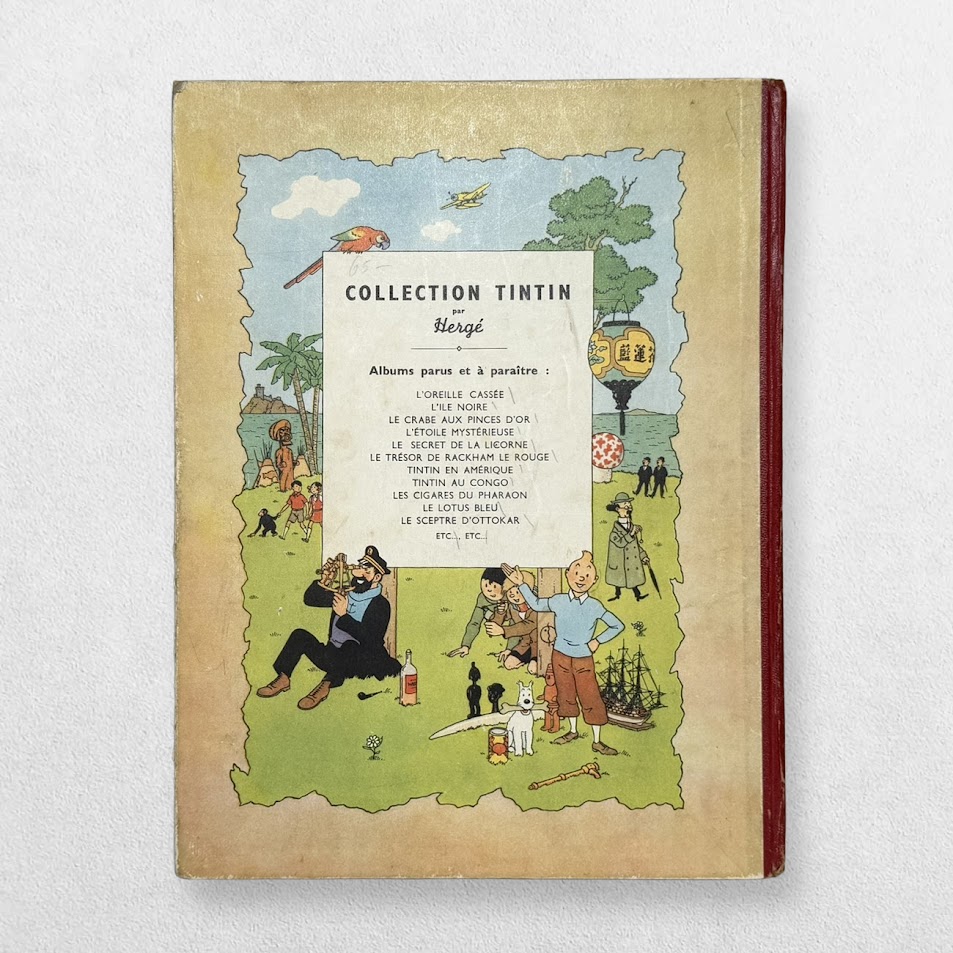
Casterman Tournai Paris, 1946-47. Printed in Belgium. Very early edition. Dated 1946 to the copyright page. Original cloth-backed boards. Red spine. Pictorial blue endpapers. ‘Les Aventures De Tintin’ lettered in red to the title page. Pp. 62. Illustrated throughout in colour by the author. Binding with minor rubbing and creasing to the spine and edges of the boards. Minor pencil marks to rear panel. Slight age toning to the pages as usual. A very good copy. Scarce.
L’Oreille Cassée: A Brief Summary
The story begins in Brussels, at the Ethnographic Museum, where a small South American statue—an Arumbaya fetish distinguished by a broken ear—is stolen. The theft seems trivial, but when the original statue is quietly replaced by a crude replica, the museum’s curator is murdered.
Tintin becomes involved after recognising that the replacement is not merely a forgery, but a deliberate attempt to conceal something far more significant.
The fetish and its hidden value
Tintin discovers that the statue is linked to South America, specifically to the fictional republics of San Theodoros and Nuevo Rico, two neighbouring states locked in political tension. The fetish itself is hollow and once concealed a valuable diamond—the real object of the theft.
This revelation shifts the narrative from museum crime to international intrigue. The statue is not an artefact of cultural value alone, but a container in a wider network of smuggling, corruption, and political violence.
Journey to San Theodoros
Tintin travels to San Theodoros, a volatile country plagued by coups, dictatorships, and foreign interference. Almost immediately, he is arrested, accused of plotting against the state, and sentenced to death.
Through a sudden coup, Tintin escapes execution, only to find that the new regime is as brutal and unstable as the last. Power in San Theodoros changes hands repeatedly, and law proves to be arbitrary and dangerous.
General Alcazar and perpetual revolution
Tintin encounters General Alcazar, a bombastic military leader who alternates between exile and dictatorship. Alcazar embodies the country’s instability: charismatic, violent, and perpetually plotting his return to power.
Tintin briefly assists Alcazar, though not out of ideological alignment. The alliance is tactical and fragile, underscoring Tintin’s position as an outsider navigating forces he does not control.
The diamond trade and betrayal
The diamond concealed within the fetish is traced through a chain of intermediaries, mercenaries, and arms dealers. Tintin uncovers a cynical system in which:
- Indigenous artefacts are exploited
- Political instability is manipulated for profit
- Loyalty shifts instantly when power changes
The fetish changes hands repeatedly, symbolising how cultural objects are stripped of meaning and reduced to commodities.
The Arumbayas and moral reversal
Tintin eventually reaches the Arumbaya people, from whom the fetish originated. He learns that the statue was sacred, and that its theft represents a deeper violation than the loss of material wealth.
In a rare reversal, Tintin is captured by the Arumbayas and prepared for execution. He escapes death only through courage, ingenuity, and a final act of moral clarity.
Resolution: restitution rather than victory
Tintin recovers the fetish and returns it to the Arumbayas, restoring it to its cultural context rather than reclaiming the diamond for profit or glory.
There is no restoration of political order in San Theodoros. Dictatorship, coups, and corruption continue unabated. Tintin leaves the country having solved the immediate mystery, but without any illusion that justice or stability has been achieved.
Narrative significance
L’Oreille cassée marks a significant evolution in the Tintin series. It introduces:
- Sustained political cynicism
- Moral ambiguity rather than clear triumph
- Recurrent fictional states as sites of systemic instability
The album is darker and more pessimistic than many earlier adventures.
Thematic overview
Key themes include:
- Cultural theft and exploitation
- The commodification of violence
- The fragility of law in authoritarian states
- Moral responsibility without political power
Tintin is no longer able to “fix” the world he enters. He can only act ethically within it.
Concluding assessment
L’Oreille cassée is one of the most disillusioned Tintin stories. It rejects the fantasy that heroism can stabilise corrupt systems. Instead, it presents a world where power circulates endlessly, violence is banal, and integrity consists in small, principled acts rather than lasting change.
This moral restraint anticipates the maturity of Hergé’s later work, positioning Tintin not as a saviour, but as a witness who chooses decency in the midst of disorder.
Why Buy from Us?
At Hornseys, we are committed to offering items that meet the highest standards of quality and authenticity. Our collection of rare books is carefully curated to ensure each edition is a valuable piece of bibliographical history. Here’s what sets us apart:
- Authenticity and Provenance: Each book is meticulously researched and verified for authenticity and collation.
- Expert Curation: Our selection process focuses on significance, condition, and rarity, resulting in a collection that is both diverse and distinguished.
- Customer Satisfaction: We aim to provide an exceptional customer experience, from detailed descriptions to secure and prompt delivery of your purchase.
- Returns Policy: We offer an unconditional guarantee on every item. If you wish to return a book, it may be sent back to us within fourteen days of receipt. Please notify us in advance if you wish to do so. The book must be returned in the same condition as it was sent for a full refund.
Cataloguer: Daniel Hornsey
Daniel Hornsey has specialised in fine and rare books, ephemera, and collectors’ editions for over thirty years. As a long-standing member of the antiquarian book trade, he has advised private collectors, curated catalogues, and sourced works for leading dealers, libraries and institutions across the world.
Hornseys’ exhibit regularly at book and map fairs in London and throughout the UK and are members of the Provincial Booksellers Fairs Association, the PBFA.
His fascination with Hergé’s work — especially ‘The Adventures of Tintin’ — began in childhood. Daniel recalls reading Tintin in original European editions and quickly recognising that these were not merely children’s books, but finely illustrated narratives crafted with artistic depth and wit.
As noted by the Musée Hergé in Louvain-la-Neuve, Hergé’s ‘ligne claire’ style has influenced generations of European comic artists and his original drawings and paintings command very high prices with his painting of ‘The Blue Lotus’ jar fetching £2.8m at auction in 2021.
By presenting these works through Hornseys’, he hopes to contribute to the continued appreciation of one of the 20th century’s most influential illustrators, helping new generations discover the artistry and legacy of Hergé.