


Related products
-

-

-

-

Paul Blake Or The Story Of A Boy’s Perils In The Islands Of Corsica And Monte Cristo
£145.00Elwes, Alfred (Leighton Binding)
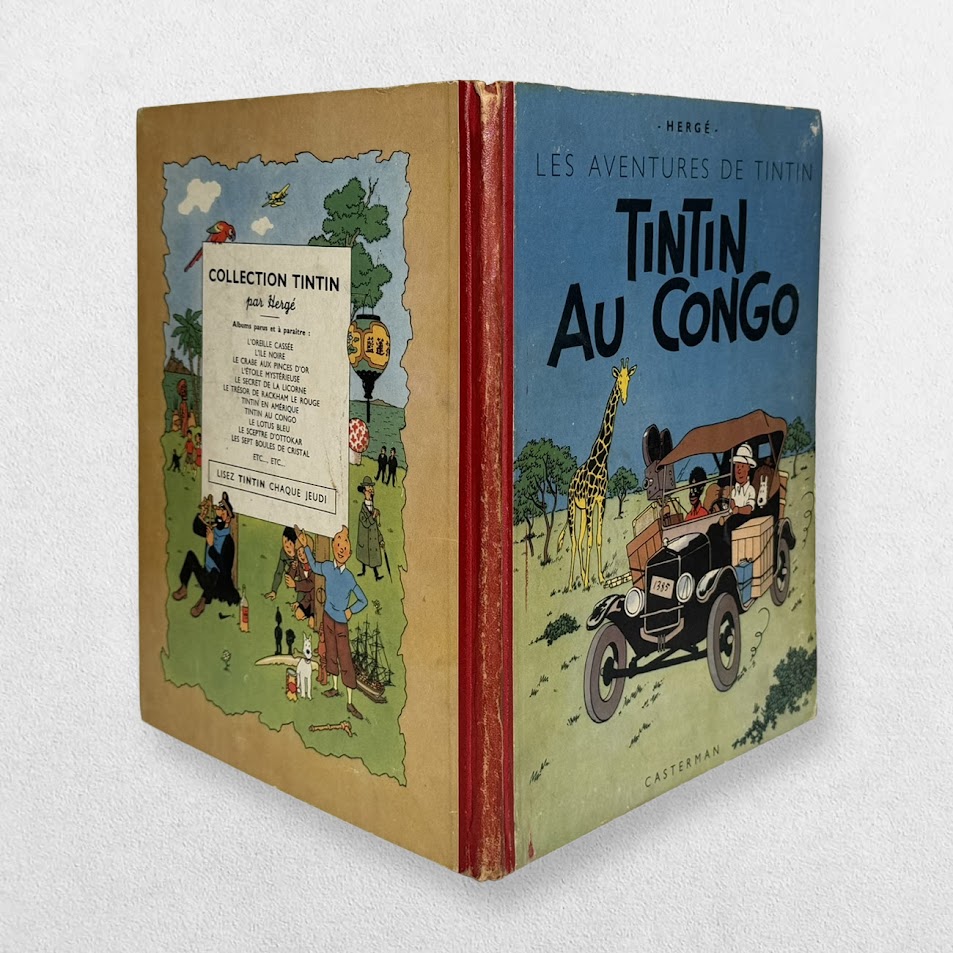
Hergé
£300.00
Availability: In stock
Author: Hergé
Price: £300.00
Publisher: Casterman
Publication date: 1948
Format: Original cloth-backed boards with pictorial endpapers
Condition: Very good
Pages: 62
Illustrations: Illustrated throughout in colour by the author
Casterman Tournai Paris, 1948. Printed in Belgium. Early edition. Original cloth-backed boards. Pictorial blue endpapers. Pp. 62. Illustrated throughout in colour by the author. Binding nice and tight with minor rubbing and creasing to the spine and edges of the boards. Slight age toning to the pages as usual. A very good, tight, copy. Scarce.
The story begins with Tintin travelling from Belgium to the Belgian Congo, accompanied by his dog Snowy. Tintin’s mission is loosely defined: he is sent as a young reporter to observe and report on life in the colony. From the outset, the narrative adopts an episodic structure rather than a tightly plotted investigation.
Upon arrival, Tintin is greeted enthusiastically by colonial officials and African villagers alike, immediately positioning him as a figure of authority and admiration.
Encounters and demonstrations of authority
Much of the early part of the story consists of self-contained episodes in which Tintin travels through the countryside, meets local people, and intervenes in various situations. He is repeatedly portrayed as:
Tintin teaches schoolchildren, administers justice in disputes, and demonstrates European technology, all of which reinforce the colonial hierarchy assumed by the narrative.
Conflict with criminals and gangsters
Running parallel to these encounters is a loose criminal subplot. Tintin attracts the attention of Al Capone’s gang, who are attempting to control diamond smuggling operations in the Congo. Gangsters repeatedly attempt to kill or capture Tintin, viewing him as a threat to their interests.
These episodes introduce danger and action, but the criminal plot remains secondary to Tintin’s role as colonial problem-solver.
Hunting and adventure
A substantial portion of the story focuses on hunting and encounters with wildlife. Tintin faces lions, crocodiles, monkeys, and rhinoceroses, often defeating or killing them through ingenuity or force.
These scenes emphasise:
From a modern perspective, these episodes are among the most controversial aspects of the album.
Escalation and capture
Tintin is eventually captured by criminals and placed in mortal danger. Through a combination of luck, intelligence, and improvisation, he escapes repeatedly. Snowy also plays a significant role, alternately providing comic relief and practical assistance.
The narrative remains episodic, with peril followed quickly by rescue or reversal.
Resolution and return
Tintin ultimately defeats the gangsters, disrupting their smuggling operations and restoring order. Colonial authorities and local populations celebrate his success.
The story concludes with Tintin returning to Belgium, hailed as a hero whose presence has brought justice, stability, and enlightenment.
Narrative structure and tone
Unlike later Tintin albums, Tintin au Congo lacks a tightly unified plot. Instead, it functions as a series of adventures linked by setting and character rather than by a central mystery.
The tone is light and confident, with little moral ambiguity. Tintin’s authority is never seriously questioned, and consequences are minimal.
Thematic overview
The album reflects the worldview of its time and original audience. Central themes include:
African characters are portrayed through stereotypes common in early twentieth-century European colonial culture, with little individuality or agency.
Historical and cultural context
Tintin au Congo was created early in Hergé’s career and reflects prevailing colonial attitudes in Belgium at the time. It predates the moral and political complexity of later albums and stands apart stylistically and thematically from the mature Tintin canon.
In later editions, certain scenes were modified, but the fundamental outlook of the story remained unchanged.
Concluding assessment
Tintin au Congo is one of the most historically significant—and most problematic—Tintin albums. Narratively simple and episodic, it lacks the sophistication of Hergé’s later work, yet it provides crucial insight into the evolution of the series and its creator.
Today, the album is best understood as a document of its time: a window into early twentieth-century European colonial imagination rather than a reflection of the values that would later define The Adventures of Tintin.
At Hornseys, we are committed to offering items that meet the highest standards of quality and authenticity. Our collection of rare books is carefully curated to ensure each edition is a valuable piece of bibliographical history. Here’s what sets us apart:
Daniel Hornsey has specialised in fine and rare books, ephemera, and collectors’ editions for over thirty years. As a long-standing member of the antiquarian book trade, he has advised private collectors, curated catalogues, and sourced works for leading dealers, libraries and institutions across the world.
Hornseys’ exhibit regularly at book and map fairs in London and throughout the UK and are members of the Provincial Booksellers Fairs Association, the PBFA.
His fascination with Hergé’s work — especially ‘The Adventures of Tintin’ — began in childhood. Daniel recalls reading Tintin in original European editions and quickly recognising that these were not merely children’s books, but finely illustrated narratives crafted with artistic depth and wit.
As noted by the Musée Hergé in Louvain-la-Neuve, Hergé’s ‘ligne claire’ style has influenced generations of European comic artists and his original drawings and paintings command very high prices with his painting of ‘The Blue Lotus’ jar fetching £2.8m at auction in 2021.
By presenting these works through Hornseys’, he hopes to contribute to the continued appreciation of one of the 20th century’s most influential illustrators, helping new generations discover the artistry and legacy of Hergé.
Elwes, Alfred (Leighton Binding)


| Cookie | Duration | Description |
|---|---|---|
| cookielawinfo-checkbox-analytics | 11 months | This cookie is set by GDPR Cookie Consent plugin. The cookie is used to store the user consent for the cookies in the category "Analytics". |
| cookielawinfo-checkbox-functional | 11 months | The cookie is set by GDPR cookie consent to record the user consent for the cookies in the category "Functional". |
| cookielawinfo-checkbox-necessary | 11 months | This cookie is set by GDPR Cookie Consent plugin. The cookies is used to store the user consent for the cookies in the category "Necessary". |
| cookielawinfo-checkbox-others | 11 months | This cookie is set by GDPR Cookie Consent plugin. The cookie is used to store the user consent for the cookies in the category "Other. |
| cookielawinfo-checkbox-performance | 11 months | This cookie is set by GDPR Cookie Consent plugin. The cookie is used to store the user consent for the cookies in the category "Performance". |
| viewed_cookie_policy | 11 months | The cookie is set by the GDPR Cookie Consent plugin and is used to store whether or not user has consented to the use of cookies. It does not store any personal data. |