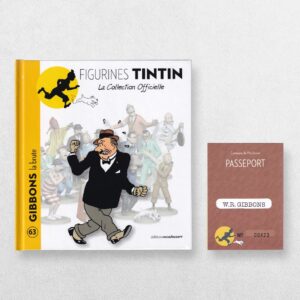
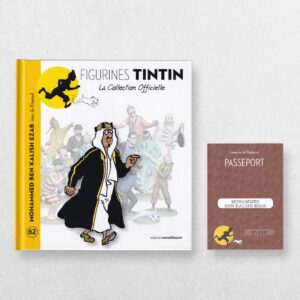
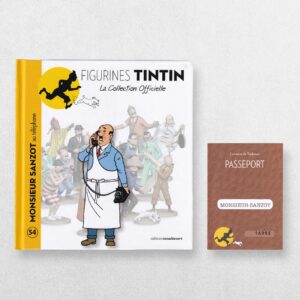
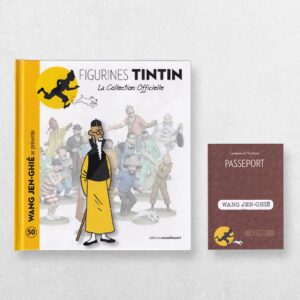
Max Bird The Ringleader – Figurines Tintin La Collection Officielle – 88 – Maxime Loiseau Le Meneur
Author: Hergé & Editions Moulinsart
Price: £90.00
Publisher: Editions Moulinsart
Publication date: 2015
Format: Original pictorial boards with passport and figurine
Condition: In near fine condition
Illustrations: Illustrated throughout
Description:
Original pictorial boards. Includes passport loosely inserted. Text in French. Includes the accompanying figurine. One from the collection of 111 books and figurines. Very slight wear. In very near fine, clean condition overall.
Max Bird: A Short Biography
Maxime Loiseau, whose name translates literally to “Max Bird”, is a background but symbolically charged character from Hergé’s Tintin and the Picaros (Tintin et les Picaros, 1976*). His official figurine from Figurines Tintin: La Collection Officielle – No. 88 – “Maxime Loiseau, le Meneur” identifies him as “the leader” or “ringleader.”
Though his on-page presence is minimal, Maxime Loiseau encapsulates a recurring idea in Hergé’s late work: the empty spectacle of political fervour, where revolution becomes theatre and leadership becomes performance.
Character Overview
| Attribute | Description |
| Full Name | Maxime Loiseau (literally “Max Bird”) |
| Role / Title | Le Meneur — “The Leader” or “Ringleader” |
| First Appearance | Tintin and the Picaros (Tintin et les Picaros, 1976) |
| Nationality | Presumed San Theodoran (fictional Latin American country) |
| Occupation | Street agitator, protest organiser |
| Symbolic Role | Embodies populism, disillusionment, and the futility of performative rebellion |
Appearance in Tintin and the Picaros
Set in the fictional republic of San Theodoros, Tintin and the Picaros depicts General Alcazar’s revolutionary struggle to reclaim power from the dictator General Tapioca. The story revisits many earlier characters but presents them in a world that has grown tired, cynical, and theatrical.
Maxime Loiseau appears during the early scenes in the capital city, Los Dopicos, amid a public demonstration. He is introduced as one of the protest leaders — waving his arms, shouting slogans, and directing the crowd’s chants. Hergé’s description and illustration of Loiseau are instantly recognisable:
- He is animated, his face alive with energy.
- His gestures are exaggerated, almost performative.
- His role as “le meneur” marks him as a figure of noise rather than consequence.
The demonstration is quickly dispersed by the authorities, highlighting the futility and theatre of political protest in Hergé’s fictional South America.
Characterisation
- The Archetype of the Agitator
Loiseau is portrayed as a born orator, a man of the crowd — passionate, rhetorical, and self-assured. Yet Hergé’s framing is ironic: his speech-making achieves nothing. He is both sincere and absurd, reflecting Hergé’s growing disillusionment with politics as spectacle.
- The Bird Imagery
The surname Loiseau (literally “the bird”) is no accident. Birds are creatures of sound, chatter, and flight — constantly moving but never settling. Maxime Loiseau’s “bird-like” qualities mirror his nature: he speaks loudly, stirs briefly, and disappears.
His name symbolises a creature of words rather than deeds, evoking transience and the illusion of freedom.
- A Man of the Moment
Loiseau’s leadership exists only for a few moments — he is a man born of crisis and noise, quickly forgotten once the scene ends. In this, Hergé turns him into an emblem of ephemeral leadership: a man who rises to speak but not to act.
Thematic and Symbolic Analysis
- The Futility of Revolutions
In Tintin and the Picaros, Hergé portrays political upheaval as a cycle without progress. When Alcazar eventually overthrows Tapioca, nothing changes: the uniforms are replaced, the slogans rewritten, but the corruption remains.
Loiseau, as le meneur, embodies this theme. He represents the illusion of change — the belief that noise equals transformation. His leadership, though passionate, leads nowhere.
- Leadership as Performance
Through Loiseau, Hergé critiques the modern cult of personality. His “leadership” consists entirely of gesture, rhetoric, and public display. The title le meneur becomes ironic: he leads a crowd that doesn’t follow, fights a cause that isn’t clear, and disappears as soon as the shouting stops.
This reflects Hergé’s late-career realism — his sense that in modern society, both politics and protest have become staged acts, disconnected from truth or consequence.
- The Voice Without Power
Maxime Loiseau’s defining feature is his voice — raised, impassioned, and articulate. Yet his words have no impact. Hergé’s composition of the protest scene exaggerates this contradiction: one man shouting in a square filled with indifferent faces.
This image of empty rhetoric serves as a quiet but pointed commentary on the post-revolutionary world of the 1970s, where ideologies proliferated but genuine justice remained elusive.
Artistic and Figurative Representation
In Figurines Tintin: La Collection Officielle (No. 88), Maxime Loiseau, le Meneur is sculpted in dynamic motion, capturing his essence as a speaker and performer.
- Pose: One arm raised, mouth open mid-speech — the embodiment of rhetorical fervour.
- Expression: Intense, animated, and slightly exaggerated — a mix of conviction and comic energy.
- Attire: Rolled sleeves, open collar, and expressive body language evoke the archetypal street agitator.
The figurine’s design underlines Hergé’s talent for distilling a character’s entire essence into posture and gesture. Even without dialogue, Loiseau’s personality is instantly readable.
Moral and Philosophical Reading
- Hergé’s Mature Cynicism
By the time he created Tintin and the Picaros, Hergé had lived through colonial propaganda, war, occupation, and the Cold War. His worldview had become nuanced and sceptical. Loiseau’s empty activism mirrors that maturity — the artist’s recognition that noise is not action, and rebellion is not reform.
- Human Comedy and Compassion
Despite the irony, Hergé treats Loiseau not with cruelty but with gentle amusement. The Joyful Bird (as his name implies) is an essential part of humanity — the instinct to rise, cry out, and demand better. His failure is comic, but his impulse is human.
- The Continuum of the “Turluron”
In spirit, Maxime Loiseau belongs to the same family as Hergé’s Joyeux Turluron archetype — the exuberant, well-meaning fool who gives life to chaos. Both embody the comic tension between passion and futility.
Cultural and Historical Context
Published in 1976, Tintin and the Picaros reflects the weariness of the post-1968 era. Hergé channels the disillusionment of a generation that had seen revolutions stall and ideologies fail.
Maxime Loiseau’s brief appearance condenses that cultural mood into a single visual metaphor — the leader whose words evaporate into thin air.
Summary
| Aspect | Description |
| Full Name | Maxime Loiseau (“Max Bird”) |
| Role | Protest leader, orator, and agitator |
| First Appearance | Tintin and the Picaros (1976) |
| Title | Le Meneur (The Leader / Ringleader) |
| Traits | Charismatic, vocal, idealistic, ineffectual |
| Symbolism | Represents political spectacle, empty rhetoric, and the illusion of change |
| Fate | Disappears into the crowd, forgotten once the moment passes |
| Figurine | No. 88 in Figurines Tintin: La Collection Officielle — captured mid-speech |
Conclusion
Maxime Loiseau (Max Bird) is one of Hergé’s many background characters whose significance far outweighs his brief appearance. In a single gesture — an arm raised and a mouth open in protest — he embodies the tragicomic essence of modern politics: passion without power, conviction without consequence.
Through Loiseau, Hergé distils an entire era’s mood — the fading idealism of the 1970s — into one image of noise and movement. He is the bird who sings of freedom, yet remains caged by circumstance; a leader without followers, a revolutionary without revolution.
Why Buy from Us?
At Hornseys, we are committed to offering items that meet the highest standards of quality and authenticity. Our collection of objects and rare books are carefully curated to ensure each edition is a valuable piece of bibliographical history. Here’s what sets us apart:
- Authenticity and Provenance: Each item is meticulously researched and verified for authenticity and collation.
- Expert Curation: Our selection process focuses on significance, condition, and rarity, resulting in a collection that is both diverse and distinguished.
- Customer Satisfaction: We aim to provide an exceptional customer experience, from detailed descriptions to secure and prompt delivery of your purchase.
- Returns Policy: We offer an unconditional guarantee on every item. If you wish to return an item, it may be sent back to us within fourteen days of receipt. Please notify us in advance if you wish to do so. The item must be returned in the same condition as it was sent for a full refund.
Cataloguer: Daniel Hornsey
Daniel Hornsey has specialised in fine and rare books, ephemera, and collectors’ editions for over thirty years. As a long-standing member of the antiquarian book trade, he has advised private collectors, curated catalogues, and sourced works for leading dealers, libraries and institutions across the world.
Hornseys’ exhibit regularly at book and map fairs in London and throughout the UK and are members of the Provincial Booksellers Fairs Association, the PBFA.
His fascination with Hergé’s work — especially ‘The Adventures of Tintin’ — began in childhood. Daniel recalls reading Tintin in original European editions and quickly recognising that these were not merely children’s books, but finely illustrated narratives crafted with artistic depth and wit.
As noted by the Musée Hergé in Louvain-la-Neuve, Hergé’s ‘ligne claire’ style has influenced generations of European comic artists and his original drawings and paintings command very high prices with his painting of ‘The Blue Lotus’ jar fetching £2.8m at auction in 2021.
By presenting these works through Hornseys’, he hopes to contribute to the continued appreciation of one of the 20th century’s most influential illustrators, helping new generations discover the artistry and legacy of Hergé.